Power Tool Accessories Market: From Market Size to Practical Business Decisions
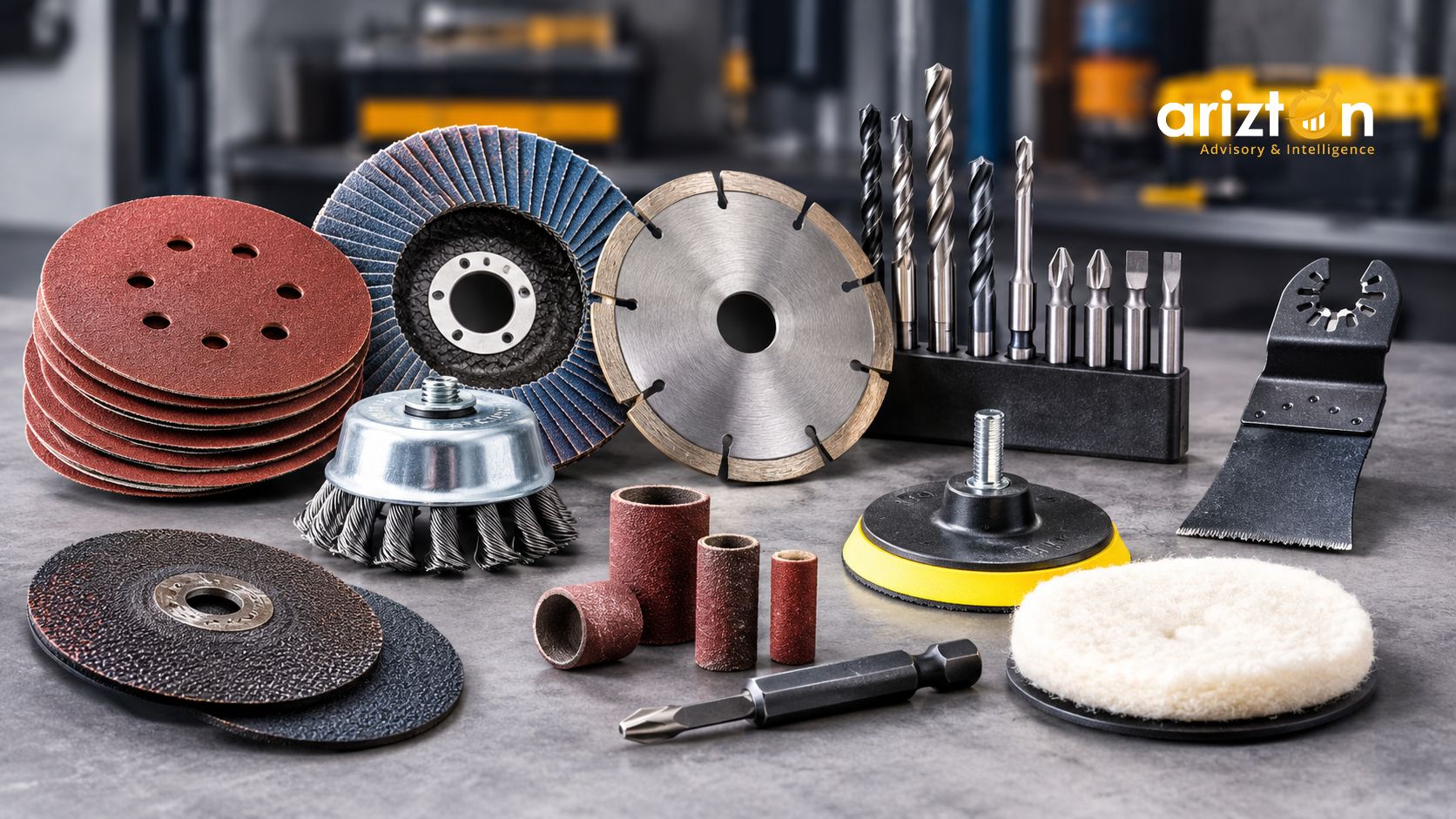
A growing market does not automatically represent a business opportunity. For manufacturers, product strategists and business development teams, the more important question is understanding where demand exists, which product categories are gaining traction, who is capturing that demand, and whether there is a commercially viable opportunity to compete.
The global power tool accessories industry offers a useful example of why market intelligence needs to go beyond headline market valuations and growth forecasts.
A market report may indicate the overall value of the industry, its projected growth and the regions contributing to demand. While these figures provide an initial understanding of the market, they do not necessarily tell a manufacturer which products to develop, where to expand distribution, how to position against competitors or where to allocate capital.
The real value of market research lies in understanding the structure behind the numbers and translating that understanding into business decisions.
Why Market Size Alone Is Not Enough
Consider a manufacturer evaluating whether to expand its power tool accessories portfolio.
Knowing that the global market is growing provides a reason to investigate further. However, management still needs answers to several questions:
- Which accessory categories are generating the strongest demand?
- Is growth concentrated in drill bits, saw blades, abrasive wheels, batteries or fastening accessories?
- Which industries consume the highest volumes of these products?
- Are customers prioritising price, durability, precision or product performance?
- Which countries offer meaningful opportunities for expansion?
- How strong is the competition in each product category?
These questions determine whether the opportunity is relevant to the manufacturer's capabilities and commercial objectives.
For example, Arizton's Power Tool Accessories Market research estimates that cutting accessories account for approximately 30% of the global market in 2025, while drill bits represent the largest accessory category.
These two findings offer different perspectives. One explains demand by operation, while the other explains demand by product category.
A manufacturer considering an expansion into cutting accessories would still need to understand which blade types, materials, applications and customer segments contribute to that opportunity.
The business decision is not simply whether the market is growing. It is whether the addressable opportunity is large enough to justify investment in product development, manufacturing capacity, distribution and marketing.
1. The Information That Is Harder to Find Independently
A considerable amount of industry information is publicly available. Company announcements, product launches, financial disclosures, trade publications, government statistics and industry associations provide useful information about market developments.
However, assembling these sources into a consistent market intelligence framework is considerably more challenging. For a manufacturer, knowing that drill bits represent the largest accessory category is useful, but it does not automatically establish whether entering this segment is commercially attractive. Drill bits account for the largest share of the global power tool accessories market, while cutting represents approximately 30% of market revenue by operation type, according to Arizton's 2026–2031 Power tools accessories market assessment.
Understanding the revenue contribution of individual accessory categories requires a more detailed assessment.
This may include:
- Drill bits
- Circular saw blades
- Reciprocating and jigsaw blades
- Abrasive wheels
- Screwdriver bits
- Batteries
- Router bits and other accessories
The challenge is defining what belongs within each category and estimating revenues across manufacturers, suppliers and distribution channels without double-counting.
Business application: Manufacturers can evaluate which categories deserve greater product development attention, where their existing portfolios are underrepresented and which segments may offer attractive growth opportunities. Further margin and competitive analysis would be needed before prioritising investment.
2. Country-Level Accessory Demand
A country with a large construction or manufacturing industry does not necessarily have an equally attractive market for every type of power tool accessory.
Demand depends on industrial activity, tool usage, local manufacturing, imports, customer purchasing patterns and the availability of competing products.
Estimating country-level demand requires reconciling different data sources and developing a consistent view of market consumption.
APAC accounts for more than 36% of the global power tool accessories market, according to Arizton's estimates for 2025. However, the region does not represent one uniform demand environment.
China, Japan and South Korea contribute through established automotive, machinery and industrial production. Vietnam's electronics assembly operations, Thailand's automotive manufacturing and Indonesia's construction and industrial projects create additional demand opportunities.
China accounted for the largest share of the APAC power tool accessories market in 2025. According to its National Bureau of Statistics, equipment manufacturing value added increased by 9.2% in 2025 and represented 36.8% of the value added of industrial enterprises above the designated size.
Business application
A manufacturer considering expansion in APAC should not simply allocate investment according to the largest country market.
It should examine the type of demand generated in each country.
For example:
- China may offer opportunities in industrial cutting and drilling applications.
- India may warrant greater attention to construction-related accessories and installation products.
- Thailand may offer opportunities linked to automotive component production.
- Vietnam may present opportunities around electronics manufacturing and equipment installation.
The next step would be to validate these opportunities through country-level accessory consumption, imports, domestic production, competitor presence and distribution research.
This helps sales and business development teams identify which countries deserve further investment and which product categories are relevant to each market.
3. Market Size by Industrial End User
Power tool accessories serve multiple industries, including:
- Construction and infrastructure
- Automotive and transportation
- Metalworking and general manufacturing
- Energy and utilities
- Electronics and electrical equipment
- Aerospace and shipbuilding
However, each industry uses different accessory types, specifications and quantities.
A construction contractor may have substantial demand for masonry drill bits and cutting blades, whereas an automotive manufacturing facility may require precision drilling, grinding and finishing accessories.
Estimating demand by end user requires allocating accessory consumption across these different applications.
An example from the industry
Arizton estimates that the industrial end-user segment will grow at a CAGR of 6.15% during the forecast period, making it the fastest-growing end-user segment.
Construction represents the largest industrial end-user category in the report.
These findings provide two different signals:
- Industrial demand is expected to expand faster than other end-user categories.
- Construction currently represents the largest industrial demand pool.
However, a manufacturer cannot automatically assume that construction is the most attractive segment for every product.
Consider the difference between two accessory manufacturers:
One specialises in masonry drill bits and concrete-cutting products. Another focuses on precision grinding and metalworking accessories.
Even if construction represents the largest industrial segment overall, the second manufacturer may find a stronger commercial opportunity in automotive or general manufacturing.
Business application: Manufacturers can identify which industries represent the strongest demand pools for their specific products and align product portfolios, technical specifications and sales strategies accordingly.
4. Market Share by Operation Type
Power tool accessories are used for different operations, including cutting, drilling, fastening, routing and other applications.
Understanding the contribution of each operation to total market revenue requires more than identifying the most commonly used products.
It involves estimating the revenue generated across different accessory applications and evaluating how demand is changing over time.
An example from the industry
Cutting accounts for approximately 30% of the global power tool accessories market in 2025, according to Arizton.
The industrial demand for cutting accessories is closely associated with metal processing, construction, manufacturing and woodworking.
The World Steel Association reported global crude steel production of approximately 1.85 billion tonnes in 2025. China produced around 960.8 million tonnes, followed by India at 165.6 million tonnes.
Steel production does not directly measure demand for power tool cutting accessories. However, it provides an important indicator of the scale of metalworking and industrial activity in these economies.
For accessory manufacturers, the next research question is more specific:
- How much metal fabrication activity involves power-tool-based cutting?
- Which cutting products are used in fabrication workshops?
- What proportion of demand comes from professional and industrial users?
- Which applications require carbide, abrasive or specialist cutting technologies?
- How frequently are these accessories replaced?
Business application: Manufacturers can use operation-level market analysis to identify attractive applications, assess product portfolio gaps and prioritise specific cutting or drilling technologies.
5. Historical Market Development and Five-Year Forecasts
A current market valuation provides only a snapshot of the industry.
Understanding how the market has developed over time helps distinguish sustained growth from temporary changes in demand.
However, historical comparisons are meaningful only when the market definition, category boundaries and valuation methodology remain consistent.
Forecasting accessory demand requires more than applying a growth rate to the current market valuation.
A credible forecast should consider factors such as:
- Construction and infrastructure activity
- Manufacturing and industrial production
- Power tool installed-base growth
- Accessory replacement cycles
- Product pricing and material costs
- Technological developments
- Changes in professional and consumer purchasing behaviour
An example from the industry
The global power tool accessories market is estimated at USD 15.50 billion in 2025 and is projected to reach USD 21.61 billion by 2031, representing a CAGR of 5.70%.
The overall forecast provides a view of the industry's expected direction. However, the growth rate alone does not tell a manufacturer which products or regions will contribute most to that expansion.
Consider a company planning its manufacturing capacity for the next five years.
If its product portfolio is concentrated in drill bits, management needs to understand whether drilling accessories are expected to grow at a similar rate to the overall market.
If demand is expanding faster in a particular country, it may also need to assess whether local manufacturing, imports or regional distribution would be the most commercially viable way to serve that demand.
Business application: Historical data and forecasts can support production planning, capacity decisions, sales targets and investment prioritisation. Scenario analysis is particularly useful when demand, raw-material prices or trade conditions change.
6. Competitive Positioning
Company websites and product catalogues make it relatively easy to identify competing products and technologies.
However, understanding the competitive position of manufacturers requires a broader assessment.
This may involve comparing:
- Product portfolio breadth
- Technology and performance specifications
- Price positioning
- Target customer segments
- Geographic presence
- Distribution networks
- Competitive strengths and weaknesses
An example from the industry
Recent product developments demonstrate how manufacturers are competing through product performance and durability rather than simply expanding product ranges.
For example:
- Milwaukee expanded its carbide saw blade portfolio for demanding demolition applications.
- FEIN introduced additional titanium nitride-coated bimetal saw blades.
- Festool expanded its range with a diamond circular saw blade for laminate and high-pressure panel applications.
- Norton introduced engineered ceramic abrasive products for carbon steel applications.
These developments indicate the importance of application-specific product performance, service life and material-removal efficiency.
However, a product launch announcement does not establish whether the product has gained market share or generated meaningful commercial returns.
A deeper competitive assessment would compare product specifications, pricing, customer adoption, distribution availability and the performance advantages claimed by manufacturers.
Business application: Manufacturers can identify gaps in their portfolios, evaluate competitive pressure and determine where differentiation may be commercially meaningful.
For example, a manufacturer competing in professional cutting accessories may need to understand whether competitors have an advantage through carbide technology, blade durability, specialist applications or established dealer relationships.
7. Market Estimation Assumptions and Limitations
One of the most overlooked aspects of market research is understanding what the market estimate actually represents.
Two research providers can publish significantly different market valuations without necessarily measuring the same market.
Differences may arise from product inclusion criteria, sales-channel coverage, geographic boundaries, valuation methods and the treatment of bundled products.
A useful market study should explain these assumptions and make its limitations transparent.
An example from the industry
Before comparing two estimates of the power tool accessories market, a manufacturer should establish:
- Does the estimate include replacement batteries?
- Does it include accessories sold with power tools?
- Does it include all power-tool-compatible accessories or only interchangeable consumables?
- Is the market measured at manufacturer selling price, distributor revenue or retail selling price?
- Are pneumatic-tool accessories included?
- Are OEM and private-label sales included?
These distinctions can materially affect the reported market value.
For example, including replacement batteries may expand the estimated market compared with a study focused primarily on interchangeable cutting, drilling and grinding accessories.
Similarly, a valuation based on retail selling prices will differ from one based on manufacturer revenues.
Business application: Strategy and investment teams can assess whether the research is sufficiently reliable and relevant to support the decision being considered. They can also avoid comparing market estimates that use fundamentally different definitions.
Translating Market Intelligence into Business Decisions
Once market data is structured and validated, its practical value becomes clearer.
For power tool accessory manufacturers, five business areas are particularly relevant.
1. Product Strategy: Which Accessory Categories Deserve Investment?
Market intelligence can help manufacturers compare category-level demand, growth, customer requirements and competitive intensity.
For example, a manufacturer evaluating an expansion into premium drill bits needs to understand not only the size of the market but also the demand for different drilling applications, price segments and product specifications.
A company may find that drill bits represent the largest accessory category, but that does not automatically make every type of drill bit an attractive investment.
It needs to evaluate the addressable professional segment, competition, product differentiation and expected returns.
This helps narrow product development priorities and identify categories that warrant further commercial investigation.
2. Competitive Strategy: Where Do Competitors Have an Advantage?
Competitor analysis should extend beyond comparing company revenues and product portfolios.
Manufacturers need to understand how competing products differ in performance, pricing, technology, target customers and distribution reach.
For example, a company competing in professional cutting accessories may need to understand whether its competitors have an advantage through product durability, specialist applications, established dealer relationships or pricing.
This information can support decisions around product differentiation and competitive positioning.
3. Geographic Expansion: Where Should Additional Sales Investment Go?
Regional market growth does not automatically translate into an attractive opportunity for every manufacturer.
A country may have substantial demand but also intense competition, established distribution networks and strong price pressure.
Comparing country-level demand, market maturity, customer segments and distribution structures can help companies evaluate where additional sales investment may be justified.
For example, a company with a strong portfolio of construction-related accessories may prioritise markets with substantial infrastructure and residential construction activity.
A manufacturer specialising in precision industrial accessories may find more relevant opportunities in established manufacturing economies.
4. Revenue Strategy: What Is the Aftermarket Opportunity?
The commercial opportunity in power tools does not end with the initial tool sale.
Accessories such as drill bits, saw blades and abrasive products generate repeat purchasing opportunities as products wear out or customers move between applications.
Manufacturers can evaluate this opportunity by examining installed-tool demand, accessory consumption, replacement frequency and purchasing behaviour.
For companies with established tool platforms, understanding the relationship between tool sales and subsequent accessory purchases can help identify opportunities to strengthen aftermarket revenue.
For example, growth in cordless tool platforms can expand the potential customer base for compatible batteries and accessories.
However, estimating the actual aftermarket opportunity requires more than a general accessories market forecast. It also requires installed-base data, replacement behaviour and brand-level purchasing intelligence.
5. Operational Strategy: Where Are the Supply-Chain Risks?
Accessory manufacturing can depend on materials such as steel, tungsten carbide and other specialised inputs.
Changes in material availability, import dependence, supplier concentration and production costs can affect manufacturing economics.
An example from the industry
According to the US Geological Survey, China accounted for approximately 79% of global tungsten mine production in 2025.
Tungsten is an important raw material for carbide products used in demanding cutting and drilling applications.
For manufacturers dependent on carbide-tipped accessories, this concentration highlights a potential supply-chain exposure.
However, mine production concentration alone does not establish the sourcing risk of an individual manufacturer. That assessment would also require information about processing capacity, supplier relationships, inventory, alternative materials and actual procurement origins.
Business application: Research into raw-material supply, sourcing geography and supplier concentration can help procurement teams evaluate exposure and consider alternative sourcing or manufacturing strategies.
Distribution Strategy: Monitoring How Products Reach Customers
Distribution is another area where overall market growth can hide important commercial differences.
Arizton's research indicates that offline distribution accounted for the largest share of the power tool accessories market in 2025, while online distribution is forecast to grow at a CAGR of 6.17% during 2025–2031.These findings suggest that traditional distribution remains important even as digital channels expand.
For professional users, immediate availability, product compatibility guidance and reliable replenishment can make physical dealers and industrial distributors particularly important.
For residential and DIY customers, online channels can provide product comparisons, wider selection and convenient purchasing.
From Market Research to Better Business Judgement
Market research should not be viewed as a substitute for internal company knowledge.
Manufacturers already possess information that external research providers may not have, including product-level sales, customer relationships, production costs, distribution performance and operational capabilities.
The power tool accessories market offers opportunities across several product categories, end-user industries and geographies. But these opportunities are not evenly distributed.
A manufacturer looking to expand its cutting accessory portfolio needs different intelligence from a distributor evaluating a new country or an investor assessing competitive positioning.
Global market growth provides the starting point. Understanding product-level demand, country-specific conditions, industrial applications, competitor strategies, distribution channels and supply-side developments provides the context needed to act on that information.
Ultimately, the objective of market intelligence is not just to understand how large an industry is, but to identify where the opportunities exist, what drives them and how a business can realistically capture them.
Read report: https://www.arizton.com/market-reports/power-tool-accessories-market-size-analysis