Between Old Lifts and New Towers, Schindler, TKE, Otis and KONE Are Racing to Modernize Malaysia
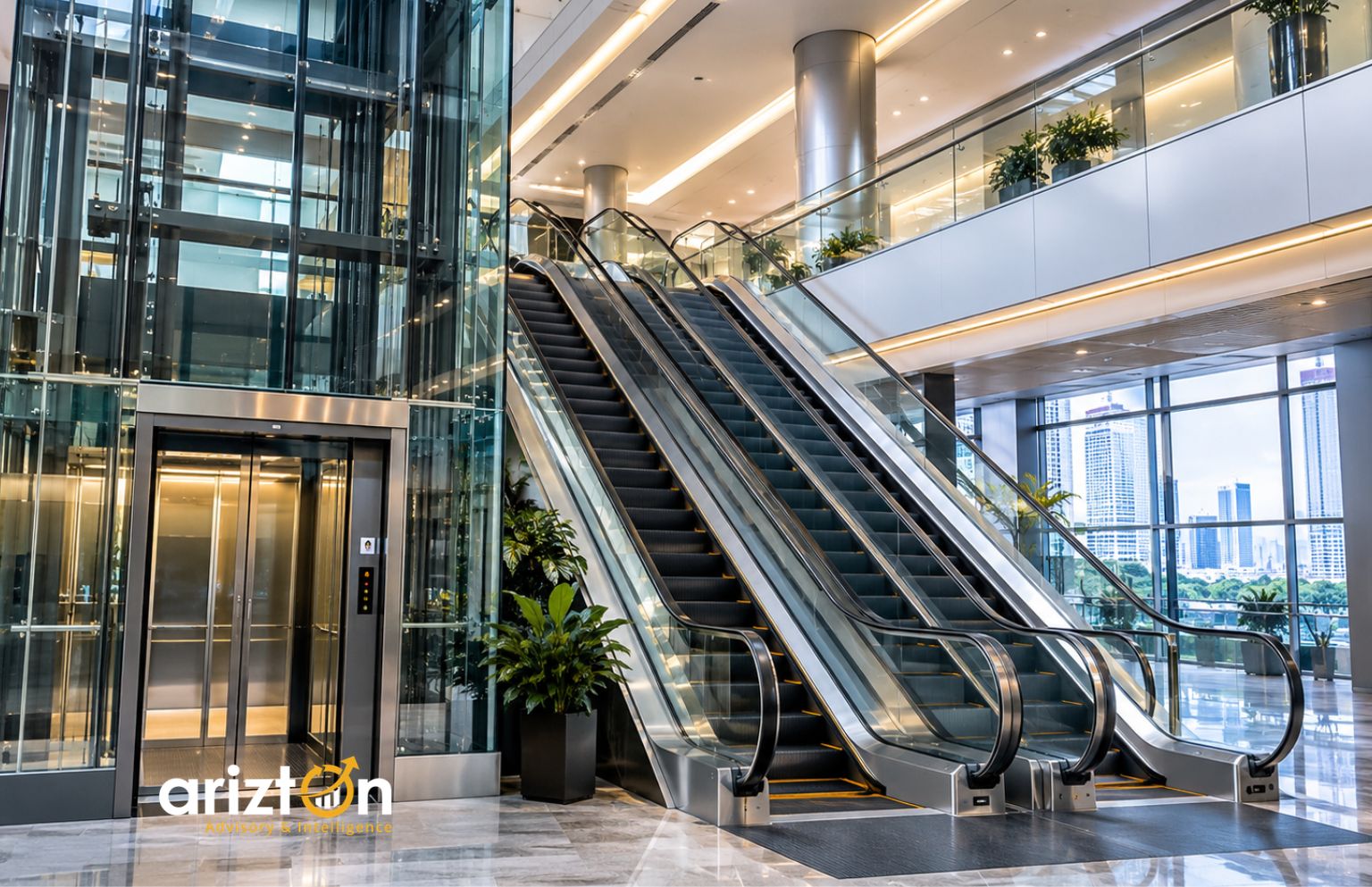
Kuala Lumpur's skyline now has a new tallest point of reference, a national rail network that's still years from finished, and a population getting older faster than most of its buildings were designed for. Each of those facts, on its own, sounds unrelated to an elevator shaft. Together, they explain why the Malaysia elevators and escalators market is being pulled in more directions at once than it has in decades.
A Market Growing on Two Fronts: New Installations and Modernization
The Malaysia elevator market by new installations was valued at approximately 12.99 thousand units in 2025 and is expected to reach around 15.36 thousand units by 2031, growing at a CAGR of 2.83%. That steady headline number, however, undersells what's actually happening: the installed base is projected to hit roughly 248.34 thousand units by 2031, and a growing share of it is old enough to need upgrading rather than replacing.
Programs like the 13th Malaysia Plan, the New Industrial Master Plan 2030, and rail projects such as the Penang Mutiara LRT and MRT3 Circle Line are expected to accelerate demand for vertical transportation well beyond what organic urban growth alone would produce.
Key growth drivers shaping the market include:
Transit expansion — LRT3, RTS Link, ECRL, MRT3, Penang LRT
Ageing population — 65+ share at 8.0% in 2025, rising toward "aged nation" status by 2030
AI & IoT adoption — predictive maintenance, smart dispatching
Green building policy — National Green Technology Policy, NEEAP
Retail expansion — 2.36 million sq ft added across three new KL malls in late 2025
Know More: Malaysia Elevators and Escalators Market Report 2026–2031
Who's Building Malaysia's Vertical Transportation Backbone?
Malaysia's elevator and escalator market is served by a tight cluster of global manufacturers, each occupying a slightly different position.
Schindler holds the largest individual share, at around 18%, built mainly on high-rise office towers and premium residential contracts through its local partner, Antah Schindler Sdn Bhd — a joint venture with roots stretching back to the 1950s.
Mitsubishi Electric and KONE compete closely behind, each with significant share concentrated in Kuala Lumpur and Johor Bahru — KONE's roughly 87-unit supply to Merdeka 118, Malaysia's tallest building, remains its clearest proof of scale, while Mitsubishi Elevator Malaysia's project list runs through KLIA, the LRT network, and several landmark hotels.
Hitachi and Otis together account for close to a quarter of the market, leaning more heavily on infrastructure, hospitals, and public buildings than on premium residential towers — Otis has operated in Malaysia since 1909, making it one of the country's longest-standing industrial players.
TK Elevator, Hyundai Elevator, and Fujitec round out the established multinational tier. TK Elevator's meta and enta MRL series target residential and mass-transit buildings up to 120 meters; Hyundai Elevator Malaysia has quietly built a base of more than 2,000 installed units nationwide; and Fujitec draws 59% of its 2024 revenue from maintenance and modernization rather than new equipment.
Local and specialist players — including Dover Elevators (M) Sdn. Bhd., EITA Elevator, Sigma Elevator, Nippon Elevator, and Toshiba Elevator and Building Systems — compete on service network depth and pricing rather than global brand recognition, while home-lift specialists like Nibav Lifts and The Elite Elevators Sdn Bhd occupy a small but distinct niche built around vacuum and compact residential systems.
What's Actually Getting Built and Signed?
Recent activity spans everything from landmark contracts to quieter accessibility fixes:
Otis secured an order in December 2024 for ten SkyRise and Arise elevators at the 68-storey Chin Hin Group Property Dawn KLCC tower, complete with SmartGrouping technology that gives passenger groups direct access to specific sky-bar floors; the project is scheduled for completion in 2029.
Schindler signed a Master Services and Supplies Agreement with hospitality group Accor in 2025, covering new installations, modernization, and maintenance across nine Asian markets, Malaysia included — a deal structured around recurring service revenue rather than a single equipment sale.
TK Elevator announced HELIX, an AI-enabled, high-speed single-deck elevator platform, in March 2026, aimed at dynamic traffic performance in taller buildings.
Jardine Schindler, the regional arm operating in Malaysia, launched a new range of customizable elevator interior finishes in February 2026, targeting architects and developers on premium projects.
The Malaysian government announced an escalator installation at Batu Caves in January 2024, offering an alternative to the site's 272-step climb for elderly and disabled visitors — a small project, but a clear signal of where accessibility policy is heading.
Three new malls — Sunway Square, KLGCC, and Hextar World — opened in late 2025, adding a combined 2.36 million sq ft of retail space and, with it, fresh demand for parallel escalators, which already account for the largest volume of new escalator installations in the country.
Construction began in Q4 2025 on the Penang International Commercial Centre, a roughly RM450 million (USD 114.23 million) mixed-use development with office, retail, and residential towers, scheduled for completion by Q4 2028 — the kind of multi-zone project where mid-capacity elevators serving 2 to 15 people do most of the work.
Modernization: The Market's Quiet Growth Engine
With buildings responsible for roughly 23% of Malaysia's energy consumption, elevators are increasingly treated as an energy line item rather than a mechanical afterthought. The modernization market is expected to reach approximately USD 46.57 million by 2031, and programs like Otis' Arise MOD and KONE's Renaissance are built specifically around upgrading existing shafts — regenerative drives, efficient motors, smart controls — rather than full replacement.
As the installed base ages alongside the population using it, modernization is shifting from an occasional service call to a recurring, budgeted line of business for every major vendor in the market.
What Lies Ahead for Malaysia's Elevator and Escalator Market?
Between now and 2031, growth in the Malaysia elevators and escalators market looks less like a single curve and more like several running in parallel: new installations climbing gradually toward 15.36 thousand units, a modernization segment scaling toward USD 46.57 million, and accessibility and smart-building requirements pulling elevators and escalators into public infrastructure that used to rely on stairs alone. Rising construction costs — a 30–40% jump tied partly to diesel prices — may push some developers toward standardized systems in the near term, but the underlying demand drivers, from ageing demographics to an expanding rail network, aren't going away. For anyone tracking segmentation by machine type, capacity, or end-user, or benchmarking vendor positioning in more detail, the Arizton Malaysia Elevators and Escalators Market Report 2026–2031 covers the numbers this article only sketches.