Can Steam Turbine Makers Keep Up With Industrial and Grid Demand at Once?
Ask a utility procurement team, a factory operations head, and an AI data center developer what's keeping them up at night, and lately you'll get the same answer: they're all waiting on the same equipment. Steam turbines, once a slow-moving, utility-only purchase, are now being fought over by industrial manufacturers securing captive power and hyperscalers building out combined-cycle plants to feed AI infrastructure. The result is a market growing faster than most people outside the power sector have noticed.
How Big Is the Steam Turbine Market Right Now?
The steam turbine market was valued at USD 22 billion in 2025 and is forecast to reach USD 28.90 billion by 2031, growing at a CAGR of 4.65%. Shipments are expected to climb to 817 units globally by 2031, pushed along by rising electricity demand — the IEA's latest mid-year update puts global electricity demand growth at 3.6% in 2026 and 3.8% in 2027 — and continued government-backed capacity expansion, from India's Nuclear Energy Mission targeting 100 GW by 2047 to China's approval of 10 new nuclear reactors backed by an estimated $27 billion.
Know More: https://www.arizton.com/market-reports/stream-turbine-market
Why Is the Industrial Steam Turbine Market Growing Faster Than People Expected?
This is where the real shift is happening. The industrial steam turbine market is being pulled forward by manufacturers who need reliable captive power, process steam, and combined heat and power (CHP) to keep continuous production running, rather than depend on strained grids.
- Manufacturing expansion is forcing the issue. India's Semiconductor Mission, Tata Electronics, and Tata Semiconductor Manufacturing signed a 2025 agreement for the country's first commercial fabrication plant, an approximately $10.7 billion project — the kind of facility that needs dependable on-site power from day one.
- CHP adoption is accelerating. Russia approved a new 275 MW steam turbine unit at Mosenergo's CHP-25 plant in 2025 to modernize district heating and improve generation efficiency, part of a broader industrial push toward cogeneration for cost and emissions reasons.
- Alternative fuel sources are adding demand. Hitachi Zosen (Kanadevia) partnered with Sumitomo Heavy Industries in 2025 to develop next-generation turbines for Japanese waste-to-energy facilities, showing steam-cycle technology's reach well beyond coal and gas.
Key Insight: the industrial steam turbine market is no longer a side story to utility-scale power — manufacturing, waste-to-energy, and cogeneration buyers are now competing for the same turbine capacity as national grids.
Where Does the Steam Turbine MRO and Service Market Fit In?
New installations are only half the story. A large share of the world's installed base — coal-fired, nuclear, biomass, and industrial steam assets — is aging, and operators are leaning on replacement, upgrade, and life-extension work instead of new builds alone. That's turning the steam turbine mro market and steam turbine service market into a growth lane in their own right.
Toshiba is set to deploy its EtaPRO AI monitoring system across 165 power plants for NTPC Limited in India, with operations starting in spring 2027 — a sign that the steam turbine service market is shifting toward predictive, AI-enabled maintenance rather than reactive repair. Triveni Turbine Limited's $34.7 million order from NTPC, covering design, engineering, fabrication, erection, commissioning, and testing of a CO₂ cycle-based energy storage system, points the same way: vendors are increasingly selling full lifecycle service contracts, not just equipment.
Bottom line: as the installed base ages, revenue in the steam turbine mro market is becoming as strategically important to vendors as new unit sales.
Why Are Multi-Stage Steam Turbines Becoming the Default Choice?
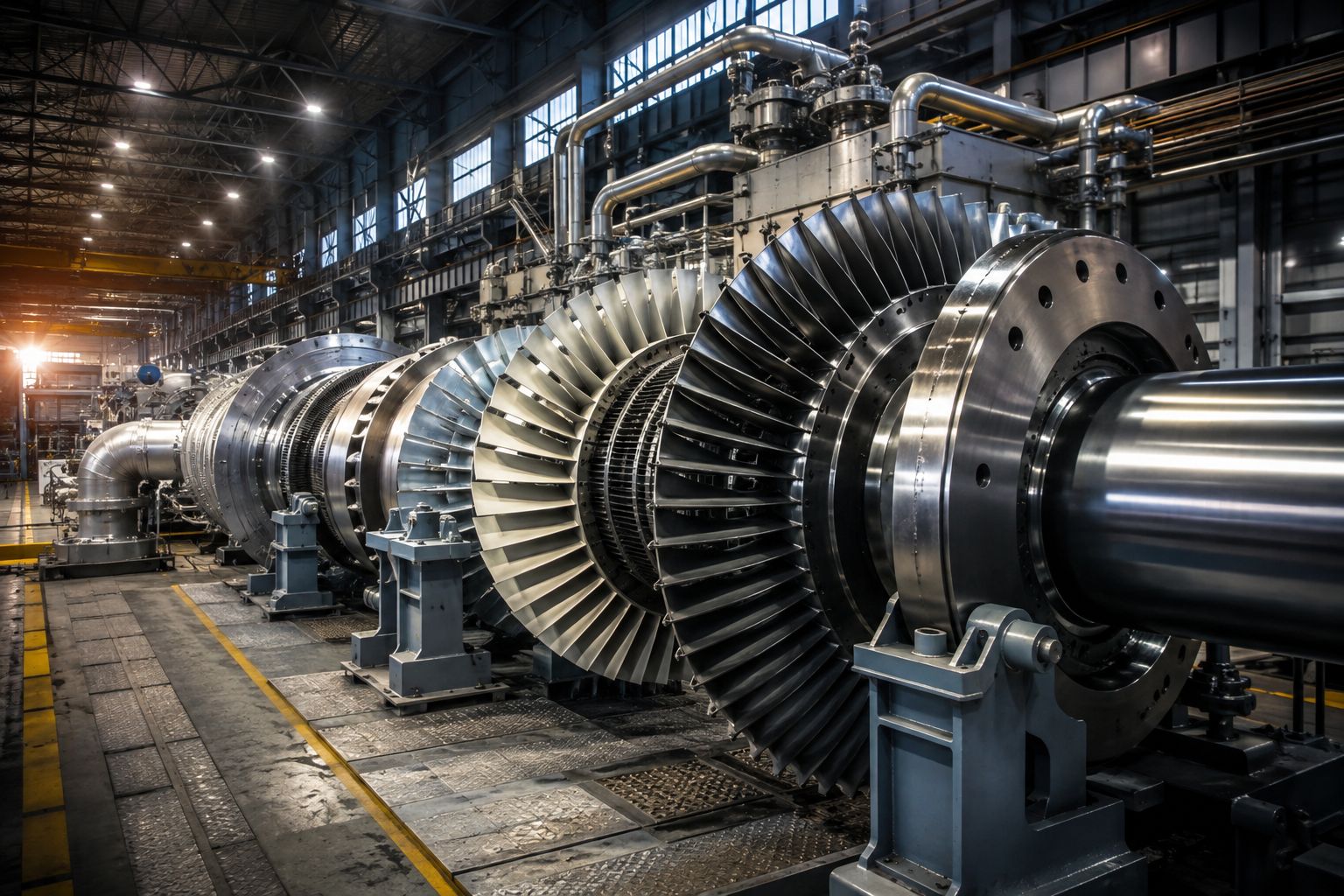
By design, the market splits into mixed-turbine, reaction turbine, and impulse turbine categories — and mixed-design units already hold around 76% share. The multi-stage steam turbine market is where that share is concentrated: multi-stage blade arrangements extract energy efficiently across the full steam expansion process while holding up under continuous baseload operation, which is exactly what supercritical, ultra-supercritical, and nuclear installations require. The above-300 MW capacity segment led the market in 2025 for the same reason, as utilities move toward higher-efficiency A-USC technology to cut fuel use and meet tightening emissions rules.
Conclusion: Turbines Are Becoming Everyone's Bottleneck
Whether it's a utility chasing grid reliability, a factory securing captive power, or a hyperscaler racing to power AI infrastructure, they're all now drawing from the same steam turbine market, projected to grow from USD 22 billion in 2025 to USD 28.90 billion by 2031. The industrial steam turbine market, the steam turbine mro market, and the multi-stage steam turbine market aren't separate stories anymore — they're the same supply chain, stretched across more buyers than it's ever had to serve before.