

Global Data Center UPS Market Growth Insights – Power Capacity to Reach 28,307 MW by 2031, Driven by Expanding Hyperscale Data Centers, Rising AI Workloads, Increasing Rack Power Densities, and Growing Demand for Reliable Power Infrastructure Across Cloud and Colocation Facilities (2026–2031)
Published Date : August 2026
Last Updated : September 2026
format: PDF
edition : Third Edition

480 pages

47 company

4 segments

9 region

55 countries
Purchase Options
Global Data Center UPS Market Landscape 2026-2031
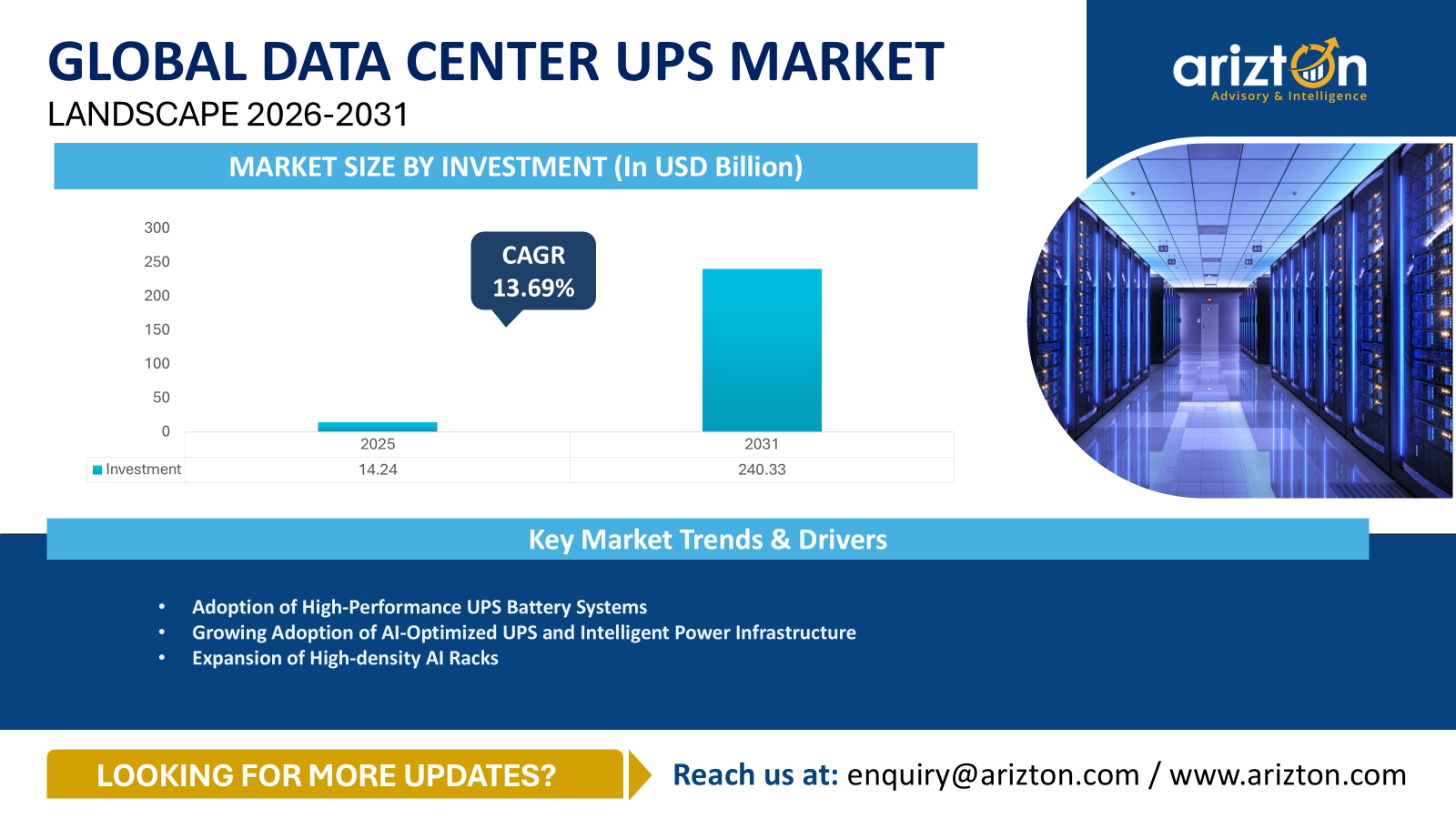
THE GLOBAL DATA CENTER UPS MARKET SIZE BY INVESTMENT WAS VALUED AT USD 14.24 BILLION IN 2025 AND IS EXPECTED TO REACH USD 30.74 BILLION BY 2031, GROWING AT A CAGR OF 13.69% FROM 2025 TO 2031
The Global Data Center UPS Market Research Report Includes Size, Share, and Growth in Terms of
- Battery Technology: VRLA, Li-ion, and Flywheel
- UPS Capacity: <=500 kVA, 500–1,000 kVA, and >1,000 kVA
- Tier Standards: Tier I & II, Tier III, and Tier IV
- Geography: North America, Latin America, Western Europe, Nordics, Central and Eastern Europe, Middle East, Africa, APAC, and Southeast Asia
Industry Analysis Report, Regional Outlook, Growth Potential, Price Trends, Competitive Market Share & Forecast 2026–2031.
This report includes market data points, ranging from trend
analyses to market estimates & forecasts that you can customize
GLOBAL DATA CENTER UPS MARKET REPORT SCOPE
| REPORT ATTRIBUTE | DETAILS |
|---|---|
| MARKET SIZE BY INVESTMENT (2031) | USD 30.74Billion |
| MARKET SIZE BY INVESTMENT (2025) | USD 14.24 Billion |
| CAGR BY INVESTMENT (2025-2031) | 13.69% |
| POWER CAPACITY (2031) | 28,307 MW |
| HISTORIC YEAR | 2022-2024 |
| BASE YEAR | 2025 |
| FORECAST YEAR | 2026-2031 |
| MARKET SEGMENTS | Battery Technology, UPS Capacity, Tier Standards, Geography |
| GEOGRAPHICAL ANALYSIS | North America, Latin America, Western Europe, Nordics, Central and Eastern Europe, Middle East, Africa, APAC, and Southeast Asia |
DATA CENTER UPS MARKET SIZE
The global data center UPS market size by investment was valued at USD 14.24 billion in 2025 and is expected to reach USD 30.74 billion by 2031, growing at a CAGR of 13.69% during the forecast period. The data center UPS market’s growth is driven by hyperscale expansion, AI workloads, as well as increasing rack power densities across cloud and colocation facilities.
According to the survey of the power-report-2026-mid-year-pulse-final, 51% of respondents rank power availability among the top site-selection criteria. Data center developers are increasingly investing in grid resilience and onsite power generation as grid constraints are encouraging investment in resilient electrical architectures, including modular UPS systems, lithium-ion batteries, and distributed power systems.
DATA CENTER UPS MARKET TRENDS
Adoption of High-performance UPS Battery Systems
The data center UPS market is experiencing strong growth, supported by rapid digitalization and the expanding adoption of advanced technologies across various industries. As organizations increasingly invest in digital transformation, the demand for reliable, energy-efficient, and resilient data center infrastructure is rising. Industries such as e-commerce, telecommunications, banking and financial services, and cloud computing rely heavily on uninterrupted data center operations, driving the need for advanced UPS systems that can provide continuous and stable power during grid fluctuations, disruptions, and outages.
Rapid Expansion of Edge Data Centers
The rapid growth of edge data centers is becoming a key driver of the data center UPS market. The expanding deployment of 5G networks, IoT devices, AI applications, Content Delivery Networks (CDNs), and other latency-sensitive technologies is encouraging enterprises to position computing infrastructure closer to end users. Unlike large hyperscale facilities, edge computing depends on a distributed network of smaller data centers, each requiring reliable backup power to maintain uninterrupted operations. Consequently, rising investments in edge data center infrastructure are creating greater demand for modular, scalable, and energy-efficient UPS systems across global markets.
MARKET GROWTH ENABLERS
Increasing Deployment of Redundant UPS Architectures for Enhanced Power Resilience
Power resilience has become a key priority for data center operators due to the increasing cost of downtime and the growing dependence on digital infrastructure for AI workloads, cloud computing, colocation services, and enterprise applications. Even short-duration power outages can lead to significant financial losses, service interruptions, and reputational risks. As a result, data center operators are increasing investments in redundant and reliable power infrastructure to ensure continuous operations across both existing and newly developed facilities.
Expansion of High-density AI Racks
The global data center industry is experiencing a notable rise in rack power density, driven by the growing adoption of AI, ML, cloud computing, HPC, big data analytics, and edge computing technologies. Increasing digital transformation across industries such as BFSI, healthcare, government, manufacturing, telecommunications, and retail is fueling the deployment of high-performance servers, advanced storage solutions, and networking equipment, resulting in significantly higher power requirements at the rack level.
MARKET RESTRAINTS
Rising Deployment Costs of Lithium-ion-based UPS Systems
The increasing focus on energy efficiency, sustainability, and operational reliability is accelerating the adoption of advanced UPS systems across data centers globally. Modern facilities require efficient and dependable backup power solutions to support high-density computing environments, AI workloads, and mission-critical applications. As a result, data center operators are increasingly exploring next-generation battery technologies, particularly lithium-ion (Li-ion) batteries, as an alternative to conventional VRLA battery systems.
Scarcity of Skilled Personnel
- The rapid growth of the global data center industry is generating strong demand for skilled professionals in areas such as design, construction, commissioning, operations, maintenance, and digital infrastructure management. The increasing development of hyperscale facilities, AI-ready campuses, cloud regions, and edge data centers is further intensifying the need for qualified talent. As a result, the availability of skilled workforce has emerged as a significant challenge for data center operators and developers worldwide.
DATA CENTER UPS MARKET SEGMENTATION INSIGHTS
- The global data center UPS market is experiencing robust growth, supported by accelerating investments in hyperscale facilities, AI-ready infrastructure, edge data centers, and cloud expansion worldwide. Demand for highly resilient power infrastructure continues to rise as operators deploy higher-density computing environments, making UPS systems a critical component of next-generation data center development. The market is expected to witness strong double-digit growth throughout the forecast period.
- Among battery technologies, lithium-ion UPS systems are projected to record the fastest growth during the forecast period. Their increasing adoption is driven by superior energy density, longer operational lifespan, reduced maintenance requirements, smaller footprint, and lower total cost of ownership. The rapid expansion of AI workloads, hyperscale campuses, and sustainability-focused infrastructure strategies is accelerating the transition from conventional battery technologies to lithium-ion solutions.
- VRLA (Valve-Regulated Lead-Acid) batteries continue to hold a significant data center UPS market share due to their extensive installed base, proven reliability, and cost-effective deployment. However, despite continued demand from enterprise and legacy data centers, the segment is expected to gradually lose market share as operators increasingly migrate toward lithium-ion technologies that offer improved efficiency, longer lifecycle performance, and better support for high-density workloads.
- Flywheel UPS systems are expected to witness steady growth, particularly in mission-critical applications where high-power density, rapid discharge capability, and minimal maintenance are key requirements. Their adoption remains strongest across hyperscale, colocation, and industrial data centers, where short-duration backup integrated with generator systems provides an efficient alternative to conventional battery-based UPS deployments.
- By UPS capacity, the greater than 1,000 kVA segment is anticipated to emerge as the fastest-growing category. Rising rack power densities, AI infrastructure deployments, and the expansion of hyperscale campuses are driving demand for high-capacity, redundant UPS systems capable of supporting large-scale computing environments.
DATA CENTER UPS MARKET GEOGRAPHICAL ANALYSIS
- The United States remains the world's largest UPS data center market, supported by large-scale hyperscale developments, AI infrastructure investments, and strong enterprise digitalization. Major operators, including Amazon Web Services (AWS), Microsoft, Google, Meta, Oracle, and CoreWeave, continue to expand high-density AI campuses, driving demand for high-capacity, lithium-ion-based UPS systems and modular power infrastructure.
- Asia-Pacific (APAC) remains the second-largest regional market and is expected to be one of the fastest-growing regions during the forecast period. Growth is fueled by rapid cloud adoption, expanding AI deployments, government-led digital transformation initiatives, and continued investments by hyperscale cloud providers and colocation operators across the region.
- Within APAC, China continues to dominate the regional market with the largest installed data center capacity, while India is emerging as one of the fastest-growing markets due to increasing investments from hyperscale cloud providers, colocation operators, and AI infrastructure developers. Meanwhile, Japan, Australia, Singapore, Indonesia, Malaysia, South Korea, and Thailand continue to expand their data center ecosystems, driving sustained demand for scalable, energy-efficient, and high-availability UPS solutions.
- Europe remains a strategically important market, led by the United Kingdom, Germany, France, the Netherlands, Italy, Spain, and the Nordic countries. Ongoing investments in hyperscale and colocation facilities, coupled with increasing rack power densities, sustainability goals, and the modernization of legacy infrastructure, are accelerating the adoption of modular and high-efficiency UPS systems across the region.
- The Middle East & Africa (MEA) is expected to witness the strongest growth momentum during the forecast period, supported by government-led digital transformation strategies, rising cloud investments, smart city developments, and the expansion of colocation infrastructure. Increasing investments in digital infrastructure are creating substantial opportunities for advanced and resilient UPS deployments.
- Within MEA, the UAE and Saudi Arabia continue to lead regional investments through large-scale hyperscale and AI-ready data center developments, while South Africa remains the continent's largest data center hub. Emerging markets such as Kenya, Nigeria, Morocco, and Egypt are also experiencing growing investments in carrier-neutral and enterprise data centers, supporting increased demand for reliable, scalable, and energy-efficient UPS infrastructure.
- In January 2026, VivoPower International acquired development rights for a 25 MW UAE data center with secured long-term power and modular scalability beyond 100 MW. The project targets high-density AI workloads and aligns with the country’s strategy of integrating energy infrastructure with digital-compute growth.
- In September 2025, Nxtra by Airtel Africa broke ground on a 44 MW data center in Tatu City, which will be developed in two phases of 22 MW each; it is slated to become operational by Q1 2027. The facility is likely to support high-density GPU workloads, cloud, and AI services while offering 99.999% uptime and redundant fiber connectivity.
- Across all regions, the rapid adoption of AI workloads, increasing rack power densities, the transition toward lithium-ion and next-generation battery technologies, growing deployment of modular UPS architectures, and a stronger emphasis on energy efficiency and operational resilience continue to reshape regional demand. These trends are encouraging operators to invest in scalable, high-efficiency power backup solutions capable of supporting next-generation digital infrastructure.
DATA CENTER UPS MARKET VENDOR LANDSCAPE
- The global data center UPS market is highly competitive, with the presence of established power infrastructure manufacturers, UPS specialists, battery technology providers, and integrated data center solution vendors competing across hyperscale, colocation, enterprise, edge, telecom, healthcare, industrial, and government sectors. Vendors continue to strengthen their market positions through product innovation, strategic partnerships, acquisitions, expansion of manufacturing capabilities, and the development of AI-ready, high-efficiency UPS solutions. Increasing demand for resilient power infrastructure and sustainability is driving investments in lithium-ion battery technologies, intelligent power management software, and modular UPS architectures.
- Leading vendors in the global data center UPS market include Borri, CENTIEL, AEG Power Solutions, Cyber Power Systems, Shenzhen KSTAR Science and Technology, AMETEK Powervar, Canovate, EverExceed, Marathon Power, Panduit, SolarEdge Technologies, Thycon, Trystar, VYCON, ZincFive, Exponential Power, and HITZINGER Electric Power. These companies offer a broad portfolio comprising modular UPS systems, static and rotary UPS solutions, intelligent power distribution systems, energy storage integration, monitoring software, and high-capacity UPS solutions designed for mission-critical data center environments.
- The market is also supported by prominent battery technology providers, including EnerSys, Exide Technologies, FIAMM Energy Technology, Saft, HBL Power Systems, Power Sonic, Haze Battery, UNIPOWER, and ZAF Energy Systems. These companies supply advanced battery technologies ranging from VRLA and lithium-ion to emerging battery chemistries, enabling higher reliability, longer lifecycle performance, reduced maintenance requirements, and improved energy efficiency for UPS deployments across modern data centers.
- Competition in the global data center UPS market is increasingly focused on high-efficiency power conversion, lithium-ion battery adoption, AI-enabled predictive monitoring, modular and scalable UPS architectures, high-power-density support, and sustainability initiatives. Vendors are differentiating themselves through advanced battery management systems, digital monitoring platforms, intelligent energy management software, integration with renewable energy and microgrids, and the development of UPS solutions capable of supporting next-generation AI and high-performance computing (HPC) workloads. Strategic collaborations with hyperscale cloud providers, colocation operators, and data center developers continue to drive innovation and market expansion globally.
SNAPSHOT
The global data center UPS market size by investment will reach USD 30.74 billion by 2031, growing at a CAGR of 13.69% from 2025 to 2031.
The following factors are likely to contribute to the growth of the global data center UPS market during the forecast period:
- Increasing Deployment of Redundant UPS Architectures for Enhanced Power Resilience
- Expansion of High-density AI Racks
Base Year: 2025
Forecast Year: 2026-2031
The study considers the present scenario of the global data center UPS market and its market dynamics for 2026−2031. It covers a detailed overview of several market growth enablers, restraints, and trends. The report offers both the demand and supply aspects of the market. It profiles and examines leading companies and other prominent ones operating in the market.
Key Vendor Profiles
- ABB
- Delta Electronics
- Eaton
- Legrand
- Schneider Electric
- Vertiv
- Piller Power Systems
Other Prominent Vendors
- AEG Power Solutions
- AMETEK Powervar
- Borri
- Cyber Power Systems
- Canovate
- CENTIEL
- Enconnex
- EverExceed
- Fuji Electric
- Hewlett Packard Enterprise
- Hitachi Hi-Rel Power Electronics
- HITEC Power Protection
- HITZINGER Electric Power
- Huawei Technologies
- Kohler
- Marathon Power
- Mitsubishi Electric
- Natron Energy
- Panduit
- Rittal
- Riello Elettronica Group
- Shenzhen KSTAR Science and Technology
- Socomec
- SolarEdge Technologies
- Trystar
- Thycon
- Toshiba
- VYCON
- ZincFive
- Solidion Technology
- Marathon Power
Prominent Battery Providers
- EnerSys
- Exide Technologies
- FIAMM Energy Technology
- Haze Battery
- HBL Power Systems
- Power Sonic
- Saft
- UNIPOWER
- ZAF Energy Systems
Segmentation by Battery Technology
- VRLA
- Li-ion
- Flywheel
Segmentation by UPS Capacity
- <=500 kVA
- 500–1,000 kVA
- >1,000 kVA
Segmentation by Tier Standards
- Tier I & II
- Tier III
- Tier IV
Segmentation by Geography
- North America
- The U.S.
- Canada
- Latin America
- Brazil
- Mexico
- Chile
- Colombia
- Argentina
- Other Latin American Countries
- Western Europe
- The U.K.
- Germany
- France
- Netherlands
- Ireland
- Switzerland
- Spain
- Italy
- Belgium
- Portugal
- Greece
- Other Western European Countries
- Nordics
- Sweden
- Denmark
- Norway
- Finland
- Iceland
- Central & Eastern Europe
- Russia
- Poland
- Austria
- Czechia
- Other Central & Eastern European Countries
- Middle East
- UAE
- Saudi Arabia
- Israel
- Oman
- Qatar
- Turkey
- Bahrain
- Kuwait
- Other Middle Eastern Countries
- Africa
- South Africa
- Kenya
- Nigeria
- Egypt
- Other African countries
- APAC
- China
- Hong Kong
- Australia
- New Zealand
- India
- Japan
- Taiwan
- South Korea
- Rest of APAC
- Southeast Asia
- Singapore
- Indonesia
- Malaysia
- Thailand
- Philippines
- Vietnam
- Other Southeast Asian Countries
GLOBAL DATA CENTER UPS MARKET FAQs
What is the growth rate of the global data center UPS market?
How big is the global data center UPS market?
What are the key trends in the data center UPS industry?
How many MW of power capacity is expected to reach the global data center UPS market by 2031?
Who are the key vendors in the global data center UPS market?
For more details, please reach us at [email protected]
1. ABOUT ARIZTON
2. ABOUT OUR DATA CENTER CAPABILITIES
3. WHAT’S INCLUDED
4. SEGMENTS INCLUDED
5. RESEARCH METHODOLOGY
6. MARKET AT GLANCE
7. PREMIUM INSIGHTS
8. INTRODUCTION
9. INVESTMENT OPPORTUNITIES
9.1. INVESTMENT: MARKET SIZE & FORECAST
9.2. POWER CAPACITY: MARKET SIZE & FORECAST
10. MARKET DYNAMICS
10.1. MARKET OPPORTUNITIES & TRENDS
10.2. MARKET GROWTH ENABLERS
10.3. MARKET RESTRAINTS
10.4. SITE SELECTION CRITERIA
11. MARKET SEGMENTATION
11.1. UPS CAPACITY
11.2. BATTERY TECHNOLOGY
12. TIER STANDARDS SEGMENTATION
13. GEOGRAPHY SEGMENTATION
14. NORTH AMERICA
14.1. MARKET SNAPSHOT & KEY HIGHLIGHTS
14.2. data center UPS market BY INVESTMENT
14.3. data center UPS market BY POWER CAPACITY
14.4. ADOPTION OF UPS SYSTEMS IN THE NORTH AMERICAN REGION
14.5. LIST OF UPCOMING DATA CENTER PROJECTS IN NORTH AMERICA
15. US
15.1. MARKET BY INVESTMENT
15.2. MARKET BY POWER CAPACITY
16. CANADA
16.1. MARKET BY INVESTMENT
16.2. MARKET BY POWER CAPACITY
17. LATIN AMERICA
17.1. MARKET SNAPSHOT & KEY HIGHLIGHTS
17.2. DATA CENTER UPS MARKET BY INVESTMENT
17.3. data center UPS market BY POWER CAPACITY
17.4. ADOPTION OF UPS SYSTEMS IN THE LATIN AMERICAN REGION
17.5. LIST OF UPCOMING DATA CENTER PROJECTS IN LATIN AMERICA
18. BRAZIL
18.1. MARKET BY INVESTMENT
18.2. MARKET BY POWER CAPACITY
19. MEXICO
19.1. MARKET BY INVESTMENT
19.2. MARKET BY POWER CAPACITY
20. CHILE
20.1. MARKET BY INVESTMENT
20.2. MARKET BY POWER CAPACITY
21. COLOMBIA
21.1. MARKET BY INVESTMENT
21.2. MARKET BY POWER CAPACITY
22. ARGENTINA
22.1. MARKET BY INVESTMENT
22.2. MARKET BY POWER CAPACITY
23. REST OF LATIN AMERICA
23.1. MARKET BY INVESTMENT
23.2. MARKET BY POWER CAPACITY
24. WESTERN EUROPE
24.1. MARKET SNAPSHOT & KEY HIGHLIGHTS
24.2. data center UPS market BY INVESTMENT
24.3. data center UPS market BY POWER CAPACITY
24.4. ADOPTION OF UPS SYSTEMS IN THE WESTERN EUROPE REGION
24.5. LIST OF UPCOMING DATA CENTER PROJECTS IN WESTERN EUROPE
25. UK
25.1. MARKET BY INVESTMENT
25.2. MARKET BY POWER CAPACITY
26. GERMANY
26.1. MARKET BY INVESTMENT
26.2. MARKET BY POWER CAPACITY
27. FRANCE
27.1. MARKET BY INVESTMENT
27.2. MARKET BY POWER CAPACITY
28. NETHERLANDS
28.1. MARKET BY INVESTMENT
28.2. MARKET BY POWER CAPACITY
29. IRELAND
29.1. MARKET BY INVESTMENT
29.2. MARKET BY POWER CAPACITY
30. SWITZERLAND
30.1. MARKET BY INVESTMENT
30.2. MARKET BY POWER CAPACITY
31. ITALY
31.1. MARKET BY INVESTMENT
31.2. MARKET BY POWER CAPACITY
32. SPAIN
32.1. MARKET BY INVESTMENT
32.2. MARKET BY POWER CAPACITY
33. BELGIUM
33.1. MARKET BY INVESTMENT
33.2. MARKET BY POWER CAPACITY
34. PORTUGAL
34.1. MARKET BY INVESTMENT
34.2. MARKET BY POWER CAPACITY
35. GREECE
35.1. MARKET BY INVESTMENT
35.2. MARKET BY POWER CAPACITY
35.3. OTHER WESTERN EUROPEAN COUNTRIES
35.4. MARKET BY INVESTMENT
35.5. MARKET BY POWER CAPACITY
36. NORDIC
36.1. MARKET SNAPSHOT & KEY HIGHLIGHTS
36.2. data center UPS market BY INVESTMENT
36.3. data center UPS market BY POWER CAPACITY
36.4. ADOPTION OF UPS SYSTEMS IN THE NORDIC REGION
36.5. LIST OF UPCOMING DATA CENTER PROJECTS IN NORDIC
37. SWEDEN
37.1. MARKET BY INVESTMENT
37.2. MARKET BY POWER CAPACITY
38. NORWAY
38.1. MARKET BY INVESTMENT
38.2. MARKET BY POWER CAPACITY
39. DENMARK
39.1. MARKET BY INVESTMENT
39.2. MARKET BY POWER CAPACITY
40. FINLAND
40.1. MARKET BY INVESTMENT
40.2. MARKET BY POWER CAPACITY
41. ICELAND
41.1. MARKET BY INVESTMENT
41.2. MARKET BY POWER CAPACITY
42. CENTRAL & EASTERN EUROPE
42.1. MARKET SNAPSHOT & KEY HIGHLIGHTS
42.2. data center UPS market BY INVESTMENT
42.3. data center UPS market BY POWER CAPACITY
42.4. ADOPTION OF UPS SYSTEMS IN THE CENTRAL & EASTERN EUROPE REGION
42.5. LIST OF UPCOMING DATA CENTER PROJECTS IN CENTRAL & EASTERN EUROPE
43. RUSSIA
43.1. MARKET BY INVESTMENT
43.2. MARKET BY POWER CAPACITY
44. POLAND
44.1. MARKET BY INVESTMENT
44.2. MARKET BY POWER CAPACITY
45. AUSTRIA
45.1. MARKET BY INVESTMENT
45.2. MARKET BY POWER CAPACITY
46. CZECHIA
46.1. MARKET BY INVESTMENT
46.2. MARKET BY POWER CAPACITY
47. OTHER CENTRAL & EASTERN EUROPEAN COUNTRIES
47.1. MARKET BY INVESTMENT
47.2. MARKET BY POWER CAPACITY
48. MIDDLE EAST
48.1. MARKET SNAPSHOT & KEY HIGHLIGHTS
48.2. data center UPS market BY INVESTMENT
48.3. data center UPS market BY POWER CAPACITY
48.4. ADOPTION OF UPS SYSTEMS IN THE MIDDLE EAST REGION
48.5. LIST OF UPCOMING DATA CENTER PROJECTS IN MIDDLE EAST
49. UAE
49.1. MARKET BY INVESTMENT
49.2. MARKET BY POWER CAPACITY
50. SAUDI ARABIA
50.1. MARKET BY INVESTMENT
50.2. MARKET BY POWER CAPACITY
51. ISRAEL
51.1. MARKET BY INVESTMENT
51.2. MARKET BY POWER CAPACITY
52. OMAN
52.1. MARKET BY INVESTMENT
52.2. MARKET BY POWER CAPACITY
53. QATAR
53.1. MARKET BY INVESTMENT
53.2. MARKET BY POWER CAPACITY
54. TURKEY
54.1. MARKET BY INVESTMENT
54.2. MARKET BY POWER CAPACITY
55. BAHRAIN
55.1. MARKET BY INVESTMENT
55.2. MARKET BY POWER CAPACITY
56. KUWAIT
56.1. MARKET BY INVESTMENT
56.2. MARKET BY POWER CAPACITY
57. OTHER MIDDLE EASTERN COUNTRIES
57.1. MARKET BY INVESTMENT
57.2. MARKET BY POWER CAPACITY
58. AFRICA
58.1. MARKET SNAPSHOT & KEY HIGHLIGHTS
58.2. data center UPS market BY INVESTMENT
58.3. data center UPS market BY POWER CAPACITY
58.4. ADOPTION OF UPS SYSTEMS IN THE AFRICA REGION
59. SOUTH AFRICA
59.1. MARKET BY INVESTMENT
59.2. MARKET BY POWER CAPACITY
60. KENYA
60.1. MARKET BY INVESTMENT
60.2. MARKET BY POWER CAPACITY
61. NIGERIA
61.1. MARKET BY INVESTMENT
61.2. MARKET BY POWER CAPACITY
62. EGYPT
62.1. MARKET BY INVESTMENT
62.2. MARKET BY POWER CAPACITY
63. OTHER AFRICAN COUNTRIES
63.1. MARKET SNAPSHOT & KEY HIGHLIGHTS
63.2. data center UPS market BY INVESTMENT
64. APAC
64.1. MARKET SNAPSHOT & KEY HIGHLIGHTS
64.2. data center UPS market BY INVESTMENT
64.3. data center UPS market BY POWER CAPACITY
64.4. ADOPTION OF UPS SYSTEMS IN THE APAC REGION
65. CHINA
65.1. MARKET BY INVESTMENT
65.2. MARKET BY POWER CAPACITY
66. HONG KONG
66.1. MARKET BY INVESTMENT
66.2. MARKET BY POWER CAPACITY
67. AUSTRALIA
67.1. MARKET BY INVESTMENT
67.2. MARKET BY POWER CAPACITY
68. NEW ZEALAND
68.1. MARKET BY INVESTMENT
68.2. MARKET BY POWER CAPACITY
69. JAPAN
69.1. MARKET BY INVESTMENT
69.2. MARKET BY POWER CAPACITY
70. INDIA
70.1. MARKET BY INVESTMENT
70.2. MARKET BY POWER CAPACITY
71. SOUTH KOREA
71.1. MARKET BY INVESTMENT
71.2. MARKET BY POWER CAPACITY
72. TAIWAN
72.1. MARKET BY INVESTMENT
72.2. MARKET BY POWER CAPACITY
73. REST OF APAC
73.1. MARKET BY INVESTMENT
73.2. MARKET BY POWER CAPACITY
74. SOUTHEAST ASIA
74.1. MARKET SNAPSHOT & KEY HIGHLIGHTS
74.2. data center UPS market BY INVESTMENT
74.3. data center UPS market BY POWER CAPACITY
74.4. ADOPTION OF UPS SYSTEMS IN THE SOUTHEAST ASIA REGION
75. SINGAPORE
75.1. MARKET BY INVESTMENT
75.2. MARKET BY POWER CAPACITY
76. INDONESIA
76.1. MARKET BY INVESTMENT
76.2. MARKET BY POWER CAPACITY
77. MALAYSIA
77.1. MARKET BY INVESTMENT
77.2. MARKET BY POWER CAPACITY
78. THAILAND
78.1. MARKET BY INVESTMENT
78.2. MARKET BY POWER CAPACITY
79. PHILIPPINES
79.1. MARKET BY INVESTMENT
79.2. MARKET BY POWER CAPACITY
80. VIETNAM
80.1. MARKET BY INVESTMENT
80.2. MARKET BY POWER CAPACITY
81. REST OF SOUTHEAST ASIA
81.1. MARKET BY INVESTMENT
81.2. MARKET BY POWER CAPACITY
82. MARKET PARTICIPANTS
82.1. KEY VENDOR PROFILES
82.2. OTHER PROMINENT VENDORS
82.3. PROMINENT BATTERY PROVIDERS
83. QUANTITATIVE SUMMARY
84. APPENDIX
84.1. ABBREVIATIONS
84.2. DEFINITIONS
84.3. SEGMENTAL COVERAGE
Select a license type that suits your business needs
Single User Licence
- Report accessible by one user only
- Free 10% or 3 days of customization
- Free post-sale service assistance
- Continuous support through email
5 User Licence
- Report accessible by 5 users within the organization
- Free 15% or 4.5 days of customization
- Continuous support through email and telephone
- Free analyst hour
- Free Upgrade: If an updated report published within 180 days of purchase, you will get the revised report free of charge
Corporate Licence
- Free Datasheet worth $1500
- Report accessible by the entire organization
- Free 20% or 6 days of customization
- Free post-sale service assistance
- Continuous support through email and telephone
- Direct access to lead analysts
- Free analyst hour
- Free Upgrade: If an updated report published within 180 days of purchase, you will get the revised report free of charge
Datasheet Licence
- Report accessible by 1 user only
- Free 15% or 32 hours of customization
- Free post-sale service assistance
- Direct access to lead analysts
Frequently Asked Questions
What is the growth rate of the global data center UPS market?
How big is the global data center UPS market?
What are the key trends in the data center UPS industry?
How many MW of power capacity is expected to reach the global data center UPS market by 2031?
Who are the key vendors in the global data center UPS market?
