
Global Personal Protective Equipment Market Research Report 2026-2031


164 pages

6 tables

50 charts

37 company

5 segments

5 region

22 countries
Purchase Options
Global Personal Protective Equipment Market Research Report 2026-2031
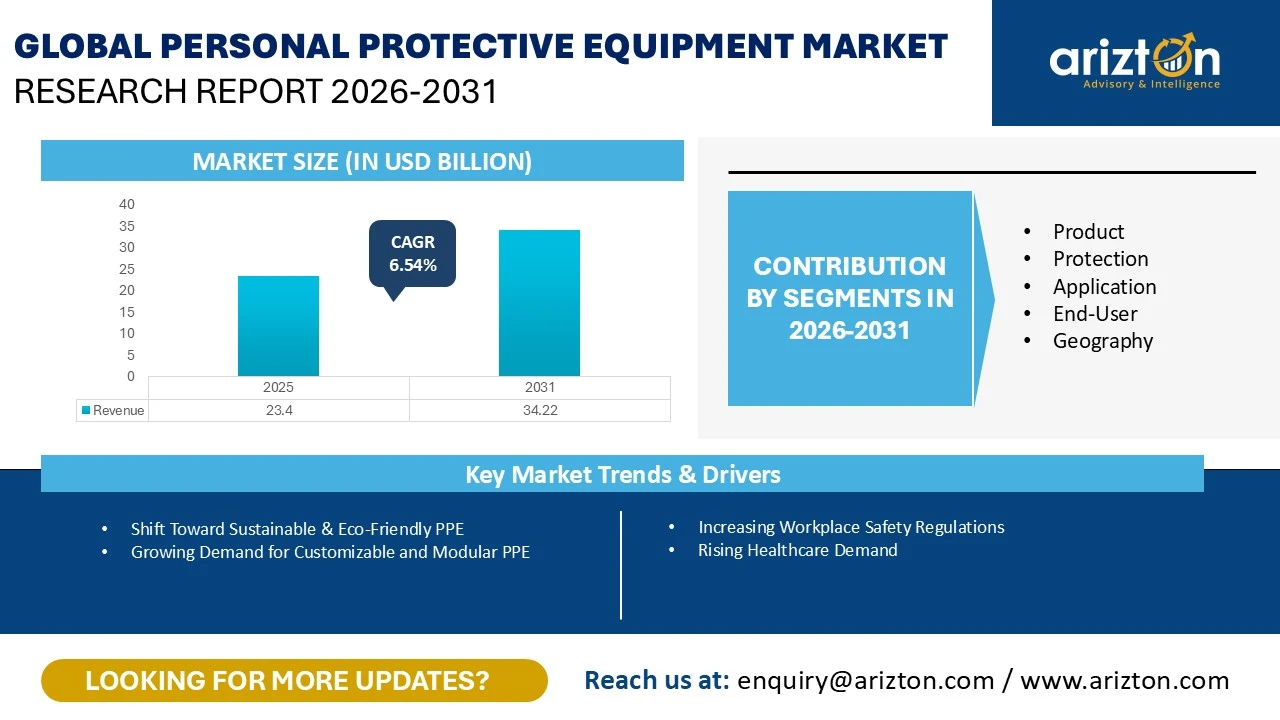
THE GLOBAL PERSONAL PROTECTIVE EQUIPMENT MARKET WAS VALUED AT USD 23.40 BILLION IN 2025 AND IS EXPECTED TO REACH USD 34.22 BILLION BY 2031, GROWING AT A CAGR OF 6.54%
The Personal Protective Equipment Market Size, Share & Trends Analysis Report By
- Product: Disposable and Reusable
- Protection: Hand Protection, Protective Clothing, Face & Eye Protection, Head Protection, Foot Protection, and Other Protection
- Application: Chemical Protection, Life Science Protection, Flame Retardant, and Other Applications
- End-User: Manufacturing, Construction, Healthcare & Life Sciences, Oil, gas & mining, and Others
- Geography: North America, Europe, APAC, Latin America, and Middle East & Africa
Industry Analysis Report, Regional Outlook, Growth Potential, Price Trends, Competitive Market Share & Forecast 2026–2031.
This report includes market data points, ranging from trend
analyses to market estimates & forecasts that you can customize
PERSONAL PROTECTIVE EQUIPMENT MARKET
| REPORT ATTRIBUTE | DETAILS |
|---|---|
| MARKET SIZE (2031) | USD 23.40 Billion |
| MARKET SIZE (2025) | USD 34.22 Billion |
| CAGR (2025-2031) | 6.54% |
| HISTORIC YEAR | 2022-2024 |
| BASE YEAR | 2025 |
| FORECAST YEAR | 2026-2031 |
| SEGMENTS BY | Product, Protection, Application, End-User, and Geography |
| GEOGRAPHIC ANALYSIS | North America, Europe, APAC, Latin America, & Middle East & Africa |
| KEY PLAYERS | 3M, Protective Industrial Products, Inc, Ansell Limited, DuPont de Nemours, Inc., and MSA Worldwide, LLC |
PERSONAL PROTECTIVE EQUIPMENT MARKET ANALYSIS
The global personal protective equipment (PPE) market is witnessing strong growth, supported by evolving industrial requirements and increasing awareness of workplace and personal safety. The market was valued at USD 23.40 billion in 2025 and is projected to reach USD 34.22 billion by 2031, expanding at a CAGR of 6.54% during the forecast period. This growth reflects sustained demand for protective equipment across industries as organizations continue to prioritize worker safety, regulatory compliance, and risk management.
The market’s expansion extends across a wide range of applications, from business-to-business industrial procurement to retail and consumer use, and is being supported by several key factors:
- Increasingly stringent workplace safety regulations across major markets.
- Growing healthcare and medical safety requirements in the post-COVID-19 environment.
- Technological advancements in respiratory protection equipment and other protective solutions.
- Increasing integration of smart technologies into PPE products to enhance safety and monitoring.
- Growing adoption of sustainable and eco-friendly materials in PPE manufacturing.
- Rising demand for customizable and modular PPE products tailored to specific user and industry requirements.
KEY TAKEAWAYS
- Product: The disposable PPE segment commanded the lion's share of the market, accounting for approximately 64% of global revenue.
- Protection Type: The hand protection segment dominated the protective equipment market, maintaining the largest market share.
- Application: Driven by a rapid rise in chemical handling risks, the chemical protection segment emerged as the fastest-growing sector, posting a CAGR of 6.78%.
- End-User: Serving as the foundation for industrial safety equipment, the manufacturing segment stood out as the largest end-user market.
- Geography: North America maintained its global dominance, capturing over 36% of the total occupational safety equipment market.
PERSONAL PROTECTIVE EQUIPMENT MARKET DRIVER ANALYSIS
Increasingly Stringent Workplace Safety Regulations
Regulatory frameworks serve as the foundational baseline for the personal safety market. As compliance standards become more stringent worldwide, procurement shifts from an optional ethical practice to a mandatory legal and fiscal obligation. Legal frameworks mandate that manufacturers strictly adhere to essential health and safety protocols, either directly via legislative compliance or by implementing harmonized industry standards. Because the industry's future depends on providing high-performance, certified gear capable of passing rigorous official audits, evolving safety legislation ensures a steady, non-seasonal demand for personal protective equipment.
Rising Healthcare Demand
The pandemic triggered a permanent operational pivot within the global healthcare infrastructure, moving from rigid cost-cutting strategies toward long-term emergency readiness and rigid infection-prevention protocols. Many healthcare facilities have instituted permanent requirements for surgical masks and regular glove replacement across all patient interactions. Furthermore, a major post-crisis backlog of elective surgeries has accelerated modern surgical activity, triggering sharp demand spikes for premium-grade surgical gowns and specialized medical gloves.
PERSONAL PROTECTIVE EQUIPMENT (PPE) MARKET TRENDS
The Integration of Smart PPE
The workplace safety equipment market is undergoing a digital transformation through Smart PPE. By integrating traditional safety gear with 5G, Bluetooth, Wi-Fi connectivity, IoT sensors, and AI-driven data analytics, smart PPE transitions industrial safety from passive protection to proactive, real-time hazard detection.
Efficacy Highlight: Real-time hazard detection and high-speed telemetry can reduce industrial accident rates by 25% to 60% almost immediately.
Driven by an emerging data-driven safety culture and seamless compatibility with the Industrial Internet of Things (IIoT), smart PPE is rapidly becoming the standard for high-exposure environments, fully justifying its premium price point.
Shift Toward Sustainable & Eco-Friendly Solutions
Driven by ESG mandates, circular economy initiatives, and a massive global waste crisis, the protective gear market is pivoting toward green alternatives. The environmental impact of legacy products is being addressed through material innovations, such as:
- Biodegradable Nitrile Gloves: Degrade in just 1 to 5 years, compared to the 100-year degradation timeline of traditional synthetic rubber.
- Alternative Raw Materials: Utilizing sustainable inputs like organic bamboo, natural fibers, and recycled synthetics.
- Circular Systems: Transitioning to heavy-duty, reusable garments and washable gloves, supported by commercial industrial laundering to slash single-use waste.
PERSONAL PROTECTIVE EQUIPMENT INDUSTRY RESTRAINTS
The Rise of Counterfeit PPE
The widespread distribution of counterfeit PPE stands as the most critical challenge facing the global protection market. Unlike generic counterfeits that merely impact brand equity, fake occupational safety equipment introduces catastrophic vulnerabilities by offering a false sense of security in life-threatening environments. Organizations that inadvertently procure these substandard, uncertified items face severe legal liabilities, crippling compliance penalties, and increased worker injury risks, severely compromising the integrity of the broader supply chain.
GLOBAL PERSONAL PROTECTIVE EQUIPMENT MARKET SEGMENT DEEP-DIVE & KEY TAKEAWAYS
To understand the mechanics of the broader ppe market, it helps to look at how specific segments are performing globally:
- Product Type: The disposable PPE segment commands the lion's share of the market, accounting for approximately 64% of global revenue. While reusable solutions are growing due to sustainability trends, single-use garments remain an operational absolute in sterile environments like pharmaceutical cleanrooms, medical facilities, and food processing plants.
- Protection Type: The hand protection segment dominates the protective equipment market, maintaining the largest market share. However, regional demands fluctuate for the body protection equipment market. For instance, North American growth centers heavily around oil, gas, and regulatory compliance; the Asia-Pacific (APAC) demand is driven by infrastructure; and the Middle East & Africa (MEA) procurement is dominated by upstream energy. Additionally, the rising trade of temperature-sensitive biologics has expanded cold-storage infrastructure, driving demand for specialized thermal body protection.
- Application: Driven by a rapid rise in chemical handling risks, the chemical protection segment has emerged as the fastest-growing sector, posting a CAGR of 6.78%. Advanced manufacturing such as the production of high-performance plastics and electric vehicle (EV) battery components involves highly volatile chemical reactions requiring advanced protective gear.
- End-User: Serving as the foundation for the industrial personal protective equipment market, the manufacturing segment stands out as the largest end-user. The global shift toward EV manufacturing introduces unique high-voltage hazards (350V to 800V), creating an entirely new market for specialized insulating gloves and arc-flash protection.
PERSONAL PROTECTIVE EQUIPMENT (PPE) MARKET GEOGRAPHICAL ANALYSIS
North America: The Established Leader
Holding over 36% of the global market share, the North American region leads the industry. Key PPE market growth factors fueling this dominant position include rapid industrial reshoring, major infrastructure expansion, and an increasingly strict regulatory environment. Within this region, the US market represents the single largest contributor. Growth here is heavily sustained by healthcare facilities shifting away from temporary emergency stockpiling to establish high-volume, permanent baselines for infection-control gear, keeping year-round demand highly predictable.
Asia-Pacific (APAC): The Growth Engine
While North America maintains the highest revenue share, APAC stands as the fastest-growing regional market globally. Fueled by rapid industrialization, evolving safety legislation, and massive investments across the automotive and green energy sectors, countries like China and India continue to serve as critical manufacturing powerhouses. Furthermore, ongoing industrial expansions in surging emerging economies such as Indonesia and Vietnam are accelerating the localized adoption of certified workplace safety equipment, ensuring the region remains the primary driver of future market volume.
Latin America & Mexico: Emerging Frontiers
Latin America is one of the fastest-growing regions in the global market, propelled by the expansion of healthcare infrastructure, tightening Occupational Health & Safety (OHS) laws, and the modernization of mining equipment—particularly during the lithium triangle mining surge. Growth is further accelerated by Brazil's psychosocial risk mandates, rising oil and gas exploration, and large-scale urban transformation projects.
Simultaneously, Mexico's localized market is experiencing steady gains driven by key industrial and economic shifts. This expansion is primarily fueled by heavy investments in healthcare infrastructure and increasingly stringent respiratory health standards across workplaces. Additionally, the country's manufacturing nearshoring boom, coupled with ongoing aerospace sector developments, is creating a massive demand for industrial safety gear.
PERSONAL PROTECTIVE EQUIPMENT MARKET COMPETITIVE LANDSCAPE
The global personal protective equipment market is highly fragmented and intensely competitive. To hedge against margin erosion in the generic mask and glove segments, leading multinational players are employing aggressive strategic measures:
- Targeted M&A Activity: Industry leaders are acquiring specialized firms within high-margin niches, including cleanroom technology, life sciences, and electrical safety.
- Supply Chain Integration: To buffer against global raw material volatility, top-tier manufacturers are vertically integrating by directly acquiring rubber plantations and chemical processing plants.
- Ecosystem Lock-in: By embedding proprietary IoT and biometric sensors into smart PPE lines, market leaders are linking physical safety gear directly to specialized monitoring software. This integration builds consumer loyalty and increases switching costs.
- Regulatory Advantages: As occupational health and safety (OHS) laws become more stringent, particularly within the EU and Latin America, the high cost of product certification is creating an entry barrier that favors well-capitalized corporations, systematically phasing out low-cost, uncertified importers.
Recent Industry Developments
- March 2026: DuPont expanded its cleanroom and high-hazard portfolio by introducing a specialized disposable garment engineered for high-containment, high-hazard environments.
- January 2026: Ansell Ltd launched the TouchNTuff 93-800, an innovative single-use nitrile glove engineered to provide at least 15 minutes of continuous protection against direct exposure to acetone.
- October 2025: 3M advanced the industrial safety equipment market with the 3M PELTOR WS ALERT XPV Headset. These solar-powered communication headsets feature Bluetooth® MultiPoint technology and noise-cancelling microphones.
- September 2025: MSA Safety Incorporated released the V-Gard H2 Full Brim Safety Type 2 Helmet, providing enhanced lateral impact protection alongside integrated sun and debris shields for demanding outdoor construction environments.
SNAPSHOT
The global personal protective equipment market size is expected to grow at a CAGR of approximately 6.54% from 2025 to 2031.
The following factors are likely to contribute to the growth of the global personal protective equipment market during the forecast period:
- Increasing Workplace Safety Regulations
- Rising Healthcare Demand
- Rising Industrialization and Infrastructure Booms
Base Year: 2025
Forecast Year: 2026-2031
The report examines the current state of the global personal protective equipment market and its market dynamics through 2026−2031. It covers a detailed overview of several market growth enablers, restraints, and trends. The study covers both the demand and supply sides of the market. It also profiles and analyses leading companies and several other prominent companies operating in the market.
Key Vendors
- 3M
- Protective Industrial Products, Inc
- Ansell Limited
- DuPont de Nemours, Inc.
- MSA Worldwide, LLC
Other Prominent Vendors
- Lakeland Industries Inc.
- Delta Plus Group
- Uvex Safety Group
- Dragerwerk AG & Co. KGaA
- Alpha Pro Tech Ltd.
- Radians Inc.
- Showa Group
- Moldex-Metric
- Mallcom India Ltd.
- MCR Safety
- Alexandra
- ASATEX AG
- Avon Technologies plc
- Bennett Safetywear
- Cardinal Health
- COFRA S.r.l.
- Dynarex Corporation
- Gateway Safety, Inc.
- Globus Global Safety
- Gore-Tex
- JSP Ltd
- Sanctum Work Wear Pvt Ltd
- Stanley Black & Decker, Inc.
- Superior Glove Works Ltd.
- Wenass
- Wurth Group
- Sioen Industries
- Portwest
- Shaanxi Dursafety Materials Co.,Ltd
- Bullard
- Supermax Corporation Berhad
- Brazil Safety Brands
Segmentation by Product
- Disposable
- Reusable
Segmentation by Protection
- Hand Protection
- Protective Clothing
- Face & Eye Protection
- Head Protection
- Foot Protection
- Other Protection
Segmentation by Application
- Chemical Protection
- Life Science Protection
- Flame Retardant
- Other Applications
Segmentation by End-User
- Manufacturing
- Construction
- Healthcare & Life Sciences
- Oil, gas & mining
- Others
Segmentation by Geography
- North America
- US
- Canada
- APAC
- China
- India
- Japan
- Australia
- South Korea
- Indonesia
- Europe
- Germany
- UK
- France
- Italy
- Spain
- Netherlands
- Poland
- Latin America
- Brazil
- Mexico
- Argentina
- Middle East & Africa
- Turkey
- Saudi Arabia
- UAE
- South Africa
PERSONAL PROTECTIVE EQUIPMENT MARKET FAQs
How big is the global personal protective equipment market?
What is the growth rate of the global personal protective equipment market?
What are the key trends in the global personal protective equipment market?
Which region dominates the global personal protective equipment market?
Which protection segment provides more business opportunities in the global personal protective equipment market?
Who are the key vendors in the global personal protective equipment market?
- EXHIBIT 1 Global PPE Market 2022-2031 ($ billion)
- EXHIBIT 2 Global PPE Market by Product 2022-2031 ($ billion)
- EXHIBIT 3 Market by Disposable 2022-2031 ($ billion)
- EXHIBIT 4 Market by Reusable 2022-2031 ($ billion)
- EXHIBIT 5 Global PPE Market by Protection 2022-2031 ($ billion)
- EXHIBIT 6 Market by Hand Protection 2022-2031 ($ billion)
- EXHIBIT 7 Market by Protective Clothing 2022-2031 ($ billion)
- EXHIBIT 8 Market by Face & Eye Protection 2022-2031 ($ billion)
- EXHIBIT 9 Market by Head Protection 2022-2031 ($ billion)
- EXHIBIT 10 Market by Foot Protection 2022-2031 ($ billion)
- EXHIBIT 11 Market by Other Protection 2022-2031 ($ billion)
- EXHIBIT 12 Global PPE Market by Application 2022-2031 ($ billion)
- EXHIBIT 13 Market by Chemical Protection 2022-2031 ($ billion)
- EXHIBIT 14 Market by Life Science Protection 2022-2031 ($ billion)
- EXHIBIT 15 Market by Flame Retardant 2022-2031 ($ billion)
- EXHIBIT 16 Market by Other Applications 2022-2031 ($ billion)
- EXHIBIT 17 Global PPE Market by End-User 2022-2031 ($ billion)
- EXHIBIT 18 Market by Manufacturing 2022-2031 ($ billion)
- EXHIBIT 19 Market by Construction 2022-2031 ($ billion)
- EXHIBIT 20 Market by Healthcare & Life Sciences 2022-2031 ($ billion)
- EXHIBIT 21 Market by Oil, gas & mining 2022-2031 ($ billion)
- EXHIBIT 22 Market by Others 2022-2031 ($ billion)
- EXHIBIT 23 Global PPE Market by Geography 2022-2031 ($ billion)
- EXHIBIT 24 North America PPE Market 2022-2031 ($ billion)
- EXHIBIT 25 US PPE Market 2022-2031 ($ billion)
- EXHIBIT 26 Canada PPE Market 2022-2031 ($ billion)
- EXHIBIT 27 APAC PPE Market 2022-2031 ($ billion)
- EXHIBIT 28 China PPE Market 2022-2031 ($ billion)
- EXHIBIT 29 India PPE Market 2022-2031 ($ billion)
- EXHIBIT 30 Japan PPE Market 2022-2031 ($ billion)
- EXHIBIT 31 Australia PPE Market 2022-2031 ($ billion)
- EXHIBIT 32 South Korea PPE Market 2022-2031 ($ billion)
- EXHIBIT 33 Indonesia PPE Market 2022-2031 ($ billion)
- EXHIBIT 34 Europe PPE Market 2022-2031 ($ billion)
- EXHIBIT 35 Germany PPE Market 2022-2031 ($ billion)
- EXHIBIT 36 UK PPE Market 2022-2031 ($ billion)
- EXHIBIT 37 France PPE Market 2022-2031 ($ billion)
- EXHIBIT 38 Italy PPE Market 2022-2031 ($ billion)
- EXHIBIT 39 Spain PPE Market 2022-2031 ($ billion)
- EXHIBIT 40 Netherlands PPE Market 2022-2031 ($ billion)
- EXHIBIT 41 Poland PPE Market 2022-2031 ($ billion)
- EXHIBIT 42 Latin America PPE Market 2022-2031 ($ billion)
- EXHIBIT 43 Brazil PPE Market 2022-2031 ($ billion)
- EXHIBIT 44 Mexico PPE Market 2022-2031 ($ billion)
- EXHIBIT 45 Argentina PPE Market 2022-2031 ($ billion)
- EXHIBIT 46 Middle East & Africa PPE Market 2022-2031 ($ billion)
- EXHIBIT 47 Turkey PPE Market 2022-2031 ($ billion)
- EXHIBIT 48 Saudi Arabia PPE Market 2022-2031 ($ billion)
- EXHIBIT 49 UAE PPE Market 2022-2031 ($ billion)
- EXHIBIT 50 South Africa PPE market 2022-2031 ($ billion)
LIST OF TABLES
- TABLE 1Global PPE Market 2022-2031 ($ billion)
- TABLE 2Global PPE Market by Product segmentation 2022-2031 ($ billion)
- TABLE 3Global PPE Market by Protection segmentation 2022-2031 ($ billion)
- TABLE 4Global PPE Market by Application segmentation 2022-2031 ($ billion)
- TABLE 5Global PPE Market by End-User segmentation 2022-2031 ($ billion)
- TABLE 6Global PPE Market by Geography 2022-2031 ($ billion)
CHAPTER – 1: Global PPE Market Overview
- Executive Summary
- Key Findings
- Key Developments
CHAPTER – 2: Global PPE Market Segmentation Data
- Product Market Insights (2022-2031)
- Disposable
- Reusable
- Protection Market Insights (2022-2031)
- Hand Protection
- Protective Clothing
- Face & Eye Protection
- Head Protection
- Foot Protection
- Other Protection
- Application Market Insights (2022-2031)
- Chemical Protection
- Life Science Protection
- Flame Retardant
- Other Applications
- End-User Market Insights (2022-2031)
- Manufacturing
- Construction
- Healthcare & Life Sciences
- Oil, gas & mining
- Others
CHAPTER – 3: Global PPE Market Prospects & Opportunities
- Global PPE Market Drivers
- Global PPE Market Trends
- Global PPE Market Constraints
CHAPTER – 4: Global PPE Market Overview
- Global PPE Market -Competitive Landscape
- Global PPE Market - Key Players
- Global PPE Market - Key Company Profiles
CHAPTER – 5: Appendix
- Research Methodology
- Abbreviations
- Arizton
Select a license type that suits your business needs
Single User Licence
- Report accessible by one user only
- Free 10% or 3 days of customization
- Free post-sale service assistance
- Continuous support through email
5 User Licence
- Report accessible by 5 users within the organization
- Free 15% or 4.5 days of customization
- Continuous support through email and telephone
- Free analyst hour
- Free Upgrade: If an updated report published within 180 days of purchase, you will get the revised report free of charge
Corporate Licence
- Free Datasheet worth $1500
- Report accessible by the entire organization
- Free 20% or 6 days of customization
- Free post-sale service assistance
- Continuous support through email and telephone
- Direct access to lead analysts
- Free analyst hour
- Free Upgrade: If an updated report published within 180 days of purchase, you will get the revised report free of charge
Datasheet Licence
- Report accessible by 1 user only
- Free 15% or 32 hours of customization
- Free post-sale service assistance
- Direct access to lead analysts
Frequently Asked Questions
How big is the global personal protective equipment market?
What is the growth rate of the global personal protective equipment market?
What are the key trends in the global personal protective equipment market?
Which region dominates the global personal protective equipment market?
Which protection segment provides more business opportunities in the global personal protective equipment market?
Who are the key vendors in the global personal protective equipment market?