
Southeast Asia Mobile Crane Market Research Report 2026-2031

Southeast Asia Mobile Crane Market Growth Insights – Market Volume to Reach 3,592 Units by 2031, Driven by Rapid Urbanization, Infrastructure Expansion, Port Modernization, and Industrial Construction Across ASEAN Economies (2026–2031)
Published Date : June 2026
Last Updated : September 2026
format: PDF
edition : Second Edition

185 pages

14 company

3 segments

1 region

5 countries
Purchase Options
Southeast Asia Mobile Crane Market Research Report 2026-2031
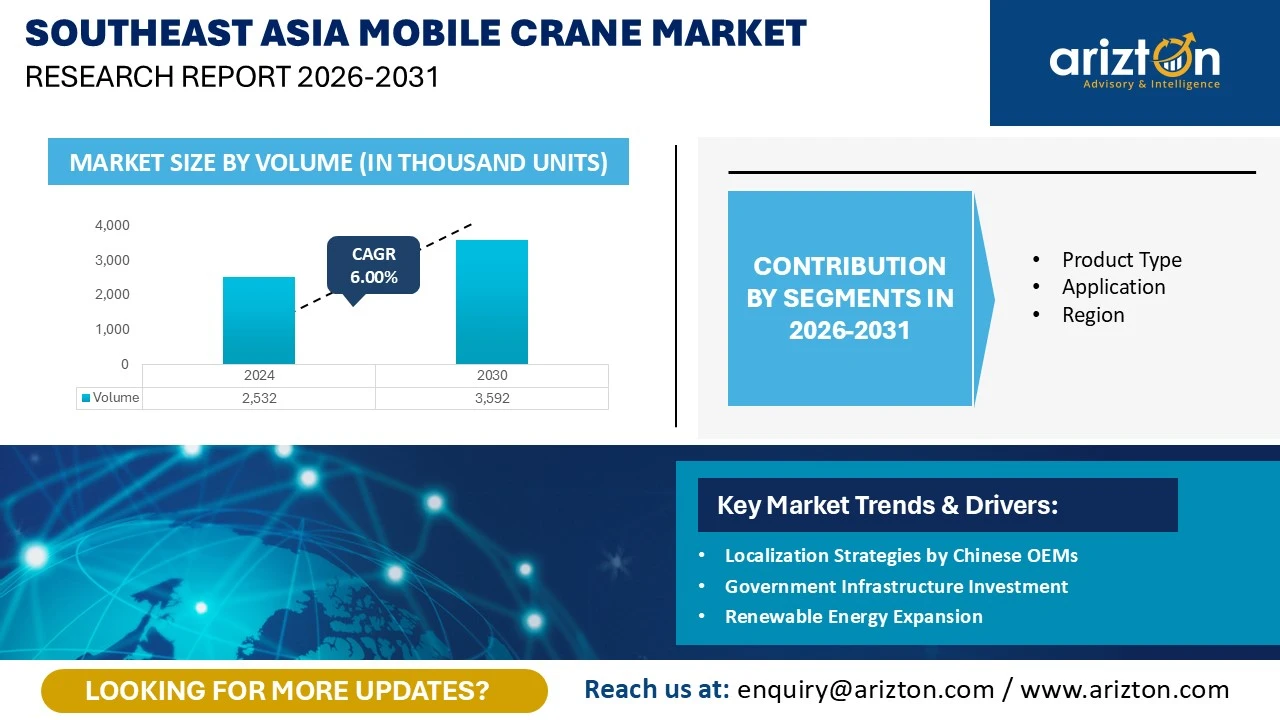
THE SOUTHEAST ASIA MOBILE CRANE MARKET SIZE WAS ESTIMATED AT 2,532 UNITS IN 2025 AND IS EXPECTED TO REACH 3,592 UNITS BY 2031, GROWING AT A CAGR OF 6.00%.
The Southeast Asia Mobile Crane Market Research Report Includes Segments By
- Product Type: Truck Mounted Crane, Crawler Crane, All Terrain Crane, Rough Terrain Crane, and Other Mobile Cranes
- Application: Construction, Mining, Manufacturing, Cargo Transport/ Port, and Others
- Region: Southeast Asia (Indonesia, Thailand, Malaysia, Philippines, and Rest of Southeast Asia)
The Industry Analysis Report Provides Industry Trends, Drivers, Opportunities, Competitive Outlook, Market Size, Sales, and Growth Forecast for 2026-2031
This report includes market data points, ranging from trend
analyses to market estimates & forecasts that you can customize
SOUTHEAST ASIA MOBILE CRANE MARKET REPORT SCOPE
| REPORT ATTRIBUTE | DETAILS |
|---|---|
| MARKET SIZE- VOLUME (2031) | 3,592 Units |
| MARKET SIZE- VOLUME (2025) | 2,532 Units |
| CAGR- VOLUME (2025-2031) | 6.00% |
| MARKET SIZE- REVENUE (2031) | USD 1.42 Billion |
| HISTORIC YEAR | 2022-2024 |
| BASE YEAR | 2025 |
| FORECAST YEAR | 2026-2031 |
| SEGMENTS BY | Product Type, Application, & Region |
| REGIONAL ANALYSIS | Indonesia, Thailand, Malaysia, Philippines, and Rest of Southeast Asia |
| KEY VENDORS | Tadano, Liebherr, Kobelco, SANY, Xuzhou Construction Machinery Group (XCMG), and Zoomlion |
SOUTHEAST ASIA MOBILE CRANE MARKET SIZE
The Southeast Asia mobile crane market size was estimated at 2,532 units in 2025 and is expected to reach 3,592 units by 2031, growing at a CAGR of 6.00% during the forecast period. The Southeast Asia mobile crane market continues to accelerate in 2026, propelled by rapid urbanization, extensive infrastructure investments, and increasing foreign direct capital inflows throughout the region.
The Southeast Asia mobile crane market is growing steadily due to rising infrastructure development, industrial expansion, port modernization, and energy-related construction across key countries such as Indonesia, Vietnam, Thailand, Malaysia, the Philippines, Singapore, and other ASEAN economies. Mobile cranes are important lifting equipment used in road and bridge construction, metro and railway projects, industrial plants, mining operations, power projects, shipyards, logistics hubs, and port facilities. Their main advantage is flexibility, as they can be moved easily from one project site to another and can support different lifting requirements in both urban and remote locations.
Government infrastructure programs are one of the strongest drivers of mobile crane demand in the region. Southeast Asian countries are investing heavily in transport connectivity, urban development, ports, airports, power transmission, and industrial corridors. The Master Plan on ASEAN Connectivity 2025 focuses on improving regional infrastructure and strengthening physical connectivity among member countries.
SOUTHEAST ASIA MOBILE CRANE MARKET SEGMENTATION INSIGHTS
- The Southeast Asia mobile crane market is dominated by truck cranes, which account for the largest share across the forecast period. In 2025, truck cranes represent 48% of total demand. By 2031, their share is expected to remain almost stable. This shows that truck cranes will continue to be the most preferred crane type despite gradual growth in other categories.
- Crawler cranes form the second-largest segment in 2025. Their share remains stable because they are mainly used in heavy infrastructure, energy, port, bridge, and industrial projects where high lifting capacity and strong ground stability are required. However, their higher cost, longer setup time, and limited road mobility restrict wider usage compared with truck cranes.
- All-terrain cranes & Rough-terrain cranes account for significant market shares in 2025. The demand for all-terrain cranes is supported by complex urban projects and industrial lifting work requiring both road mobility and off-road capability. Rough-terrain cranes demand is supported by mining, energy, and remote construction sites.
- The Southeast Asia mobile crane market is mainly driven by construction applications, which account for the largest share during the forecast period. In 2025, construction represents around 47% of total mobile crane demand, making it the leading application segment.
- The construction segment holds the largest share because mobile cranes are widely required in infrastructure and building projects. Countries such as Indonesia, Vietnam, Thailand, Malaysia, and the Philippines are investing in roads, bridges, railways, airports, metro systems, industrial parks, commercial buildings, and urban development projects. Mobile cranes are used for lifting steel structures, precast concrete, heavy equipment, construction materials, and machinery at project sites.
- Logistics and port applications form the second-largest segment in 2025. Demand is supported by port modernization, container terminal expansion, shipyard activity, and rising regional trade. Mobile harbour cranes, crawler cranes, and truck cranes are used for cargo handling, terminal construction, and maintenance activities.
SOUTHEAST ASIA MOBILE CRANE MARKET TRENDS
Localization Strategies by Chinese OEMS
- Chinese mobile crane manufacturers are shifting from a traditional export-led sales model to a more localized operating model in Southeast Asia. Earlier, many Chinese OEMs mainly supplied mobile cranes from China through dealers or distributors.
- However, leading players such as Zoomlion, SANY, and XCMG are now strengthening their regional presence through local subsidiaries, service centers, dealer networks, spare parts support, and local manufacturing or assembly.
- This trend is visible in markets such as Thailand, Malaysia, Vietnam, the Philippines, and Indonesia, where infrastructure development, industrial expansion, energy projects, and port modernization are creating steady demand for cranes.
Digital Technology & IOT Integration
- Digital technology and IoT integration are becoming an important trend in the Southeast Asia mobile crane market as contractors, rental companies, and logistics operators look for better equipment uptime, safety, and fleet productivity.
- Modern cranes are increasingly being equipped with sensors, telematics, cloud-based monitoring, remote diagnostics, and predictive maintenance tools. These systems help operators track machine location, operating hours, fuel consumption, load conditions, maintenance status, and fault alerts in real time.
- For equipment rental companies, fleet utilization and downtime directly affect profitability. A connected crane fleet allows owners to monitor equipment across multiple job sites, schedule maintenance before failures occur, reduce unplanned breakdowns, and improve asset deployment.
SOUTHEAST ASIA MOBILE CRANE MARKET DRIVERS
Government Infrastructure Investment
- Rising infrastructure investment is one of the strongest demand drivers for the Southeast Asia crane market. Across the region, governments are accelerating large-scale projects in airports, railways, new urban centers, ports, industrial corridors, and public infrastructure.
- These projects require continuous lifting, installation, material handling, and structural assembly, creating strong demand for mobile cranes, crawler cranes, truck-mounted cranes, gantry cranes, and port cranes.
- Overall, Southeast Asia’s infrastructure push creates a strong market opportunity for crane OEMs, dealers, and rental companies. Demand will be driven not only by new crane sales but also by spare parts, maintenance contracts, operator training, and after-sales services.
Renewable Energy Expansion
- Renewable energy expansion is becoming a major growth driver for the Southeast Asia crane market. As governments move toward cleaner power generation, the region is seeing rising investment in solar parks, wind farms, hydropower projects, transmission lines, substations, offshore energy assets, and grid infrastructure. These projects require cranes at multiple stages, including foundation work, tower erection, turbine installation, transformer handling, module lifting, maintenance, and offshore platform support.
- The renewable energy market creates a high-value opportunity for crane in the Southeast Asian market. As Southeast Asia accelerates its energy transition, crane suppliers that can serve wind, solar, hydropower, geothermal, grid, and offshore energy projects will be well positioned for future growth.
INDUSTRY RESTRAINTS
Rising Material & Construction Costs
- Rising material and construction costs are a key restraint for the Southeast Asia crane market, particularly in price-sensitive construction and infrastructure segments. Although crane demand is supported by large public infrastructure pipelines, higher project costs can delay investment decisions, reduce contractor margins, and slow equipment purchases.
- Inflation has moderated from the peak levels seen during the Russia-Ukraine supply shock, but cost pressure has not fully returned to normal levels. The Asian Development Bank reported that inflation in developing Asia was 4.8% in 2025 and expected to remain 4.6% in 2026.
- In the Southeast Asian construction market, the material and labour cost escalation became a major challenge for construction markets such as Singapore, Malaysia, Thailand, and Vietnam.
Rising Construction Costs
- Skilled operator shortage is one of the major restraints for the Southeast Asia crane market because cranes require trained, certified, and experienced personnel for safe and efficient operation.
- As infrastructure, construction, mining, logistics, and port projects expand across the region, demand for crane operators, riggers, signal persons, lifting supervisors, and maintenance technicians is increasing. However, the supply of qualified workers has not grown at the same pace, creating a gap between crane fleet expansion and actual equipment utilization.
- This issue is particularly important for mobile cranes, where incorrect operation can lead to safety incidents, project delays, equipment damage, and higher insurance or compliance costs.
VENDOR LANDSCAPE
- The Southeast Asia mobile crane market is moderately competitive, with global leaders, regional distributors, niche players, and specialized crane suppliers competing across construction, infrastructure, ports, mining, and energy projects. Market leaders such as SANY, XCMG, Zoomlion, Liebherr, and Tadano hold strong positions due to their wide product portfolios, established dealer networks, strong after-sales service, and ability to serve large infrastructure and industrial projects.
- Chinese brands such as SANY, XCMG, and Zoomlion are especially competitive in price-sensitive markets, while Liebherr and Tadano maintain strength in premium segments where reliability, safety, and advanced lifting technology are key buying factors.
- Niche players such as LiuGong, Terex, and Manitex operate with more focused product ranges and selective geographic presence. These companies typically compete in specific applications or countries where they have dealer support, rental partnerships, or specialized equipment demand. Their competitiveness depends heavily on local distribution strength and service availability.
- Emerging challengers, including Manitowoc, Kobelco, and Sumitomo, are gaining attention through technologically advanced products and application-specific solutions. They are well-positioned in crawler cranes, heavy lifting, and specialized construction projects, but their market share remains challenged by the aggressive pricing and broad availability of leading Chinese brands.
SNAPSHOT
The Southeast Asia mobile crane market size by volume is expected to grow at a CAGR of approximately 6.00% from 2025 to 2031.
The following factors are likely to contribute to the growth of the Southeast Asia mobile crane market during the forecast period:
- Government Infrastructure Investment
- Renewable Energy Expansion
- Mining Sector Growth
Base Year: 2025
Forecast Year: 2026-2031
The report considers the present scenario of the Southeast Asia mobile crane market and its market dynamics for 2026−2031. It covers a detailed overview of several market growth enablers, restraints, and trends. The study covers both the demand and supply sides of the industry. It also profiles and analyzes leading companies and several other prominent companies operating in the industry.
Key Company Profiles
- Tadano
- Liebherr
- Kobelco
- SANY
- XCMG
- Zoomlion
Other Prominent Company Profiles
- Manitowoc
- Sumitomo Heavy Industries Construction Crane Co. Ltd
- Konecranes
- Kato Works
- Terex Corporation
- LiuGong
- Mammoet
- Manitowoc
Segmentation by Product Type
- Truck Mounted Crane
- Crawler Crane
- All Terrain Crane
- Rough Terrain Crane
- Other Mobile Crane (Carry Deck Crane, Floating Crane, Pick & Carry, Side lifter, Gantry Crane & Aerial Crane)
Segmentation by Application
- Construction
- Mining
- Manufacturing
- Cargo Transport/ Port
- Others (Waste Management, Agriculture, Oil & Gas Extraction, Utilities & Energy, Power Generation, Disaster Management)
Segmentation by Region
- Southeast Asia
- Indonesia
- Thailand
- Malaysia
- Philippines
- Rest of Southeast Asia
SOUTHEAST ASIA MOBILE CRANE MARKET FAQs
What is the growth rate of the Southeast Asia mobile crane market?
How big is the Southeast Asia mobile crane market?
Who are the key players in the Southeast Asia mobile crane market?
What are the trends in the Southeast Asia mobile crane market?
For more details, please reach us at [email protected]
1. SCOPE & COVERAGE
• MARKET DERIVATION
• MARKET DEFINITION
• SEGMENT COVERAGE & DEFINITION
2. PREMIUM INSIGHTS
• KEY MARKET HIGHLIGHTS
• REGIONAL INSIGHTS
3. MARKET DYNAMICS
• INTRODUCTION
• OPPORTUNITIES AND TRENDS
• MARKET ENABLERS
• MARKET RESTRAINTS
• MARKET LANDSCAPE
4. MARKET SEGMENTATION
• PRODUCT TYPE
• APPLICATION
5. GEOGRAPHICAL SEGMENTATION
• SOUTHEAST ASIA
o INDONESIA
o THAILAND
o MALAYSIA
o PHILIPPINES
o REST OF SOUTHEAST ASIA
6. COMPETITIVE LANDSCAPE
• COMPETITIVE SCENARIO
• KEY COMPANY PROFILES
• OTHER PROMINENT COMPANY PROFILES
Select a license type that suits your business needs
Single User Licence
- Report accessible by one user only
- Free 10% or 3 days of customization
- Free post-sale service assistance
- Continuous support through email
5 User Licence
- Report accessible by 5 users within the organization
- Free 15% or 4.5 days of customization
- Continuous support through email and telephone
- Free analyst hour
- Free Upgrade: If an updated report published within 180 days of purchase, you will get the revised report free of charge
Corporate Licence
- Free Datasheet worth $1500
- Report accessible by the entire organization
- Free 20% or 6 days of customization
- Free post-sale service assistance
- Continuous support through email and telephone
- Direct access to lead analysts
- Free analyst hour
- Free Upgrade: If an updated report published within 180 days of purchase, you will get the revised report free of charge
Datasheet Licence
- Report accessible by 1 user only
- Free 15% or 32 hours of customization
- Free post-sale service assistance
- Direct access to lead analysts
Frequently Asked Questions
What is the growth rate of the Southeast Asia mobile crane market?
How big is the Southeast Asia mobile crane market?
Who are the key players in the Southeast Asia mobile crane market?
What are the trends in the Southeast Asia mobile crane market?
Other RELATED Reports
Southeast Asia Construction Equipment Market Research Report 2025-2030
Published : January 2026

Indonesia Mobile Crane Market - Strategic Assessment & Forecast 2021-2027
Published : November 2021