



Global Teleradiology Market Research Report 2026-2031
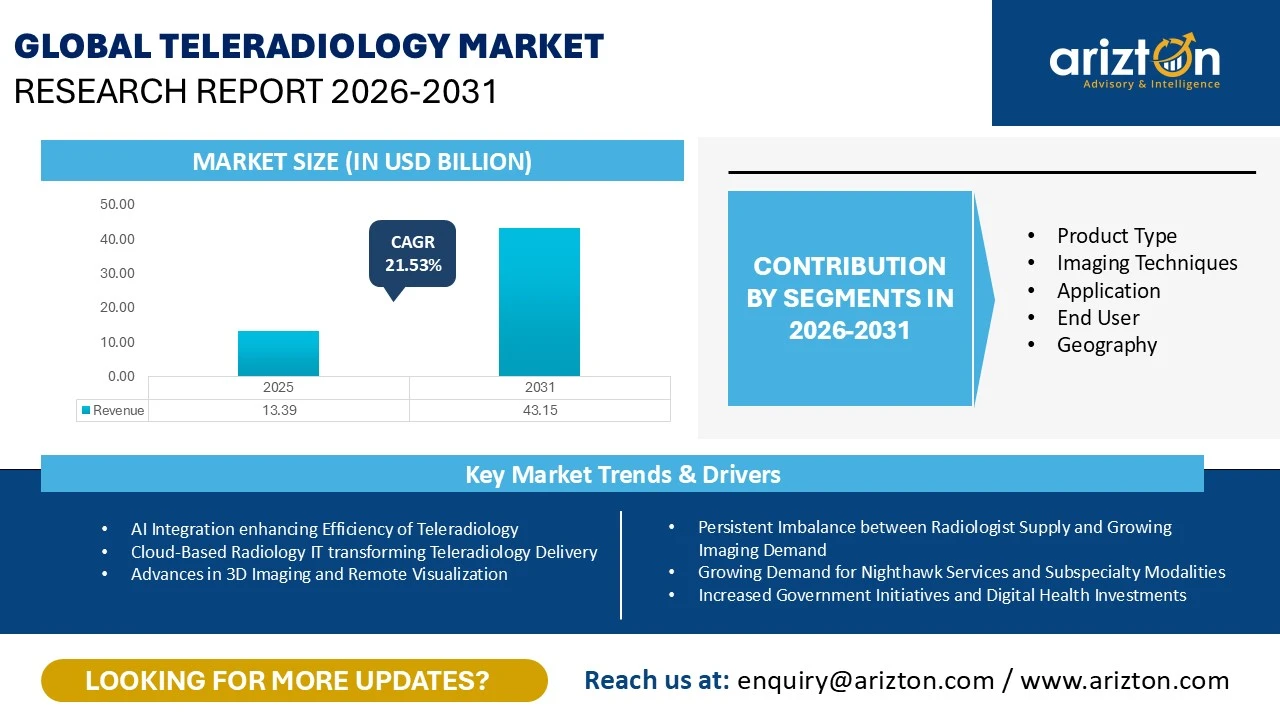
THE GLOBAL TELERADIOLOGY MARKET WAS VALUED AT USD 13.39 BILLION IN 2025 AND IS EXPECTED TO REACH USD 43.15 BILLION BY 2031, GROWING AT A CAGR OF 21.53% DURING THE FORECAST PERIOD.
The Teleradiology Market Size, Share & Trends Analysis Report By
- Product Type: Services (General Consultation, Nighthawk & Emergency, Second Opinions, and Specialty/Elective Services) and Software & Hardware
- Imaging Techniques: Ultrasound, Radiography, CT, MRI, Mammography, PET/ SPECT, and Others
- Application: Cardiology, Orthopedic, Oncology, Neurology, Gastroenterology, Dental, Obstetrics & Gynecology, and Other Applications
- End User: Hospitals, Diagnostics Imaging Centers & Labs, Ambulatory & Urgent Care Centers, and Others
- Geography: North America, Europe, APAC, Latin America, & Middle East & Africa
Industry Analysis Report, Regional Outlook, Growth Potential, Price Trends, Competitive Market Share & Forecast 2026–2031.
This report includes market data points, ranging from trend
analyses to market estimates & forecasts that you can customize
TELERADIOLOGY MARKET REPORT SCOPE
| REPORT ATTRIBUTE | DETAILS |
|---|---|
| MARKET SIZE (2031) | USD 43.15 Billion |
| MARKET SIZE (2025) | USD 13.39 Billion |
| CAGR (2025-2031) | 21.53% |
| HISTORIC YEAR | 2022-2024 |
| BASE YEAR | 2025 |
| FORECAST YEAR | 2026-2031 |
| SEGMENTS BY | Product Type, Imaging Techniques, Applications, End-User, and Geography |
| GEOGRAPHIC ANALYSIS | North America, Europe, APAC, Latin America, & Middle East & Africa |
| KEY PLAYERS | Philips, Agfa-Gevaert, Radiology Partners, Everlight Radiology, Evidia Group, Teleradiology Solutions (TRS), IK Partners, RadNet, Inc., I-MED Radiology Network, and Siemens Healthineers |
TELERADIOLOGY MARKET SIZE ANALYSIS
The global teleradiology market is projected to reach USD 43.15 billion by 2031, expanding at a CAGR of 21.53% during the forecast period.
Market growth is driven by the increasing demand for diagnostic imaging, a shortage of radiologists, and the ongoing digital transformation of healthcare systems. The rising prevalence of chronic diseases, aging populations, and expanding disease screening programs have significantly increased imaging volumes, creating greater demand for timely and accurate radiology reporting. However, the supply of qualified radiologists has not kept pace with this growing demand, accelerating the adoption of teleradiology services.
Teleradiology has become a critical component of modern diagnostic imaging by enabling the secure transmission and remote interpretation of medical images. It helps healthcare providers improve access to specialist expertise, reduce reporting turnaround times, optimize radiology workflows, and deliver high-quality diagnostic services across geographically dispersed and underserved regions.
The market is further supported by structural and technological advancements, including the expansion of high-speed internet connectivity, increasing adoption of imaging modalities such as CT, MRI, and PET scanners, and favourable government initiatives promoting telemedicine and digital health infrastructure. These factors are enabling healthcare providers to extend radiology services beyond conventional hospital settings, improving diagnostic reach and operational efficiency.
KEY TAKEAWAYS
- Product Type: The services segment accounted for approximately 70% of the global teleradiology market.
- Imaging Techniques: The ultrasound segment holds the largest global market share.
- Application: Cardiology represents the leading application segment in the market.
- End User: Diagnostic imaging centers are projected to grow at the fastest CAGR of 22.65% during the forecast period.
- Geography: North America dominated the market in 2025, accounting for around 44% of the global share.
TELERADIOLOGY MARKET TRENDS
AI Integration Enhancing Efficiency of Teleradiology
The integration of artificial intelligence (AI) into teleradiology platforms is emerging as a key trend shaping the global market. AI-powered technologies are increasingly being incorporated into radiology workflows to automate image analysis, prioritize urgent cases, assist in lesion detection, and support report generation, enhancing the overall efficiency of diagnostic services.
These advanced capabilities improve diagnostic accuracy, reduce reporting turnaround times, and streamline radiologists' workloads by enabling faster interpretation of medical images. As healthcare providers continue to adopt AI-enabled imaging solutions, the technology is expected to create significant growth opportunities by delivering more scalable, efficient, and precise teleradiology services while supporting improved patient outcomes across global healthcare systems.
Cloud-Based Radiology IT Transforming Service Delivery
The growing adoption of cloud-based Picture Archiving and Communication Systems (PACS) is emerging as a major trend in the global teleradiology market. Healthcare providers are increasingly implementing cloud-based platforms to securely store, manage, and share medical imaging data across multiple healthcare facilities, enabling seamless collaboration among radiologists and clinicians regardless of location.
This shift is driven by the need for scalable, cost-effective, and interoperable imaging solutions capable of supporting increasing diagnostic imaging volumes and geographically distributed healthcare networks. Cloud-based PACS enhances data accessibility, strengthens information security, simplifies system integration, and enables faster remote image interpretation. As healthcare organizations continue to modernize their digital infrastructure, cloud technology is expected to play a pivotal role in advancing teleradiology services and improving the efficiency, flexibility, and quality of diagnostic imaging.
TELERADIOLOGY MARKET DRIVERS
Rising Infrastructure Demand and Workforce Gap
The shortage of radiologists, coupled with the rising demand for diagnostic imaging services, is a major driver of the global teleradiology market. Increasing imaging volumes, limited training capacity, an aging radiology workforce, and growing levels of professional burnout have created significant challenges for healthcare providers in meeting the demand for timely diagnostic reporting.
These challenges are further intensified by disparities in healthcare access, particularly in rural and underserved regions where access to specialized radiology expertise is limited. Teleradiology addresses these issues by enabling the remote interpretation of medical images, reducing reporting delays, supporting continuous 24/7 radiology services, and improving access to specialist expertise. As a result, healthcare organizations are increasingly adopting teleradiology solutions to enhance diagnostic efficiency, optimize radiology workflows, and improve patient care outcomes.
Growing Demand for Nighthawk and Subspecialty Services
The increasing demand for round-the-clock (nighthawk) radiology services and access to subspecialty expertise is a key driver of the global teleradiology market. The growing use of advanced imaging technologies in emergency departments, trauma centers, and critical care settings has increased the need for rapid image interpretation and faster reporting, driving the adoption of remote radiology services.
In addition, the rising complexity of diagnostic imaging procedures, particularly computed tomography (CT) and magnetic resonance imaging (MRI), has heightened the demand for radiologists with specialized expertise. Teleradiology enables healthcare providers to access subspecialty radiologists regardless of geographic location, improving diagnostic accuracy, reducing report turnaround times, enhancing workflow efficiency, and ensuring continuous, high-quality patient care across diverse healthcare settings.
INDUSTRY RESTRAINTS
Regulatory Complexity and Cross-Border Challenges
Despite its strong growth potential, the teleradiology market faces challenges related to regulatory uncertainty, legal complexities, and data security concerns. The absence of standardized regulatory frameworks in many regions creates ambiguity regarding licensure, liability, and compliance requirements.
Cross-border teleradiology services are further restricted by varying licensing regulations, limiting scalability and global expansion. Additionally, unclear accountability in malpractice cases and concerns over data protection increase operational risks. These factors contribute to higher compliance costs and act as significant barriers to market growth.
TELERADIOLOGY MARKET SEGMENTATION INSIGHTS
Insight by Product Type
The global teleradiology market is segmented into services and software & hardware, with the services segment holding the largest share of approximately 70%. Its dominance is supported by the growing demand for outsourced radiology expertise and round-the-clock diagnostic support.
General consultation services represent a major component of this segment, supported by the increasing adoption of virtual healthcare models. These models facilitate real-time collaboration between radiologists and clinicians, support multidisciplinary consultations, and enable faster clinical decision-making. The integration of telemedicine into routine healthcare workflows has further contributed to the segment's expansion.
The shortage and uneven geographical distribution of radiologists are also driving demand for teleradiology services. With more than 5 billion medical imaging procedures performed annually and limited radiologist availability across many regions, healthcare systems face significant diagnostic capacity constraints. Increasing imaging volumes, fueled by population ageing and the rising prevalence of chronic diseases, are further strengthening the need for remote radiology services.
Insight by Imaging Techniques
The ultrasound segment holds the largest share of the global teleradiology market, supported by its widespread clinical use, affordability, portability, and non-ionizing nature. Ultrasound is extensively used for routine diagnostic applications, including obstetrics, abdominal imaging, and cardiac examinations.
Technological advancements are further expanding the capabilities of ultrasound-based teleradiology. AI-powered solutions can support real-time imaging guidance, automated image acquisition, and diagnostic analysis, enabling non-specialist operators to conduct examinations more effectively. In addition, 5G connectivity enables low-latency data transmission, supporting real-time remote collaboration and faster diagnostic interpretation.
The combination of technological advancements and growing demand for accessible, portable imaging solutions is strengthening the role of ultrasound in teleradiology, particularly across remote and resource-constrained healthcare settings.
Insight by Application
The cardiology segment accounts for the largest share of the global teleradiology market, primarily driven by the high prevalence of cardiovascular diseases and the need for timely interpretation of cardiac imaging. Diagnostic procedures such as echocardiography, CT angiography, and cardiac MRI often require rapid specialist assessment, increasing the adoption of teleradiology services.
Teleradiology also expands access to specialized cardiac expertise by reducing geographical barriers. Patients in rural and underserved areas can receive specialist interpretations without traveling long distances, helping reduce healthcare costs and supporting timely treatment decisions. This contributes to improved access to cardiac care and more efficient healthcare delivery.
Insight by End User
Diagnostic imaging centers are expected to witness strong growth in the global teleradiology market. This growth is supported by rising imaging volumes, increasing pressure to optimize operational costs, and growing demand for access to radiologists with specialized expertise.
Many diagnostic imaging centers primarily focus on image acquisition and may have limited or no in-house radiology staff. Teleradiology enables these facilities to remotely access qualified radiologists for image interpretation without maintaining full-time specialist teams. This model helps reduce staffing and operational costs while supporting timely reporting, diagnostic quality, and workflow efficiency.
TELERADIOLOGY MARKET GEOGRAPHICAL ANALYSIS
In 2025, North America accounted for the largest share of approximately 44% of the global teleradiology market. The region’s dominance is supported by advanced healthcare infrastructure, favorable reimbursement policies for telemedicine, and strong government support for digital health initiatives.
Imaging volumes in the region continue to rise due to ageing populations, increasing chronic disease prevalence, and expanded screening programs. In the United States alone, imaging procedures exceed one billion annually, growing steadily each year, while the radiologist workforce expands at a slower rate. This persistent imbalance continues to drive demand for teleradiology solutions.
Europe is also witnessing steady market growth, supported by rising diagnostic demand, workforce shortages, and strong adoption of digital health technologies across countries such as the UK, Germany, France, the Netherlands, Spain, Italy, and Poland. Well-established healthcare systems and increasing imaging volumes are further driving the need for efficient and scalable radiology services across the region.
TELERADIOLOGY MARKET VENDOR INSIGHTS
The global teleradiology market is highly fragmented, with competition among established healthcare technology providers, specialized teleradiology service companies, and emerging digital health firms. While leading vendors maintain a strong market presence through broad service portfolios, strategic partnerships, and advanced imaging technologies, emerging players continue to capitalize on opportunities created by increasing demand for remote diagnostic services and digital healthcare transformation.
Major companies, including Koninklijke Philips, Radiology Partners, and Teleradiology Solutions, are strengthening their market positions through continuous investments in AI-enabled imaging, cloud-based platforms, workflow automation, and integrated diagnostic solutions. At the same time, companies such as Everlight Radiology and Evidia Group are rapidly expanding their geographic footprint and service capabilities, while Agfa-Gevaert Group continues to enhance its presence through innovation in enterprise imaging and healthcare IT solutions.
Competitive differentiation is increasingly driven by the ability to provide scalable cloud-based platforms, AI-assisted image interpretation, seamless integration with PACS, RIS, and Hospital Information Systems (HIS), rapid report turnaround times, and compliance with evolving regulatory and data security standards. Vendors that continue to invest in technological innovation and specialized radiology expertise are expected to strengthen their competitive position in the global teleradiology market.
SNAPSHOT
The global teleradiology market size is expected to grow at a CAGR of approximately 21.53% from 2025 to 2031.
The following factors are likely to contribute to the growth of the global teleradiology market during the forecast period:
- Electrification Expands Laser Deployment and Tightens Quality Requirements
- Automation and High-Mix Production Elevate Software-Defined Laser Processing
- Miniaturization Expands Low-Thermal Precision Processing Needs
- Traceability and Governance Increase Demand for Marking and Process Data
Base Year: 2025
Forecast Year: 2026-2031
The report examines the current state of the global teleradiology market and its market dynamics through 2026−2031. It covers a detailed overview of several market growth enablers, restraints, and trends. The study covers both the demand and supply sides of the market. It also profiles and analyses leading companies and several other prominent companies operating in the market.
Key Company Profiles
- Koninklijke Philips
- Business Overview
- Product Offerings
- Key Developments
- Key Strategies
- Key Strengths
- Key Opportunities
- Agfa-Gevaert
- Radiology Partners
- Everlight Radiology
- Evidia Group
- Teleradiology Solutions
- Medica Group,
- RadNet, Inc
- I-MED Radiology Network
- Siemens Healthineers
Other Company Profiles
- CloudexRadiology
- Business Overview
- Product Offerings
- Telemedicine Clinic
- Onrad Inc
- Ramsoft
- Fujifilm Holdings Corporation
- Telerad Tech
- Statrad
- Medweb
- Webrad Technology
- 5C Network
- Doctor- Net Inc
- Nighthawk Radiology
- Vesta Teleradiology
- Mayfair Diagnostics
- Voyager Imaging
- Radmedic Group
- Speciality Teleradiology
- Real Radiology
- Nextrad Teleradiology
- Radsource LLC
- Experity
- Usarad Holdings
- Cerner
Segmentation by Product Type
- Services
- General Consultation
- Nighthawk & Emergency
- Second Opinions
- Specialty/Elective Services
- Software & Hardware
Segmentation by Imaging Techniques
- Ultrasound
- Radiography
- CT
- MRI
- Mammography
- PET/ SPECT
- Others
Segmentation by Application
- Cardiology
- Orthopedic
- Oncology
- Neurology
- Gastroenterology
- Dental
- Obstetrics & Gynecology
- Other Applications
Segmentation by End User
- Hospitals
- Diagnostics Imaging Centers & Labs
- Ambulatory & Urgent Care Centers
- Others
Segmentation by Geography
- North America
- U.S.
- Canada
- Europe
- Germany
- France
- Italy
- UK
- Spain
- Poland
- Netherlands
- APAC
- China
- Japan
- South Korea
- India
- Australia
- Latin America
- Brazil
- Mexico
- Argentina
- Middle East & Africa
- Turkey
- Saudi Arabia
- UAE
- South Africa
TELERADIOLOGY MARKET FAQ
Who are the major players in the global teleradiology market?
How big is the global teleradiology market?
Which region dominates the global teleradiology market?
What are the key trends in the global teleradiology market?
What is the growth rate of the global teleradiology market?
For more details, please reach us at [email protected]
1. SCOPE & COVERAGE
• MARKET DERIVATION
• MARKET DEFINITION
• SEGMENT COVERAGE & DEFINITION
2. PREMIUM INSIGHTS
• KEY MARKET HIGHLIGHTS
• REGIONAL INSIGHTS
3. MARKET DYNAMICS
• INTRODUCTION
• IMPACT OF ONGOING TARIFF WAR
• OPPORTUNITIES AND TRENDS
• MARKET ENABLERS
• MARKET RESTRAINS
• MARKET LANDSCAPE
4. MARKET SEGMENTATION
• PRODUCT TYPE
• IMAGING TECHNIQUE
• APPLICATION
• END USER
5. GEOGRAPHICAL SEGMENTATION
• NORTH AMERICA
• EUROPE
• ASIA
• LATIN AMERICA
• MIDDLE EAST
6. COMPETITIVE LANDSCAPE
• COMPETITIVE SCENARIO
• KEY COMPANY PROFILES
• OTHER PROMINENT COMPANY PROFILE
Select a license type that suits your business needs
Single User Licence
- Report accessible by one user only
- Free 10% or 3 days of customization
- Free post-sale service assistance
- Continuous support through email
5 User Licence
- Report accessible by 5 users within the organization
- Free 15% or 4.5 days of customization
- Continuous support through email and telephone
- Free analyst hour
- Free Upgrade: If an updated report published within 180 days of purchase, you will get the revised report free of charge
Corporate Licence
- Free Datasheet worth $1500
- Report accessible by the entire organization
- Free 20% or 6 days of customization
- Free post-sale service assistance
- Continuous support through email and telephone
- Direct access to lead analysts
- Free analyst hour
- Free Upgrade: If an updated report published within 180 days of purchase, you will get the revised report free of charge
Datasheet Licence
- Report accessible by 1 user only
- Free 15% or 32 hours of customization
- Free post-sale service assistance
- Direct access to lead analysts
Frequently Asked Questions
Who are the major players in the global teleradiology market?
How big is the global teleradiology market?
Which region dominates the global teleradiology market?
What are the key trends in the global teleradiology market?
What is the growth rate of the global teleradiology market?
Teleradiology Market Report 2026-2031
Other RELATED Reports


Global Telemedicine and Digital Health Market Research Report 2026–2031
Published : January 2026
