Cutting Tools Market to Reach USD 15.45 Billion by 2031 as Manufacturers Chase Longer Tool Life and Less Downtime
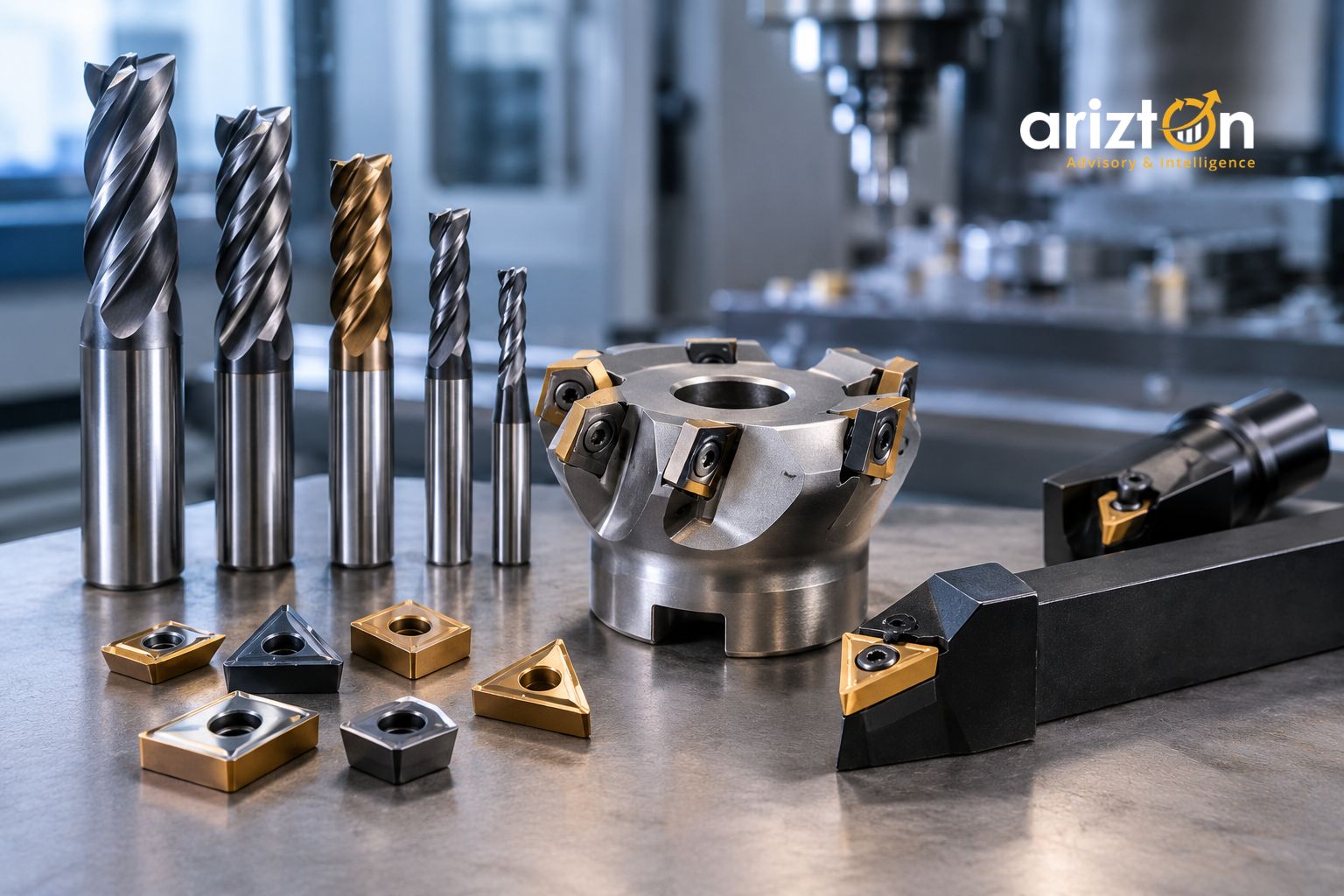
Arizton’s latest research estimates that the global cutting tools market is projected to grow from USD 10.50 billion in 2025 to USD 15.45 billion by 2031 as manufacturers invest in CNC machining, automation, high-speed production, and tooling designed for harder materials.
Cutting tools are becoming more closely tied to manufacturing productivity. As production lines become more automated, manufacturers are looking beyond the basic ability of a tool to cut material. Tool life, machining speed, dimensional accuracy, surface quality, and downtime are increasingly influencing tooling decisions.
The global cutting tools market is expected to grow at a 6.65% CAGR between 2025 and 2031, with shipment volume projected to reach 1.65 billion units by 2031.
View Report: https://www.arizton.com/market-reports/cutting-tools-market
Cutting Tools Are Becoming a Productivity Priority
One of the clearest signs of this shift is the growing use of indexable cutting tools. The segment accounted for around 55% of the market in 2025.
The appeal is straightforward: manufacturers can replace worn inserts without replacing the complete tool body. This helps reduce tool-change time and downtime while allowing different insert grades and geometries to be used for different machining requirements.
Product development is moving in the same direction. In 2026, Kennametal introduced its FIX8 heavy-duty turning system, while Seco Tools introduced the X-Tip Drill with exchangeable carbide tips.
Both developments reflect a broader move toward tooling that can deliver greater flexibility and utilization in production environments.
For Split on Groovers / Milling / Drills numbers : https://www.arizton.com/customize-report/5222
Faster Machines Are Changing Tool Requirements
The push for shorter machining cycles is also changing the requirements placed on cutting tools.
High-speed and high-feed machining are being adopted to improve machine utilization and increase material-removal rates. Seco Tools' High Feed SP07 is designed around this requirement, using four-edge inserts and supporting high metal-removal rates at shallow depths of cut while targeting unmanned production.
The change is particularly relevant as manufacturers expand CNC machining centers, automated tool changers, and robotic machining systems. Tools used in these environments need more predictable performance because production can continue for extended periods with limited operator intervention.
Harder Materials Add Another Challenge
The materials being processed are also becoming more demanding.
Titanium alloys, nickel-based superalloys, hardened steels, stainless steel, and composites can generate high cutting forces, heat, and accelerated wear. This is creating demand for advanced carbide, coated, ceramic, CBN, and other high-performance tools.
Aerospace manufacturing provides a clear example. GE Aerospace announced a further USD 1 billion investment in its U.S. manufacturing sites and supplier base in 2026, while Aequs is developing a USD 220 million aerospace manufacturing facility in Hosur, Tamil Nadu, focused on high-value aero-engine and landing-system components and advanced superalloys such as Inconel.
As these components become more complex, the ability of cutting tools to maintain performance under demanding conditions becomes increasingly important.
Automotive Still Drives a Large Part of the Opportunity
The automotive industry accounted for the largest share of the global cutting tools market in 2025.
Automotive manufacturers and component suppliers use cutting tools across turning, milling, drilling, boring, threading, and grooving operations. The shift toward electric vehicles is also changing the types of components being machined rather than removing the need for machining.
Battery housings, motor components, reduction gears, drive shafts, aluminum structures, and other EV components continue to require precision machining.
For Automotive vs Aerospace share: reach at [email protected]
APAC Remains the Largest Manufacturing Base
APAC accounted for around 36% of the global cutting tools market in 2025, supported by its concentration of automotive, electronics, semiconductor, aerospace, machinery, and general manufacturing activity.
China, Japan, South Korea, Taiwan, and India remain important machining and production centers. Manufacturing expansion and supply-chain diversification across India and Southeast Asia are further strengthening the region's industrial base.
The region's semiconductor manufacturing ecosystem is another important demand source, with PwC estimating that about 69% of global semiconductor-equipment spending accumulated during 2024–2030 is concentrated in APAC.
The Competition Is Shifting
The cutting tools market remains moderately concentrated, with the top five companies accounting for approximately 29.5% of global market revenue in 2025.
Competition is increasingly centered on tool life, machining speed, material compatibility, precision, customization, availability, and total cost of ownership.
Key companies include Sandvik, Kennametal, IMC/ISCAR, Mitsubishi Materials, Kyocera, Sumitomo Electric, Seco Tools, Walter, OSG, Ceratizit, Tungaloy, MAPAL, Gühring, and YG-1.
The market's direction is therefore becoming less about simply supplying more cutting tools and more about helping manufacturers machine faster, run longer, reduce downtime, and handle increasingly demanding materials.
Looking to understand where cutting-tool demand is expanding and which technologies are shaping purchasing decisions?
Explore the report structure, key trends, market segments, competitive landscape, and growth opportunities covered in Arizton’s Global Cutting Tools Market report.
View: https://www.arizton.com/market-reports/cutting-tools-market
Contact Us
Mail: [email protected]
Contact Us: https://www.arizton.com/contact-us
Website: https://www.arizton.com/
Call: +1 312-680-2940
Source: Arizton Advisory & Intelligence