How IoT Sensors and AI Are Turning Passive Safety Gear into Predictive Protection
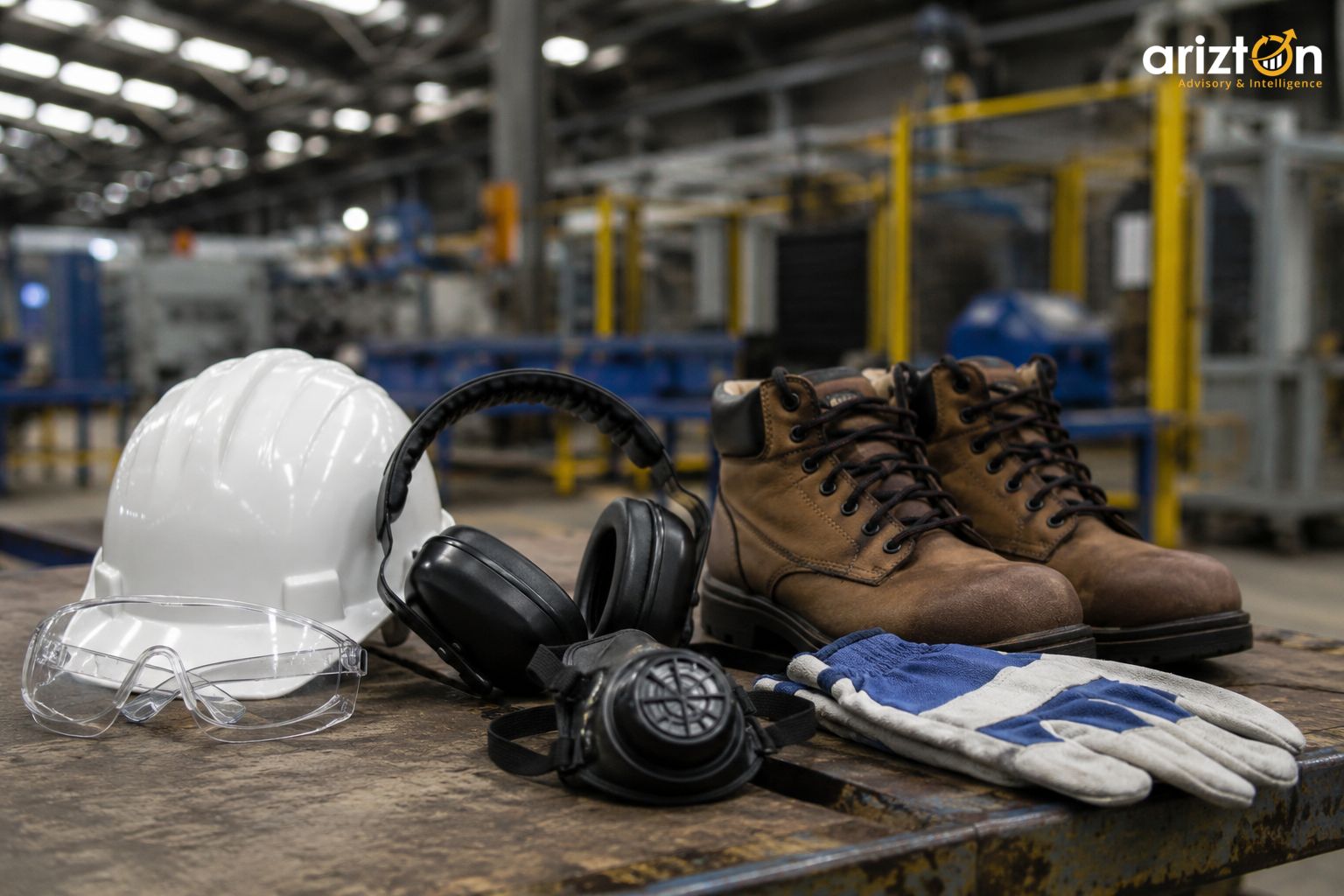
The personal protective equipment market is undergoing a structural transformation. What was once a straightforward procurement category — gloves, helmets, respirators — has evolved into a sophisticated, technology-driven industry shaped by AI-integrated safety gear, post-pandemic healthcare mandates, chemical industry expansion, and increasingly stringent regulatory enforcement across every major economy. Understanding the PPE market today means understanding the forces reshaping how enterprises protect their most valuable asset: their people.
How Big Is the Global PPE Market?
The short answer: larger than most industries assume — and accelerating.
The global personal protective equipment (PPE) market was valued at USD 23.40 billion in 2025 and is projected to reach USD 34.22 billion by 2031, growing at a compound annual growth rate (CAGR) of 6.54%. This is not marginal growth. It reflects a fundamental shift in how governments, healthcare systems, and industrial enterprises treat worker protection — not as an optional ethical consideration, but as a mandatory legal and operational obligation.
The market spans a wide range of product categories: disposable and reusable PPE, hand and body protection, respiratory equipment, eye and face protection, and — increasingly — smart, sensor-integrated safety systems. Among all these, disposable PPE leads with approximately 64% market share, underscoring the dominance of hygiene-critical industries like healthcare, pharmaceuticals, and food processing.
Geographically, North America commands over 36% of the global PPE market share. The Asia-Pacific region, while smaller in absolute terms today, is growing fastest — driven by the industrial expansion of China, India, Indonesia, and Vietnam. Europe maintains strong demand through REACH and EU OHS compliance mandates.
Know More: https://www.arizton.com/market-reports/personal-protective-equipment-market
What Is Driving Growth in the Personal Protective Equipment Market?
Several converging forces are pushing the PPE market beyond its historical baseline.
The most powerful structural driver is regulatory pressure. Governments across North America, Europe, and increasingly Asia-Pacific are tightening occupational health and safety laws, requiring employers to provide certified PPE, monitor workplace hazards, and demonstrate compliance with evolving standards. This reframes PPE procurement from a discretionary safety budget line into a permanent operational expenditure — one with legal and financial consequences for non-compliance.
Healthcare demand is a second major catalyst. COVID-19 permanently altered hospital protocols. Many medical centers have implemented standing requirements for masks and regular glove replacement during all patient contact, well beyond respiratory-case-only applications. The backlog of elective surgeries postponed during the pandemic has since generated a sharp rebound in surgical activity, directly boosting demand for premium surgical gowns and specialized gloves.
- Regulatory compliance mandates: PPE procurement is now a legal obligation, not a seasonal expense.
- Healthcare sector baseline demand: hospitals now maintain permanent high-volume PPE supply chains.
- Chemical industry expansion: specialty chemical manufacturing and battery production are driving fastest-growing segment growth at 6.78% CAGR.
What Is the PPE Procurement Strategy for Large Enterprises?
For enterprise procurement teams, the PPE supply landscape has changed materially since 2020. The most competitive buyers are no longer simply selecting the lowest-cost vendor — they are building multi-tier supply chains with certified manufacturers, implementing smart inventory systems, and aligning PPE procurement with ESG and compliance reporting frameworks.
A strategic PPE bulk purchasing approach should account for three dimensions: certification compliance (OSHA, REACH, EN ISO standards), supply chain resilience (raw material control, regional warehousing, supplier financial stability), and total cost of ownership over product lifecycle — not just unit price.
Leading manufacturers are vertically integrating in response to these enterprise demands. Major players are acquiring rubber plantations and chemical plants to control raw material pricing and protect against global shortage-driven cost spikes. For buyers, this means negotiating long-term agreements with suppliers that have demonstrable upstream control is a strategic advantage, not just a procurement preference.
Key Insight: The growing distribution of counterfeit PPE is one of the most significant risks in enterprise procurement. Fake PPE provides no genuine protection while creating a dangerous false sense of security — and exposes organizations to substantial legal liability and financial penalties. Procurement teams must verify supplier certification credentials rigorously and purchase only from auditable, compliant sources.
What Are the PPE Requirements for Healthcare Workers in 2026?
Healthcare PPE requirements have been permanently elevated. The COVID-19 pandemic fundamentally shifted medical procurement away from cost-cutting toward emergency readiness, rigorous hygiene standards, and robust supply chain redundancy.
In 2026, standard protocols at leading medical institutions require mask use and glove replacement for all patient-contact scenarios, not just infectious disease or respiratory wards. The rebound in elective surgeries has created sustained demand for premium surgical gowns, sterile gloves, and face shields. Cold storage expansion — driven by the growing global trade of temperature-sensitive goods like vaccines — has also increased demand for specialized protective clothing rated for freezing environments.
- Disposable PPE remains the gold standard in healthcare: single-use equipment breaks the chain of infection transmission more reliably than any reusable alternative.
- Hospital PPE supply chains have moved from emergency procurement to permanent baseline inventory management.
- The medical PPE supply chain increasingly prioritizes certified, traceable sourcing as regulatory scrutiny of counterfeit products intensifies.
What Is the Best PPE for Hand Protection? A Buyer's Guide
Hand protection is the single largest segment in the global PPE market, commanding the dominant share of protection-category revenue in 2025. This reflects the breadth of industries where hand hazards exist: semiconductor cleanrooms, chemical processing, construction, food manufacturing, oil and gas, and healthcare all generate significant demand for purpose-specific glove formulations.
When evaluating industrial safety gloves, procurement buyers should assess: cut resistance rating (EN ISO 21420, ANSI ISEA 105 standard tiers), chemical permeation resistance and breakthrough time for specific substances (EN 374), grip and dexterity requirements for the task, and material compatibility with the operating environment (latex, nitrile, neoprene, cut-resistant fiber blends).
In January 2026, Ansell Ltd introduced the TouchNTuff 93-800 — a single-use glove engineered to provide a minimum of 15 minutes of protection against acetone exposure. This launch reflects an industry-wide shift toward substance-specific performance labeling, giving procurement teams more granular protection data than generic "chemical resistant" classifications had previously allowed.
Key Insight: For semiconductor cleanrooms, food-grade low-particle nitrile gloves are mandatory. For EV battery assembly, insulating gloves rated for high-voltage exposure are a non-negotiable requirement. Cut-resistant gloves in ANSI A4–A6 range are standard for metal fabrication and glass handling. The right glove is task-specific — a procurement strategy that standardizes on a single glove type across facilities will create compliance gaps.
What Is the Best PPE for Chemical Protection?
Chemical protection is the fastest-growing application segment in the global PPE market, projected to expand at a CAGR of 6.78% through 2031. The drivers are clear: specialty chemical manufacturing is scaling, battery component production involves volatile chemical reactions, and regulatory frameworks like REACH and OSHA now require PPE to meet specific chemical resistance standards for thousands of individual substances.
Selecting chemical-resistant PPE requires moving beyond generic "chemical resistance" claims to substance-specific permeation data. Acetone, aromatic solvents, acid solutions, and battery electrolytes each interact differently with glove and garment materials — a product rated for one chemical class may offer minimal protection against another. Enterprises should maintain substance-specific PPE selection matrices aligned to their chemical inventory and compliance obligations.
In March 2026, DuPont introduced a new specialized disposable garment engineered for cleanrooms, containment operations, and high-hazard industrial environments — reflecting the growing demand for protection solutions that combine disposability with high-performance chemical barrier properties.
- Chemical Protection PPE CAGR: 6.78% (2025–2031) — fastest-growing application segment.
- REACH and OSHA mandate substance-specific chemical resistance ratings for PPE used in regulated industries.
- Battery component and high-performance plastics manufacturing is generating new demand for advanced chemical protective equipment.
Conclusion: A Market at the Center of the Global Safety Imperative
The PPE market is no longer a commodity procurement category. It is the safety infrastructure of the industrial economy — increasingly intelligent, increasingly regulated, and increasingly central to how enterprises manage legal compliance, ESG commitments, and workforce protection obligations simultaneously. Whether measured by its USD 23.40 billion present valuation, its USD 34.22 billion trajectory, or its role in protecting workers from chemical exposure, electrical hazards, infectious disease, and physical harm, the personal protective equipment market has become indispensable.
The challenges are real: counterfeit products eroding market trust, supply chain fragility exposed by geopolitical volatility, and the transition costs of moving toward sustainable materials. But the direction of the market is clear. Enterprises that build intelligent, certified, compliant PPE supply chains today are positioning themselves ahead of regulatory tightening, ESG scrutiny, and the technological shift toward smart safety ecosystems that will define industrial operations through the next decade.