Who Are the Top Industrial Laser Providers and Which Machines Lead the US Market?
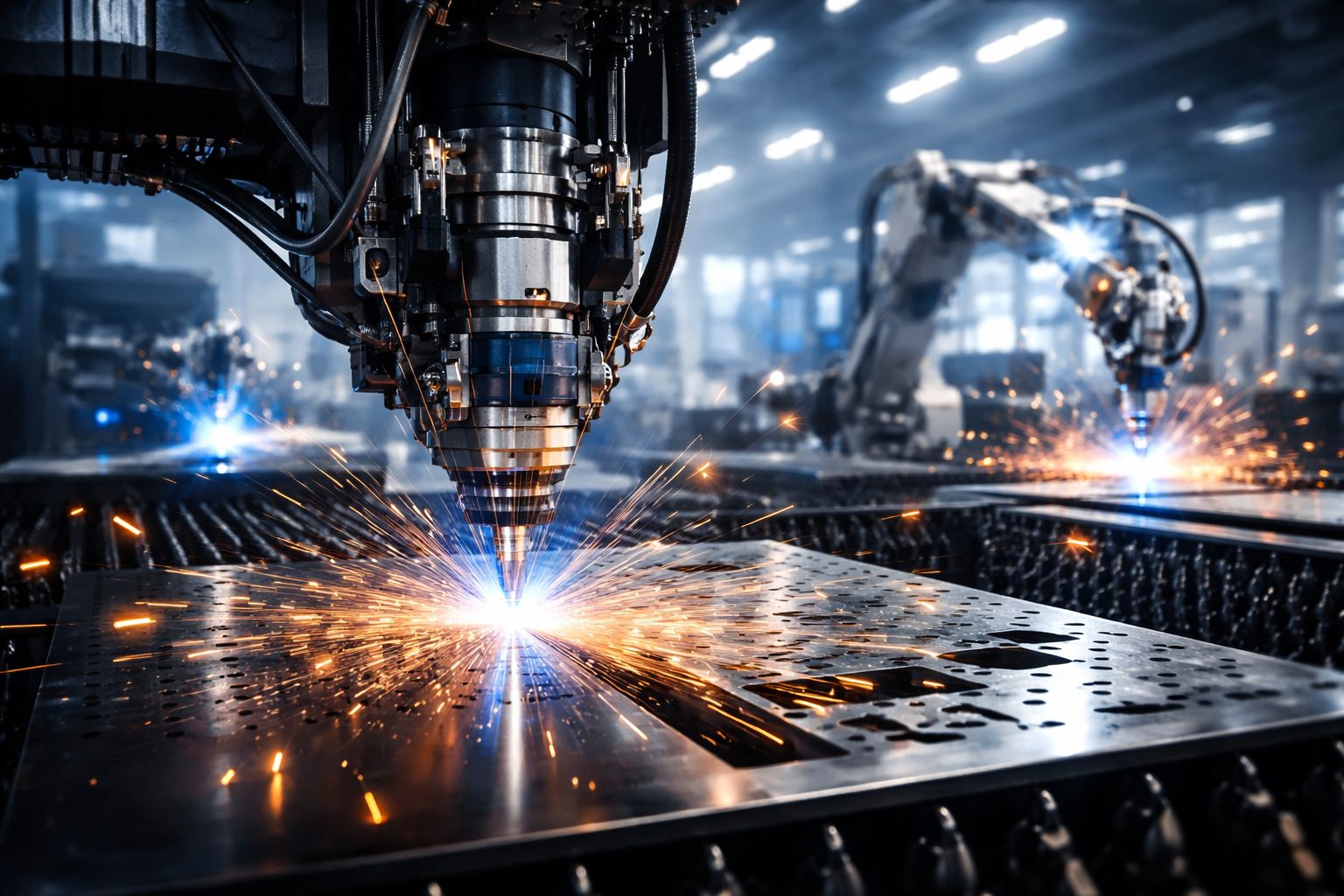
The industrial laser market is undergoing a quiet but consequential transformation. What was once a precision-manufacturing niche — dominated by a handful of German and Japanese OEMs — has expanded into a foundational layer of modern production. Fiber lasers cut car doors. Blue diode lasers weld EV battery tabs. Ultrafast lasers dice semiconductor wafers at sub-micron tolerances. The same technology thread runs through all of it, and the market behind it is growing fast. This guide answers the questions buyers, analysts, and engineers are asking most, from market size to machine costs to where to buy.
How big is the industrial laser market?
The global industrial laser market was valued at USD 7.8 billion in 2025 and is projected to reach USD 10.9 billion by 2031, growing at a CAGR of 5.80%. This is not incremental growth — it reflects a structural shift in how manufacturers approach precision, throughput, and automation. Laser-based cutting, welding, marking, and microprocessing are replacing legacy tooling across metal fabrication, electronics, and e-mobility production.
The Asia-Pacific region accounts for approximately 53% of global market share, driven by the scale of manufacturing activity across automotive, electronics, and semiconductor sectors. OICA reported 54.9 million motor vehicles produced in Asia Oceania in 2024 alone — a production base that demands industrial laser systems at every stage, from chassis cutting to powertrain component marking. Europe holds second place, with 11.4 million EU car production units in 2024 supporting steady laser adoption in cutting, welding, and precision fabrication.
India is projected to register the highest regional CAGR through 2031. The country's semiconductor ambitions are moving from policy to production — approved facilities include Tata Electronics' Dholera site targeting around 50,000 wafer starts per month. Each of these projects represents concrete laser system procurement demand for wafer processing, marking, and packaging lines.
SEMI reported that 18 new semiconductor fabs were expected to begin construction in 2025, including 15 new 300 mm facilities set to begin operating between 2026 and 2027. Projects like Texas Instruments' Sherman site and Samsung's Taylor facility are not just chipmaking milestones — they are laser system demand events, requiring precision processing, traceability marking, and automated inspection at scale.
Top industrial laser service providers
The global market is served by a concentrated group of laser source manufacturers and laser-enabled machine tool OEMs, supported by a broader ecosystem of automation, optics, and motion-control providers. Competition is increasingly shaped by software ecosystems, service coverage, and application-specific expertise — not raw laser power alone.
- TRUMPF: Global leader in laser cutting and welding systems. Expanding digital production-control, automation, and monitoring capabilities. Reported group order intake of $5.08B in FY2023/24.
- IPG Photonics: The defining name in high-power fiber laser sources. Positions energy-efficient fiber lasers around lower power consumption. Offers the LightWELD Cobot System for automated high-mix, low-volume fabrication.
- Coherent Corp.: Major supplier of lasers and photonics technologies. Strengths in flexible fiber-laser architectures for welding and joining, with exposure to cyclical industrial end markets.
- Bystronic: Swiss precision manufacturer of laser cutting and bending systems. Expanding connected factory software, automation, and workflow coordination alongside core machine hardware.
- AMADA: Japanese OEM with a broad portfolio of laser cutting, punching, and bending equipment. Strong in sheet metal fabrication with integrated automation solutions.
- Laserline GmbH: Specialist in blue diode lasers for copper-intensive joining — battery components, electrical contacts, thin foils — with particular relevance to EV manufacturing.
- Yamazaki Mazak: Announced OPTIPLEX 3015 HP / 4220 HP high-power 2D fiber laser machines in September 2025 for faster thick-plate processing. US headquarters in Florence, Kentucky.
- Bodor Laser: Cost-competitive fiber laser cutting platform. Launched the EC Series in June 2025 — an affordable sheet metal platform with shuttle tables targeting cost-sensitive fabricators.
Know More: https://www.arizton.com/market-reports/industrial-laser-market
How do industrial fiber lasers work for manufacturing?
Industrial fiber lasers generate a high-intensity beam by stimulating active ions — typically ytterbium — embedded in a doped optical fiber, using pump diodes as the energy source. The fiber itself serves as both the gain medium and the delivery path. The laser beam exits directly from the fiber end, producing a high-quality, tightly focused output with excellent beam consistency.
In a manufacturing environment, this beam is directed through a cutting or welding head fitted with focusing optics. The concentrated energy density at the focal point melts, vaporizes, or ablates material with precision. An assist gas — nitrogen, oxygen, or argon depending on the application — is coaxially delivered through the nozzle to eject molten material, protect the lens, and influence cut-edge chemistry.
Medium-power systems ranging from 1 to 6 kW anchor mainstream industrial deployment. They cover the widest range of cutting and welding tasks in high-mix production environments where speed, output quality, and program flexibility all matter. In laser welding, many applications operate at 2 to 3 kW, producing deep seams with controlled heat distortion and cycle-time alignment within production cells.
Fiber lasers are automation-compatible by design. Beam delivery via flexible fiber cable allows robotic heads to move freely through six-axis motion paths without free-space optical alignment. This makes fiber the natural platform for cobot and robotic welding cells — and a core reason FANUC and IPG Photonics both position fiber-based robotic systems around adaptability and weld quality in high-mix environments.
Where to buy industrial-grade CO₂ lasers for engraving in the US
CO₂ lasers hold approximately 21% of the broader industrial laser market and remain the technology of choice for processing non-metal materials — plastics, acrylic, wood, leather, textiles, paper, rubber, and glass. Their long wavelength (10.6 µm) produces strong absorption in these substrates, enabling efficient cutting, engraving, and surface marking that fiber lasers at near-infrared wavelengths cannot match.
- Trotec Laser (US offices)
Austrian brand widely considered the industry benchmark for CO₂ engraving and cutting. Sells direct with a US service and support network. Strong in signage, awards, and light industrial fabrication.
- Epilog Laser — Golden, Colorado
Colorado-based manufacturer of CO₂ and fiber laser engravers. Available direct and through authorized US resellers. Popular across small manufacturers, sign shops, and educational institutions.
- Universal Laser Systems — Scottsdale, Arizona
Arizona-based OEM offering modular CO₂ and fiber systems. Used in industrial manufacturing, research, and government environments. Notable for upgrade-path modularity.
- Boss Laser — Sanford, Florida
Florida-based seller of affordable CO₂ laser cutters and engravers. Strong among small fabricators, makerspaces, and first-time buyers.
For production-line CO₂ applications — high-speed marking on packaging lines, OEM integration — also evaluate SYNRAD (a Novanta brand) and Coherent's RF-excited CO₂ laser sources. These are built for industrial duty cycles where consumer-grade engravers are not a fit.
Best industrial laser machines for metal cutting in the US
For US buyers, the most relevant considerations are power range, domestic service network, software ecosystem, and total cost of ownership. The medium-power band of 1 to 6 kW covers the broadest range of commercial sheet metal applications. Higher-power systems above 10 kW are increasingly relevant for thick structural sections in heavy fabrication, automotive, and energy applications.
TRUMPF TruLaser 5030 Direct + US service network
- 3 – 15 kW · High-mix precision sheet metal
- Industry benchmark for precision 2D cutting. Full automation integration and the broadest service coverage of any laser OEM in the US market.
Bystronic ByStar Fiber Direct + US service network
- 3 – 30 kW · Smart factory integration
- Best for facilities prioritizing connected production workflows. Strong software layer for machine utilization monitoring and automation coordination.
AMADA ENSIS-AJ Direct + US service network
- 3 – 9 kW · Thin-to-thick variable material cutting
- Beam oscillation adjusts automatically for material thickness, reducing the need for nozzle and parameter changes across a mixed job queue.
Mazak OPTIPLEX 3015 HP US HQ — Florence, KY
- Up to 30 kW · High-throughput thick-plate cutting
- Purpose-built for heavy-section productivity. Strong fit for fabricators cutting structural steel, heavy plate, and large-format components at volume.
Bodor EC Series US distributor network
- 3 – 12 kW · Cost-sensitive fabrication shops
- Most affordable entry into the fiber cutting segment without sacrificing core throughput. Shuttle table design supports continuous loading in high-volume environments.
For tube and structural applications in the US — increasingly relevant in automotive chassis and renewable energy structures — also evaluate BLM Group's LT7 and Mazak's OPTIPLEX 4220 HP. Metal fabrication customers adopt laser cutting specifically because software-based programs handle diverse part mixes without tooling changes, enabling faster changeovers and higher utilization than legacy punching or waterjet alternatives.
Comparing laser types for welding applications
Selecting the right laser type for welding is not primarily a question of brand — it is a question of wavelength and material interaction. The physics of how different wavelengths are absorbed by different metals drives the choice more than any other factor. This is especially visible in copper processing, where the material's high reflectivity at infrared wavelengths can lead to inconsistent energy coupling and weld defects — a known limitation of standard fiber lasers that has opened the door for visible-wavelength alternatives.
Fiber laser (infrared)
- Strengths: High power, automation-compatible via fiber cable, excellent for steel and aluminum, low operating cost per kW.
- Limitations: Poor absorption in copper — high reflectivity causes inconsistent energy coupling and weld defects.
CO₂ laser
- Strengths: Polymer welding, sealing, and non-metal joining applications where other laser types are ineffective.
- Limitations: Not suited for most metals; mirror-based beam delivery limits robotic integration versus fiber-delivered systems.
The EV manufacturing sector is the clearest illustration of how wavelength selection has become a strategic decision. Laserline highlights that blue diode lasers are especially effective for electrical contacts, battery components, and thin sheets or foils — exactly the materials at the core of EV battery and power electronics manufacturing. As copper usage rises across electrified systems, manufacturers seeking consistent weld quality are increasingly evaluating visible-wavelength platforms alongside conventional fiber.
Global EV battery demand exceeded 750 GWh in 2023. US battery manufacturing capacity reached more than 200 GWh in 2024, with nearly 700 GWh under construction. Every gigawatt-hour of that capacity represents production equipment procurement — and laser welding systems are central to battery cell tab welding, busbar joining, electrode cutting, case sealing, and e-motor hairpin stripping.
Conclusion: From Precision Tool to Manufacturing Backbone
The industrial laser market is evolving into a core enabler of modern manufacturing, driven by precision, automation, and scalability demands across industries. Growth is no longer incremental but structural, fueled by EVs, semiconductors, and advanced fabrication needs. As technology advances, differentiation will hinge on application expertise, software integration, and service ecosystems. Ultimately, lasers are not just tools—they are becoming foundational to next-generation production systems.