What Is Driving the Growth of the Global Power Tools Market Through 2031?
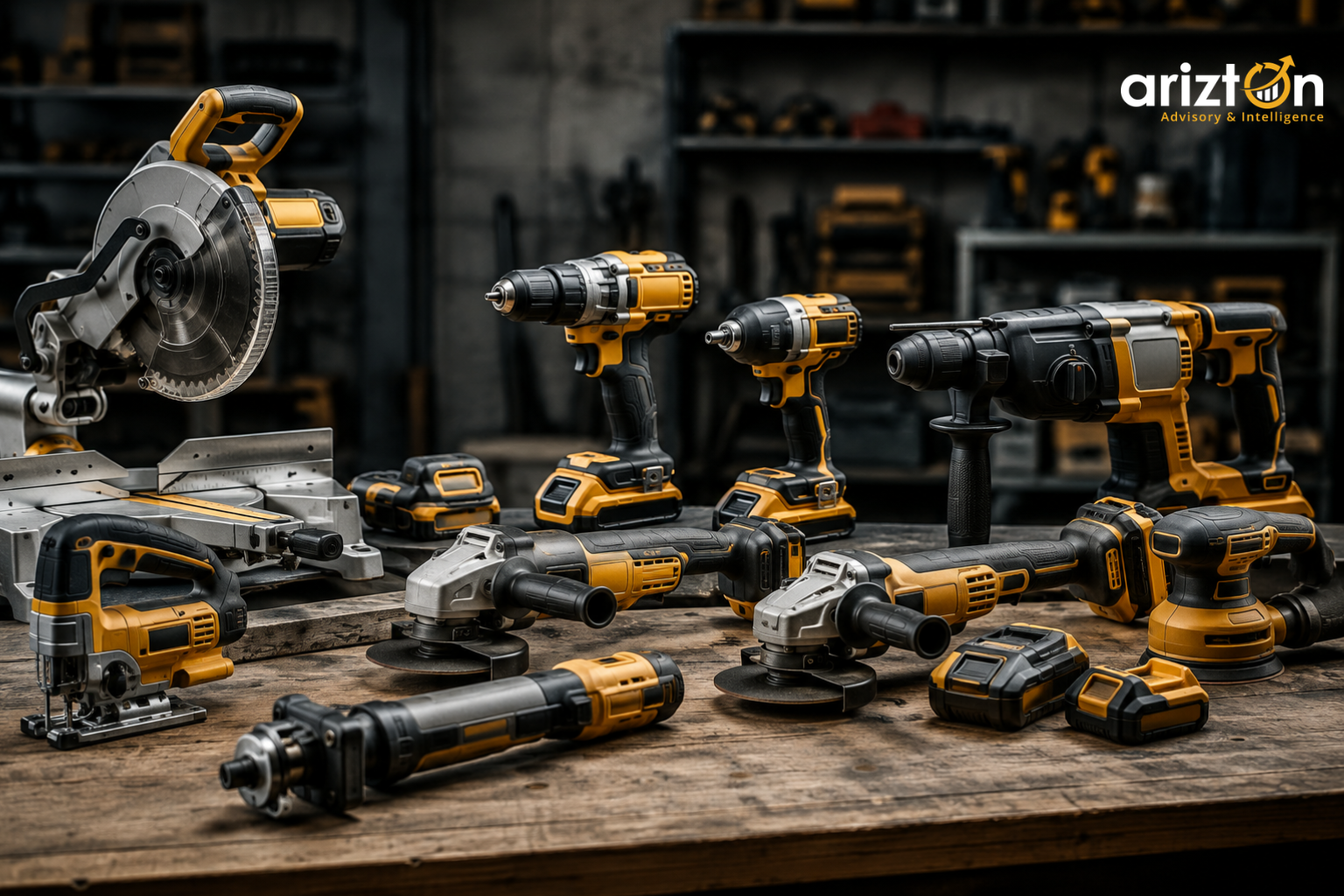
If you have stepped onto a job site, visited an automotive assembly plant, or spent a Saturday working on a home renovation project recently, you’ve likely noticed a distinct quietness replacing the traditional roar of heavy equipment. The tangled web of extension cords, heavy air hoses, and bulky gasoline generators is rapidly disappearing. In their place? Sleek, ultra-efficient battery systems and connected smart tools.
The global power tools market is experiencing a massive evolution. Valued at USD 46.84 billion in 2025, the market is projected to reach USD 67.80 billion by 2031, expanding at a compound annual growth rate (CAGR) of 6.36%.
Whether in heavy industrial construction or precision woodworking, power tools are no longer just mechanical muscle they are sophisticated, data-driven productivity platforms.
How is the cordless and brushless revolution transforming the power tools market?
The transition from corded and pneumatic tools to cordless, battery-powered systems represents the single largest shift in modern job-site equipment. Driven by rapid advancements in lithium-ion technology and brushless motors, today's cordless tools match and often exceed the power output of their traditional corded predecessors.
- Unified Battery Ecosystems: Major manufacturers have shifted toward shared battery platforms. Contractors no longer need separate chargers and power sources for every tool; a single high-capacity battery pack can power everything from an impact driver to a heavy-duty demolition hammer.
- The Brushless Advantage: Brushless motors reduce internal friction and heat build-up. This yields higher torque, longer runtimes per charge, and significantly reduced maintenance costs over the tool's lifecycle.
- Mobility and Job-Site Safety: Eliminating trailing cables and air lines significantly lowers trip hazards and gives operators unrestricted movement across scaffolding, high-rises, and remote job sites.
To Know more:
https://www.arizton.com/market-reports/power-tools-market
What is driving the adoption of smart tools and connected job sites?
Digitalization is officially making its mark on power tools. Through Bluetooth, RFID, and IoT integration, tools are transforming into connected nodes within broader fleet management systems.
Industry Snapshot: Fleet management platforms such as Milwaukee’s ONE-KEY, Hilti’s ON!Track, and the Bosch Professional Toolbox App allow site managers to track equipment location in real time, monitor tool utilization, check battery health, and automate preventive maintenance schedules before a breakdown stalls production.
This shift toward smart asset management helps construction firms and industrial facilities curb equipment loss, lower operational downtime, and track total cost of ownership with pinpoint accuracy.
What are the key market drivers, from woodworking to electric vehicles?
Two major industrial sectors are accelerating the demand for precision power tools worldwide:
- Custom Woodworking and Home Improvement: The surge in demand for custom furniture, modular cabinetry, and high-end interior finishing has boosted reliance on precision cordless tools. Equipment like circular saws, routers, orbital sanders, and planers are vital for maintaining rapid turnaround times without sacrificing finish quality.
- Automotive & EV Manufacturing: As global auto giants transition toward electric vehicle (EV) production, high-volume assembly lines require advanced, programmable fastening systems. Cordless impact wrenches, precision nutrunners, and torque-controlled assembly tools ensure stringent safety standards and uniform quality across complex battery and drivetrain installations.
How is the market segmented at a glance?
- By Operation: Cutting tools including circular saws, angle grinders, and band saws accounted for the largest market share at 47% in 2025, driven by extensive fabrication, demolition, and raw material processing requirements.
- By Power Source: The battery-powered (cordless) segment is leading the charge as the fastest-growing category, expanding at a 6.95% CAGR.
- By End-User Industry: The industrial sector remains the dominant force overall, with the energy sector (spanning wind farms, solar plants, and oil & gas facilities) standing out as a primary consumer of heavy-duty, high-performance tools.
- By Distribution Channel: Offline channels including authorized equipment dealers, specialty tool supply houses, and commercial distributors continue to hold the top spot. Professional buyers strongly lean on hands-on product demonstrations, immediate tool availability, and dedicated repair or warranty services.
What are the regional dynamics of the market?
- Asia-Pacific (APAC): Dominates the global landscape with approximately 36% of total market share. Driven by rapid urbanization, massive infrastructure expansion, and mega-manufacturing hubs in China, India, Japan, and South Korea, APAC stands as both the largest and fastest-growing region.
- North America: Holds a substantial market share backed by strong residential remodeling trends, commercial infrastructure growth, and early adoption of smart, connected job-site solutions.
- Europe: Driven by strict workplace safety regulations, sustainable construction initiatives, and high demand for energy-efficient equipment across manufacturing powerhouses like Germany, the UK, and France.
How is the competitive landscape evolving?
The global marketplace is highly fragmented yet anchored by well-known industry leaders including Stanley Black & Decker (DeWalt, Craftsman), Bosch, Makita, and Hilti, alongside TTI (Milwaukee Tool). While regional manufacturers frequently enter the market with cost-competitive alternatives, global brands maintain their edge by offering unified battery platforms, superior tool durability, extensive warranty networks, and integrated software solutions.