

Global Power Tools Market Growth Insights - Powered & Cordless Tools, Advancements in Power Tool Technologies, and Increasing Demand for High-Performance Drilling, Cutting, Grinding, and Material Processing Equipment (2026–2031)
To Be Published : October 2026
Last Updated : October 2026
format: PDF
edition : Second Edition

271 pages

55 company

7 segments

5 region

29 countries
Purchase Options
Global Power Tools Market Research Report 2026-2031
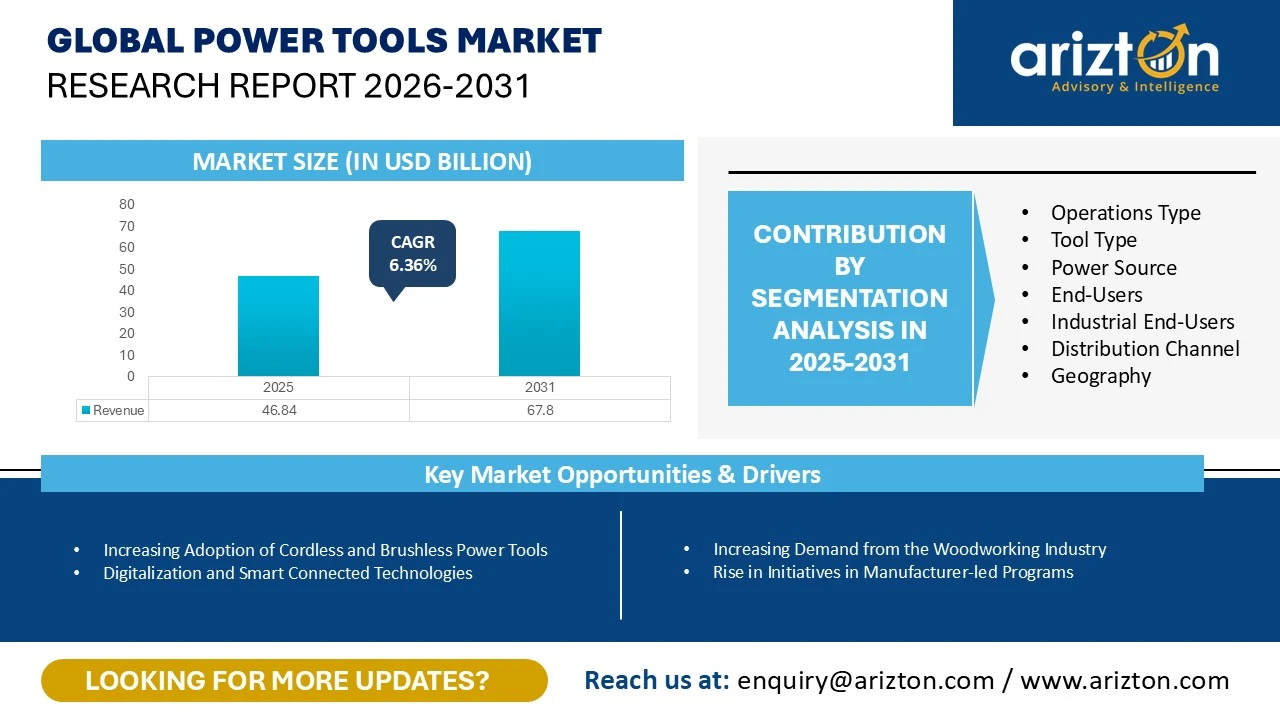
THE GLOBAL POWER TOOLS MARKET WAS VALUED AT USD 46.84 BILLION IN 2025 AND IS EXPECTED TO REACH USD 67.80 BILLION BY 2031, GROWING AT A CAGR OF 6.36% FROM 2025 TO 2031.
The Power Tools Market Size, Share & Trends Analysis Report By
- Operations Type: Cutting, Drilling, Fastening, Routing and planning, and Others
- Tool Type: Drilling And Fastening Tools, Cutting Tools, Grinding and Sanding Tools, Polishing Tools, Shaping and Routing Tools, Pneumatic Tools, Power Screwdrivers, Impact and Demolition Tools, Measuring and Layout Tools, and Others
- Power Source: Battery-Powered, Electric-Powered, and Others
- End-Users: Industrial, Commercial, and Residential
- Industrial End-Users: Energy, Construction, Aerospace, Automotive, Electronics, Shipbuilding, and Others
- Distribution Channel: Offline and Online
- Geography: North America, Europe, APAC, Latin America, and Middle East & Africa
Industry Analysis Report, Regional Outlook, Growth Potential, Price Trends, Competitive Market Share & Forecast 2026–2031.
This report includes market data points, ranging from trend
analyses to market estimates & forecasts that you can customize
POWER TOOLS MARKET REPORT SCOPE
| REPORT ATTRIBUTE | DETAILS |
|---|---|
| MARKET SIZE (2031) | USD 67.80 Billion |
| MARKET SIZE (2025) | USD 46.84 Billion |
| CAGR (2025-2031) | 6.36% |
| HISTORIC YEAR | 2022- 2024 |
| BASE YEAR | 2025 |
| FORECAST YEAR | 2026-2031 |
| SEGMENTS BY | Operations Type, Tool Type, Power Source, End-Users, Industrial End-Users, Distribution Channel, and Geography |
| GEOGRAPHIC ANALYSIS | North America, Europe, APAC, Latin America, and Middle East & Africa |
| KEY PLAYERS | Stanley Black & Decker, Inc., Techtronic Industries Co. Ltd. (TTI), Bosch Power Tools, Makita Corporation, Hilti Corporation, Snap-on Incorporated, Apex Tool Group, Koki Holdings Co., Ltd. (HiKOKI), Positec Group, and Festool GmbH |
POWER TOOLS MARKET SIZE & SHARE
The global power tools market size was valued at USD 46.84 billion in 2025 and is expected to reach USD 67.80 billion by 2031, growing at a CAGR of 6.36% during the forecast period. The market is a vital segment of the broader industrial equipment and construction tools industry. It comprises electrically powered, battery-powered, pneumatic, hydraulic, and other mechanically driven tools designed to perform drilling, fastening, cutting, grinding, sanding, polishing, demolition, routing, and material processing operations with greater speed, precision, and efficiency than conventional hand tools.
Power tools are extensively used across construction, manufacturing, automotive, aerospace, metalworking, woodworking, shipbuilding, mining, energy, maintenance and repair (MRO), and residential DIY applications. The market also includes complementary accessories such as batteries, chargers, drill bits, saw blades, grinding discs, abrasives, and cutting attachments that enhance productivity and operational flexibility.
Applications of Power Tools
Power tools are used across a wide range of industrial, commercial, and residential applications where productivity, precision, and operational efficiency are essential.
- Construction & Infrastructure: Power tools are extensively used for drilling, fastening, concrete demolition, cutting, grinding, and finishing operations in residential, commercial, and infrastructure development projects.
- Manufacturing & Industrial Production: Manufacturers utilize power tools for assembly, machining, fabrication, maintenance, and production line operations to improve efficiency and maintain product quality.
- Automotive & Aerospace: Precision fastening systems, impact tools, grinders, and cutting equipment are widely employed in vehicle manufacturing, aircraft assembly, maintenance, and repair operations.
- Energy, Shipbuilding & Heavy Industries: Industrial-grade power tools support installation, maintenance, inspection, welding preparation, and structural fabrication activities across power plants, oil & gas facilities, renewable energy projects, and shipyards.
- Residential & DIY: Growing consumer interest in home renovation, furniture assembly, woodworking, gardening, and repair activities continues to increase demand for cordless drills, saws, multi-tools, and other user-friendly power tools.
As industries continue prioritizing automation, mobility, operational efficiency, and digital connectivity, the Global Power Tools Market is expected to play an increasingly important role in supporting construction, manufacturing, infrastructure modernization, and residential improvement activities worldwide. Continuous innovations in cordless technology, smart tool management, battery platforms, and connected job-site solutions are expected to further strengthen market growth throughout the forecast period.
POWER TOOLS MARKET TRENDS
Increasing Adoption of Cordless and Brushless Power Tools
The global power tools market is undergoing a rapid transition from corded and pneumatic equipment to cordless battery-powered systems, driven by continuous advancements in lithium-ion battery technology, brushless motors, fast-charging capabilities, and high-performance battery platforms. Modern cordless tools now deliver power levels comparable to corded equipment while offering greater mobility, lower maintenance requirements, and improved operator safety. As construction sites, manufacturing facilities, and maintenance operations increasingly prioritize productivity and flexibility, cordless platforms have become the preferred choice for professional users.
- Expansion of High-Performance Battery Platforms: Manufacturers continue introducing higher-capacity battery systems capable of supporting heavy-duty applications without compromising runtime.
- Growing Adoption in Professional Construction: Contractors increasingly prefer cordless drills, rotary hammers, impact drivers, grinders, and demolition tools that eliminate cable restrictions and improve job-site efficiency.
- Improved Battery Compatibility: Unified battery ecosystems enable users to operate multiple tools using a single battery platform, reducing equipment costs and simplifying fleet management.
- Advancements in Brushless Motor Technology: Brushless motors improve efficiency, increase tool lifespan, reduce maintenance requirements, and deliver higher torque.
- Growing Penetration in Emerging Markets: Rapid urbanization, industrialization, and infrastructure investments are accelerating cordless tool adoption across developing economies.
Digitalization and Smart Connected Technologies in the Global Power Tools Market
Digital transformation is reshaping the power tools industry as manufacturers increasingly integrate Bluetooth, RFID, NFC, cloud connectivity, IoT platforms, and digital fleet management capabilities into professional equipment. Connected tools enable contractors and industrial users to monitor tool location, battery health, equipment utilization, service schedules, and maintenance requirements in real time, improving productivity while minimizing operational downtime and equipment loss.
- Milwaukee enhanced its ONE-KEY platform with advanced inventory management and equipment diagnostics.
- Hilti expanded ON! Track with AI-enabled maintenance scheduling and utilization analytics.
- Bosch Professional upgraded its Toolbox App with battery diagnostics and operating condition monitoring for connected power tools.
POWER TOOLS MARKET ENABLERS
Increasing Demand from the Woodworking Industry
The woodworking industry continues to be a major growth enabler for the global power tools market due to rising demand for furniture manufacturing, customized interiors, modular kitchens, cabinetry, flooring, and residential renovation projects. Growing urbanization, increasing housing construction, and higher consumer spending on home improvement have significantly increased the need for precision woodworking equipment. Manufacturers are increasingly adopting advanced power tools to improve productivity, reduce production time, and achieve superior finishing quality.
Examples:
- Manufacturers increasingly utilize cordless circular saws, routers, planers, orbital sanders, jigsaws, and nail guns to improve production efficiency.
- The growing popularity of customized furniture and modular kitchens is increasing demand for professional woodworking power tools.
- Bosch, Makita, Stanley Black & Decker (DEWALT), Milwaukee Tool, and Festool continue expanding professional woodworking product portfolios.
Rising Automotive and Industrial Manufacturing Activities
Growing investments in automotive manufacturing, industrial production, aerospace, electronics, and heavy engineering are significantly increasing demand for professional power tools. Modern manufacturing facilities require precision fastening, drilling, grinding, polishing, cutting, and assembly tools capable of supporting high-volume production while maintaining operational efficiency and product quality. The expansion of electric vehicle production and smart manufacturing facilities is further accelerating the adoption of advanced cordless and connected power tools.
Examples:
- Electric vehicle manufacturers including Tesla, BYD, Hyundai, and Volkswagen continue expanding production facilities, increasing demand for programmable fastening systems and precision assembly tools.
- Automotive manufacturers increasingly utilize cordless impact wrenches, nutrunners, torque tools, grinders, and polishing equipment to improve manufacturing efficiency.
- Aerospace and electronics manufacturers continue adopting lightweight, high-precision cordless tools for assembly and maintenance operations.
POWER TOOLS MARKET SEGMENTATION INSIGHTS
INSIGHTS BY OPERATIONS TYPE
The global power tools market by operations type is segmented into cutting, drilling, fastening, routing and planning, and others. The cutting segment accounted for the largest market share of 47% in 2025. The segment dominates the market owing to its extensive application across construction, metal fabrication, woodworking, automotive manufacturing, shipbuilding, aerospace, and industrial processing industries. The segment's leadership is primarily attributed to the increasing demand for precision cutting, material processing, and fabrication activities that require high-speed, accurate, and efficient cutting solutions.
Power tools such as circular saws, reciprocating saws, jigsaws, band saws, angle grinders, and cut-off machines are widely used to improve productivity, reduce material wastage, and enhance operational efficiency. Furthermore, continuous advancements in cordless technology, brushless motors, and high-performance cutting accessories continue to strengthen the adoption of cutting power tools across both professional and residential applications.
INSIGHTS BY TOOL TYPE
Based on the tool type, the drilling and fastening tools segment dominates the global power tools market share due to its widespread adoption across construction, manufacturing, automotive assembly, maintenance, and residential applications. The segment's leadership is primarily attributed to the versatility and extensive use of drills, impact drivers, rotary hammers, screwdrivers, and fastening systems for drilling, anchoring, installation, and assembly operations. Increasing construction activities, infrastructure development, industrial automation, and residential renovation projects continue to strengthen demand for drilling and fastening tools worldwide, making them an indispensable part of both professional and DIY tool portfolios.
INSIGHTS BY POWER SOURCE
The battery-powered segment shows significant growth, with the fastest-growing CAGR of 6.95% during the forecast period. The segment dominates owing to continuous advancements in lithium-ion battery technology, brushless motors, and fast-charging systems. The segment's leadership is primarily attributed to the superior mobility, enhanced operator safety, reduced maintenance requirements, and greater operational flexibility offered by battery-powered tools compared with conventional electric-powered alternatives. Their widespread adoption across construction sites, manufacturing facilities, automotive assembly plants, woodworking, maintenance operations, and residential DIY applications has accelerated the transition toward cordless platforms.
Furthermore, manufacturers continue investing in high-capacity battery systems, intelligent battery management technologies, and unified battery ecosystems that allow multiple tools to operate on a single battery platform, further strengthening the growth of this segment.
INSIGHTS BY END-USERS
The industrial segment dominates the global power tools market with the largest share in 2025. The adoption of power tools across construction, manufacturing, automotive, aerospace, shipbuilding, metal fabrication, mining, and maintenance, repair, and operations (MRO) activities is helping segmental growth.
The segment's leadership is primarily attributed to increasing investments in industrial automation, smart manufacturing, infrastructure development, and production capacity expansion, which require high-performance, durable, and precision-engineered power tools.
Based on the Industrial end-users, the energy segment dominates the market share due to increasing investments in renewable energy, power generation, transmission & distribution infrastructure, and oil & gas projects. Power tools are extensively used for installation, fabrication, maintenance, drilling, fastening, cutting, and repair operations across wind farms, solar power plants, substations, refineries, and utility infrastructure, driving sustained demand for high-performance professional tools.
INSIGHTS BY DISTRIBUTION CHANNEL
The global power tools market by distribution channel is segmented into offline and online. The offline segment dominates the market share owing to the strong presence of authorized distributors, industrial equipment dealers, specialty tool retailers, and home improvement stores worldwide. The segment's leadership is primarily attributed to the preference of professional contractors, industrial buyers, and commercial customers for physical product demonstrations, technical consultation, immediate product availability, and comprehensive after-sales services, including installation support, maintenance, repairs, and warranty assistance. Well-established dealer networks and long-standing manufacturer–distributor relationships continue to reinforce the dominance of offline sales, particularly for high-value professional and industrial power tools.
POWER TOOLS MARKET GEOGRAPHICAL ANALYSIS
The APAC power tools market dominates the global market with the largest share of around 36%. The market is growing owing to rapid industrialization, expanding manufacturing activities, large-scale infrastructure development, and increasing residential and commercial construction projects across China, India, Japan, South Korea, and Southeast Asia. The region's leadership is primarily attributed to strong automotive and electronics manufacturing, rising adoption of cordless power tools, growing investments in renewable energy projects, and the presence of major manufacturing hubs, making APAC the largest and fastest-growing regional market.
The North America power tools market continues to hold a significant share of the global market, driven by robust construction activities, a well-established manufacturing sector, and high adoption of technologically advanced power tools. Increasing investments in residential renovation, commercial infrastructure, industrial automation, and electric vehicle manufacturing continue to support market growth. The region also benefits from the strong presence of leading manufacturers, widespread adoption of cordless and connected power tools, and growing demand from professional contractors and DIY consumers.
The Europe power tools market is supported by its advanced industrial base, strong automotive and aerospace industries, and increasing investments in sustainable construction and smart manufacturing. Growing demand for energy-efficient, battery-powered power tools, coupled with stringent workplace safety regulations and Industry 4.0 initiatives, continues to accelerate market adoption. In addition, increasing renovation activities and infrastructure modernization across Germany, the UK, France, Italy, and other European countries contribute to steady regional growth.
POWER TOOLS MARKET COMPETITIVE LANDSCAPE
The global power tool market is characterized by low market concentration and high competition among players. The present scenario drives vendors to alter and refine their unique value propositions to achieve a strong market presence. Currently, the market is highly fragmented and dominated by Stanley Black & Decker, Bosch, and TTI. Moreover, numerous domestic tool manufacturers produce tools in various shapes and designs that replicate products from renowned vendors. These major vendors have a global presence in three major regions, namely North America, APAC, and Europe.
Several vendors in the market offer products with similar technical specifications, such as length, width, and cutting techniques, at low prices. This is likely to intensify the price war among vendors during the forecast period. The market is prone to the threat of infiltration with low-quality products. Major vendors in the market continually compete for the leading position with occasional spurts of competition from other local vendors. The presence of diversified global and regional vendors characterizes the market. As international players expand their market footprint, regional vendors will likely find it increasingly difficult to compete with these global players. The competition will be solely based on features, such as durability, lifespan, tool performance, price, and customization.
KEY COMPETITORS
- Stanley Black & Decker remains one of the world's largest power tool manufacturers, supported by globally recognized brands including DeWalt, Stanley, Craftsman, and BLACK+DECKER. The company serves professional contractors, industrial users, and DIY consumers through a broad portfolio of cordless, corded, outdoor, and hand tools.
- Bosch is recognized for its engineering excellence and premium-quality professional power tools. The company offers one of the industry's broadest portfolios across drilling, fastening, cutting, grinding, measuring, and woodworking applications.
- Makita is a global leader in cordless power tools and is recognized for its reliable battery platforms and professional-grade equipment. The company serves construction, industrial, woodworking, and landscaping markets through an extensive portfolio of cordless and electric tools.
- Hilti specializes in premium power tools for construction, infrastructure, energy, and industrial applications. The company differentiates itself through integrated hardware, software, fleet management, and engineering services rather than competing primarily on price.
SNAPSHOT
The global power tools market size is expected to grow at a CAGR of approximately 6.36% from 2025 to 2031.
The following factors are likely to contribute to the growth of the global power tools market during the forecast period:
- Increasing Demand from the Woodworking Industry
- Rise in Initiatives in Manufacturer-led Programs
- Rise in Number of Infrastructure Development Projects
- Favourable Government Policies and Incentives
Base Year: 2025
Forecast Year: 2026-2031
The report examines the current state of the global power tools market and its market dynamics through 2026−2031. It covers a detailed overview of several market growth enablers, restraints, and trends. The study covers both the demand and supply sides of the market. It also profiles and analyses leading companies and several other prominent companies operating in the market.
Key Company Profiles
- Stanley Black & Decker, Inc.
- Business Overview
- Product Offerings
- Key Developments
- Key Strategies
- Key Strengths
- Key Opportunities
- Techtronic Industries Co. Ltd. (TTI)
- Bosch Power Tools
- Makita Corporation
- Hilti Corporation
- Snap-on Incorporated
- Apex Tool Group
- Koki Holdings Co., Ltd. (HiKOKI)
- Positec Group
- Festool GmbH
Other Prominent Company Profiles
- Chervon Holdings Limited
- Business Overview
- Product Offerings
- Milwaukee Tool
- FEIN (C. & E. FEIN GmbH)
- Ferm International B.V.
- Ryobi
- Metabo
- Kärcher (Alfred Kärcher SE & Co. KG)
- Würth Group
- Wacker Neuson Group
- Mafell AG
- Yamabiko Corporation
- Pferd.
- Aimco
- Festool
- CS Unitec, Inc.
- Dynabrade, Inc.
- Husqvarna AB
- STIHL
- Panasonic
- Kyocera Corporation
- Uryu Seisaku, LTD.
- Atlas Copco AB
- Ingersoll Rand Inc.
- Emerson Electric Co.
- Ridgid
- Craftsman
- Irwin Tools
- Porter-Cable
- Diablo Tools
- KOBALT
- Dremel
- PROXXON GmbH
- PARKSIDE
- Chicago Pneumatic
- Matco Tools Corporation
- Cornwell Quality Tools Company
- SENCO
- Paslode
- WORX
- Masterforce
- Einhell Germany AG
- Evolution Power Tools Ltd.
- JET Tools
- Baier Elektrowerkzeuge GmbH & Co. KG
- Scheppach GmbH
Segmentation by Operations Type
- Cutting
- Drilling
- Fastening
- Routing and planning
- Others
Segmentation by Tool Type
- Drilling And Fastening Tools
- Cutting Tools
- Grinding And Sanding Tools
- Polishing Tools
- Shaping And Routing Tools
- Pneumatic Tools
- Power Screwdrivers
- Impact And Demolition Tools
- Measuring And Layout Tools
- Others
Segmentation by Power Source
- Battery-Powered
- Electric-Powered
- Others
Segmentation by End-Users
- Industrial
- Commercial
- Residential
Segmentation by Industrial End Users
- Energy
- Construction
- Aerospace
- Automotive
- Electronics
- Shipbuilding
- Others
Segmentation by Distribution Channel
- Offline
- Online
Segmentation by Geography
- North America
- US
- Canada
- Europe
- Germany
- France
- Russia
- UK
- Norway
- Denmark
- Italy
- Poland
- Spain
- APAC
- China
- Japan
- India
- Australia
- South Korea
- Indonesia
- Thailand
- Vietnam
- Malaysia
- Taiwan
- Latin America
- Brazil
- Mexcio
- Agrentina
- Chile
- Colombia
- Middle East & Africa
- Saudi Arabia
- UAE
- South Africa
POWER TOOLS MARKET FAQs
What is the growth rate of the global power tools market?
How big is the global power tools market?
What are the key trends in the global power tools market?
Which region dominates the global power tools market?
Who are the major players in the global power tools market?
For more details, please reach us at [email protected]
. Scope & Coverage
- Market Definition
- Inclusions
- Exclusions
- Market Estimation Caveats
- Market Size & Forecast Periods
- Historic Period: 2022-2024
- Base Year: 2025
- Forecast Period: 2026-2031
- Market Size (2022-2031) Revenue
- Market Segments
- Market Segmentation by Tool Type
- Market Segmentation by Operations Type
- Market Segmentation by Power Source
- Market Segmentation by End User
- Market Segmentation by Industrial End User
- Market Segmentation by Distribution Channel
- Market Segmentation by Geography
2. Opportunity Pockets
3. Introduction
- Recent Developments in the Global Power Tools Industry
- Role of Power Tools in Industrial Manufacturing and Construction
- Role of Power Tools in the Global Industrial Ecosystem
- Battery Technology Advancements and Smart Connected Power Tools
- Distribution Network Overview
- Parameters Impacting Market Growth
4. Market Opportunities & Trends
- Increasing Adoption of Cordless and Brushless Power Tools
- Digitalization and Smart Connected Technologies in the Global Power Tools Market
- Expansion of Infrastructure Development and Industrial Construction Activities
- Growing Focus on Sustainability and Energy-Efficient Power Tool Solutions
5. Market Growth Enablers
- Increasing Demand from the Woodworking Industry
- Rise in Initiatives in Manufacturer-led Programs
- Rise in Number of Infrastructure Development Projects
- Favourable Government Policies and Incentives
6. Market Restraints
- Supply Chain Disruptions and Critical Component Shortages
- Increasing Tariffs on Steel and Aluminum Raw Materials
- Intense Competition from Low-Cost and Counterfeit Products
- High Initial Cost of Professional Cordless Tool Ecosystems
7. Market Landscape
8. Five Forces Analysis
9. Operations Type Covered: (Market Size & Forecast: 2022-2031)
- Cutting
- Drilling
- Fastening
- Routing and planning
- Others
10. Tool Type Covered: (Market Size & Forecast: 2022-2031)
- Drilling And Fastening Tools
- Cutting Tools
- Grinding And Sanding Tools
- Polishing Tools
- Shaping And Routing Tools
- Pneumatic Tools
- Power Screwdrivers
- Impact And Demolition Tools
- Measuring And Layout Tools
- Others
11. Power Source Covered: (Market Size & Forecast: 2022-2031)
- Battery-Powered
- Electric-Powered
- Others
12. End-users Covered: (Market Size & Forecast: 2022-2031)
- Industrial
- Commercial
- Residential
13. Industrial End Users Covered: (Market Size & Forecast: 2022-2031)
- Energy
- Construction
- Aerospace
- Automotive
- Electronics
- Shipbuilding
- Others
14. Distribution Channel Covered: (Market Size & Forecast: 2022-2031)
- Offline
- Online
15. Geography (Market Size & Forecast: 2022-2031)
Regional Analysis within North America
- US
- CANADA
Regional Analysis within Europe
- Germany
- France
- Russia
- UK
- Norway
- Denmark
- Italy
- Poland
- Spain
Regional Analysis within APAC
- China
- Japan
- India
- Australia
- South Korea
- Indonesia
- Thailand
- Vietnam
- Malaysia
- Taiwan
Regional Analysis within Latin America
- Brazil
- Mexcio
- Agrentina
- Chile
- Colombia
Regional Analysis within Middle East Africa
- Saudi Arabia
- UAE
- South Africa
14. Competitive Landscape
15. Competitive Overview
- Key Developments
16. Key Company Profiles
- Stanley Black & Decker, Inc.
- Techtronic Industries Co. Ltd. (TTI)
- Bosch Power Tools
- Makita Corporation
- Hilti Corporation
- Snap-on Incorporated
- Apex Tool Group
- Koki Holdings Co., Ltd. (HiKOKI)
- Positec Group
- Festool GmbH
17. Other Prominent Company Profiles
- Chervon Holdings Limited
- Milwaukee Tool
- FEIN (C. & E. FEIN GmbH)
- Ferm International B.V.
- Ryobi
- Metabo
- Kärcher (Alfred Kärcher SE & Co. KG)
- Würth Group
- Wacker Neuson Group
- Mafell AG
- Yamabiko Corporation
- Pferd.
- Aimco
- Festool
- CS Unitec, Inc.
- Dynabrade, Inc.
- Husqvarna AB
- STIHL
- Panasonic
- Kyocera Corporation
- Uryu Seisaku, LTD.
- Atlas Copco AB
- Ingersoll Rand Inc.
- Emerson Electric Co.
- Ridgid
- Craftsman
- Irwin Tools
- Porter-Cable
- Diablo Tools
- KOBALT
- Dremel
- PROXXON GmbH
- PARKSIDE
- Chicago Pneumatic
- Matco Tools Corporation
- Cornwell Quality Tools Company
- SENCO
- Paslode
- WORX
- Masterforce
- Einhell Germany AG
- Evolution Power Tools Ltd.
- JET Tools
- Baier Elektrowerkzeuge GmbH & Co. KG
- Scheppach GmbH
18. Report Summary
- Key Takeaways
- Strategic Recommendations
Select a license type that suits your business needs
Single User Licence
- Report accessible by one user only
- Free 10% or 3 days of customization
- Free post-sale service assistance
- Continuous support through email
5 User Licence
- Report accessible by 5 users within the organization
- Free 15% or 4.5 days of customization
- Continuous support through email and telephone
- Free analyst hour
- Free Upgrade: If an updated report published within 180 days of purchase, you will get the revised report free of charge
Corporate Licence
- Free Datasheet worth $1500
- Report accessible by the entire organization
- Free 20% or 6 days of customization
- Free post-sale service assistance
- Continuous support through email and telephone
- Direct access to lead analysts
- Free analyst hour
- Free Upgrade: If an updated report published within 180 days of purchase, you will get the revised report free of charge
Datasheet Licence
- Report accessible by 1 user only
- Free 15% or 32 hours of customization
- Free post-sale service assistance
- Direct access to lead analysts
Frequently Asked Questions
What is the growth rate of the global power tools market?
How big is the global power tools market?
What are the key trends in the global power tools market?
Which region dominates the global power tools market?
Who are the major players in the global power tools market?
Other RELATED Reports