
Africa Data Center Construction Market – Industry Outlook & Forecast 2026-2031

Africa Data Center Construction Market Size, Share, Industry Analysis by Colocation Data Centers, Hyperscale Data Centers, and Enterprise Data Centers, Electrical Infrastructure, Mechanical Infrastructure, Cooling Systems, Tier Standards
Published Date : May 2026
Last Updated : July 2026
format: PDF
edition : Fifth Edition

189 pages

94 company

9 segments

1 region

5 countries
Purchase Options
Africa Data Center Construction Market – Industry Outlook & Forecast 2026-2031
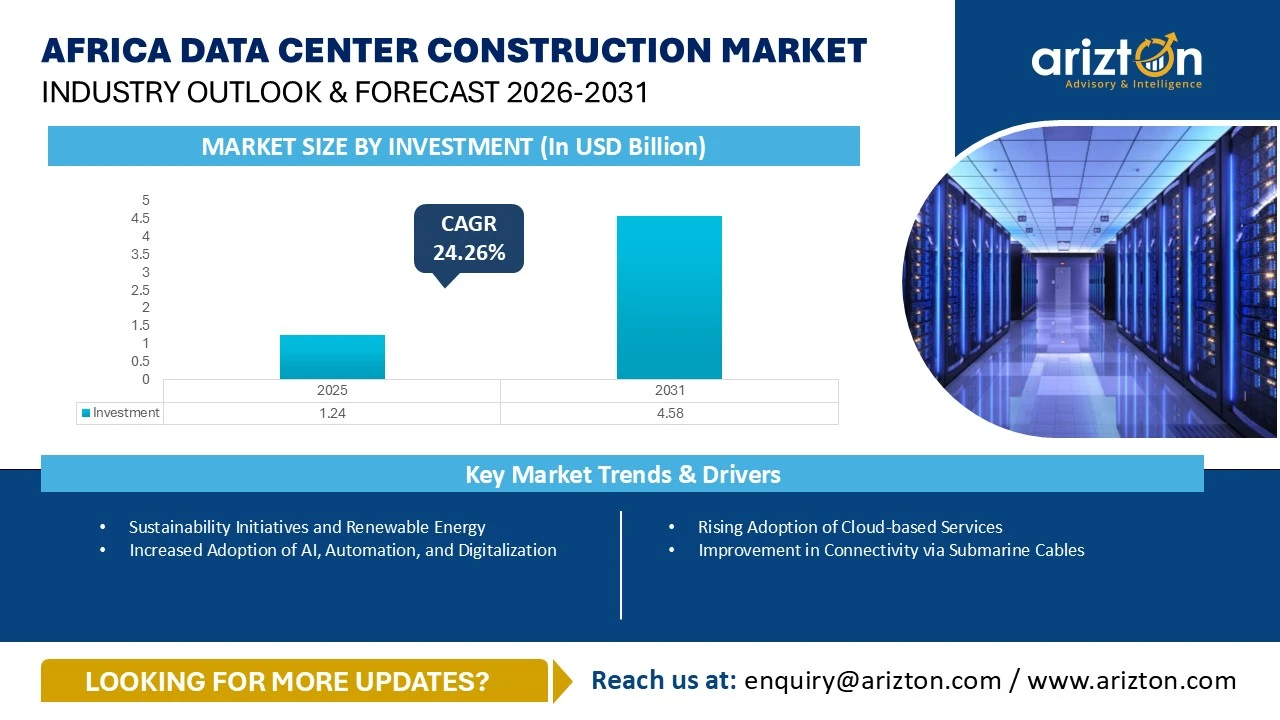
AFRICA DATA CENTER CONSTRUCTION MARKET SIZE WAS VALUED AT USD 1.24 BILLION IN 2025 AND IS EXPECTED TO REACH USD 4.58 BILLION BY 2031, GROWING AT A CAGR OF 24.26% DURING 2025-2031.
The Africa Data Center Construction Market Research Report Includes Size, Share, and Growth in Terms of
- Facility Type: Hyperscale Data Centers, Colocation Data Centers, and Enterprise Data Centers
- Infrastructure: Electrical Infrastructure, Mechanical Infrastructure, and General Construction
- Electrical Infrastructure: UPS Systems, Generators, Transfer Switches & Switchgears, PDUs, and Other Electrical Infrastructure
- Mechanical Infrastructure: Cooling Systems, Racks, and Other Mechanical Infrastructure
- Cooling System: CRAC & CRAH Units, Chillers Units, Cooling Towers, Condensers, and Dry Coolers, and Other Cooling Units
- Cooling Techniques: Air-based Cooling and Liquid-based Cooling
- General Construction: Core & Shell Development, Installation & Commissioning Services, Engineering & Building Design, Fire Detection & Suppression, Physical Security, and DCIM/BMS Solutions
- Tier Standards: Tier I & Tier II, Tier III, and Tier IV
- Geography: Africa (South Africa, Kenya, Nigeria, Egypt, and Other African Countries)
Industry Analysis Report, Regional Outlook, Growth Potential, Price Trends, Competitive Market Share & Forecast 2026–2031.
This report includes market data points, ranging from trend
analyses to market estimates & forecasts that you can customize
AFRICA DATA CENTER CONSTRUCTION MARKET REPORT SCOPE
| REPORT ATTRIBUTE | DETAILS |
|---|---|
| MARKET SIZE BY INVESTMENT (2031) | USD 4.58 Billion |
| MARKET SIZE BY INVESTMENT (2025) | USD 1.24 Billion |
| CAGR BY INVESTMENT (2025-2031) | 24.26% |
| MARKET SIZE - AREA (2031) | 1,337.5 Thousand Sq. Ft. |
| POWER CAPACITY (2031) | 348 MW |
| HISTORIC YEAR | 2022-2024 |
| BASE YEAR | 2025 |
| FORECAST YEAR | 2026-2031 |
| MARKET SEGMENTS | Facility Type, Infrastructure, Electrical Infrastructure, Mechanical Infrastructure, Cooling Systems, Cooling Technique, General Construction, Tier Standards, and Geography |
| GEOGRAPHICAL ANALYSIS | Africa (South Africa, Kenya, Nigeria, Egypt, and Other African Countries) |
AFRICA DATA CENTER CONSTRUCTION MARKET SIZE
The Africa data center construction market size was valued at USD 1.24 billion in 2025 and is expected to reach USD 4.58 billion by 2031, growing at a CAGR of 24.26% during the forecast period.
South Africa is expected to account for the largest share of investments supported by mature infrastructure, strong connectivity, and the presence of multiple global cloud regions. Other high-growth markets, such as Nigeria and Kenya, are attracting significant capital due to rising enterprise demand and improving connectivity ecosystems. In addition, colocation facilities will remain the dominant segment across power capacity, investment, and physical area, highlighting the growing preference among enterprises and cloud providers to outsource infrastructure to specialized operators. At the same time, hyperscale investments are expected to emerge gradually toward the later years of the forecast period, reflecting growing interest from global cloud providers in expanding their footprint in Africa.
AFRICA DATA CENTER CONSTRUCTION MARKET KEY TRENDS
Sustainability Initiatives and Renewable Energy
- According to its updated national pledge (NDC, 2025), Kenya commits to reducing greenhouse-gas emissions by 35% by 2035 relative to the “business‑as‑usual” baseline — combining domestic efforts and international support. The long-term climate plan of Kenya aims for a low-emission economy by 2050, with deep decarbonization across sectors (energy, transport, industry, agriculture, and waste).
- The Egyptian government is making substantial efforts to shift toward sustainability by implementing several sustainability measures to minimize the nation’s environmental impact and carbon emissions. The Egyptian government is committed to generating approximately 12 GW of renewable energy in 2026.
- In South Africa, data center operators are adopting renewable energy for data centers. For instance, in February 2025, Teraco, a Digital Realty company, announced the signing of a Power Purchase Agreement (PPA) with NOA, an integrated energy aggregator based in South Africa, to acquire renewable energy (wind energy) for use in its data center.
- Nigeria is embracing sustainable practices in data centers to comply with regulatory requirements and support environmental goals. Data centers are implementing measures to enhance energy efficiency, reduce carbon footprints by investing in solar and renewable energy, as well as lower power consumption through advanced cooling techniques. Green data projects and investments have become a significant topic of discussion in the region.
Increased Adoption of AI, Automation, and Digitalization
- Africa is accelerating its shift toward AI, automation, and digitization, supported by advances in cloud computing, data centers, and supercomputing capabilities for climate research. The region is leveraging AI to enhance productivity across sectors, while prioritizing renewable energy and sustainable digital solutions.
- In August 2025, the Egyptian Ministry of Planning, Economic Development, and International Cooperation announced plans to invest approximately $255.6 million in the country’s ICT sector by the end of FY 2026 to accelerate digital transformation across Egypt, while positioning the country as one of the leading regional tech hubs in Africa.
- Nigeria is accelerating its shift toward AI and digitization, supported by advancements in cloud computing, data centers, and supercomputing capabilities for climate research. The country is leveraging AI to enhance productivity across sectors, while prioritizing renewable energy and sustainable digital solutions. For instance, in February 2025, Microsoft announced an initiative to train one million Nigerians in AI skills, aligning with forecasts that AI could add $15 billion to Nigeria’s GDP by 2030.
- The government of South Africa is investing in AI. For instance, in July 2025, South Africa’s Minister of Science, Technology, and Innovation announced the country’s investment of approximately $28.4 million in AI, blockchain, and other emerging technologies to strengthen foundational digital capabilities in the public sector. Additionally. The fund supports the Foundational Digital Capabilities Research (FDCR) platform and the Centre for Artificial Intelligence Research (CAIR) across nine universities located in Cape Town, Pretoria, Stellenbosch, and Sol Plaatje University.
Rising Adoption of Cloud-based Services
- The Kenya Cloud Policy (2024) introduces a cloud-first approach, encouraging organizations to prioritize the adoption of cloud computing technologies over traditional on-premises infrastructure. This is expected to stimulate increased investment in cloud services across the country.
- In March 2026, Atlancis Technologies and Everse Technology launched Servernah Cloud, Kenya’s first sovereign AI cloud platform, hosted at the iXAfrica Data Centres facility in Nairobi. The platform enables enterprises and government organizations to run AI workloads locally, supporting digital sovereignty and the expansion of AI infrastructure in Kenya.
- In November 2025, Tata Consultancy Services (TCS), Sybyl, and iXAfrica Data Centres announced a strategic partnership to establish and scale sovereign cloud infrastructure in Kenya and other East African countries. It provides Kenyan businesses and governments with access to secure cloud services hosted locally, instead of relying on cloud providers abroad; this helps with data sovereignty, compliance with local laws, and control over sensitive data.
- In May 2025, Safaricom entered into a strategic partnership with iXAfrica Data Centres to deliver the first AI-ready data center services in East Africa to enterprise and cloud solutions clients.
- In May 2025, the Kenyan government launched the Kenya AI & Cloud Pioneer Initiative during a summit with Huawei Cloud. This initiative aims to accelerate cloud and AI adoption across public and private sectors, promote cloud-native infrastructure, and support digital transformation.
SEGMENTATION INSIGHTS
- The Africa data center construction market continues to witness strong growth in infrastructure investments, driven by increasing hyperscale developments, colocation expansion, and enterprise digitalization across key countries such as South Africa, Kenya, Nigeria, and Egypt. The market is expected to grow from around USD 1.24 billion in 2025 to nearly USD 4.58 billion by 2031, registering a CAGR of approximately 24.26% during 2025–2031.
- Electrical infrastructure continues to account for a significant share of investments in the Africa data center construction market due to the increasing deployment of high-density IT loads and the growing requirement for reliable backup power systems. The segment is projected to grow at a CAGR of around 24.36% during the forecast period. UPS systems and generators are expected to witness strong demand owing to unstable grid connectivity and rising focus on operational reliability across African markets.
- Mechanical infrastructure investments are also witnessing substantial growth with the rising adoption of advanced cooling technologies and energy-efficient solutions in hyperscale and colocation facilities. Cooling systems continue to dominate the mechanical infrastructure segment as operators increasingly focus on reducing energy consumption and improving power usage effectiveness (PUE).
- General construction investments are expected to grow significantly across the African data center market due to increasing greenfield developments and large-scale hyperscale projects. The segment is projected to register a significant growth during the forecast period. The growing presence of global cloud operators and colocation providers is driving investments in core & shell development, modular construction, and sustainable building designs across the region.
- The increasing adoption of cloud computing, AI, big data analytics, IoT, and digital banking services across Africa is accelerating the demand for scalable and high-performance data center facilities. This is encouraging operators to deploy advanced power and cooling infrastructure to support higher rack densities and improve operational efficiency.
- Major operators and investors, including global hyperscale cloud providers and regional colocation companies, are actively expanding their footprint across Africa. The rising investments in submarine cable connectivity, renewable energy integration, and smart infrastructure development continue to support the growth of electrical, mechanical, and general construction segments across the region.
GEOGRAPHICAL ANALYSIS
- In the Africa data center construction market, South Africa continues to dominate the market in terms of investment, area development, and power capacity, owing to the strong presence of colocation operators, submarine cable connectivity, and increasing cloud adoption. However, several emerging markets across Africa are witnessing significant growth driven by AI adoption, digital transformation, and hyperscale cloud expansion.
- The Africa data center construction market is witnessing strong investments from global hyperscale operators, colocation providers, telecom companies, and regional investors. Increasing internet penetration, rising enterprise cloud adoption, deployment of submarine cables, and government-led digital initiatives are supporting data center developments across the continent.
- South Africa dominates the Africa data center construction market in terms of investment and operational power capacity. The country also leads in area development and installed power capacity due to the expansion activities of operators such as Teraco, Africa Data Centres, NTT DATA, and Vantage Data Centers.
- South Africa continues to attract major investments because of established fiber connectivity, reliable colocation demand, access to renewable energy procurement, and strong enterprise presence. However, certain locations in the country continue to face power availability challenges and grid instability concerns.
- Nigeria is one of the fastest-growing data center markets in Africa in terms of investment and power capacity. The country is witnessing increasing demand from cloud providers, fintech companies, telecom operators, and enterprise customers. Investments in Nigeria are expected to grow nearly USD 559 million by 2031.
- Kenya has emerged as a key digital infrastructure hub in East Africa, driven by increasing hyperscale interest, submarine cable connectivity, and growing cloud adoption. Nairobi is attracting investments from both regional and international data center operators, including iXAfrica Data Centres, Open Access Data Centres, and Africa Data Centres.
- Egypt is witnessing strong growth in the Africa data center construction market due to its strategic geographic location connecting Africa, Europe, and the Middle East through multiple submarine cable systems. The country is increasingly attracting hyperscale and colocation investments supported by government-led digital transformation initiatives.
- In December 2025, Egyptian Electricity Transmission Company (EETC) secured financing of approximately $237.2 million from the European Bank for Reconstruction and Development (EBRD) to upgrade and modernize grid infrastructure in the country.
- Other African countries, including Morocco, Ethiopia, Ghana, Djibouti, Angola, and Rwanda, are also witnessing rising investments in digital infrastructure and data center developments. These countries are increasingly attracting edge, colocation, and telecom-based data center deployments to support local cloud and connectivity demand.
- In terms of area development, South Africa accounted is expected to exceed 550 thousand square feet by 2031. Nigeria and Kenya are also expected to witness strong growth in white floor space additions during the forecast period.
- In terms of power capacity, Nigeria and Egypt are also expected to witness significant capacity additions due to increasing hyperscale and colocation developments across major cities.
- The Africa data center construction market is increasingly benefiting from abundant renewable energy resources, including solar and wind power across several countries. Governments across South Africa, Kenya, Egypt, and Nigeria are introducing favourable digital economy policies, smart city initiatives, and connectivity infrastructure projects that continue to support long-term market growth.
VENDOR LANDSCAPE
- The Africa data center construction market has the presence of major IT infrastructure providers such as Arista Networks, Atos, Broadcom, Cisco Systems, Dell Technologies, Fujitsu, Hewlett Packard Enterprise, Hitachi Vantara, Huawei Technologies, IBM, Lenovo, NetApp, NVIDIA, and ZTE that provide servers, storage, networking, AI, and cloud infrastructure solutions across Africa.
- Key support infrastructure vendors operating in the Africa data center construction market include ABB, Alfa Laval, Carrier, Caterpillar, Cummins, Delta Electronics, Eaton, Evapco, Honeywell, Johnson Controls, Legrand, nVent, Rittal, Rolls‑Royce, Schneider Electric, Siemens, STULZ, Trane, and Vertiv that offer power, cooling, UPS, generators, and rack infrastructure solutions for hyperscale and colocation facilities across the region.
- The market has a strong presence of regional and global construction contractors, engineering firms, and consultants such as AECOM, Arup, AtkinsRéalis, Copy Cat Group, Crovik Technologies, Edarat Group, Future-tech, Gruppo ICM, H&MV Engineering, ISG, Orascom Construction, REDCON Construction, Rider Levett Bucknall, Royal HaskoningDHV, Shaker Consultancy Group, and Sterling and Wilson that provide design, engineering, commissioning, and construction services for data center facilities in Africa.
- Increasing investments in hyperscale and colocation facilities across South Africa, Kenya, Nigeria, Egypt, and Morocco are creating significant revenue opportunities for civil contractors, MEP service providers, and local subcontractors in the Africa data center construction market.
- The market is witnessing investments from new and expanding data center operators such as CloudOne, G42, Gulf Data Hub, Khazna Data Centers, iXAfrica Data Centres, NTT DATA, Open Access Data Centres, Rack Centre, Raxio Data Centre, Teraco, and Vantage Data Centers that are expanding hyperscale, AI-ready, and carrier-neutral facilities across the continent.
- Major cloud and hyperscale operators such as Amazon Web Services, Google, Microsoft, Meta, and Oracle are increasing investments in Africa through cloud regions, availability zones, AI infrastructure, and colocation partnerships, thereby driving large-scale data center construction activities across the region.
SNAPSHOT
The Africa data center construction market size by investment will reach USD 4.58 billion by 2031, growing at a CAGR of 24.26% from 2025 to 2031.
The following factors are likely to contribute to the growth of the Africa data center construction market during the forecast period:
- Rising Adoption of Cloud-based Services
- Improvement in Connectivity via Submarine Cables
Base Year: 2025
Forecast Year: 2026-2031
The study considers the present scenario of the Africa data center construction market and its market dynamics for 2026−2031. It covers a detailed overview of several market growth enablers, restraints, and trends. The report offers both the demand and supply aspects of the market. It profiles and examines leading companies and other prominent ones operating in the market.
The report includes the investment in the following areas:
- Facility Type
- Hyperscale Data Centers
- Colocation Data Centers
- Enterprise Data Centers
- Infrastructure
- Electrical Infrastructure
- Mechanical Infrastructure
- General Construction
- Electrical Infrastructure
- UPS Systems
- Generators
- Transfer Switches & Switchgears
- PDUs
- Other Electrical Infrastructure
- Mechanical Infrastructure
- Cooling Systems
- Racks
- Other Mechanical Infrastructure
- Cooling System
- CRAC & CRAH Units
- Chillers Units
- Cooling Towers, Condensers, and Dry Coolers
- Other Cooling Units
- Cooling Techniques
- Air-based Cooling Technique
- Liquid-based Cooling Technique
- General Construction
- Core & Shell Development
- Installation & Commissioning Services
- Engineering & Building Design
- Fire Detection & Suppression
- Physical Security
- DCIM/BMS Solutions
- Tier Standards
- Tier I & Tier II
- Tier III
- Tier IV
- Geography
- Africa
- South Africa
- Kenya
- Nigeria
- Egypt
- Other African Countries
Key Data Center Support Infrastructure Providers
- ABB
- Alfa Laval
- Baudouin
- Carrier
- Caterpillar
- Cummins
- Delta Electronics
- Eaton
- Envicool
- Evapco
- Honeywell
- Johnson Controls
- KSTAR
- Legrand
- nVent
- Piller Power Systems
- Rehlko (Kohler)
- Rittal
- Rolls-Royce
- Schneider Electric
- Siemens
- STULZ
- Trane
- Vertiv
Key Data Center Construction Contractors
- AECOM
- Arup
- B2 Architects
- BlueSun DC
- Copy Cat Group
- Crovik Technologies
- Eastra Solutions
- Edarat Group
- EDS Engineering
- Egypro
- Future-tech
- GREA
- Gruppo ICM
- H&MV Engineering
- HubTech
- Ingenium
- Interkel Group
- ISF Group
- ISG
- Kent
- Kinetic Controls
- LYT Architecture
- Master Power Technologies
- MWK Engineering
- Norkun Intakes
- Orascom Construction PLC
- Raya Network Services
- REDCON Construction Co. S.A.E
- Remax Consult
- Reno Design and Finish
- Rider Levett Bucknall
- Royal HaskoningDHV
- Shaker Consultancy Group
- Sterling and Wilson
- Summit Technology Solutions
- Tetra Tech
- Tri-Star Construction
- Turner & Townsend
- United For Technology Solutions
- WBHO Construction
- Westwood Management
- X2X Group
Data Center Investors
- 21st Century Technologies
- Africa Data Centres
- Digital Parks Africa
- Digital Realty
- e& Egypt
- ECC Solutions
- Equinix
- GPX Global Systems
- iXAfrica Data Centres
- Microsoft
- MTN
- Nxtra by Airtel
- Open Access Data Centres
- Orange Business
- Paratus Namibia
- Rack Centre
- Raya Data Center
- Safaricom
- Telecom Egypt
- Telkom Kenya
- Vantage Data Centers
New Entrants
- Cloudoon
- G42
- Gulf Data Hub
- Kasi Cloud
- Khazna Data Centers
- NEOIX
- Otech
AFRICA DATA CENTER CONSTRUCTION MARKET FAQs
What is the estimated market size in terms of area in the Africa data center construction market by 2031?
How big is the Africa data center construction market?
What is the growth rate of the Africa data center construction market?
How many MW of power capacity is expected to reach the Africa data center construction market by 2031?
What are the key trends in the Africa data center construction market?
For more details, please reach us at [email protected]
1. ABOUT ARIZTON
2. ABOUT OUR DATA CENTER CAPABILITIES
3. WHAT’S INCLUDED
4. SEGMENTS INCLUDED
5. RESEARCH METHODOLOGY
6. MARKET AT GLANCE
7. PREMIUM INSIGHTS
8. INTRODUCTION
9. INVESTMENT OPPORTUNITIES
9.1. INVESTMENT: MARKET SIZE & FORECAST
9.2. IMPACT OF MIDDLE EAST WAR
9.3. AREA: MARKET SIZE & FORECAST
9.4. POWER CAPACITY: MARKET SIZE & FORECAST
10. MARKET DYNAMICS
10.1. MARKET OPPORTUNITIES & TRENDS
10.2. MARKET GROWTH ENABLERS
10.3. MARKET RESTRAINTS
10.4. SITE SELECTION CRITERIA
11. FACILITY TYPE SEGMENTATION
11.1. HYPERSCALE DATA CENTERS
11.2. COLOCATION DATA CENTERS
11.3. ENTERPRISE DATA CENTERS
12. INFRASTRUCTURE SEGMENTATION
12.1. ELECTRICAL INFRASTRUCTURE
12.2. MECHANICAL INFRASTRUCTURE
12.3. COOLING SYSTEMS
12.4. COOLING TECHNIQUES
12.5. GENERAL CONSTRUCTION
13. TIER STANDARDS SEGMENTATION
14. GEOGRAPHY SEGMENTATION
15. AFRICA
15.1. MARKET SNAPSHOT & KEY HIGHLIGHTS
15.2. DATA CENTER MARKET BY INVESTMENT
15.3. DATA CENTER MARKET BY AREA
15.4. DATA CENTER MARKET BY POWER CAPACITY
15.5. DATA CENTER MARKET BY SUPPORT INFRASTRUCTURE
16. SOUTH AFRICA
16.1. IMPACT OF AI ON DATA CENTER INDUSTRY IN SOUTH AFRICA
16.2. GOVERNMENT RULE AND REGULATION FOR DATA CENTER
16.3. MARKET BY INVESTMENT
16.4. MARKET BY AREA
16.5. MARKET BY POWER CAPACITY
16.6. KEY SUPPORT INFRASTRUCTURE ADOPTION
16.7. MARKET BY INFRASTRUCTURE
16.8. LIST OF UPCOMING DATA CENTER PROJECTS IN SOUTH AFRICA
17. KENYA
17.1. IMPACT OF AI ON DATA CENTER INDUSTRY IN KENYA
17.2. GOVERNMENT RULE AND REGULATION FOR DATA CENTER
17.3. MARKET BY INVESTMENT
17.4. MARKET BY AREA
17.5. MARKET BY POWER CAPACITY
17.6. KEY SUPPORT INFRASTRUCTURE ADOPTION
17.7. MARKET BY INFRASTRUCTURE
17.8. LIST OF UPCOMING DATA CENTER PROJECTS IN KENYA
18. NIGERIA
18.1. IMPACT OF AI ON DATA CENTER INDUSTRY IN NIGERIA
18.2. GOVERNMENT RULE AND REGULATION FOR DATA CENTER
18.3. MARKET BY INVESTMENT
18.4. MARKET BY AREA
18.5. MARKET BY POWER CAPACITY
18.6. KEY SUPPORT INFRASTRUCTURE ADOPTION
18.7. MARKET BY INFRASTRUCTURE
18.8. LIST OF UPCOMING DATA CENTER PROJECTS IN NIGERIA
19. EGYPT
19.1. IMPACT OF AI ON DATA CENTER INDUSTRY IN EGYPT
19.2. GOVERNMENT RULE AND REGULATION FOR DATA CENTER
19.3. MARKET BY INVESTMENT
19.4. MARKET BY AREA
19.5. MARKET BY POWER CAPACITY
19.6. KEY SUPPORT INFRASTRUCTURE ADOPTION
19.7. MARKET BY INFRASTRUCTURE
19.8. LIST OF UPCOMING DATA CENTER PROJECTS IN EGYPT
20. OTHER AFRICAN COUNTRIES
20.1. MARKET BY INVESTMENT
20.2. MARKET BY AREA
20.3. MARKET BY POWER CAPACITY
20.4. KEY SUPPORT INFRASTRUCTURE ADOPTION
20.5. MARKET BY INFRASTRUCTURE
21. MARKET PARTICIPANTS
21.1. SUPPORT INFRASTRUCTURE PROVIDERS
21.2. DATA CENTER CONTRACTORS & SUBCONTRACTORS
21.3. DATA CENTER INVESTORS
21.4. NEW ENTRANTS
22. QUANTITATIVE SUMMARY
23. APPENDIX
23.1. ABBREVIATIONS
23.2. DEFINITIONS
23.3. SEGMENTAL COVERAGE
Select a license type that suits your business needs
Single User Licence
- Report accessible by one user only
- Free 10% or 3 days of customization
- Free post-sale service assistance
- Continuous support through email
5 User Licence
- Report accessible by 5 users within the organization
- Free 15% or 4.5 days of customization
- Continuous support through email and telephone
- Free analyst hour
- Free Upgrade: If an updated report published within 180 days of purchase, you will get the revised report free of charge
Corporate Licence
- Free Datasheet worth $1500
- Report accessible by the entire organization
- Free 20% or 6 days of customization
- Free post-sale service assistance
- Continuous support through email and telephone
- Direct access to lead analysts
- Free analyst hour
- Free Upgrade: If an updated report published within 180 days of purchase, you will get the revised report free of charge
Datasheet Licence
- Report accessible by 1 user only
- Free 15% or 32 hours of customization
- Free post-sale service assistance
- Direct access to lead analysts
Frequently Asked Questions
What is the estimated market size in terms of area in the Africa data center construction market by 2031?
How big is the Africa data center construction market?
What is the growth rate of the Africa data center construction market?
How many MW of power capacity is expected to reach the Africa data center construction market by 2031?
What are the key trends in the Africa data center construction market?
Other RELATED Reports
South Africa Data Center Market - Investment Analysis & Growth Opportunities 2026-2031
Published : March 2026

