

MarTech AI Market Growth Insights – Driven by AI Integration Across Marketing Platforms, Expanding First-Party Customer Data Utilization, Rising Demand for Multichannel Personalization, and Increasing Focus on Measurable Marketing ROI & Commercial Outcomes (2026–2031)
To Be Published : September 2026
Last Updated : August 2026
format: PDF

263 pages

54 company

6 segments

5 region

24 countries
Purchase Options
Global AI Martech Market Research Report 2026-2031
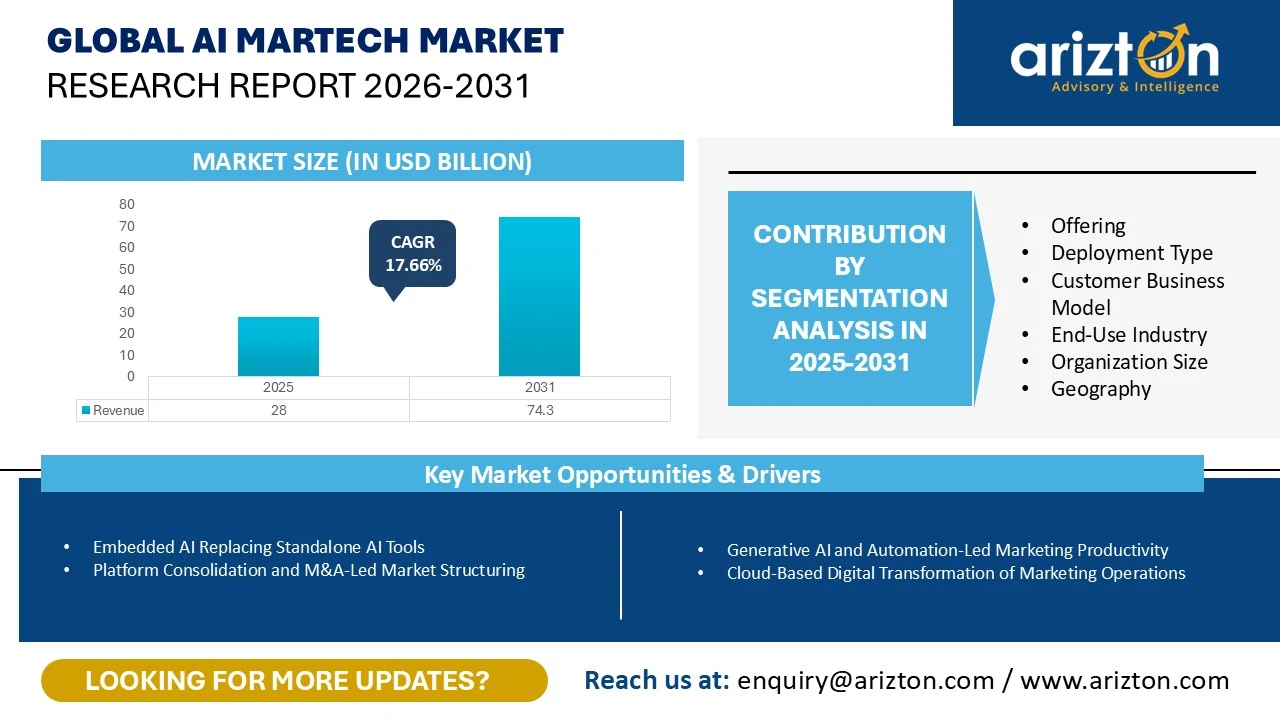
THE GLOBAL AI MARTECH MARKET WAS VALUED AT USD 28 BILLION IN 2025 AND IS EXPECTED TO REACH USD 74.30 BILLION BY 2031, GROWING AT A CAGR OF 17.66% FROM 2025 TO 2031.
The AI Martech Market Size, Share & Trends Analysis Report By
- Offering: Software Solutions, Professional Services, and Managed Services
- Deployment Type: Cloud Deployment, Hybrid Deployment, and Private Deployment
- Organization Size: Large Enterprises, Medium Enterprises, and Small Businesses
- Customer Business Model: Business-to-Consumer (B2C), Business-to-Business (B2B), Business-to-Business-to-Consumer (B2B2C), and Direct-to-Consumer (D2C)
- End-Use Industry: Retail & E-commerce, BFSI, IT & Telecommunications, Media & Entertainment, Consumer Goods, Healthcare & Life Sciences, Travel & Hospitality, Automotive, Education & EdTech, and Other Industries
- Geography: North America, Europe, APAC, Latin America, and Middle East & Africa
Industry Analysis Report, Regional Outlook, Growth Potential, Price Trends, Competitive Market Share & Forecast 2026–2031.
This report includes market data points, ranging from trend
analyses to market estimates & forecasts that you can customize
GLOBAL AI MARTECH MARKET REPORT SCOPE
| REPORT ATTRIBUTE | DETAILS |
|---|---|
| Market Size (2031) | USD 74.30 Billion |
| Market Size (2025) | USD 28 Billion |
| CAGR (2025-2031) | 17.66% |
| HISTORIC YEAR | 2022-2024 |
| BASE YEAR | 2025 |
| FORECAST YEAR | 2026-2031 |
| SEGMENTS BY | Offering, Deployment Type, Customer Business Model, End-Use Industry, Organization Size, and Geography |
| GEOGRAPHIC ANALYSIS | North America, Europe, APAC, Latin America, and Middle East & Africa |
| KEY PLAYERS | Adobe, Salesforce, Google, Microsoft, Meta, Amazon Ads, Oracle, SAP, HubSpot, and Braze |
AI MARTECH MARKET SIZE & SHARE
The global AI MarTech market size was valued at USD 28 billion in 2025 and is expected to reach USD 74.30 billion by 2031, growing at a CAGR of 17.66% during the forecast period. Growth is supported by AI integration within established marketing platforms, greater activation of first-party customer data, rising demand for multichannel personalization, and stronger pressure to connect marketing expenditure with measurable commercial outcomes.
Customer preference is shifting from isolated AI tools toward AI embedded within marketing automation, customer engagement, content, advertising, and analytics workflows. Embedded capabilities can use approved data, campaign history, brand assets, permissions, and performance signals without requiring separate operating environments. For instance, Salesforce Marketing Cloud Next supports campaign briefs, audience creation, content development, customer journeys, and performance insights within an integrated platform.
Adoption is widening among medium enterprises and small businesses because cloud delivery, standardized integrations, subscription pricing, and embedded AI reduce technical and staffing requirements. For example, Eurostat reported that 17% of small EU enterprises and around 30% of medium enterprises used AI technologies in 2025, compared with 55% of large enterprises. This adoption gap indicates considerable expansion potential as accessible platforms reduce implementation costs and organizational complexity.
New Product Developments in the AI Marketing Technology Market
- In April 2026, Bloomreach launched Loomi AI for Shopify, connecting Shopify customer, product, commerce, and behavioral data with Bloomreach’s marketing and search products. The integration strengthens Bloomreach’s commerce-marketing position by reducing implementation complexity and coordinating search, recommendations, messaging, and personalization across customer touchpoints.
- In March 2026, Criteo expanded Criteo GO with full self-service access for small and medium-sized businesses and growth-stage commerce brands. The expansion enables advertisers to independently create accounts, configure billing, and launch campaigns, widening access to Criteo’s AI-powered cross-channel advertising and performance-optimization capabilities.
- In March 2026, LiveRamp launched new agentic AI capabilities across identity, audience development, campaign planning, activation, and measurement. The release extends LiveRamp’s role from identity and data collaboration toward governed AI-supported campaign execution, cross-channel analysis, and marketing-investment optimization.
- In June 2025, Jasper launched a multi-agent platform developed for enterprise marketing teams. The platform extended Jasper beyond individual content generation into content strategy, workflow coordination, campaign production, and brand-controlled execution, positioning the company to participate more broadly in enterprise content operations.
- In June 2025, HCLSoftware launched HCL Unica+, a MarTech platform incorporating agentic AI capabilities, customer intelligence, real-time personalization, campaign orchestration, and privacy controls. The launch modernized HCL Unica’s enterprise campaign-management portfolio for organizations requiring AI-supported execution alongside governance and deployment flexibility.
Merger & Acquisitions in the AI MarTech Market
- In March 2025, DoubleVerify acquired Rockerbox, adding performance attribution, optimization, and marketing-measurement capabilities. According to DoubleVerify, the acquisition was completed for $82.6 million, net of cash acquired. The transaction broadened DoubleVerify’s position beyond media-quality verification and connected advertising delivery more closely with lower-funnel outcomes and marketing-investment decisions.
MARTECH AI MARKET TRENDS & ENABLERS
- Platform consolidation and capability expansion are encouraging enterprises to manage more MarTech functions through fewer strategic vendors. Providers are broadening their platforms across customer data, identity, content, automation, advertising, attribution, and measurement. This can reduce the number of integrations and commercial relationships customers must maintain, although broader suites may introduce migration challenges or provide less functional depth than specialist applications.
- Privacy-first marketing is increasing the strategic value of consented first-party data. For instance, the General Data Protection Regulation governs personal-data processing in Europe and includes protections concerning profiling and decisions based solely on automated processing that produce legal or similarly significant effects. These requirements reinforce demand for consent-aware profiles, identity resolution, controlled activation, processing transparency, and auditable personalization.
- Multimodal content generation and individualized decisioning are expanding the depth of AI-led personalization. For example, Google Product Studio can create or enhance product images, remove or replace backgrounds, improve resolution, and generate product videos. BrazeAI Decisioning Studio can select channels, messages, offers, creative treatments, timing, and frequency for individual customers. These capabilities move AI MarTech beyond text generation toward adaptive creative production and individualized engagement.
- Marketing operations are becoming more cross-functional and measurement-led. AI deployment requires closer coordination among marketing, data, technology, legal, cybersecurity, procurement, and brand-management teams. At the same time, attribution, experimentation, creative analysis, and budget optimization are becoming part of active campaign execution. This increases demand for shared governance, role-based permissions, approval workflows, common performance definitions, and platforms connecting customer response with measurable commercial outcomes.
INDUSTRY RESTRAINTS
- MarTech integration complexity and insufficient data readiness delay deployment because AI systems must connect CRM records, customer profiles, commerce platforms, content repositories, consent information, advertising systems, and analytics environments. Duplicate identities, inconsistent definitions, incomplete integrations, and delayed data movement weaken audience selection and personalization. Organizations may therefore postpone broader automation until data architecture, platform ownership, integration responsibilities, and quality standards are clearly established.
AI MARTECH MARKET SEGMENTATION INSIGHTS
INSIGHTS BY OFFERING
The global AI MarTech market by offering is segmented into software solutions, professional services, and managed services. Software solutions accounted for the largest market share of around 73% in 2025. The growth is significant because enterprises purchase these platforms as the core technology layer for continuously managing customer data, content, campaigns, personalization, advertising, engagement, and performance measurement. Subscription and usage-based models generate recurring revenue across multiple users, brands, channels, and geographies, while Professional and Managed Services are generally purchased to support implementation or ongoing operations.
For instance, Oracle Eloqua Marketing Automation supports campaign design, lead management, audience engagement, and multichannel execution, while Sprinklr Marketing coordinates content, organic campaigns, paid media, approvals, and performance analysis across digital channels.
INSIGHTS BY DEPLOYMENT MODE
Based on the deployment mode, the hybrid deployment is expected to register the highest CAGR of 18.20% during the forecast period. Organizations with sensitive customer information or established internal systems increasingly combine cloud-based AI capabilities with privately controlled customer records, consent data, and analytics environments.
The model fits enterprises where marketing outcomes depend on data held outside the campaign platform. Large retailers use it for warehouse-connected retail media audiences, banks for consent-aware communication, airlines for loyalty activation, insurers for controlled cross-selling, and telecom operators for retention campaigns based on billing and service records. Its value lies in controlled data use rather than basic cloud convenience across complex operating markets.
For instance, SAS Customer Intelligence 360 supports a hybrid marketing architecture that connects its cloud platform with customer data and marketing processes maintained in on-premises or customer-selected environments.
INSIGHTS BY ORGANIZATION SIZE
Based on organization size, the large enterprises accounted for the largest global AI MarTech market share in 2025, as organizations manage larger customer databases, multiple brands, business units, countries, languages, channels, and regulatory requirements.
Large Enterprises (1,000+ Employees) cover customers using AI MarTech in marketing environments with many brands, regions, approval layers, and customer data systems. The difference is not scale alone. These customers need AI to control access, review content, localize campaigns, manage audience rules, and keep customer-facing messages consistent across teams where brand, legal, privacy, and consumer trust risks are higher and more visible.
For example, Microsoft Dynamics 365 Customer Insights combines unified customer profiles with real-time journey orchestration, audience segmentation, AI-supported content, and multichannel engagement. Such integrated capabilities support the complex data environments and broader implementation scope associated with large enterprise deployments.
INSIGHTS BY CUSTOMER BUSINESS MODEL
The business-to-consumer (B2C) held the largest global AI martech market share in 2025. B2C organizations manage high customer volumes, frequent interactions, loyalty programs, extensive product or service portfolios, and directly measurable digital journeys. Retailers, financial institutions, telecommunications providers, media platforms, travel companies, and consumer brands therefore use AI MarTech across acquisition, recommendations, lifecycle communication, retention, cross-selling, and campaign optimization.
Direct-to-Consumer (D2C) is projected to record the highest CAGR during the forecast period. D2C brands depend on owned websites, applications, email, messaging, and first-party customer profiles rather than relying entirely on intermediaries.
For instance, Tealium AudienceStream CDP resolves customer identities, builds unified profiles, creates dynamic audience segments, and activates data across connected marketing systems in real time. These capabilities support direct acquisition, personalization, repeat purchases, and retention.
INSIGHTS BY END-USE INDUSTRY
The retail & e-commerce segment dominates and holds the largest share of the global AI martech market. The segment covers AI tools used by retailers, marketplaces, and digital-first brands close to the buying moment. It includes AI search, product ranking, recommendations, cart recovery, replenishment reminders, loyalty offers, onsite retail media, and shopper-based activation across web, app, email, SMS, loyalty, and paid commerce channels during live purchase journeys across categories globally today.
The industry is growing as it combines high transaction volumes, large product catalogues, browsing behaviour, loyalty information, retail media, and directly measurable conversion journeys.
For example, Google Performance Max uses AI across bidding, budget allocation, audiences, creative assets, and attribution to promote retail products across Search, YouTube, Display, Discover, Gmail, and Maps through a single campaign.
AI MARKETING TECHNOLOGY MARKET GEOGRAPHICAL ANALYSIS
North America held the largest regional share of around 40% of the global AI MarTech market. Leadership is supported by the concentration of major AI, cloud, CRM, customer-data, advertising-technology, analytics, and customer-engagement vendors in the US. Mature enterprise software procurement, extensive digital advertising activity, and broad adoption across retail, BFSI, technology, media, healthcare, and consumer industries sustain a larger established revenue base than in other regions.
APAC is projected to register the highest regional CAGR during the forecast period. Growth is supported by large digital-commerce ecosystems, expanding enterprise technology adoption, wider cloud-platform availability, and increasing customer engagement through mobile commerce, applications, social platforms, and messaging channels across China, India, Japan, South Korea, Indonesia, Singapore, and Vietnam.
China accounted for the largest share of the APAC AI MarTech market in 2025. Its leadership reflects the scale of domestic e-commerce, social commerce, mobile platforms, retail media, and digital advertising. For instance, the National Bureau of Statistics of China reported that the country’s online retail sales reached $2.24 trillion in 2025, increasing by 8.6%, while online sales of physical goods represented around 26% of total retail sales of consumer goods. This commercial scale generates substantial customer, product, transaction, and advertising data, supporting higher demand for personalization, audience management, campaign automation, retail-media optimization, and marketing measurement.
AI MARTECH MARKET VENDOR LANDSCAPE
The global AI MarTech market is layered across large integrated technology and marketing-platform vendors, specialist marketing & advertising platforms, and AI-native workflow providers. Competition occurs across customer data, content, automation, personalization, engagement, advertising, analytics, attribution, and orchestration. Customers may consolidate multiple workflows with a major platform or combine specialist products where functional depth is more important than platform breadth.
Adobe, Salesforce, Microsoft, Google, and Oracle compete through broad enterprise ecosystems encompassing different combinations of customer data, cloud infrastructure, content, advertising, CRM, analytics, and marketing automation. HubSpot combines CRM and embedded marketing functionality with a stronger position among small and medium-sized organizations rather than following the same complex multinational-enterprise model.
Braze, Klaviyo, Sprinklr, LiveRamp, The Trade Desk, AppLovin, 6sense, and Hightouch compete through specialized capabilities such as lifecycle engagement, customer-data activation, identity resolution, social marketing, account intelligence, media decisioning, campaign measurement, and advertising optimization. Their competitive positions are strengthened by deeper functionality in specific workflows, allowing customers to supplement broader enterprise platforms with purpose-built tools for acquisition, engagement, audience activation, and performance improvement.
Competition is increasingly focused on platforms that connect customer data, content creation, campaign decisions, execution, and performance measurement. Bringing these functions together reduces manual work and helps marketers understand which activities generate results. However, vendors must also provide reliable integrations, data protection, brand controls, implementation support, and measurable returns to become long-term enterprise platforms rather than standalone AI tools.
SNAPSHOT
The global AI Martech market size is expected to grow at a CAGR of approximately 17.66% from 2025 to 2031.
The following factors are likely to contribute to the growth of the global AI Martech market during the forecast period:
- Generative AI and Automation-Led Marketing Productivity
- Cloud-Based Digital Transformation of Marketing Operations
- First-Party Data and Customer Data Ownership
- Personalization and Customer Experience Differentiation
- Budget Reallocation Toward Efficiency-Focused MarTech
Base Year: 2025
Forecast Year: 2026-2031
The report examines the current state of the global AI Martech market and its market dynamics through 2026−2031. It covers a detailed overview of several market growth enablers, restraints, and trends. The study covers both the demand and supply sides of the market. It also profiles and analyses leading companies and several other prominent companies operating in the market.
Key Vendors
- Adobe
- Business Overview
- Product Offerings
- Key Developments
- Key Strategies
- Key Strengths
- Key Opportunities
- Salesforce
- Microsoft
- Meta
- Amazon Ads
- Oracle
- SAP
- HubSpot
- Braze
Other Prominent Vendors
- Intuit Mailchimp
- Business Overview
- Product Offerings
- ActiveCampaign
- Iterable
- HCL Software
- Klaviyo
- MoEngage
- Optimove
- Insider One
- Attentive
- Yotpo
- Bloomreach
- Twilio Segment
- Hightouch
- Treasure Data
- RudderStack
- LiveRamp
- Mastercard Dynamic Yield
- Optimizely
- Contentful
- FullStory
- Contentsquare
- Canva
- Jasper
- Writer
- Persado
- Copy.ai
- Anyword
- DoubleVerify
- Ahrefs
- Sprinklr
- Hootsuite
- Sprout Social
- Yext
- 6sense
- Demandbase
- ZoomInfo
- SAS Customer Intelligence 360
- Amplitude
- Mixpanel
- AppsFlyer
- The Trade Desk
- Criteo
- AppLovin
- Taboola
Segmentation by Offering
- Software Solutions
- Professional Services
- Managed Services
Segmentation by Deployment Type
- Cloud Deployment
- Hybrid Deployment
- Private Deployment
Segmentation by Organization Size
- Large Enterprises
- Medium Enterprises
- Small Business
Segmentation by Customer Business Model
- Business-to-Consumer (B2C)
- Business-to-Business (B2B)
- Business-to-Business-to-Consumer (B2B2C)
- Direct-to-Consumer (D2C)
Segmentation by End-Use Industry
- Retail & E-commerce
- BFSI
- IT & Telecommunications
- Media & Entertainment
- Consumer Goods
- Healthcare & Life Sciences
- Travel & Hospitality
- Automotive
- Education & EdTech
- Other Industries
Segmentation by Geography
- North America
- US
- Canada
- Europe
- Germany
- UK
- France
- Italy
- Spain
- Netherlands
- Sweden
- Poland
- APAC
- China
- Japan
- India
- South Korea
- Australia
- Indonesia
- Singapore
- Vietnam
- Latin America
- Brazil
- Mexico
- Argentina
- Middle East & Africa
- UAE
- Saudi Arabia
- South Africa
GLOBAL AI MARTECH MARKET FAQs
How big is the global AI Martech market?
What is the growth rate of the global AI Martech market?
What are the key trends in the global AI Martech market?
Which region dominates the global AI Martech market?
Who are the major players in the global AI Martech market?
For more details, please reach us at [email protected]
- Chapter 1- Scope & Coverage
- Market Definition
- Inclusion
- Exclusions
- Market Estimation Caveats
- Market Derivation
- Market Segmentation by Offering
- Market Segmentation by Deployment Type
- Market Segmentation by Organization Size
- Market Segmentation by Customer Business Model
- Market Segmentation by End-Use Industry
- Chapter 2- Premium Insights
- Chapter 3- Market Dynamics
- Introduction
- Technology Analysis
- Growth Opportunities and Market Challenges
- Stakeholders and Buying Criteria
- Pricing Models and ASP Analysis
- Investment and Funding Landscape
- Generative AI Impact
- Market Opportunities & Trends
- Platform Consolidation and M&A-Led Market Structuring
- Embedded AI Replacing Standalone AI Tools
- Agentic AI and Autonomous Marketing Workflows
- Privacy-First and Signal-Resilient Marketing
- Marketing Measurement Modernization
- Market Growth Enablers
- Generative AI and Automation-Led Marketing Productivity
- Cloud-Based Digital Transformation of Marketing Operations
- First-Party Data and Customer Data Ownership
- Personalization and Customer Experience Differentiation
- Budget Reallocation Toward Efficiency-Focused MarTech
- Market Restraints
- MarTech Stack Complexity and Integration Burden
- AI Skills Gap and Organizational Readiness Issues
- ROI Uncertainty and Measurement Limitations
- Data Quality and Governance Constraints
- Vendor Dependency and Platform Flexibility Risk
- Market Landscape
- Five Forces Analysis
- Chapter 4- Market Segmentation
- Offering (Market Size & Forecast: 2022-2031)
- Software Solutions
- Professional Services
- Managed Services
- Customer Business Model (Market Size & Forecast: 2022-2031)
- Business-to-Consumer (B2C)
- Business-to-Business (B2B)
- Business-to-Business-to-Consumer (B2B2C
- Direct-to-Consumer (D2C)
- Deployment Type (Market Size & Forecast: 2022-2031)
- Cloud Deployment
- Hybrid Deployment
- Private Deployment
- End-Use Industry (Market Size & Forecast: 2022-2031)
- Retail & E-commerce
- BFSI
- IT & Telecommunications
- Media & Entertainment
- Consumer Goods
- Healthcare & Life Sciences
- Travel & Hospitality
- Automotive
- Education & EdTech
- Other Industries
- Organization Size (Market Size & Forecast: 2022-2031)
- Large
- Medium
- Small
- Chapter 5- Geography Segmentation
- Geography Segmentation (Market Size & Forecast: 2022-2031)
- Geographic Overview – Market Maturity Index
- North America
- US
- Canada
- Europe
- Germany
- UK
- France
- Italy
- Spain
- Netherlands
- Sweden
- Poland
- APAC
- China
- Japan
- India
- South Korea
- Australia
- Indonesia
- Singapore
- Vietnam
- Latin America
- Brazil
- Mexico
- Argentina
- MEA
- UAE
- Saudi Arabia
- South Africa
- Chapter 6- Competitive Landscape
- Competitive Landscape
- Competition Overview
- Key Developments
- Key Company Profiles
- Other Prominent Company Profiles
- Report Summary
- Key Takeaways
- Strategic Recommendations
Select a license type that suits your business needs
Single User Licence
- Report accessible by one user only
- Free 10% or 3 days of customization
- Free post-sale service assistance
- Continuous support through email
5 User Licence
- Report accessible by 5 users within the organization
- Free 15% or 4.5 days of customization
- Continuous support through email and telephone
- Free analyst hour
- Free Upgrade: If an updated report published within 180 days of purchase, you will get the revised report free of charge
Corporate Licence
- Free Datasheet worth $1500
- Report accessible by the entire organization
- Free 20% or 6 days of customization
- Free post-sale service assistance
- Continuous support through email and telephone
- Direct access to lead analysts
- Free analyst hour
- Free Upgrade: If an updated report published within 180 days of purchase, you will get the revised report free of charge
Datasheet Licence
- Report accessible by 1 user only
- Free 15% or 32 hours of customization
- Free post-sale service assistance
- Direct access to lead analysts
Frequently Asked Questions
How big is the global AI Martech market?
What is the growth rate of the global AI Martech market?
What are the key trends in the global AI Martech market?
Which region dominates the global AI Martech market?
Who are the major players in the global AI Martech market?
Other RELATED Reports



Generative AI in Software Development Market - Global Outlook & Forecast 2025 - 2030
Published : April 2025