

196 pages

30 company

7 segments

5 region

25 countries
Purchase Options
Global Battery Separator Market Research Report 2026-2031
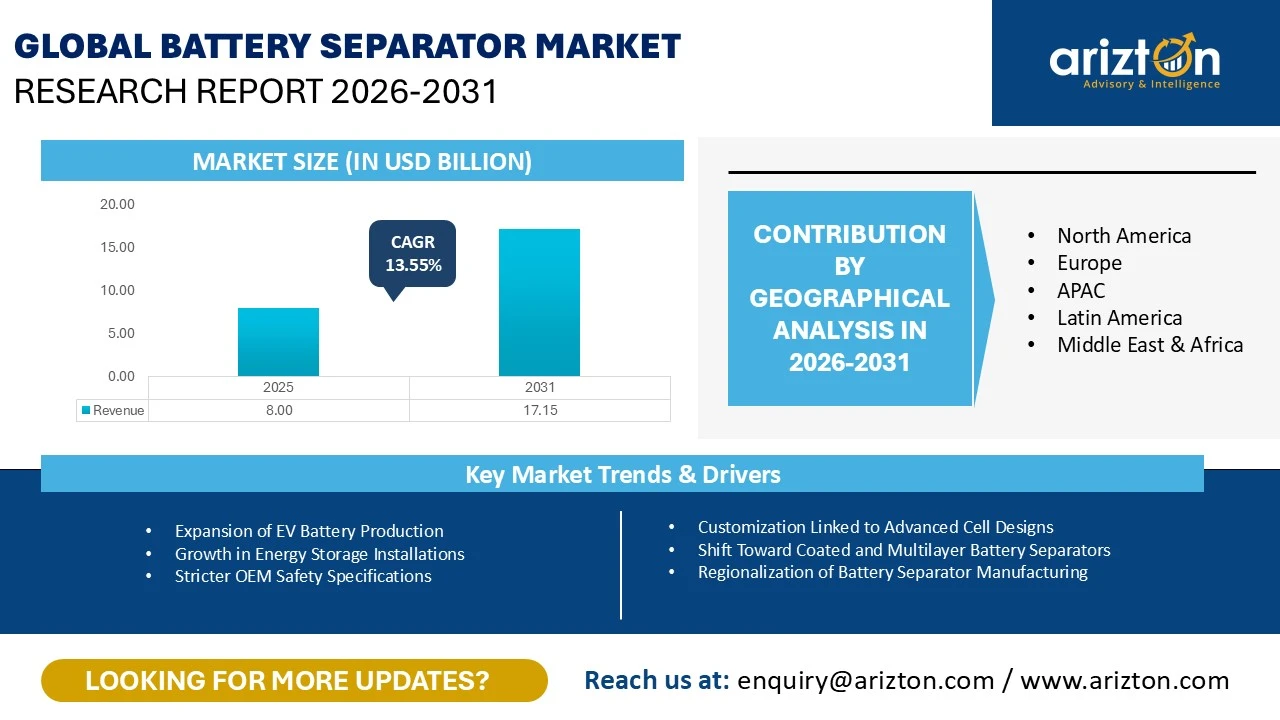
THE GLOBAL BATTERY SEPARATOR MARKET WAS VALUED AT USD 8.00 BILLION IN 2025 AND IS EXPECTED TO REACH USD 17.15 BILLION BY 2031, GROWING AT A CAGR OF 13.55%.
The Battery Separator Market Size, Share, & Trends Analysis Report By
- Battery Chemistry: Lithium-ion batteries, Lead-acid batteries, Nickel-based batteries, Sodium-ion batteries, and Others
- Separator Material: Polyethylene (PE), Polypropylene (PP), Multilayer polyolefin (PP/PE/PP), Nonwoven materials, Ceramic-based materials, and Others
- Manufacturing Process: Wet process, Dry process, and Others
- Separator Thickness: ≤ 10 µm, 11–15 µm, 16–20 µm, and 20 µm
- Battery Form Factor: Cylindrical cells, Prismatic cells, and Pouch cells
- End-Use Application: Electric vehicles, Consumer electronics, Energy storage systems, and Industrial & other applications
- Geography: North America, Europe, APAC, Latin America, and Middle East & Africa
Industry Analysis Report, Regional Outlook, Growth Potential, Price Trends, Competitive Market Share & Forecast 2026–2031.
This report includes market data points, ranging from trend
analyses to market estimates & forecasts that you can customize
BATTERY SEPARATOR MARKET REPORT SCOPE
| REPORT ATTRIBUTE | DETAILS |
|---|---|
| MARKET SIZE (2031) | USD 17.15 Billion |
| MARKET SIZE (2025) | USD 8.00 Billion |
| CAGR (2025-2031) | 13.55% |
| HISTORIC YEAR | 2022-2024 |
| BASE YEAR | 2025 |
| FORECAST YEAR | 2026-2031 |
| SEGMENTS BY | Battery Chemistry, Separator Material, Manufacturing Process, Separator Thickness, Battery Form Factor, End-Use Application, and Geography |
| GEOGRAPHIC ANALYSIS | North America, Europe, APAC, Latin America, and Middle East & Africa |
| KEY PLAYERS | SEMCORP, Asahi Kasei Corporation., SK Group, and W-SCOPE Korea |
BATTERY SEPARATOR MARKET ANALYSIS
The global battery separator market is experiencing robust growth, fueled by the rapid adoption of electric vehicles (EVs), expanding energy storage systems (ESS), and continuous advancements in battery technologies. Valued at USD 8.00 billion in 2025, the market is projected to reach USD 17.15 billion by 2031, registering a CAGR of 13.55% during the forecast period.
The industry is evolving from a traditional volume-driven film manufacturing business into a high-performance materials market where safety, reliability, and technological innovation are the primary competitive differentiators. Growing demand for lithium-ion battery separators in EVs and stationary energy storage applications is driving manufacturers to develop advanced separator materials with superior thermal stability, mechanical strength, and longer operational life. As battery performance expectations continue to rise, battery separator manufacturing is increasingly focused on precision engineering, quality consistency, and material innovation rather than production volume alone.
What is a Battery Separator?
A separator in lithium-ion battery systems is a microporous membrane that prevents direct contact between electrodes while allowing ion transport. These battery separator materials are essential for ensuring battery safety, cycle life, and operational efficiency.
In modern cell manufacturing, even minor variations in separator properties such as porosity, thickness, or electrolyte wettability can impact yield, safety, and warranty performance. As a result, lithium-ion battery separator procurement is highly qualification-driven, with manufacturers relying on pre-approved suppliers.
MARKET TRENDS & STRATEGIC ENABLERS
Rising EV Production Accelerating Demand for EV Battery Separators
The rapid expansion of the electric vehicle industry remains the strongest growth catalyst for the battery separator market. With global EV sales surpassing 17 million units in 2024, demand for high-performance EV battery separators has increased substantially.
Since separators directly influence battery safety, charging efficiency, and thermal management, automotive manufacturers require advanced materials capable of supporting high-energy-density battery cells while meeting stringent safety and warranty requirements. As gigafactory investments continue worldwide, manufacturers are expanding battery separator manufacturing capacity to ensure reliable supply for next-generation EV batteries.
Energy Storage Systems Creating a Second Growth Engine
Beyond transportation, utility-scale energy storage systems are becoming another major demand driver. Increasing renewable energy deployment requires long-duration, high-reliability battery storage, boosting the need for premium lithium-ion battery separators with enhanced durability and extended calendar life.
Government incentives further strengthen this demand. For example, clean energy investment tax credits supporting energy storage installations after December 2024 are encouraging greater deployment of ESS projects, creating sustained opportunities for separator manufacturers.
Advanced Coating Technologies Transforming Battery Separator Design
The market is steadily transitioning from conventional separator films toward high-value engineered materials. Manufacturers are investing heavily in:
- Ceramic-coated separators
- Multilayer separator structures
- Functional coated membranes
These advanced battery membrane separators significantly improve thermal stability, puncture resistance, dimensional stability, and protection against internal short circuits. As a result, coated porous separator films are becoming increasingly important for large-format EV batteries and high-voltage battery systems.
Regional Supply Chain Localization
Governments and automotive manufacturers are actively regionalizing battery supply chains to reduce geopolitical risks and improve supply security. North America and Europe are witnessing significant investments in domestic battery separator manufacturing, supported by public funding and localization initiatives that encourage regional production ecosystems.
INDUSTRY RESTRAINTS & CAPITAL REALITIES
Despite strong market demand, expanding production capacity remains highly capital intensive.
Manufacturing high-quality porous separator films requires sophisticated film-stretching and coating technologies capable of maintaining extremely tight tolerances in thickness, pore distribution, cleanliness, and defect control. Achieving consistent production yields often requires lengthy optimization periods, making capacity expansion both expensive and time-consuming.
The market also faces several commercial challenges, including:
- Lengthy product qualification cycles
- Continuous pricing pressure
- Dependence on a limited number of Tier-1 battery manufacturers
- Frequent requalification when battery cell designs change
Since separators directly influence battery safety, automotive and ESS manufacturers conduct extensive validation before approving new suppliers, creating high entry barriers for emerging companies.
SEGMENTATION INSIGHTS
By Battery Chemistry
Lithium-ion batteries account for more than 65% of the global battery separator market, making lithium-ion battery separators the largest product segment.
Their dominance is driven by widespread adoption across:
- Electric vehicles
- Consumer electronics
- Grid-scale energy storage systems
Because lithium-ion batteries use flammable electrolytes and operate at high energy densities, separators must provide exceptional thermal stability, consistent ion transport, and outstanding mechanical integrity.
Within this segment:
- EV manufacturers prioritize durability, thermal resistance, and production consistency.
- Energy storage providers focus on long operational life and abuse tolerance.
- Consumer electronics manufacturers emphasize ultra-thin separators, production efficiency, and cost optimization.
Although lithium-ion remains the dominant chemistry, lead-acid, nickel-based, and emerging sodium-ion batteries continue to create specialized demand for separator materials.
By Separator Material
Polyethylene remains the leading separator material due to its excellent balance of safety, manufacturability, and cost.
Polyethylene-based battery membrane separators are widely used in EV batteries and stationary storage because they provide predictable thermal shutdown behavior and excellent manufacturing consistency. They frequently serve as standalone films or as the shutdown layer in multilayer separator designs.
Meanwhile, polypropylene separators and hybrid material combinations are increasingly adopted where higher tensile strength or specific thermal properties are required.
By Manufacturing Process
Wet Process (Fastest Growing)
The wet process is expected to expand at a CAGR of 13.92%.
This manufacturing method creates highly uniform interconnected pore structures with superior caliper control, resulting in premium-quality porous separator films that minimize impedance variation. Consequently, wet-process separators are widely preferred for:
- Electric vehicles
- Fast-charging batteries
- Premium consumer electronics
Dry Process
The dry process continues to maintain significant market share due to its solvent-free production, lower manufacturing costs, and scalable production capabilities.
Manufacturers such as ENTEK utilize extrusion, heat-setting, and stretching technologies to produce consistent separators with controlled porosity, making this approach attractive for cost-sensitive applications.
By Separator Thickness
The 16–20 µm thickness segment dominates the market.
This thickness range provides an ideal combination of:
- Mechanical strength
- Puncture resistance
- Dimensional stability
- High-speed manufacturability
Thicker battery membrane separators better withstand electrode roughness, contamination, and thermal stress while reducing the likelihood of wrinkles and damage during automated cell assembly.
By Battery Form Factor
Pouch batteries account for the largest share of separator demand.
These batteries require highly flexible porous separator films capable of maintaining structural integrity during repeated expansion and contraction throughout battery cycling. Superior puncture resistance and low thermal shrinkage are essential to ensure long-term reliability.
By End-Use Application
Electric Vehicles
Electric vehicles remain the largest application segment for the battery separator market. Modern EV battery separators are engineered safety components designed to deliver reliable performance throughout a vehicle's lifetime while maintaining safety under demanding operating conditions.
Energy Storage Systems
Energy storage systems are emerging as one of the fastest-growing applications, supported by renewable energy expansion, government incentives, and increasing investments in utility-scale battery projects.
Consumer Electronics & Industrial Applications
Consumer electronics and industrial batteries continue to generate stable demand for ultra-thin, cost-efficient lithium-ion battery separators optimized for high-volume production.
GEOGRAPHICAL ANALYSIS
Asia-Pacific: Global Manufacturing Hub
Asia-Pacific accounts for approximately 55% of the global battery separator market, making it the industry's largest regional market.
China dominates regional production through extensive EV manufacturing capacity, strong government support, and major domestic manufacturers. Ongoing safety regulation updates are encouraging wider adoption of ceramic-coated and functional battery membrane separators.
Japan and South Korea remain global technology leaders, supplying advanced battery separator manufacturing expertise, precision film-stretching technologies, and premium coated separators to battery manufacturers worldwide.
North America: Fastest-Growing Regional Market
North America is projected to register the highest growth during 2026–2031.
Government incentives, including Inflation Reduction Act manufacturing credits and Department of Energy funding, are accelerating domestic battery production. Major investments in separator manufacturing facilities and gigafactories are strengthening regional supply chains while increasing demand for locally produced EV battery separators.
COMPETITIVE VENDOR LANDSCAPE
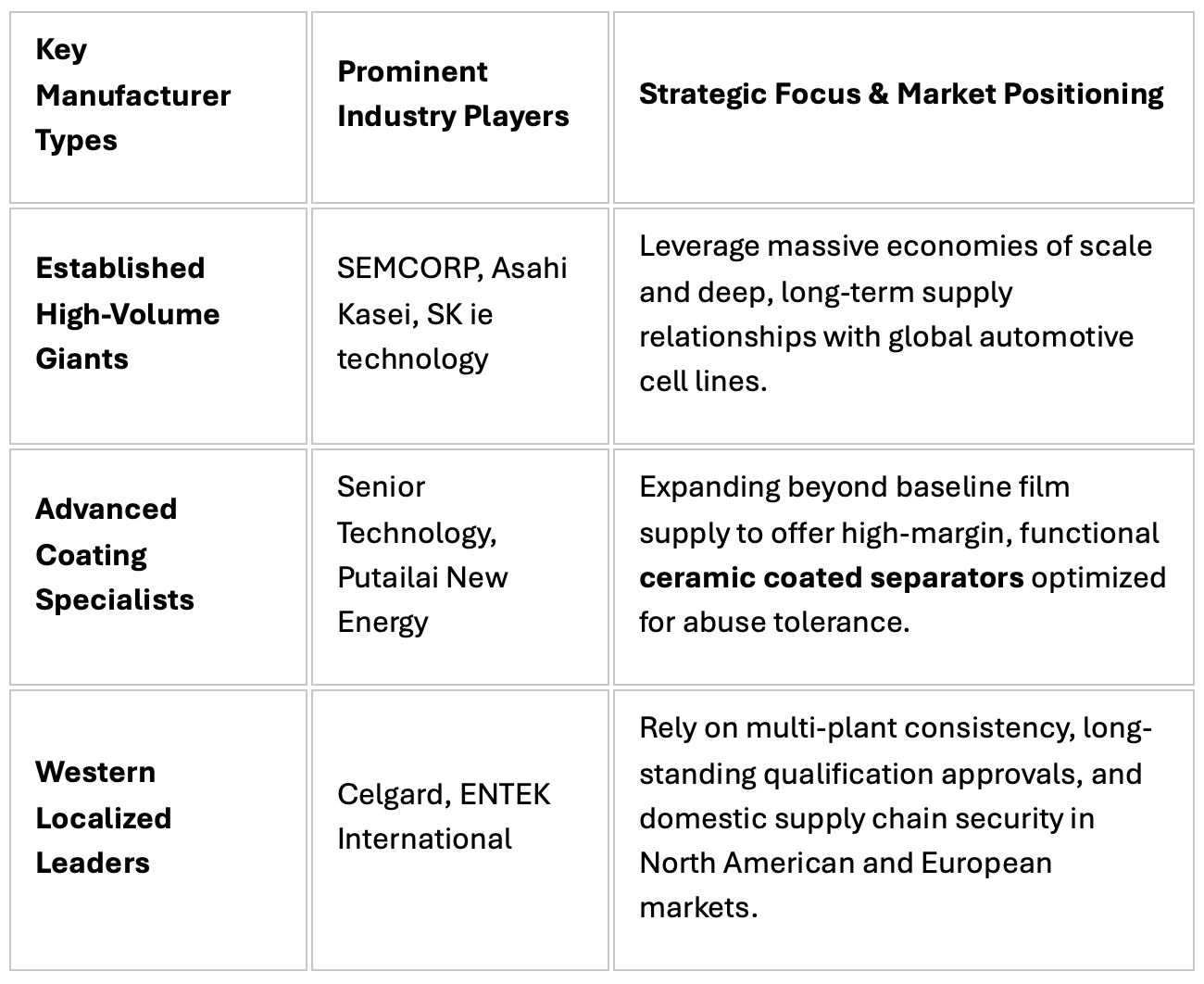
The global battery separator market remains highly competitive but relatively concentrated. Success depends less on production volume and more on long-term qualification with major battery manufacturers.
Because lithium-ion battery separators directly influence battery safety and reliability, battery producers rarely switch suppliers once a battery platform has been commercially validated, creating strong competitive advantages for established manufacturers.
Strategic Industry Developments
Several strategic investments and corporate restructuring activities are reshaping the market:
- Kingswood Capital Management acquired Daramic from Asahi Kasei, strengthening its focus on lead-acid battery separators.
- I Squared Capital invested in ENTEK to accelerate domestic
- ZIMT received the 2025 Gaogong Lithium Battery "Product of the Year" award for its advanced coated separator technologies.
- Sumitomo Chemical reorganized its Pervio heat-resistant separator business by consolidating manufacturing operations in South Korea while maintaining next-generation R&D activities in Japan.
As global electrification accelerates, demand for advanced battery membrane separators, porous separator films, EV battery separators, and high-performance lithium-ion battery separators will continue to increase, making innovation, manufacturing precision, and localized production the key competitive factors shaping the industry's future.
SNAPSHOT
The global battery separator market size is expected to grow at a CAGR of approximately 13.55% from 2025 to 2031.
The following factors are likely to contribute to the growth of global battery separator market during the forecast period:
- Expansion of EV Battery Production
- Growth in Energy Storage Installations
- Stricter OEM Safety Specifications
- Gigafactory Led Capacity Expansion
Base Year: 2025
Forecast Year: 2026-2031
The report examines the current state of the global battery separator market and its market dynamics through 2026−2031. It covers a detailed overview of several market growth enablers, restraints, and trends. The study covers both the demand and supply sides of the market. It also profiles and analyses leading companies and several other prominent companies operating in the market.
Key Company Profiles
- SEMCORP
- Business Overview
- Product Offerings
- Key Developments
- Key Strategies
- Key Strengths
- Key Opportunities
- Asahi Kasei Corporation.
- SK Group
- W-SCOPE Korea
Other Prominent Company Profiles
- Shenzhen Senior Technology Material Co., Ltd.
- Business Overview
- Product Offerings
- Toray Industries, Inc.
- Sumitomo Chemical
- Celgard LLC
- ENTEK
- Sinoma Science & Technology Co., Ltd.
- ZIMT
- Cangzhou Mingzhu Plastic Co., Ltd.
- Shanghai Putailai New Energy Technology Co., Ltd. (PTL)
- Hebei Gellec New Energy Technology Co., Ltd.
- UBE Corporation
- Teijin Limited
- Freudenberg Performance Materials
- Huiqiang New Energy
- Microporous
- Daramic
- Hollingsworth & Vose
- Ahlstrom
- Maxell, Ltd.
- Mitsubishi Paper Mills Limited
- Jiangsu Horizon New Energy Technology Co., Ltd.
- Beijing SOJO Electric Co., Ltd.
- Delfortgroup AG
- SWM International
- Yingkou Zhongjie Shida Separator Co., Ltd.
- Nippon Paper PAPYLIA Co., Ltd.
- Segmentation by Battery Chemistry
- Lithium-ion batteries
- Lead-acid batteries
- Nickel-based batteries
- Sodium-ion batteries
- Others
- Segmentation by Separator Material
- Polyethylene (PE)
- Polypropylene (PP)
- Multilayer polyolefin (PP/PE/PP)
- Nonwoven materials
- Ceramic-based materials
- Others
Segmentation by Manufacturing Process
- Wet process
- Dry process
- Others
Segmentation by Separator Thickness
- ≤ 10 µm
- 11–15 µm
- 16–20 µm
- 20 µm
Segmentation by Battery Form Factor
- Cylindrical cells
- Prismatic cells
- Pouch cells
Segmentation by End-Use Application
- Electric vehicles
- Consumer electronics
- Energy storage systems
- Industrial & other applications
Segmentation by Geography
- APAC
- China
- South Korea
- Japan
- India
- Thailand
- Indonesia
- Vietnam
- Malaysia
- Australia
- North America
- U.S.
- Canada
- Europe
- Poland
- Germany
- Hungary
- France
- UK
- Italy
- Spain
- Latin America
- Brazil
- Mexico
- Argentina
- Middle East & Africa
- Saudi Arabia
- UAE
- South Africa
- Morocco
BATTERY SEPARATOR MARKET FAQs
How big is the global battery separator market?
What is the growth rate of the global battery separator market?
Which region dominates the global battery separator market?
Who are the major players in the global battery separator market?
What are the key trends in the global battery separator market?
For more details, please reach us at [email protected]
- Chapter 1- Scope & Coverage
- Market Definition
- Inclusion
- Exclusions
- Market Estimation Caveats
- Market Derivation
- Market Segmentation by Battery Chemistry
- Market Segmentation by Separator Material
- Market Segmentation by Manufacturing Process
- Market Segmentation by Separator Thickness
- Market Segmentation by Battery Form Factor
- Market Segmentation by End-Use Application
- Chapter 2- Premium Insights
- Chapter 3- Market Dynamics
- Introduction
- Value Chain Analysis
- Product Architecture & Selection Logic
- Patent Activity Shaping Coating and Process Differentiation in Separators
- Government Regulations Shaping Battery Separators
- Market Opportunities & Trends
- Shift Toward Coated and Multilayer Battery Separators
- Customization Linked to Advanced Cell Designs
- Regionalization of Battery Separator Manufacturing
- Increasing Process Expertise and IP Concentration
- Market Growth Enablers
- Expansion of EV Battery Production
- Growth in Energy Storage Installations
- Stricter OEM Safety Specifications
- Gigafactory Led Capacity Expansion
- Market Restraints
- High Capital Intensity of Battery Separator Manufacturing
- Lengthy Qualification and Validation Cycles
- Persistent Pricing Pressure Across the Battery Value Chain
- Dependence on a Concentrated Customer Base
- Market Landscape
- Five Forces Analysis
- Chapter 4- Market Segmentation
- Battery Chemistry (Market Size & Forecast: 2022-2031)
- Lithium-ion batteries
- Lead-acid batteries
- Nickel-based batteries
- Sodium-ion batteries
- Others
- Separator Material (Market Size & Forecast: 2022-2031)
- Polyethylene (PE)
- Polypropylene (PP)
- Multilayer polyolefin (PP/PE/PP)
- Nonwoven materials
- Ceramic-based materials
- Others
- Manufacturing Process (Market Size & Forecast: 2022-2031)
- Wet process
- Dry process
- Others
- Separator Thickness (Market Size & Forecast: 2022-2031)
- ≤ 10 µm
- 11–15 µm
- 16–20 µm
- 20 µm
- Battery Form Factor (Market Size & Forecast: 2022-2031)
- Cylindrical cells
- Prismatic cells
- Pouch cells
- End-Use Application (Market Size & Forecast: 2022-2031)
- Electric vehicles
- Consumer electronics
- Energy storage systems
- Industrial & other applications
- Chapter 5- Geography Segmentation
- Geography Segmentation (Market Size & Forecast: 2022-2031)
- Geographic Overview – Market Maturity Index
- APAC
- China
- South Korea
- Japan
- India
- Thailand
- Indonesia
- Vietnam
- Malaysia
- Australia
- North America
- US
- Canada
- Europe
- Poland
- Germany
- Hungary
- France
- UK
- Italy
- Spain
- Latin America
- Brazil
- Mexico
- Argentina
- MEA
- Saudi Arabia
- UAE
- South Africa
- Morocco
- Chapter 6- Competitive Landscape
- Competitive Landscape
- Competition Overview
- Key Developments
- Key Company Profiles
- Other Prominent Company Profiles
- Report Summary
- Key Takeaways
- Strategic Recommendations
Select a license type that suits your business needs
Single User Licence
- Report accessible by one user only
- Free 10% or 3 days of customization
- Free post-sale service assistance
- Continuous support through email
5 User Licence
- Report accessible by 5 users within the organization
- Free 15% or 4.5 days of customization
- Continuous support through email and telephone
- Free analyst hour
- Free Upgrade: If an updated report published within 180 days of purchase, you will get the revised report free of charge
Corporate Licence
- Free Datasheet worth $1500
- Report accessible by the entire organization
- Free 20% or 6 days of customization
- Free post-sale service assistance
- Continuous support through email and telephone
- Direct access to lead analysts
- Free analyst hour
- Free Upgrade: If an updated report published within 180 days of purchase, you will get the revised report free of charge
Datasheet Licence
- Report accessible by 1 user only
- Free 15% or 32 hours of customization
- Free post-sale service assistance
- Direct access to lead analysts
Frequently Asked Questions
How big is the global battery separator market?
What is the growth rate of the global battery separator market?
Which region dominates the global battery separator market?
Who are the major players in the global battery separator market?
What are the key trends in the global battery separator market?
Other RELATED Reports
Global Electric Vehicle Battery Technology Market Research Report 2026-2031
Published : January 2026