
Europe Laboratory Information System (LIS) Market Research Report 2026-2031


121 pages

6 tables

21 charts

25 company

5 segments

1 region

6 countries
Purchase Options
Europe Laboratory Information System (LIS) Market Research Report 2026-2031
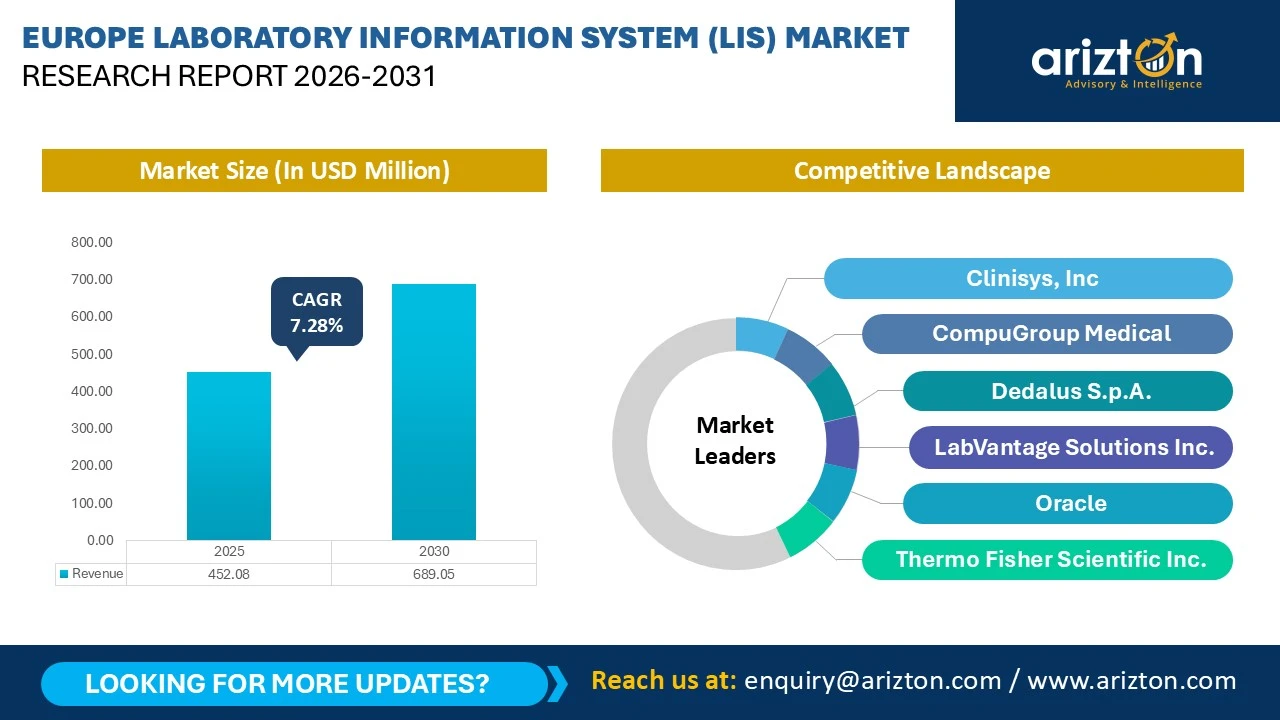
THE EUROPE LABORATORY INFORMATION SYSTEMS (LIS) MARKET WAS VALUED AT USD 452.08 MILLION IN 2025 AND IS PROJECTED TO REACH USD 689.05 MILLION BY 2031, GROWING AT A CAGR OF 7.28% DURING THE FORECAST PERIOD.
The Europe Laboratory Information System (LIS) Market Size, Share & Trends Analysis Report By
- Product Type: Integrated LIS and Standalone LIS
- Hosting: Cloud-Based, Hybrid, and On-Premises
- Component: Services and Software
- End-User: Hospital-Based Laboratories and Private Outpatient Laboratories
- Region: Germany, UK, France, Italy, Spain, Belgium
Industry Analysis Report, Regional Outlook, Growth Potential, Price Trends, Competitive Market Share & Forecast 2026–2031.
This report includes market data points, ranging from trend
analyses to market estimates & forecasts that you can customize
EUROPE LABORATORY INFORMATION SYSTEM (LIS) MARKET REPORT SCOPE
| REPORT ATTRIBUTE | DETAILS |
|---|---|
| MARKET SIZE (2031) | USD 689.05 Million |
| MARKET SIZE (2025) | USD 452.08 Million |
| CAGR (2025-2031) | 7.28% |
| HISTORIC YEAR | 2022-2024 |
| BASE YEAR | 2025 |
| FORECAST YEAR | 2026-2031 |
| SEGMENTS BY | Product Type, Hosting, Component, End-User, and Region |
| REGIONAL ANALYSIS | Germany, UK, France, Italy, Spain, Belgium |
| KEY PLAYERS | Clinisys, Inc., CompuGroup Medical, Dedalus S.p.A., LabVantage Solutions Inc., Oracle, and Thermo Fisher Scientific Inc. |
EUROPE LABORATORY INFORMATION SYSTEM MARKET ANALYSIS
The Europe laboratory information systems (LIS) market was valued at USD 452.08 million in 2025 and is expected to reach USD 689.05 million by 2031, expanding at a CAGR of 7.28% during the forecast period. Market growth is driven by increasing diagnostic test volumes, the rising adoption of molecular diagnostics, growing demand for improved diagnostic accuracy and laboratory workflow efficiency, and the increasing prevalence of chronic diseases. The integration of AI-enabled LIS with advanced data analytics, along with the growing adoption of cloud-based deployment and mobile accessibility, is further supporting market expansion. Looking ahead, the incorporation of AI-powered clinical decision support into standalone LIS platforms is expected to create new growth opportunities by enabling greater automation and precision in advanced diagnostic applications, including genomic mapping and liquid biopsy analysis.
KEY TAKEAWAYS
- Product Type: The integrated LIS segment accounted for the largest market share of around 68%.
- Hosting: The cloud-based segment shows the highest growth, with a CAGR of 8.69% during the forecast period.
- Component: The services segment dominates and holds the largest laboratory information systems (LIS) market share in Europe.
- End-User: The hospital-based laboratories segment dominates the end-user segmentation of the Europe LIS market.
- Region: Germany dominates the Europe laboratory information system (LIS) market with a share of around 23%.
Recent Product Developments in the European LIS Market
- In March 2026, LabVantage Solutions Inc. launched LabVantage Cortex, a specialized automation and AI layer. This next-generation solution targets the complex data needs of forensic and life sciences laboratories, utilizing cloud infrastructure to transform raw information into actionable business intelligence.
- In November 2025, Clinisys, Inc. released the 2025.2 update for its primary laboratory platform, the Clinisys Laboratory Solution (CLS). This latest iteration introduces new enhancements to the company's core informatics suite
LABORATORY INFORMATION SYSTEM (LIS) MARKET TRENDS
Cloud-based LIS Deployment
Traditional laboratory information systems (LIS) were primarily developed to manage text-based records, manual data entry, and physical sample tracking. However, the growing adoption of digital pathology, remote diagnostics, and whole slide imaging (WSI) is generating large volumes of image files, complex metadata, and AI-generated data that conventional systems may struggle to handle. Consequently, laboratories are increasingly adopting advanced digital pathology LIS platforms that integrate imaging systems, AI-powered analytical tools, and data management capabilities within a unified environment. This integration facilitates the efficient management of digital images, annotations, and patient information while improving workflow efficiency and supporting diagnostic accuracy.
AI-enabled LIS and Advanced Data Analytics
Cloud-based deployment is emerging as a significant trend in the Europe laboratory information systems (LIS) market. As laboratories consolidate into larger multi-site networks, cloud-based LIS solutions enable centralized data management by connecting multiple facilities through a unified platform, reducing the need for dedicated on-premise infrastructure at individual locations. This centralized model supports collaboration, streamlines laboratory workflows, and improves access to data across geographically distributed facilities.
The increasing adoption of advanced diagnostic technologies, including digital pathology and next-generation sequencing (NGS), is generating substantial volumes of complex data that require scalable storage and high-performance computing capabilities. Cloud infrastructure addresses these requirements by providing flexible, secure, and cost-effective data management solutions that can offer greater scalability than traditional on-premise systems.
EUROPE LABORATORY INFORMATION SYSTEM (LIS) MARKET DRIVERS
Growing Diagnostic Test Volumes and Molecular Diagnostics
Rising diagnostic test volumes and the increasing adoption of molecular diagnostics are key growth drivers for the Europe LIS market. Laboratories are upgrading outdated infrastructure to manage the growing volume and complexity of modern diagnostic testing. The combination of higher testing frequencies and increasingly complex genetic data is transforming LIS platforms from basic administrative tools into critical components of diagnostic workflows.
As genetic sequencing and molecular testing continue to expand, next-generation LIS solutions are expected to play an increasingly important role in integrating multi-omic data with conventional clinical information. At the same time, advances in AI and cloud-native technologies are helping laboratories manage increasingly complex testing requirements amid a persistent shortage of skilled laboratory personnel.
Europe's ageing population and rising prevalence of chronic diseases are also increasing demand for diagnostic services. To manage higher workloads, laboratories are adopting advanced automation technologies. Modern LIS platforms act as centralized systems for coordinating robotic equipment and automated analyzers, enabling laboratories to process large sample volumes with limited manual intervention.
Improving Diagnostic Accuracy and Workflow Efficiency
The growing focus on diagnostic accuracy and laboratory workflow efficiency is another key driver of the European LIS market. Errors during pre-analytical processes, including sample sorting and labeling, can affect diagnostic outcomes. Modern LIS platforms address these risks by integrating technologies such as RFID and barcoding to digitally verify samples and ensure that tests are associated with the correct patient.
LIS platforms are also evolving from conventional data repositories into advanced diagnostic support systems. Features such as delta checks, which compare current results with historical patient data, and clinical decision support (CDS) tools can help healthcare professionals interpret complex pathology and molecular diagnostic results more effectively.
Advanced LIS solutions can further improve laboratory productivity by automating reflex testing and using auto-validation to release routine results automatically. This allows laboratory personnel to focus on complex or high-risk cases while reducing operational delays. By helping minimize diagnostic bottlenecks and potentially reducing unnecessary extensions of patient hospital stays, modern LIS platforms are expected to support continued demand across the European healthcare sector during the forecast period.
INDUSTRY RESTRAINTS
Integration Challenges
System integration remains a significant challenge in the European LIS market due to the region's fragmented healthcare infrastructure, which includes legacy software systems and varying national healthcare standards. The complexity increases further as healthcare providers seek seamless cross-border data exchange and interoperability.
As laboratories consolidate and adopt greater levels of automation, differences in communication protocols and system architectures can create isolated data silos. These silos can limit workflow efficiency, restrict access to relevant patient information, and introduce potential risks to clinical accuracy and patient safety.
Addressing interoperability and integration challenges will therefore be essential for enabling seamless patient data exchange, supporting connected laboratory networks, and improving the overall efficiency of Europe's diverse healthcare infrastructure.
EUROPE LIS MARKET SEGMENTATION INSIGHTS
INSIGHT BY PRODUCT TYPE
The Europe laboratory information systems (LIS) market by product type is segmented into integrated LIS and standalone LIS. The integrated LIS segment accounted for the largest market share of around 68%. Integrated LIS systems create a centralized data repository by merging laboratory findings with billing, pharmacy data, and patient medical histories. This unified approach has made them the standard for major European medical centers and large-scale hospital networks. Integrated platforms are also well-suited to spearhead the implementation of the European Electronic Health Record Exchange Format (EEHRxF), facilitating the seamless and secure exchange of digital health information across the EU.
As the European market experiences increasing mergers and acquisitions by large diagnostic networks, there is a strong shift toward centralized IT governance. These organizations prefer to migrate acquired laboratories onto integrated platforms to ensure consistency across their entire service network, thereby driving the demand for LIS in the European market during the forecast period.
INSIGHT BY HOSTING
Based on the hosting, the cloud-based segment holds the largest Europe laboratory information systems (LIS) market share and shows the highest growth, with a CAGR of 8.69% during the forecast period. It is driven by several factors, including lower initial costs, scalability, remote access, automatic updates, and disaster recovery capabilities. In cloud-based hosting, the infrastructure enables laboratories to scale storage and computational power on demand during high-traffic periods, such as seasonal outbreaks or public health emergencies, without the need to invest in additional physical servers.
By adopting a cloud model, facilities can avoid the high costs associated with building on-site server rooms and maintaining dedicated hardware support teams, significantly reducing the initial financial burden of advanced software. Additionally, automated off-site backups ensure that critical patient records remain accessible even in the event of local hardware failures or physical damage to the facility, thereby driving the demand for LIS in the European market during the forecast period.
INSIGHT BY COMPONENT
Based on the component, the services segment dominates and holds the largest laboratory information systems (LIS) market share in Europe, driven by factors such as regulatory consulting, complex implementation processes, managed IT services, system integration, and continuous training. There is an ongoing need for integration services as laboratories work to connect their LIS with Electronic Health Records (EHR), billing systems, and Point-of-Care Testing (POCT) devices to build a coordinated digital ecosystem.
Transitioning from outdated legacy LIS to modern platforms is a complex process that requires specialized data migration and configuration services to ensure data accuracy and security during transfer. Additionally, due to high staff turnover in the diagnostic sector, laboratories require continuous training programs, which are essential for educating new technicians on system protocols and maintaining operational safety and efficiency.
INSIGHT BY END-USER
The hospital-based laboratories segment dominates the end-user segmentation of the Europe laboratory information system (LIS) market, driven by factors such as service centralization, interdisciplinary integration, acute care focus, infection control, and public health mandates. European hospital groups are increasingly consolidating separate facility laboratories into centralized core labs to reduce overhead, a shift that requires advanced multi-site LIS architectures capable of managing logistics and data across entire networks.
LIS technology also plays a critical role in tracking hospital-acquired infections (HAIs) and monitoring antimicrobial resistance patterns, with real-time data analysis enabling more effective infection control measures. To support comprehensive patient care, modern LIS platforms must seamlessly integrate with radiology, pharmacy, and oncology systems, ensuring that diagnostic information is readily accessible to the entire clinical team.
EUROPE LIS MARKET REGIONAL ANALYSIS
Germany dominates the Europe laboratory information system (LIS) market with a share of around 23%, driven by factors such as an ageing population, increasing adoption of digital and personalized medicine, rising chronic disease rates, robust healthcare infrastructure, government mandates for digital healthcare processes, and high R&D expenditure in medical technology. Germany maintains a leading position in the global healthcare landscape, allocating a larger share of its GDP to healthcare than any other European nation, consistently ranking among the top ten countries worldwide for per capita health expenditure and supporting a workforce of approximately 6.1 million professionals.
The expansion of Germany’s LIS market is further supported by shifting demographics, including declining birth rates and a rising maternal age. This trend is encouraging laboratories to move beyond basic testing volumes and focus on managing more complex, high-value diagnostic data.
The UK is the fastest-growing market in the Europe LIS sector, driven by factors such as the NHS's long-term digitization strategy, consolidation of pathology services, an extensive network of hospital laboratories, and mandates for unified LIS platforms across multiple hospital sites. The market is further shaped by the widespread integration of Electronic Health Records (EHR), the adoption of advanced laboratory informatics solutions, and a clear shift from on-premises systems to cloud-based LIS to enable multi-location access.
However, the UK LIS market faces challenges, including resistance to technological change among staff accustomed to legacy systems and significant budget constraints within the public healthcare system.
COMPETITIVE LANDSCAPE
The Europe laboratory information systems (LIS) market is moderately fragmented, with competition among established global vendors as well as regional and specialized solution providers. Market participants are focusing on product innovation, research and development, and strategic investments in digital pathology integration, cloud-based deployment, artificial intelligence (AI), and advanced data analytics to strengthen their competitive position.
Competition is particularly strong in the integrated LIS segment, where Electronic Health Record (EHR) providers are expanding their offerings to deliver seamless interoperability across hospital networks. Many vendors are also adopting direct sales strategies to improve customer engagement, enhance profit margins, and reduce reliance on fragmented distribution channels.
As laboratories accelerate their digital transformation initiatives, competitive differentiation is increasingly based on the ability to deliver seamless cloud migration, AI-enabled workflow automation, and advanced interoperability capabilities with existing healthcare IT systems. At the same time, niche vendors continue to maintain a strong market presence by offering specialized LIS solutions tailored to disciplines such as pathology, hematology, molecular diagnostics, and other laboratory specialties, providing greater functionality than generalized hospital information systems.
SNAPSHOT
The Europe laboratory information system (LIS) market size is expected to grow at a CAGR of approximately 7.28% from 2025 to 2031.
The following factors are likely to contribute to the growth of the Europe laboratory information system (LIS) market during the forecast period:
- Chronic Disease Prevalence
- Improving Diagnostic Accuracy and Workflow Efficiency
- Growing Diagnostic Test Volumes and Molecular Diagnostics
Base Year: 2025
Forecast Year: 2026-2031
The report examines the current state of the Europe laboratory information system (LIS) market and its market dynamics through 2026−2031. It covers a detailed overview of several market growth enablers, restraints, and trends. The study covers both the demand and supply sides of the market. It also profiles and analyses leading companies and several other prominent companies operating in the market.
Key Vendors
- Clinisys, Inc.
- CompuGroup Medical
- Dedalus S.p.A.
- LabVantage Solutions Inc.
- Oracle
- Thermo Fisher Scientific Inc.
Other Prominent Vendors
- Agilent Technologies, Inc.
- Autoscribe Informatics Limited (UK)
- Epic Systems Corporation
- Eusoft Srl
- Illumina, Inc.
- LabWare
- Magentus
- NEXUS AG
- NovoPath 360
- Soft Computer Consultants
- STARLIMS
- Sysmex Corporation
- AAC Infotray AG
- Cirdan
- LabOS
- Medical Information Technology, Inc.
- Technidata
- LabLynx
- Werfen
Segmentation by Product Type
- Integrated LIS
- Standalone LIS
Segmentation by Hosting
- Cloud-Based
- Hybrid
- On-Premises
Segmentation by Component
- Services
- Software
Segmentation by End-User
- Hospital-Based Laboratories
- Private Outpatient Laboratories
Segmentation by Geography
- EUROPE
- Germany
- UK
- France
- Italy
- Spain
- Belgium
EUROPE LABORATORY INFORMATION SYSTEM (LIS) MARKET FAQs
What is the growth rate of the Europe laboratory information systems (LIS) market?
How big is the Europe laboratory information system (LIS) market?
What are the key trends in the Europe laboratory information system (LIS) market?
Which region dominates the Europe laboratory information systems (LIS) market?
Which hosting segment provides more business opportunities in the Europe laboratory information systems (LIS) market?
Who are the major players in the Europe laboratory information system (LIS) market?
EXHIBIT 1 Europe LIS Market 2022-2031 ($ Million)
EXHIBIT 2 Europe LIS Market by Product Type 2022-2031 ($ Million)
EXHIBIT 3 Market by Integrated LIS 2022-2031 ($ Million)
EXHIBIT 4 Market by Standalone LIS 2022-2031 ($ Million)
EXHIBIT 5 Europe LIS Market by Hosting 2022-2031 ($ Million)
EXHIBIT 6 Market by Cloud-based 2022-2031 ($ Million)
EXHIBIT 7 Market by Hybrid 2022-2031 ($ Million)
EXHIBIT 8 Market by On-Premises 2022-2031 ($ Million)
EXHIBIT 9 Europe LIS Market by Component 2022-2031 ($ Million)
EXHIBIT 10 Market by Services 2022-2031 ($ Million)
EXHIBIT 11 Market by Software 2022-2031 ($ Million)
EXHIBIT 12 Europe LIS Market by End-User 2022-2031 ($ Million)
EXHIBIT 13 Market by Hospital-Based Laboratories 2022-2031 ($ Million)
EXHIBIT 14 Market by Private Outpatient Laboratories 2022-2031 ($ Million)
EXHIBIT 15 Europe LIS Market by Geography 2022-2031 ($ Million)
EXHIBIT 16 Germany LIS Market 2022-2031 ($ Million)
EXHIBIT 17 UK LIS Market 2022-2031 ($ Million)
EXHIBIT 18 France LIS Market 2022-2031 ($ Million)
EXHIBIT 19 Italy LIS Market 2022-2031 ($ Million)
EXHIBIT 20 Spain LIS Market 2022-2031 ($ Million)
EXHIBIT 21 Belgium LIS Market 2022-2031 ($ Million)
LIST OF TABLES
TABLE 1Europe LIS Market 2022-2031 ($ Million)
TABLE 2Europe LIS Market by Product Type segmentation 2022-2031 ($ Million)
TABLE 3Europe LIS Market by Hosting segmentation 2022-2031 ($ Million)
TABLE 4Europe LIS Market by Component segmentation 2022-2031 ($ Million)
TABLE 5Europe LIS Market by End-User segmentation 2022-2031 ($ Million)
TABLE 6Europe LIS Market by Geography 2022-2031 ($ Million)
CHAPTER – 1: Europe LIS Market Overview
- Executive Summary
- Key Findings
- Key Developments
CHAPTER – 2: Europe LIS Market Segmentation Data
- Product Type Market Insights (2022-2031)
- Integrated LIS
- Standalone LIS
- Hosting Market Insights (2022-2031)
- Cloud-Based
- Hybrid
- On-Premises
- Component Market Insights (2022-2031)
- Services
- Software
- End-User Market Insights (2022-2031)
- Hospital-Based Laboratories
- Private Outpatient Laboratories
CHAPTER – 3: Europe LIS Market Prospects & Opportunities
- Europe LIS Market Drivers
- Europe LIS Market Trends
- Europe LIS Market Constraints
CHAPTER – 4: Europe LIS Market Overview
- Europe LIS Market - Competitive Landscape
- Europe LIS Market - Key Players
- Europe LIS Market - Key Company Profiles
CHAPTER – 5: Appendix
- Research Methodology
- Abbreviations
- Arizton
Select a license type that suits your business needs
Single User Licence
- Report accessible by one user only
- Free 10% or 3 days of customization
- Free post-sale service assistance
- Continuous support through email
5 User Licence
- Report accessible by 5 users within the organization
- Free 15% or 4.5 days of customization
- Continuous support through email and telephone
- Free analyst hour
- Free Upgrade: If an updated report published within 180 days of purchase, you will get the revised report free of charge
Corporate Licence
- Free Datasheet worth $1500
- Report accessible by the entire organization
- Free 20% or 6 days of customization
- Free post-sale service assistance
- Continuous support through email and telephone
- Direct access to lead analysts
- Free analyst hour
- Free Upgrade: If an updated report published within 180 days of purchase, you will get the revised report free of charge
Datasheet Licence
- Report accessible by 1 user only
- Free 15% or 32 hours of customization
- Free post-sale service assistance
- Direct access to lead analysts
Frequently Asked Questions
What is the growth rate of the Europe laboratory information systems (LIS) market?
How big is the Europe laboratory information system (LIS) market?
What are the key trends in the Europe laboratory information system (LIS) market?
Which region dominates the Europe laboratory information systems (LIS) market?
Which hosting segment provides more business opportunities in the Europe laboratory information systems (LIS) market?
Who are the major players in the Europe laboratory information system (LIS) market?
Other RELATED Reports

U.S. Laboratory Information Management System (LIMS) Market - Focused Insights 2025-2030
Published : June 2025
