
Europe Neonatal Ventilators Market Research Report 2026-2031


127 pages

6 tables

27 charts

18 company

5 segments

1 region

12 countries
Purchase Options
Europe Neonatal Ventilators Market Research Report 2026-2031
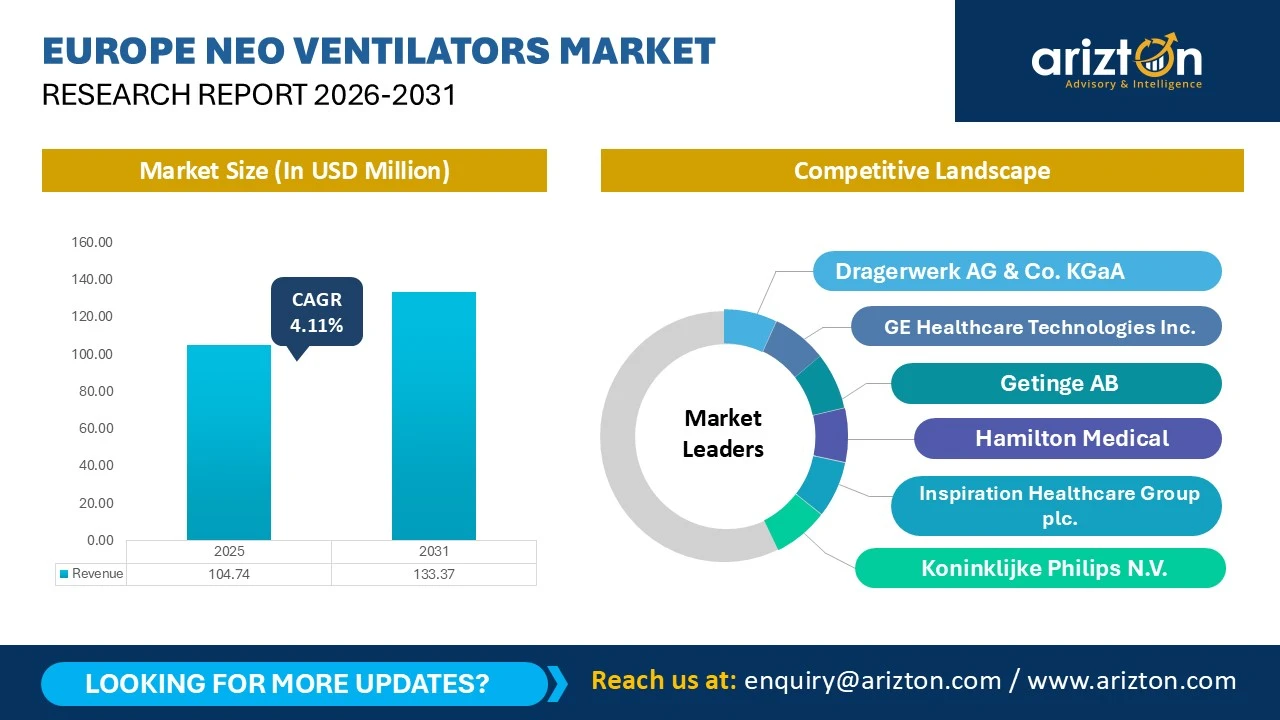
THE EUROPE NEONATAL VENTILATORS MARKET WAS VALUED AT USD 104.74 MILLION IN 2025 AND IS PROJECTED TO REACH USD 133.37 MILLION BY 2031, GROWING AT A CAGR OF 4.11% DURING THE FORECAST PERIOD.
The Europe Neonatal Ventilators Market Size, Share & Trends Analysis Report By
- Component: Consumables & Accessories and Devices
- Functionality: Non-invasive and Hybrid
- Mobility: Standalone and Portable
- End-User: Hospitals, Maternity & Specialty Care, and Other Users
- Region: Germany, UK, France, Italy, Spain, Poland, Netherlands, Belgium, Sweden, Switzerland, Austria, and Portugal
Industry Analysis Report, Regional Outlook, Growth Potential, Price Trends, Competitive Market Share & Forecast 2026–2031.
This report includes market data points, ranging from trend
analyses to market estimates & forecasts that you can customize
EUROPE NEONATAL VENTILATORS MARKET REPORT SCOPE
| REPORT ATTRIBUTE | DETAILS |
|---|---|
| MARKET SIZE (2031) | USD 133.37 Million |
| MARKET SIZE (2025) | USD 104.74 Million |
| CAGR (2025-2031) | 4.11% |
| HISTORIC YEAR | 2022-2024 |
| BASE YEAR | 2025 |
| FORECAST YEAR | 2026-2031 |
| SEGMENTS BY | Component, Functionality, Mobility, End-User, and Geography |
| REGIONAL ANALYSIS | Germany, UK, France, Italy, Spain, Poland, Netherlands, Belgium, Sweden, Switzerland, Austria, and Portugal |
| KEY PLAYERS | Dragerwerk AG & Co. KGaA, GE Healthcare Technologies Inc., Getinge AB, Hamilton Medical, Inspiration Healthcare Group plc., and Koninklijke Philips N.V |
Europe Neonatal Ventilators Market Size & Outlook
The Europe neonatal ventilators market was valued at USD 104.74 million in 2025 and is projected to reach USD 133.37 million by 2031, expanding at a CAGR of 4.11% during the forecast period.
The market is being driven by rising preterm birth rates, increasing maternal age at first childbirth, and the growing adoption of minimally invasive neonatal respiratory therapies. These factors are contributing to sustained demand for advanced respiratory support systems across neonatal intensive care units (NICUs) in Europe.
Product innovation is also transforming the market, with manufacturers moving beyond conventional fixed-parameter ventilators toward advanced adaptive and closed-loop systems. These technologies can respond to an infant’s respiratory and neural signals and dynamically adjust parameters such as PEEP, FiO₂, and airflow, supporting more personalized respiratory care. In addition, universal ventilator platforms designed to support a broad range of patients, from extremely premature infants to adults, are gaining attention as hospitals seek greater operational flexibility and cost efficiency.
Portable neonatal ventilators are also witnessing increasing adoption, supported by the need for reliable respiratory assistance during patient transfers across hospitals, clinics, and regionalized care networks. Government funding, EU-supported NICU infrastructure initiatives, and NGO programs focused on reducing infant mortality are further supporting market development across both mature and emerging European healthcare systems.
Europe records approximately 500,000 premature births annually, representing around 10% of total births. The substantial preterm population creates a consistent need for specialized neonatal respiratory support and provides a strong underlying demand base for advanced neonatal ventilation equipment across the region.
KEY TAKEAWAYS
- By Component: The consumables & accessories segment accounted for the largest market share of approximately 60% in 2025, driven by recurring single-use component demand across NICUs.
- By Functionality: The non-invasive neonatal ventilation segment is the fastest-growing, registering a CAGR of 5.17% during the forecast period, as clinicians prioritize lung-protective strategies and reduced intubation-related complications.
- By Mobility: The standalone segment holds the largest Europe neo ventilators market share in 2025, while portable ventilators represent the fastest-growing sub-segment.
- By End-User: The hospital segment accounts for the largest market share, driven by growing NICU admissions and high-risk pregnancy hospitalizations.
- By Geography: Germany is the largest revenue contributor with over 15% market share, followed by the UK and France..
Recent Developments in Europe Neo Ventilators Market
- In January 2025, Hamilton Medical launched HAMILTON‑HF90. It is offering a complete solution for high-flow oxygen therapy. It is an all‑in‑one device that helps to enhance patient comfort and support mobility.
- In February 2024, Getinge AB introduced Servo TwinView, a web-based platform that allows clinicians to monitor ventilator metrics from a distance.
Mergers & Acquisitions in Europe Neo Ventilators Market
- In July 2025, Philips formed strategic alliances with four major critical care firms—Getinge, Dräger, Hamilton Medical, and infusion technology leader B. Braun to optimize clinical workflows and improve patient care environments.
NICU EQUIPMENT DEMAND & INVESTMENT OPPORTUNITY
The European neonatal medtech investment environment presents compelling opportunities across both established and transitioning healthcare markets. Several converging structural forces are widening the addressable market for NICU equipment across the region.
- Government-led infant mortality reduction programs: Major European powers including France, Germany, and the UK are providing substantial funding for the upgrade of neonatal intensive care facilities. EU developmental initiatives are additionally facilitating the acquisition of high-end respiratory devices in Eastern Europe to align their medical capabilities with Western standards.
- Rising NICU admissions across Europe: The consistent growth of NICU capacity across Europe, driven by an increasing frequency of premature and high-risk births, is directly translating into stronger procurement demand for neonatal ventilators and respiratory disposables.
- UK regulatory and legislative tailwinds: The introduction of UK legislation providing up to 12 weeks of statutory neonatal care leave for parents of babies requiring intensive care reflects growing recognition of neonatal care needs, supporting investments in advanced NICU infrastructure. UKCA requirements under the MHRA and NHS procurement standards are further strengthening product quality and clinical safety standards.
EUROPE NEONATAL VENTILATORS MARKET TRENDS
Technological Advancements
Technological advancements are a key trend in the neonatal-ventilators market. This trend is majorly driven by factors including focus on improving survival rates, clinician workload & staff shortages, need to mitigate lung injury, modernisation of infrastructure, integration with quality dashboards & hospital IT, and rising incidence to preterm births. Modern neonatal ventilators leverage cutting-edge technology to prioritize lung-protective care, specifically designed to safeguard the delicate physiology of premature babies while reducing the incidence of chronic conditions like Bronchopulmonary Dysplasia (BPD). Recent technological advancements include adaptive & intelligent ventilation algorithms, non-invasive ventilation (NIV) enhancements, integrated monitoring & connectivity, transport optimization, graphical interfaces & decision support tools, synchronized patient triggering, etc. Modern medical advancements reduce the workload for clinical teams while maintaining precise, stable oxygenation for neonates. By offering diverse ventilation modes within a single platform, these devices allow for seamless transitions between therapies, optimizing efficiency during critical emergency interventions. Thus, advancement in technologies will be expected to drive the demand for neo ventilators in the European market during the forecast period.
Universal Ventilator Platforms
The European neonatal respiratory sector is seeing an evolution of a move towards universal ventilation platforms. This shift is motivated by the medical community's demand for greater clinical adaptability and the desire to streamline hospital workflows. By catering to diverse age groups, ranging from micro-preemies to adults, these adaptive systems offer hospitals greater clinical flexibility and cost-effectiveness. The companies are creating ventilators with extensive therapeutic versatility, enabling a single unit to serve diverse patient groups and adapt to multiple clinical environments. These adaptable systems facilitate a seamless transition between stationary bedside care and emergency transport across various hospital departments.
EUROPE NEONATAL VENTILATORS MARKET DRIVERS
Growing Demand for Minimally Invasive Treatments
Growing demand for minimally invasive treatments acts as a primary catalyst for the European neo ventilators market. It is driven by several factors that include technological integration, improved patient tolerance, ease of use & workflow, and reduction of chronic complications. Minimally invasive treatment methods in ventilation, specifically Bubble CPAP and High-Flow Nasal Cannula (HFNC)are preferred for their intuitive design, helping hospitals manage staffing gaps where specialized respiratory experts are scarce. By removing the need for an endotracheal tube, infants require fewer sedatives, which encourages immediate maternal bonding and the practice of Kangaroo Mother Care. Current European protocols for treating Respiratory Distress Syndrome (RDS) now advocate for Less Invasive Surfactant Administration (LISA). This method enables the delivery of surfactant while the infant is supported by non-invasive ventilation, such as CPAP.
Government & NGO Programs to Reduce Infant Mortality
Government & NGO Programs to reduce infant mortality are a major driver in the Europe neo ventilators market. It is driven by several factors that include NGO-led crisis reliance, direct procurement & subsidies, funding for R&D, financial risk mitigation, and infrastructure expansion. Major European powers, including France, Germany, and the UK, are focusing on improving newborn survival rates by providing substantial funding for the upgrade of intensive care facilities. Simultaneously, developmental initiatives supported by the European Union are facilitating the acquisition of high-end respiratory devices in Eastern Europe to align their medical capabilities with Western standards. The demand for sophisticated neonatal ventilators is rising as a direct result of government-backed initiatives to better equip and expand NICUs and NBSUs. By strengthening healthcare infrastructure through increased funding, authorities are ensuring that life-saving ventilation equipment is a staple in newly established newborn care centers.
INDUSTRY RESTRAINTS
Training & Skilled Staff Shortage
Training & Skilled Staff Shortage is one of the major challenges in the Europe neo ventilators market. It is due to the limited number of trained NICU professionals globally, limited neonatal ventilation is complex & high-risk, fear of misuse & legal risk, uneven distribution of killed staff, and high training & retaining costs. A lack of educational resources in low-income areas serves as a bottleneck for regional growth, as there are few experts available to train on-site staff. Consequently, the high-end features of modern respiratory systems often go unused, with operators defaulting to basic modes. This has forced vendors to integrate comprehensive clinical training packages into their sales models to ensure that advanced equipment can be utilized to its full potential. The sophisticated nature of technologies like High-Frequency Jet Ventilation (HFJV) demands an expert grasp of infant lung physiology. Because many facilities lack seasoned respiratory therapists or neonatologists, the use of such advanced hardware is often restricted to top-tier tertiary hospitals, limiting its reach in smaller clinics. A shortage of proficient healthcare professionals often compromises the standard of neonatal care, negatively impacting clinical outcomes and parental trust. Consequently, the challenge of recruiting a qualified workforce acts as a significant bottleneck, potentially stalling the adoption and market expansion of neo ventilators.
EUROPE NEONATAL VENTILATORS MARKET SEGMENTATION INSIGHTS
INSIGHT BY COMPONENT
The Europe neonatal ventilators market by component is segmented into consumables & accessories and devices. The consumables & accessories segment accounted for the largest market share of around 60%. The segment growth is a mature and stable market supported by strong neonatal care systems and high healthcare spending, though declining birth rates limit volume growth. This segment is experiencing an accelerating growth as the clinics and hospitals are focused on patient-specific and infection control interfaces for avoiding cross-contamination.
Although the consumables and accessories are low-cost, but it generate higher revenue and margin, as it required for each replaced ventilator and each patient. Adoption of specific consumables, such as low-dead-space circuits or specific nasal prongs, is driven by evidence around lowering nasal injury and clinician comfort.
INSIGHT BY FUNCTIONALITY
Based on the functionality, the non-invasive neonatal ventilation segment shows significant growth, with the fastest-growing CAGR of 5.17% during the forecast period, as clinicians prioritise lung-protective strategies, reduced intubation-related complications, and improved neonatal outcomes. The non-invasive modes include CPAP, BiPAP, high-flow nasal cannula therapy, and nasal intermittent positive pressure ventilation (NIPPV), allowing clinicians to provide continuous or intermittent support while preserving spontaneous breathing.
By eliminating the necessity for intubation, non-invasive methods markedly decrease the likelihood of respiratory tract injuries and healthcare-associated infections typically linked to invasive procedures. It fuels the growth of non-invasive ventilators in the European markets.
INSIGHT BY MOBILITY
Based on mobility, the standalone segment holds the largest Europe neo ventilators market share in 2025. Standalone ventilators are sophisticated, high-capacity machines engineered to provide continuous and intensive respiratory care within NICU environments. They command the largest device price points and generate multi-year installation and service contracts. These units are preferred in hospital settings due to their comprehensive features, high precision, and ability to support critically ill neonates requiring long-term respiratory assistance.
The portable neo ventilators segment is the fastest-growing within the mobility segmentation. Portable neonatal ventilators are battery-operated or lightweight devices designed for intrahospital transport, interfacility transfers by air or ambulance, and low-resource care settings. Hospitals are increasingly equipping transport and ambulance teams, as well as remote clinics, with portable ventilators to extend reliable neonatal respiratory support beyond centralized NICU environments.
INSIGHT BY END-USER
The Europe neonatal ventilators market by end user is segregated into hospitals, maternity & speciality care, and other users. The hospital segment accounted for the largest market share. It is driven by several factors includes the government funding for upgrading ageing ventilators, the growing number of ICU admissions for Neonates, and increasing high-risk pregnancies, which require immediate hospitalization as per the NICU stabilization. In 2023, there were almost 2.3 million hospital beds available across the EU.
These centers require neo ventilators with pressure/volume targeting, closed-loop features, leak compensation, and advanced monitoring. High patient throughput helps to generate the recurring revenue from filters, interfaces, and circuits.
The consistent growth of Neonatal Intensive Care Unit (NICU) capacity across Europe, necessitated by a rising frequency of premature births, is a primary driver for equipment demand. The hospitals spend more money on buying advanced multi-mode neo ventilators and make a purchase, including training, spare parts, and extended warranties. There is a rising demand for AI-enabled early warning systems for infection and apnea detection.
EUROPE NEO VENTILATORS MARKET REGIONAL ANALYSIS
Europe represents the second-largest market in the global neonatal ventilators market and is characterized by a current shift toward non-invasive, automated, and lung-protective respiratory technologies. The market is driven by technological advancements and automation, rising preterm birth incidence, government healthcare initiatives, funding programs, and national neonatal care policies.
Germany is the largest revenue contributor with over 15% market share, supported by a strong domestic OEM base, well-funded hospital systems, tight hospital procurement cycles, and a focus on evidence-based and training-led ventilation practices in tertiary centers.
The UK is the fastest-growing country in the Europe neo ventilators market, driven by active clinical research and adoption of closed-loop ventilation, strong neonatal transport networks, a large NHS market with centralized procurement cycles, and a growing regulatory emphasis on product quality and post-market surveillance under UKCA and MHRA frameworks.
France, Italy, Spain, and Poland represent additional growth markets, with EU-backed infrastructure funding increasingly supporting the acquisition of advanced neonatal respiratory devices across Eastern European healthcare systems.
EUROPE NEO VENTILATORS MARKET VENDOR LANDSCAPE
The Europe neo ventilators market features a fragmented yet competitive vendor landscape. Leading players maintain massive installed bases in NICUs across the region and operate strong global distribution networks. These companies are not merely selling neonatal ventilators — they are delivering integrated NICU solutions that include AI-driven data platforms, patient monitors, and comprehensive clinical training packages. Stringent regulatory requirements and high R&D costs create a significant barrier to entry that protects established players from new entrants.
Leading vendors are actively adopting AI and automation, racing to lead with closed-loop ventilators that automatically adjust pressure and oxygen levels based on a baby's real-time physiological needs. Chinese manufacturers are creating competitive pressure in emerging European markets by offering premium features at lower price points — posing a growing challenge to established Western brands in cost-sensitive segments.
- Drägerwerk AG & Co. KGaA (Germany): A dominant European player with comprehensive NICU ventilation and monitoring systems. Expanding its neonatal division with AI-powered tools.
- Hamilton Medical (Switzerland): Known for intelligent ventilation algorithms, including NAVA-enabled platforms. The HAMILTON-C6 Neo is purpose-built for neonatal ICUs. Launched the HAMILTON-HF90 high-flow oxygen therapy device in January 2025.
- Getinge AB (Sweden): Servo-type ventilators with NAVA and Edi monitoring are a clinical benchmark across European NICUs. Launched the Servo TwinView remote monitoring platform in February 2024. Entered a strategic alliance with Philips in July 2025.
- Koninklijke Philips N.V. (Netherlands): Formed strategic alliances in July 2025 with Getinge, Dräger, Hamilton Medical, and B. Braun to optimize critical care clinical workflows and patient care environments.
- Löwenstein Medical SE & Co. KG (Germany): A notable European manufacturer supporting technology refresh cycles and strengthening advanced neonatal ventilator adoption across European health systems.
SNAPSHOT
The Europe neonatal ventilators market size is expected to grow at a CAGR of approximately 4.11% from 2025 to 2031.
The following factors are likely to contribute to the growth of the Europe neo ventilators market during the forecast period:
- Rising Age of First-time Mothers
- Growing Demand for Minimally Invasive Treatments
- Government & NGO Programs to Reduce Infant Mortality
Base Year: 2025
Forecast Year: 2026-2031
The report examines the current state of the Europe neonatal ventilators market and its market dynamics through 2026−2031. It covers a detailed overview of several market growth enablers, restraints, and trends. The study covers both the demand and supply sides of the market. It also profiles and analyses leading companies and several other prominent companies operating in the market.
Key Vendors
- Dragerwerk AG & Co. KGaA
- Business Overview
- Product Offerings
- Key Developments
- Key Strategies
- Key Strengths
- Key Opportunities
- GE Healthcare Technologies Inc.
- Getinge AB
- Hamilton Medical
- Inspiration Healthcare Group plc.
- Koninklijke Philips N.V.
Other Prominent Vendors
- Air Liquide
- Business Overview
- Product Offerings
- ATOM MEDICAL Corp.
- Bunnell Incorporated
- Fritz Stephan GmbH
- ICU Medical, Inc.
- Leistung Equipamentos LTDA
- Lowenstein Medical SE & Co. KG
- Max Meditech Pvt. Ltd.
- Metran Co., Ltd.
- Nihon Kohden Corporation
- Shenzhen Mindray Bio-Medical Electronics Co., Ltd.
- Zoll Medical Corporation
Segmentation by Component
- Consumables & Accessories
- Devices
Segmentation by Functionality
- Non-invasive
- Hybrid
Segmentation by Mobility
- Standalone
- Portable
Segmentation by End-User
- Hospitals
- Maternity & Specialty Care
- Other Users
Segmentation by Geography
- EUROPE
- Germany
- UK
- France
- Italy
- Spain
- Poland
- Netherlands
- Belgium
- Sweden
- Switzerland
- Austria
- Portugal
EUROPE NEONATAL VENTILATORS MARKET FAQs
Which functionality segment provides more business opportunities in the Europe neonatal ventilators market?
What is the growth rate of the Europe neonatal ventilators market?
Which country dominates the Neonatal ventilators market in Europe?
How big is the Europe neonatal ventilators market?
Who are the major players in the Europe neonatal ventilators market?
EXHIBIT 1 Europe Neo Ventilators Market 2022-2031 ($ MN)
EXHIBIT 2 Europe Neo Ventilators Market by Component 2022-2031 ($ MN)
EXHIBIT 3 Market by Consumables & Accessories 2022-2031 ($ MN)
EXHIBIT 4 Market by Devices 2022-2031 ($ MN)
EXHIBIT 5 Europe Neo Ventilators Market by Functionality 2022-2031 ($ MN)
EXHIBIT 6 Market by Non-Invasive 2022-2031 ($ MN)
EXHIBIT 7 Market by Hybrid 2022-2031 ($ MN)
EXHIBIT 8 Europe Neo Ventilators Market by Mobility 2022-2031 ($ MN)
EXHIBIT 9 Market by Standalone 2022-2031 ($ MN)
EXHIBIT 10 Market by Portable 2022-2031 ($ MN)
EXHIBIT 11 Europe Neo Ventilators Market by End-User 2022-2031 ($ MN)
EXHIBIT 12 Market by Hospitality 2022-2031 ($ MN)
EXHIBIT 13 Market by Maternity & Specialty Care 2022-2031 ($ MN)
EXHIBIT 14 Market by Other Users 2022-2031 ($ MN)
EXHIBIT 15 Europe Neo Ventilators Market by Geography 2022-2031 ($ MN)
EXHIBIT 16 Germany Neo Ventilators Market 2022-2031 ($ MN)
EXHIBIT 17 UK Neo Ventilators Market 2022-2031 ($ MN)
EXHIBIT 18 France Neo Ventilators Market 2022-2031 ($ MN)
EXHIBIT 19 Italy Neo Ventilators Market 2022-2031 ($ MN)
EXHIBIT 20 Spain Neo Ventilators Market 2022-2031 ($ MN)
EXHIBIT 21 Poland Neo Ventilators Market 2022-2031 ($ MN)
EXHIBIT 22 Netherlands Neo Ventilators Market 2022-2031 ($ MN)
EXHIBIT 23 Belgium Neo Ventilators Market 2022-2031 ($ MN)
EXHIBIT 24 Sweden Neo Ventilators Market 2022-2031 ($ MN)
EXHIBIT 25 Switzerland Neo Ventilators Market 2022-2031 ($ MN)
EXHIBIT 26 Austria Neo Ventilators Market 2022-2031 ($ MN)
EXHIBIT 27 Portugal Neo Ventilators Market 2022-2031 ($ MN)
LIST OF TABLES
TABLE 1Europe Neo Ventilators Market 2022-2031 ($ MN)
TABLE 2Europe Neo Ventilators Market by Component segmentation 2022-2031 ($ MN)
TABLE 3Europe Neo Ventilators Market by Functionality segmentation 2022-2031 ($ MN)
TABLE 4Europe Neo Ventilators Market by Mobility segmentation 2022-2031 ($ MN)
TABLE 5Europe Neo Ventilators Market by End-User segmentation 2022-2031 ($ MN)
TABLE 6Europe Neo Ventilators Market by Geography 2022-2031 ($ MN)
CHAPTER – 1: Europe Neo Ventilators Market Overview
- Executive Summary
- Key Findings
- Key Developments
CHAPTER – 2: Europe Neo Ventilators Market Segmentation Data
- Component Market Insights (2022-2031)
- Consumables & Accessories
- Devices
- Functionality Market Insights (2022-2031)
- Non-invasive
- Hybrid
- Mobility Market Insights (2022-2031)
- Standalone
- Portable
- End-User Market Insights (2022-2031)
- Hospitals
- Maternity & Specialty Care
- Other Users
CHAPTER – 3: Europe Neo Ventilators Market Prospects & Opportunities
- Europe Neo Ventilators Market Drivers
- Europe Neo Ventilators Market Trends
- Europe Neo Ventilators Market Constraints
CHAPTER – 4: Europe Neo Ventilators Market Overview
- Europe Neo Ventilators Market -Competitive Landscape
- Europe Neo Ventilators Market - Key Players
- Europe Neo Ventilators Market - Key Company Profiles
CHAPTER – 5: Appendix
- Research Methodology
- Abbreviations
- Arizton
Select a license type that suits your business needs
Single User Licence
- Report accessible by one user only
- Free 10% or 3 days of customization
- Free post-sale service assistance
- Continuous support through email
5 User Licence
- Report accessible by 5 users within the organization
- Free 15% or 4.5 days of customization
- Continuous support through email and telephone
- Free analyst hour
- Free Upgrade: If an updated report published within 180 days of purchase, you will get the revised report free of charge
Corporate Licence
- Free Datasheet worth $1500
- Report accessible by the entire organization
- Free 20% or 6 days of customization
- Free post-sale service assistance
- Continuous support through email and telephone
- Direct access to lead analysts
- Free analyst hour
- Free Upgrade: If an updated report published within 180 days of purchase, you will get the revised report free of charge
Datasheet Licence
- Report accessible by 1 user only
- Free 15% or 32 hours of customization
- Free post-sale service assistance
- Direct access to lead analysts
Frequently Asked Questions
Which functionality segment provides more business opportunities in the Europe neonatal ventilators market?
What is the growth rate of the Europe neonatal ventilators market?
Which country dominates the Neonatal ventilators market in Europe?
How big is the Europe neonatal ventilators market?
Who are the major players in the Europe neonatal ventilators market?

