

Flexible Packaging Market Growth Insights – Driven by Rising Demand for Convenient, Lightweight, and Sustainable Packaging Solutions Across Food, Beverage, Healthcare, Personal Care, and Consumer Goods Industries (2026–2031)
Published Date : June 2026
Last Updated : September 2026
format: PDF
edition : Sixth Edition

320 pages

80 company

5 segments

5 region

30 countries
Purchase Options
Global Flexible Packaging Market Research Report 2026-2031
THE GLOBAL FLEXIBLE PACKAGING MARKET WAS VALUED AT USD 242 BILLION IN 2025 AND IS EXPECTED TO REACH USD 320.57 BILLION BY 2031, GROWING AT A CAGR OF 4.80%.
The Flexible Packaging Market Size, Share & Trends Analysis Report By
- Product: Bags & Sacks, Pouches, and Others
- Material: Flexible Plastic, Flexible Paper, and Foil
- Application: Consumer Packaging and Industrial Packaging
- Consumer Flexible Packaging: Bakery & Confectionery, Meat, Poultry & Seafood, Dairy, RTE, Frozen Food, Healthcare, Personal Care, Tea & Coffee, Pet Food, and Others
- Geography: North America, Europe, APAC, Latin America, and Middle East & Africa
Industry Analysis Report, Regional Outlook, Growth Potential, Price Trends, Competitive Market Share & Forecast 2026–2031.
This report includes market data points, ranging from trend
analyses to market estimates & forecasts that you can customize
FLEXIBLE PACKAGING MARKET REPORT SCOPE
| REPORT ATTRIBUTE | DETAILS |
|---|---|
| MARKET SIZE (2031) | USD 320.57 Billion |
| MARKET SIZE (2025) | USD 242 Billion |
| CAGR (2025-2031) | 4.80% |
| HISTORIC YEAR | 2022-2024 |
| BASE YEAR | 2025 |
| FORECAST YEAR | 2026-2031 |
| SEGMENTS BY | Product, Material, Application, Consumer Flexible Packaging, and Geography |
| GEOGRAPHIC ANALYSIS | North America, Europe, APAC, Latin America, & Middle East & Africa |
| KEY PLAYERS | Amcor, Berry Global Inc., Mondi Group, Sealed Air, Transcontinental Inc., Sonoco Products Company, Huhtamaki, Ahlstrom, Smurfit Westrock, and AptarGroup, Inc. |
FLEXIBLE PACKAGING MARKET SIZE ANALYSIS
The global flexible packaging market was valued at USD 242 billion in 2025 and is expected to reach USD 320.57 billion by 2031, growing at a CAGR of 4.80%. Growth is being supported by rising demand for lightweight, convenient, customizable, and cost-efficient packaging across food and beverages, personal care, healthcare, household, and industrial applications.
For packaging manufacturers and converters, the opportunity is no longer limited to increasing production volumes. Material selection, packaging formats, sustainability, performance, and application requirements are becoming important factors in winning new business.
Printed flexible packaging continues to be widely used for brand differentiation and product visibility. At the same time, monolayer and mono-material structures are gaining attention as brands look for packaging that can support recycling and downgauging while maintaining the required strength and barrier performance. This shift is creating opportunities for companies that can offer sustainable solutions without compromising product protection, shelf life, or cost.
The change in customer expectations is already visible in the market. Shorr Packaging’s 2025 consumer study found that 90% of consumers are more likely to buy from brands using sustainable packaging, while 54% had consciously purchased products with sustainable packaging in the previous six months. For packaging suppliers, this points to a clear need to understand how sustainability is influencing brand and packaging decisions — and where customers are willing to shift to alternative materials or formats.
Shelf-life extension is another important area of opportunity. Packaging that protects products from oxygen, moisture, and contamination can help reduce product loss and improve supply-chain efficiency. The need is significant: UNEP estimates that food loss and waste contributes 8%–10% of global greenhouse gas emissions. This strengthens the role of high-performance flexible packaging in applications where product protection directly affects waste, cost, and sustainability targets.
E-commerce is also changing packaging requirements. Brands and retailers are looking for lighter, right-sized, and lower-waste formats that can withstand distribution while reducing material use. Amazon, for example, has avoided 4.2 million metric tons of packaging materials since 2015 and reduced its global single-use plastic delivery packaging by 16.4% in 2024. These developments indicate where large-scale buyers are directing packaging innovation and where suppliers may need to adapt their product portfolios.
Healthcare and pharmaceutical applications provide another growth avenue, particularly for packaging that offers sterility, product protection, ease of use, and reliable barrier performance. Together with food, e-commerce, personal care, and household applications, these segments are creating different requirements for materials, formats, and packaging performance.
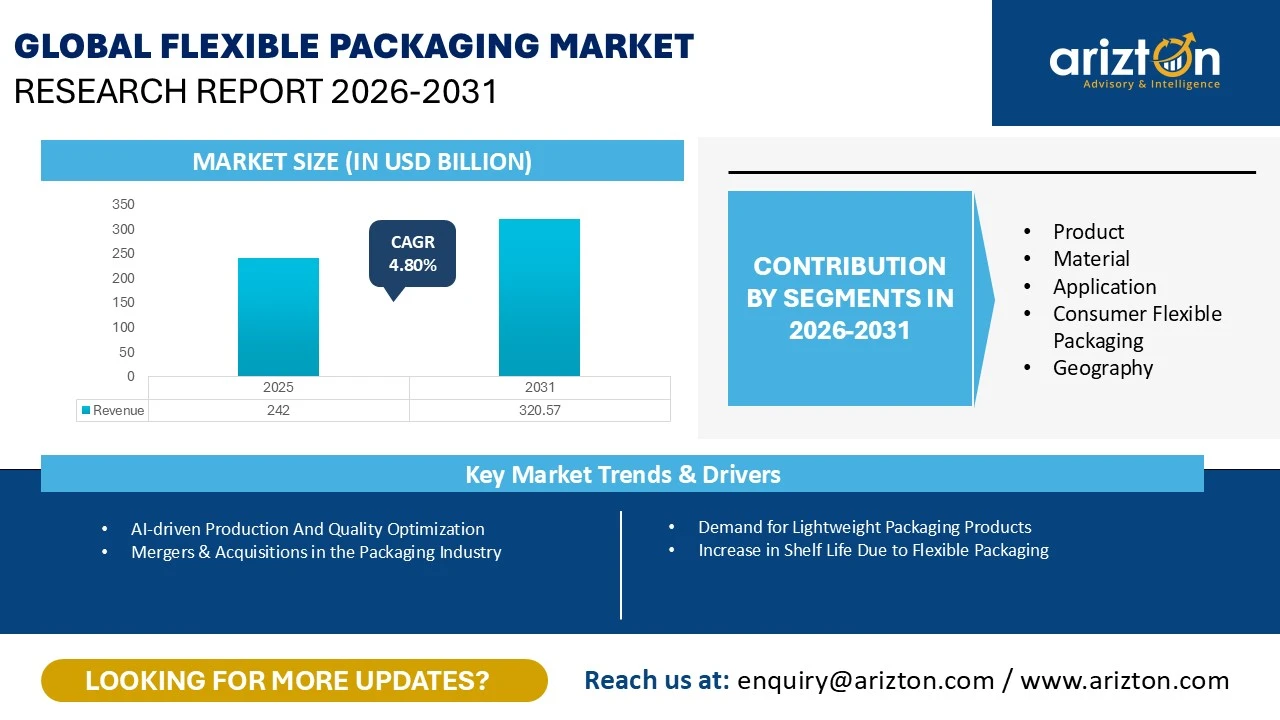
Key Takeaways
- Product: The bags & sacks accounted for the largest market share of around 43%.
- Material: The flexible paper is expected to grow at a CAGR of 4.73% during 2025–2031.
- Application: The industrial packaging segment accounted for the second-largest global flexible packaging market share in 2025.
- Consumer Flexible Packaging: The bakery & confectionery segment dominates and holds the largest market share.
- Geography: The APAC flexible packaging market accounted for the largest market share of around 38%.
Mergers & Acquisitions in the Flexible Packaging Market
- In April 2025, Amcor completed its merger with Berry Global, expanding its global scale across consumer and healthcare packaging and strengthening its flexible packaging footprint.
- In April 2025, TOPPAN completed the acquisition of Sonoco's Thermoformed & Flexibles Packaging business for approximately $1.8 billion, accelerating its global expansion in sustainable packaging.
- In March 2026, Amcor partnered with DCM to introduce recycle-ready mono-PE fertilizer packaging in Europe with 35% post-consumer recycled content. The new flexible packaging replaces a previous multi-material structure, supports existing recycling streams, reduces the carbon footprint by 17%, and strengthens Amcor's position in sustainable industrial and specialty flexible packaging.
Recent Product Developments in the Flexible Packaging Market
- In February 2025, Berry Global unveiled its next-generation Bontite Sustane Stretch Film with 30% certified post-consumer recycled content. The film supports palletized goods across logistics, food & beverage, retail, manufacturing, pharmaceuticals, and e-commerce, while improving load stability, reducing reliance on virgin plastic, and supporting recyclable PE film applications where collection systems exist.
FLEXIBLE PACKAGING MARKET TRENDS & ENABLERS
Sustainability is becoming a key factor driving the evolution of the flexible packaging market as manufacturers increasingly adopt recyclable, downgauged, compostable, and mono-material packaging solutions to comply with regulatory requirements and meet changing consumer preferences. These innovations are enabling packaging converters to improve material efficiency while supporting brand owners in achieving circular economy and sustainability objectives. Greater collaboration among raw material suppliers, packaging converters, and equipment manufacturers is also accelerating the commercialization of recyclable laminate structures across food, personal care, and household product applications.
The growing preference for lightweight packaging is further supporting market expansion by reducing material consumption, transportation costs, and carbon emissions. According to Flexible Packaging Europe, flexible packaging offers a packaging-to-product ratio that is 5 to 10 times lower than many conventional rigid packaging formats. This provides significant advantages for high-volume consumer goods by improving freight efficiency, optimizing resource utilization, and lowering overall packaging costs while supporting sustainability goals.
The ability to extend product shelf life remains one of the strongest value propositions of flexible packaging. Advanced barrier materials protect products from oxygen, moisture, light, and contamination, helping preserve freshness, quality, and safety throughout storage and distribution. This is particularly critical for food, fresh produce, pharmaceuticals, and pet food, where minimizing spoilage directly improves profitability and reduces waste. According to the United Nations Environment Programme (UNEP), food loss and waste contribute approximately 8%–10% of global greenhouse gas emissions, highlighting the growing importance of protective packaging solutions that enhance shelf life and support global sustainability efforts.
INDUSTRY RESTRAINTS
- Raw material volatility restrains the flexible packaging market size by raising costs for packaging converters across resins, films, adhesives, paper, and board. Flexible Packaging Europe, an industry association representing the European flexible packaging sector, reported that high-density polyethylene (HDPE) and low-density polyethylene (LDPE) prices increased by 3% and 4%, respectively, in Q1 2025 versus Q4 2024, making sourcing discipline, pricing pass-through, and inventory planning important for companies and converters globally. This cost pressure is particularly pronounced in the north america flexible packaging market, where converters serve high-volume, margin-sensitive categories across food, household, and industrial segments.
FLEXIBLE PACKAGING MARKET SEGMENTAL INSIGHTS
INSIGHTS BY PRODUCT
The product type segment comprises bags & sacks, pouches, and other flexible packaging formats, highlighting their extensive use across bulk packaging, consumer goods, refill packs, e-commerce shipments, and specialized protective applications.
Bags & sacks held the largest share of the global flexible packaging market in 2025, driven by strong demand from the food, agriculture, construction, chemicals, and industrial sectors. These packaging formats offer high strength, efficient storage, and cost-effective transportation for bulk products. According to the Food and Agriculture Organization (FAO), global cereal utilization is projected to reach 2,946 million tonnes in the 2025/26 marketing year, supporting sustained demand for durable and high-capacity packaging solutions used for grains, food products, and other bulk commodities.
INSIGHT BY MATERIAL
Based on material, the flexible paper segment is projected to witness steady growth during the forecast period, driven by increasing demand for recyclable and lower-plastic packaging solutions across food, bakery, confectionery, personal care, and dry goods applications. Paper-based flexible packaging combines sustainability with essential functional benefits such as lightweight construction, excellent printability, ease of handling, and compatibility with a wide range of formats, including pouches, sachets, wraps, and flow packs.
Growth in this segment is further supported by the expansion of e-commerce, packaged snacks, coffee, pet food, personal care, and dry food products, where lightweight and space-efficient packaging is increasingly preferred. Paper-based pouches and mailer-style packaging help reduce storage and transportation requirements while providing brands with a stronger sustainability profile, making them an attractive alternative to conventional plastic-based flexible packaging solutions.
INSIGHT BY APPLICATION
Based on application, the industrial packaging segment held the second-largest share of the global flexible packaging market in 2025. Demand is driven by industries such as chemicals, construction materials, agriculture, processed goods, and export logistics, where flexible packaging solutions provide strength, durability, and cost efficiency. Products including form-fill-seal bags, liners, heavy-duty sacks, and protective films help reduce packaging weight while ensuring safe product containment, efficient handling, and reliable transportation. These advantages continue to support the adoption of flexible packaging across industrial supply chains focused on operational efficiency and logistics performance.
Industrial packaging also plays a critical role in maintaining product quality and workplace safety. It helps manufacturers comply with regulatory standards for safe handling, storage, and transportation while protecting products from contamination, moisture, and physical damage throughout the supply chain. Durable packaging solutions, such as heavy-duty bags and corrugated shipping materials, contribute to secure product delivery, reduced losses, and improved supply chain reliability.
FLEXIBLE PACKAGING MARKET GEOGRAPHICAL ANALYSIS
The Asia-Pacific (APAC) flexible packaging market is projected to register the fastest growth during the forecast period, driven by rising demand for packaged food and beverages, rapid urbanization, expanding e-commerce, supportive sustainability initiatives, and increasing investments in packaging conversion facilities. The region continues to offer significant growth opportunities for packaging converters, raw material suppliers, film manufacturers, and consumer goods companies expanding their production capacity.
China and India remain the primary growth engines of the APAC market due to their large consumer populations, expanding packaged food industries, flourishing e-commerce sectors, and growing domestic manufacturing capabilities. The rapid increase in online retail is driving demand for lightweight, durable, and shipment-ready flexible packaging solutions that enhance product protection while reducing logistics costs.
In Europe, market growth is increasingly influenced by sustainability regulations, circular economy initiatives, and rising demand for recyclable packaging materials. Brand owners are accelerating the transition toward environmentally responsible packaging solutions that reduce plastic consumption and improve recyclability. According to Eurostat, the European Union generated 35.3 kilograms of plastic packaging waste per person in 2023, highlighting the need for packaging formats that support waste reduction and recycling objectives.
Germany remains one of Europe's leading flexible packaging markets, supported by its well-established food processing industry, strong pharmaceutical sector, advanced recycling infrastructure, and mature packaging manufacturing ecosystem. Increasing adoption of mono-material packaging, recyclable laminates, and circular packaging designs is reinforcing market growth as manufacturers align with the country's stringent sustainability and recycling requirements.
FLEXIBLE PACKAGING MARKET VENDOR LANDSCAPE
The flexible packaging market remains highly fragmented, comprising a mix of large multinational corporations and numerous regional or niche players across the world. While global players continue to lead through advanced technologies, economies of scale, and extensive distribution networks, local manufacturers still compete by offering customization, cost advantages, and faster turnaround times.
Competition is fueled by rapid innovation in materials, barrier technologies, and sustainability-driven R&D. Players continue to invest in developing recyclable, mono-material, and other advanced flexible packaging solutions to meet regulatory and consumer demands. This is particularly evident in the medical flexible packaging market, where sterility requirements and compliance standards are raising the bar for material performance and traceability.
Flexible packaging companies are competing by offering high customization, short-run capabilities, and digital printing solutions. This remains particularly important in industries such as snacks, pet food, and cosmetics, where brand differentiation and faster product launches are key.
Major firms are actively using mergers and acquisitions to enter new regions, broaden product portfolios, and strengthen production capabilities. Consolidation is becoming an important route to build scale, improve material innovation, and serve multinational customers that require consistent quality, compliance, and supply reliability across multiple packaging markets.
Sustainability has become a core competitive battleground. Firms that offer lightweight, recyclable, and mono-material packaging continue to gain advantage, especially in Europe and North America, where regulatory pressure and customer expectations remain strong.
SNAPSHOT
The global flexible packaging market size is expected to grow at a CAGR of approximately 4.80% from 2025 to 2031.
The following factors are likely to contribute to the growth of the global flexible packaging market during the forecast period:
- Increasing Workplace Safety Regulations
- Rising Healthcare Demand
- Rising Industrialization and Infrastructure Booms
Base Year: 2025
Forecast Year: 2026-2031
The report examines the current state of the global flexible packaging market and its market dynamics through 2026−2031. It covers a detailed overview of several market growth enablers, restraints, and trends. The study covers both the demand and supply sides of the market. It also profiles and analyses leading companies and several other prominent companies operating in the market.
Key Vendors
- Amcor
- Berry Global Inc.
- Mondi Group
- Sealed Air
- Transcontinental Inc.
- Sonoco Products Company
- Huhtamaki
- Ahlstrom
- Smurfit Westrock
- AptarGroup, Inc.
Other Prominent Vendors
- All4Labels
- Aluberg S.p.A.
- American Packaging Corporation
- Aran Group
- Bioplast
- Bischof+Klein SE & Co. KG
- Bühler
- Carcano Antonio S.p.A.
- CCL Industries Inc.
- Cellografica Gerosa S.p.A.
- Cosmo Films
- Coveris
- Danaflex
- DazPak
- Di Mauro Officine Grafiche S.p.A.
- Eco Flexibles
- ePac Holdings, LLC
- Etapak
- Eurofoil Luxembourg S.A.
- FlexPack
- Gascogne Flexible
- Glenroy, Inc.
- Global-Pak, Inc.
- Goglio S.p.A.
- Grupo Lantero
- Guala Pack
- Innovia Films
- International Paper
- Industria Termoplastica Pavese (ITP)
- O. Kleiner AG
- Korozo Group
- Krajcár Packaging Ltd.
- LEEB GmbH & Co. KG
- Notpla Limited
- Novolex
- Perlen Packaging
- Plastic Suppliers Inc.
- Plastixx FFS Technologies
- Polypak Packaging
- Printpack
- ProAmpac
- Pro-Pac Packaging Limited
- Reynolds Group Ltd.
- Ringmetall
- RKW Group
- Rockwell Solutions
- Saica
- SCHMID FOLIEN GmbH & Co. KG
- Schur
- SIG
- Sigma Plastics Group
- Stora Enso
- Südpack
- Symetal
- Reflex Group
- UFlex Limited
- Walki Group Oy
- Winpak Ltd.
- Wipf AG
- Constantia Flexibles
- TOPPAN Holdings
- SCG Packaging (SCGP)
- Jindal Films
- Oben Group
- Elif
- PPC Flex
- C-P Flexible Packaging
- Accredo Packaging
- KM Packaging
- Liquibox
Segmentation by Product
- Bags & Sacks
- Pouches
- Others
Segmentation by Material
- Flexible Plastic
- Flexible Paper
- Foil
Segmentation by Application
- Consumer Packaging
- Industrial Packaging
Segmentation by Consumer Flexible Packaging
- Bakery & Confectionery
- Meat, Poultry & Seafood
- Dairy
- RTE
- Frozen Food
- Healthcare
- Personal Care
- Tea & Coffee
- Pet Food
- Others
Segmentation by Geography
- North America
- US
- Canada
- APAC
- China
- India
- Japan
- Australia
- South Korea
- Indonesia
- Vietnam
- Thailand
- New Zealand
- Europe
- Germany
- UK
- France
- Italy
- Benelux
- Scandinavia
- Spain
- Poland
- Switzerland
- Austria
- Latin America
- Brazil
- Mexico
- Argentina
- Chile
- Middle East & Africa
- Turkey
- Egypt
- Saudi Arabia
- UAE
- South Africa
FLEXIBLE PACKAGING MARKET FAQs
How big is the global flexible packaging market?
What is the growth rate of the global flexible packaging market?
What are the key trends in the global flexible packaging market?
Which region dominates the global flexible packaging market?
Who are the major players in the global flexible packaging market?
For more details, please reach us at [email protected]
- Chapter 1- Scope & Coverage
- Market Definition
- Inclusion
- Exclusions
- Market Estimation Caveats
- Market Derivation
- Market Segmentation by Product
- Market Segmentation by Material
- Market Segmentation by Application
- Market Segmentation by Consumer Flexible Packaging
- Chapter 2- Premium Insights
- Chapter 3- Market Dynamics
- Introduction
- Product Architecture and Design Intelligence
- End-Use Market Trends and Demand Linkages
- Value Chain and Industry Ecosystem Analysis
- Technology and Material Innovation Outlook
- AI and Digital Enablement in Flexible Packaging
- Market Opportunities & Trends
- Increased Focus on Sustainable Flexible Packaging
- AI-driven Production and Quality Optimization
- Rising Demand for E-commerce-optimized Flexible Packaging
- Mergers & Acquisitions in the Packaging Industry
- Market Growth Enablers
- Demand for Lightweight Packaging Products
- Increase in Shelf Life due to Flexible Packaging
- Increasing Demand from Healthcare & Pharmaceutical Sectors
- Market Restraints
- Rise in Cost of Raw Materials
- Perishability of Packaging Materials
- Recycling Challenges with Flexible Packaging Products
- Market Landscape
- Five Forces Analysis
- Chapter 4- Market Segmentation
- Product (Market Size & Forecast: 2022-2031)
- Bags & Sacks
- Pouches
- Others
- Material (Market Size & Forecast: 2022-2031)
- Flexible Plastic
- Flexible Paper
- Foil
- Application (Market Size & Forecast: 2022-2031)
- Consumer Packaging
- Industrial Packaging
- Consumer Flexible Packaging (Market Size & Forecast: 2022-2031)
- Bakery & Confectionery
- Meat, Poultry & Seafood
- Dairy
- RTE
- Frozen Food
- Healthcare
- Personal Care
- Tea & Coffee
- Pet Food
- Others
- Chapter 5- Geography Segmentation
- Geography Segmentation (Market Size & Forecast: 2022-2031)
- Geographic Overview – Market Maturity Index
- APAC
- China
- India
- Japan
- Australia
- South Korea
- Indonesia
- Vietnam
- Thailand
- New Zealand
- North America
- US
- Canada
- Europe
- Germany
- UK
- France
- Italy
- Benelux
- Scandinavia
- Spain
- Poland
- Switzerland
- Austria
- Latin America
- Brazil
- Mexico
- Argentina
- Chile
- MEA
- Turkey
- Egypt
- Saudi Arabia
- UAE
- South Africa
- Chapter 6- Competitive Landscape
- Competitive Landscape
- Competition Overview
- Key Developments
- Market Share Analysis
- Key Company Profiles
- Other Prominent Company Profiles
- Report Summary
- Key Takeaways
- Strategic Recommendations
Select a license type that suits your business needs
Single User Licence
- Report accessible by one user only
- Free 10% or 3 days of customization
- Free post-sale service assistance
- Continuous support through email
5 User Licence
- Report accessible by 5 users within the organization
- Free 15% or 4.5 days of customization
- Continuous support through email and telephone
- Free analyst hour
- Free Upgrade: If an updated report published within 180 days of purchase, you will get the revised report free of charge
Corporate Licence
- Free Datasheet worth $1500
- Report accessible by the entire organization
- Free 20% or 6 days of customization
- Free post-sale service assistance
- Continuous support through email and telephone
- Direct access to lead analysts
- Free analyst hour
- Free Upgrade: If an updated report published within 180 days of purchase, you will get the revised report free of charge
Datasheet Licence
- Report accessible by 1 user only
- Free 15% or 32 hours of customization
- Free post-sale service assistance
- Direct access to lead analysts
Frequently Asked Questions
How big is the global flexible packaging market?
What is the growth rate of the global flexible packaging market?
What are the key trends in the global flexible packaging market?
Which region dominates the global flexible packaging market?
Who are the major players in the global flexible packaging market?