




Global HVAC Market Research Report 2026-2031
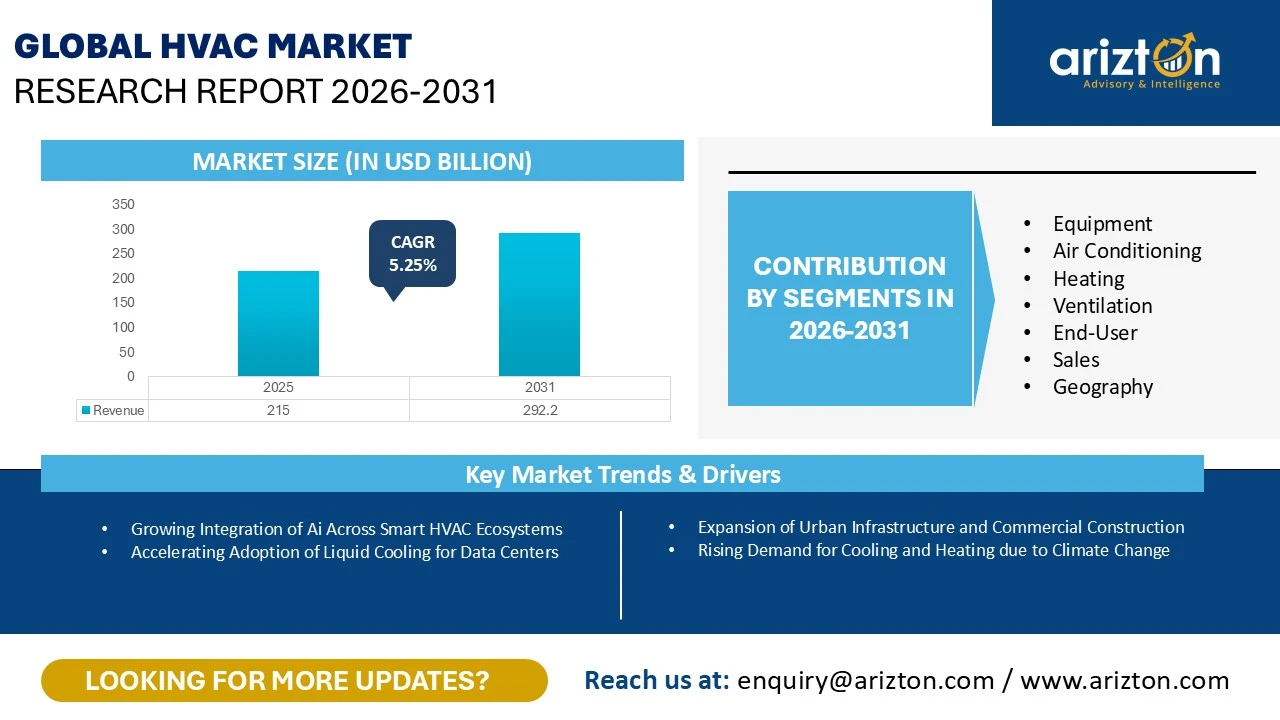
THE GLOBAL HVAC MARKET SIZE WAS VALUED AT USD 215 BILLION IN 2025 AND IS EXPECTED TO REACH USD 292.20 BILLION BY 2031, GROWING AT A CAGR OF 5.25% FROM 2025 TO 2031
The HVAC Market Size, Share & Trends Analysis Report By
- Equipment: Air Conditioning, Heating, and Ventilation
- Air Conditioning: CAC, RAC, Chillers, VRF/VRV, and Other Air Conditioning Equipment
- Heating: Heat Pumps, Boiler Units, Furnaces, and Other Heating Equipment
- Ventilation: AHU, Fan Coil Units, Humidifiers & Dehumidifiers, and Other Ventilation Equipment
- End-User: Residential, Commercial, and Industrial
- Sales Channel: Distributors & Wholesalers, Dealers & Installers, OEM Direct Sales, and Retail & E-Commerce
- Geography: North America, Europe, APAC, Latin America, and Middle East & Africa
Industry Analysis Report, Regional Outlook, Growth Potential, Price Trends, Competitive Market Share & Forecast 2026–2031.
This report includes market data points, ranging from trend
analyses to market estimates & forecasts that you can customize
GLOBAL HVAC MARKET REPORT SCOPE
| REPORT ATTRIBUTE | DETAILS |
|---|---|
| MARKET SIZE (2031) | USD 292.20 Billion |
| MARKET SIZE (2025) | USD 215 Billion |
| CAGR (2025-2031) | 5.25% |
| HISTORIC YEAR | 2022-2024 |
| BASE YEAR | 2025 |
| FORECAST YEAR | 2026-2031 |
| SEGMENTS BY | Equipment, Air Conditioning, Heating, Ventilation, End-User, Sales Channel, and Geography |
| GEOGRAPHIC ANALYSIS | North America, Europe, APAC, Latin America, & Middle East & Africa |
| KEY PLAYERS | Lennox International Inc., Midea Group, Gree Electric Appliances Inc., Carrier Global Corporation, Bosch, Daikin, LG, Mitsubishi Electric, Panasonic, Samsung, Trane Technologies, and Vaillant Group |
HVAC MARKET ANALYSIS
The global HVAC market size was valued at USD 215 billion in 2025 and is expected to reach USD 292.20 billion by 2031, growing at a CAGR of 5.25% during the forecast period. The HVAC market is witnessing steady growth as it becomes a substantial component of building infrastructure, supported by stable new construction, replacement, and renovation across residential and non-residential buildings.
The rapid growth of real estate and infrastructure projects, specifically in economies such as China, India, South Korea, Brazil, Germany, France, the UK, and Spain, among others, is gradually increasing the demand for HVAC systems. For instance, projects such as Hyatt House Bengaluru, India, expected to open in 2027, and the construction of Indonesia’s new legislative and judicial complexes, which began in 2025 with completion targeted for 2027, emphasize consistent growth, thereby supporting sustained demand for HVAC systems.
The HVAC market is also witnessing a strong shift as governments across the regions encourage building decarbonization and electrification initiatives through policies such as the EU’s Energy Performance of Buildings Directive (EPBD) and the US's ENERGY STAR. These are accelerating the replacement of fossil-fuel-based heating systems with energy-efficient heat pumps and low-emission HVAC technologies, thereby significantly supporting the demand for advanced residential and commercial climate-control systems.
HVAC MARKET - KEY INSIGHTS
- Equipment: In 2025, the air conditioning segment accounted for the largest share of around 45%.
- Air Conditioning: The CAC segment accounted for the largest global HVAC market share
- Heating: The heat pumps segment accounted for the largest revenue share of around 40% in the global HVAC market.
- Ventilation: The air handling units (AHU) segment accounted for a significant share of over 38% in 2025
- End-User: The commercial end-user segment shows the fastest-growing CAGR of 6.13% during the forecast period.
- Sales Channel: The distributors & wholesalers accounted for the largest share in 2025.
- Geography: In 2025, APAC is the largest region in the global HVAC market, accounting for more than 44% of market share.
Recent Product Development in the HVAC Market
- In 2025, Daikin launched its EWYK-QZ modular air-to-water heat pump at ISH 2025, designed for commercial/industrial applications using low GWP R-290 (propane) refrigerant.
Mergers & Acquisitions in the HVAC Market
- In 2025, Bosch Group completed the acquisition of Johnson Controls’ residential and light commercial HVAC business on July 31, 2025, for approximately $8 billion.
- In 2025, Midea Group and Frigicoll announced a joint venture agreement in Spain and France to establish Midea Frigicoll HVAC Spain and Midea HVAC France, expanding their long-running partnership into a new operating model.
HVAC MARKET TRENDS & DRIVERS
Shift Toward Modular & Decentralized HVAC Solutions
The market is gradually shifting toward modular and decentralized HVAC systems, supported by varied initiatives such as the EU’s EPBD IV, incentives under the US Inflation Reduction Act (IRA), and building electrification programs in China and Japan. This evolution shows a transition from centralized boiler-based infrastructure toward distributed, electrically driven heating architectures that improve flexibility, efficiency, and retrofit compatibility across diverse building types. Further, leading manufacturers are also supporting this shift through massive product expansions, such as Daikin, which has introduced R-290-based modular platforms scaled up to 2000 kW, enabling distributed deployment across commercial buildings, industrial facilities, and district-level applications.
Surge in VRF & High-Efficiency HVAC Technologies
VRF systems are one of the fastest-growing multi-split HVAC systems because of the rising adoption of energy-efficient and flexible climate control solutions. Additionally, VRF systems are gradually substituting conventional chiller–boilers in commercial buildings worldwide because of their ability to provide decentralized zoning and lower distribution losses across complex building layouts. This shift is also supported by regulations such as the F-Gas Regulation and the EU's EPBD IV, ASHRAE 90.1 energy standards in the US, China's Green Building Evaluation Standard, and rising demand for low-carbon building infrastructure across commercial and institutional sectors.
Expansion of Urban Infrastructure and Commercial Construction
The rising construction activities are steadily supporting the demand for HVAC as they are now critical components across residential and commercial buildings to ensure ventilation, proper cooling, and indoor comfort. For instance, in APAC projects, such as India’s massive airport development, the Noida International Airport, located 72 km from New Delhi inaugurated by Prime Minister Narendra Modi in March 2026. Additionally, projects such as Nantes University Hospital in Europe, which is a 230,000-square-meter hospital projects is expected to be completed by the end of 2026, emphasizing the steady expansion of construction activities worldwide, thereby supporting the demand for global HVAC systems.
Growth in Renovation and Home Improvement Programs
The rising home improvement and renovation activities are significantly supporting the market growth of HVAC systems as the aging building stock accelerates the massive replacement and retrofit activities worldwide. For instance, Saudi Arabia’s Vision 2030 and SEEP (ongoing 2024–2026) are driving building retrofits, increasing demand for smart HVAC systems, and the European Commission’s Renovation Wave Strategy (launched in 2020 and scaled through 2024–2026 implementation phases) aims to double building renovation rates by 2030.
HVAC MARKET SEGMENTATION INSIGHTS
INSIGHT BY EQUIPMENT
The global HVAC market by equipment is segmented into air conditioning, heating, and ventilation. In 2025, the air conditioning segment accounted for the largest revenue share of around 45%, because of the strong dependence on space-cooling systems across residential and commercial infrastructure. HVAC manufacturers are increasingly focusing on high-efficiency cooling systems, hybrid HVAC integration, and sustainable product development to align with climate targets and F-gas regulation compliance. For instance, Daikin Industries won the National Energy Conservation Award 2025 for the most energy-efficient air conditioner.
INSIGHT BY AIR CONDITIONING
Based on the air conditioning, the centralized air conditioning systems (CAC) segment accounted for the largest global HVAC market share in 2025 because of steady expansion driven by growing commercial construction activity, modernization of existing infrastructure, and rising demand for energy-efficient centralized HVAC solutions across offices, healthcare facilities, hospitality establishments, airports, and other large commercial buildings worldwide.
CAC demand is increasingly influenced by the need for efficient air distribution systems integrated into building architecture. Modern commercial developments prioritize ducted central AC systems with advanced airflow zoning to improve thermal consistency and reduce energy losses. In premium office developments, airports, and mixed-use commercial complexes worldwide, centralized AHU-based systems are designed to optimize airflow management across facilities, ensuring balanced cooling while supporting increasingly stringent building energy-efficiency standards.
INSIGHT BY HEATING
Based on heating, the heat pumps segment accounted for the largest revenue share of around 40% in the global HVAC market, because of rising adoption across colder regions like Europe and North America. The market is primarily driven by decarbonization targets, building electrification policies, fossil-fuel heating replacement, and rising energy-efficiency requirements across global heating infrastructure.
Government regulations and incentive programs continue to accelerate heat pump adoption globally during 2025–2026. Initiatives such as the U.S. Inflation Reduction Act, the EU Green Deal, China's Dual Carbon Goals, and national building-electrification programs are encouraging the deployment of heat pumps across residential and commercial buildings as countries seek to reduce dependence on fossil-fuel-based heating systems.
INSIGHT BY VENTILATIONS
Based on ventilation equipment, the air handling units (AHU) segment accounted for a significant share of over 38% in 2025 because of their important role in centralized air distribution, filtration, and conditioning across large commercial and institutional buildings such as offices, hospitals, airports, shopping malls, and industrial facilities.
Modern AHUs are increasingly integrated with energy-efficient HVAC architecture and building management systems. Building owners across the US, Europe, China, and the Gulf countries are adopting smart AHUs equipped with variable-speed fans, IoT sensors, and automated airflow controls. This enables real-time optimization of energy consumption, improved indoor air quality, and compliance with evolving energy-efficiency regulations and green building standards.
INSIGHT BY END-USER
The commercial end-user segment shows significant growth, with the fastest-growing CAGR of 6.13% during the forecast period. The growth is driven by continued expansion of commercial real estate, increasing investment in energy-efficient building infrastructure, and rising adoption of advanced HVAC and building automation systems. The demand is primarily supported by offices, retail spaces, hotels, hospitals, educational institutions, airports, and data centers, where HVAC systems play a critical role in ensuring thermal comfort, indoor air quality, and compliance with stringent energy efficiency standards.
APAC contributes significantly to commercial HVAC demand through the continuous development of high-rise offices, mixed-use projects, airports, data centers, and urban infrastructure, creating sustained demand for large-capacity and energy-efficient HVAC solutions.
INSIGHT BY SALES CHANNEL
The global HVAC market by sales channel is segregated into distributors & wholesalers, dealers & installers, OEM direct sales, and retail & e-commerce. The distributors & wholesalers accounted for the largest share in 2025, supported by extensive regional supply networks, strong contractor relationships, and the capability to provide an extensive portfolio of HVAC equipment, its spare parts, and aftermarket services across the globe.
Leading HVAC manufacturers are increasingly strengthening their distributor ecosystems to improve aftermarket service capabilities and accelerate the adoption of energy-efficient HVAC technologies worldwide. Companies such as Daikin, Carrier, Trane Technologies, Johnson Controls, and Mitsubishi Electric leverage extensive global distributor and contractor networks to support sales, installation, and service activities across key markets.
HVAC MARKET GEOGRAPHICAL ANALYSIS
In 2025, APAC is the largest region in the global HVAC market, accounting for more than 44% of the market share. China is the largest contributor, and India is the fastest-growing market, owing to the rising government initiatives like the Pradhan Mantri Awas Yojana (PMAY), which continues to support large-scale affordable housing delivery.
Additionally, the North America region is the second-largest market, and the US dominates the region and accounts for a significant revenue share in 2025, characterized by a strong mix of replacement-driven residential demand and cyclical new construction activity. This is further supported by efficiency programs such as ENERGY STAR and incentive frameworks under the Inflation Reduction Act (IRA), which are accelerating the adoption of high-performance HVAC systems.
Moreover, the European HVAC market is steadily rising due to stable public investment initiatives such as the Affordable Homes Plans and the Net Zero Strategy 2050, which are driving large-scale retrofit and refurbishment activities across the existing building stock. Germany, being the largest contributor expected to grow at a significant rate during the forecast period, and Spain is the fastest-growing market owing to rising large-scale infrastructure investments such as Aena, which announced plans to invest approximately $15.2 billion in airport upgrades between 2027 and 2031.
HVAC MARKET COMPETITIVE ANALYSIS
The global HVAC market is highly fragmented and encompasses international and regional players such as Lennox, Daikin, Mitsubishi Electric, Panasonic, LG Electronics, Trane Technologies, and Samsung, among others, which hold significant market share because of their broad product portfolios and are implementing various strategies such as technological advancements, M&A, and collaboration with various retailers to stay competitive in the growing market. For instance, in 2025, Samsung Electronics acquired a Germany-based leading European HVAC solutions provider, FlaktGroup, from private equity firm Triton for approximately $1.7 billion to strengthen Samsung's position in the global data center and commercial cooling markets.
SNAPSHOT
The global HVAC market size is expected to grow at a CAGR of approximately 5.25% from 2025 to 2031.
The following factors are likely to contribute to the growth of the global HVAC market during the forecast period:
- Expansion of Urban Infrastructure and Commercial Construction
- Rising Demand for Cooling and Heating due to Climate Change
- Growth in Renovation and Home Improvement Programs
- Increase In Government Subsidies and Green Financing Programs
Base Year: 2025
Forecast Year: 2026-2031
The report examines the current state of the global HVAC market and its market dynamics through 2026−2031. It covers a detailed overview of several market growth enablers, restraints, and trends. The study covers both the demand and supply sides of the market. It also profiles and analyses leading companies and several other prominent companies operating in the market.
Key Company Profiles
- Lennox International Inc.
- Midea Group
- Gree Electric Appliances Inc.
- Carrier Global Corporation
- Bosch
- Daikin
- LG
- Mitsubishi Electric
- Panasonic
- Samsung
- Trane Technologies
- Vaillant Group
Other Prominent Vendors
- Aldes
- Alfa Laval
- Biddle Air Systems
- Camfil
- CIAT
- Elco Burners
- Ferroli
- NIBE Group
- LFB Group
- Hisense HVAC
- Groupe Atlantic
- Nuaire
- Ostberg
- Riello Group
- Soler & Palau (S&P)
- Swegon
- TROX Gmbh
- Clivet
- Vent-Axia
- VTS Group
- WOLF Gmbh
- Zehnder Group AG
- Haier HVAC Solutions
- Modine HVAC
- Blue Star Europe B.V.
- H.Stars Group
- GENERAL HVAC Solutions Euro GmbH
- Baxi
- Brink Climate Systems
- Brotje
- Thermoscreens
- Powrmatic
- Cooltherm
- Chiller LTD.
- Dogu Iklimlendirme
- FLOWAIR
- COOPER&HUNTER
- Frico
- Galletti
- HiRef
- Inventor
- Imbat
- Ariston Group
- BDR Thermea Group
- Glen Dimplex Group
- Stiebel Eltron
Segmentation by Equipment
- Air Conditioning
- CAC
- RAC
- Chillers
- VRF/VRV
- Other Air Conditioning Equipment
- Heating
- Heat Pump
- Boiler Units
- Furnaces
- Others
- Ventilation
- AHU
- Fan Coil Units
- Humidifiers & Dehumidifiers
- Other Ventilation Equipment
Segmentation by End-user
- Residential
- Commercial
- Industrial
Segmentation by Sales Channel
- Distributors & Wholesalers
- Dealers & Installers
- OEM Direct Sales
- Retail & E-Commerce
Segmentation by Geography
- APAC
- China
- India
- Japan
- South Korea
- Australia
- Indonesia
- North America
- US
- Canada
- Europe
- Western & Southern Europe
- Germany
- UK
- France
- Italy
- Spain
- Netherlands
- Switzerland
- Belgium
- Austria
- Portugal
- Greece
- Ireland
- Central & Eastern Europe
- Poland
- Russia
- Czech Public
- Romania
- Hungary
- Slovakia
- Ukraine
- Nordic
- Sweden
- Norway
- Finland
- Denmark
- Latin America
- Brazil
- Mexico
- Argentina
- Chile
- Middle East & Africa
- Saudi Arabia
- UAE
- South Africa
- Turkey
HVAC MARKET FAQs
What is the growth rate of the global HVAC market?
How big is the HVAC market?
What are the significant trends in the global HVAC market?
Who are the key players in the global HVAC market?
Which region holds the most prominent global HVAC market share?
For more details, please reach us at [email protected]
CHAPTER 1- SCOPE & COVERAGE
MARKET DEFINITION
- INCLUSION
- EXCLUSIONS
- MARKET ESTIMATION CAVEATS
MARKET DERIVATION
- MARKET SEGMENTATION BY EQUIPMENT
- MARKET SEGMENTATION BY AIR CONDITIONING
- MARKET SEGMENTATION BY HEATING
- MARKET SEGMENTATION BY VENTILATION
- MARKET SEGMENTATION BY END-USER
- MARKET SEGMENTATION BY SALES CHANNEL
CHAPTER 2- PREMIUM INSIGHTS
CHAPTER 3- MARKET DYNAMICS
INTRODUCTION
- OVERVIEW
- REGULATIONS & SUSTAINABILITY DRIVE EUROPE HVAC MARKET
- INNOVATION DRIVEN BY REGULATION AND ELECTRIFICATION IN THE EUROPEAN HVAC MARKET
- HEAT PUMP MARKET DYNAMICS IN EUROPE
- PROS AND CONS OF SMART HVAC SYSTEMS
MARKET OPPORTUNITIES & TRENDS
- GROWING INTEGRATION OF AI ACROSS SMART HVAC ECOSYSTEMS
- ACCELERATING ADOPTION OF LIQUID COOLING FOR DATA CENTERS
- ADVANCEMENT OF LOW-GWP REFRIGERANTS & SUSTAINABLE COOLING TECHNOLOGIES
- SHIFT TOWARD MODULAR & DECENTRALIZED HVAC SOLUTIONS
- SURGE IN VRF & HIGH-EFFICIENCY HVAC TECHNOLOGIES
MARKET GROWTH ENABLERS
- EXPANSION OF URBAN INFRASTRUCTURE AND COMMERCIAL CONSTRUCTION
- RISING DEMAND FOR COOLING AND HEATING DUE TO CLIMATE CHANGE
- GROWTH IN RENOVATION AND HOME IMPROVEMENT PROGRAMS
- INCREASE IN GOVERNMENT SUBSIDIES AND GREEN FINANCING PROGRAMS
MARKET RESTRAINTS
- HIGH UPFRONT EXPENDITURE
- SUPPLY-CHAIN INFLATION PRESSURES PROFITABILITY
- SKILLED LABOR SHORTAGE AND TECHNICAL WORKFORCE CONSTRAINTS
- OEM RE-TOOLING PRESSURE FROM REFRIGERANT TRANSITION UNCERTAINTY
MARKET LANDSCAPE
- MARKET OVERVIEW
- MARKET SIZE & FORECAST
- FIVE FORCES ANALYSIS
- VALUE CHAIN ANALYSIS
CHAPTER 4- MARKET SEGMENTATION
EQUIPMENT (MARKET SIZE & FORECAST: 2022-2031)
- AIR CONDITIONING
- HEATING
- VENTILATION
AIR CONDITIONING (MARKET SIZE & FORECAST: 2022-2031)
- CAC
- RAC
- CHILLERS
- VRF/VRV
- OTHER AIR CONDITIONING EQUIPMENT
HEATING (MARKET SIZE & FORECAST: 2022-2031)
- HEAT PUMPS
- BOILER UNITS
- FURNACES
- OTHER HEATING EQUIPMENT
VENTILATION (MARKET SIZE & FORECAST: 2022-2031)
- AHU
- FAN COIL UNITS
- HUMIDIFIERS & DEHUMIDIFIERS
- OTHER VENTILATION EQUIPMENT
END-USER (MARKET SIZE & FORECAST: 2022-2031)
- RESIDENTIAL
- COMMERCIAL
- INDUSTRIAL
SALES CHANNEL (MARKET SIZE & FORECAST: 2022-2031)
- DISTRIBUTOS & WHOLESALERS
- DEALERS & INSTALLERS
- OEM DIRECT SALES
- RETAIL & E-COMMERCE
CHAPTER 5- GEOGRAPHY SEGMENTATION
GEOGRAPHY SEGMENTATION (MARKET SIZE & FORECAST: 2022-2031)
GEOGRAPHIC OVERVIEW – MARKET MATURITY INDEX
- APAC
- CHINA
- INDIA
- JAPAN
- SOUTH KOREA
- AUSTRALIA
- INDONESIA
- NORTH AMERICA
- US
- CANADA
- EUROPE
- WESTERN & SOUTHERN EUROPE
- GERMANY
- FRANCE
- UK
- ITALY
- SPAIN
- NETHERLANDS
- SWITZERLAND
- BELGIUM
- AUSTRIA
- PORTUGAL
- GREECE
- IRELAND
- CENTRAL & EASTERN EUROPE
- POLAND
- RUSSIA
- CZECH REPUBLIC
- ROMANIA
- HUNGARY
- SLOVAKIA
- UKRAINE
- NORDICS
- SWEDEN
- NORWAY
- FINLAND
- DENMARK
- LATIN AMERICA
- BRAZIL
- MEXICO
- ARGENTINA
- CHILE
- MIDDLE EAST & AFRICA
- SOUDI ARABIA
- UAE
- SOUTH AFRICA
- TURKEY
CHAPTER 6- COMPETITIVE LANDSCAPE
COMPETITIVE LANDSCAPE
- COMPETITION OVERVIEW
- RECENT DEVELOPMENTS
- BUYER DECISION FACTORS
- KEY GROWTH STRATEGIES ADOPTED BY HVAC VENDORS
KEY COMPANY PROFILES
OTHER PROMINENT COMPANY PROFILES
REPORT SUMMARY
- KEY TAKEAWAYS
- STRATEGIC RECOMMENDATIONS
Select a license type that suits your business needs
Single User Licence
- Report accessible by one user only
- Free 10% or 3 days of customization
- Free post-sale service assistance
- Continuous support through email
5 User Licence
- Report accessible by 5 users within the organization
- Free 15% or 4.5 days of customization
- Continuous support through email and telephone
- Free analyst hour
- Free Upgrade: If an updated report published within 180 days of purchase, you will get the revised report free of charge
Corporate Licence
- Free Datasheet worth $1500
- Report accessible by the entire organization
- Free 20% or 6 days of customization
- Free post-sale service assistance
- Continuous support through email and telephone
- Direct access to lead analysts
- Free analyst hour
- Free Upgrade: If an updated report published within 180 days of purchase, you will get the revised report free of charge
Datasheet Licence
- Report accessible by 1 user only
- Free 15% or 32 hours of customization
- Free post-sale service assistance
- Direct access to lead analysts
Frequently Asked Questions
What is the growth rate of the global HVAC market?
How big is the HVAC market?
What are the significant trends in the global HVAC market?
Who are the key players in the global HVAC market?
Which region holds the most prominent global HVAC market share?
Other RELATED Reports

Europe HVAC Maintenance and Services Market - Industry Outlook & Forecast 2024-2029
Published : May 2024
