

Industrial Door Market Size & Share Analysis. Growth, Revenue By Raw Material, Type, Rolling Doors, Operation, End-Users, Distribution Channel, Geography. This Industry Analysis Covers the Market Size (in USD Million) for the Above Segment.
Published Date : August 2025
Last Updated : January 2026
format: PDF

192 pages

28 company

7 segments

5 region

25 countries
Purchase Options
Global Industrial Door Market Research Report 2025-2030
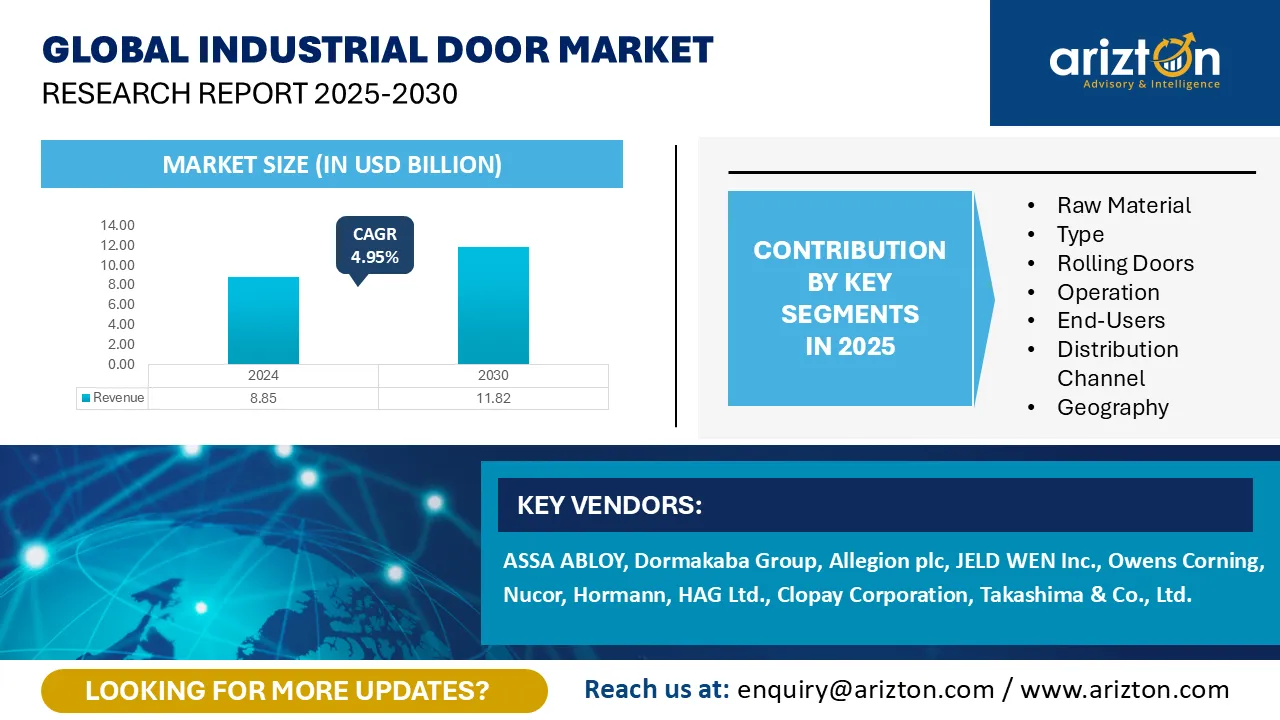
THE GLOBAL INDUSTRIAL DOOR MARKET SIZE IS EXPECTED TO REACH USD 11.82 BILLION BY 2030 FROM USD 8.85 BILLION IN 2024, GROWING AT A CAGR OF 4.95% DURING THE FORECAST PERIOD.
The Global Industrial Door Market Size, Share, & Trends Analysis Report By
- Raw Material: Metal, PVC, FRP/Glass Composite, and Others
- Type: Rolling Doors, Sectional Doors, Sliding Doors, Folding Doors, and Others
- Rolling Doors: Roll Up Doors and High Speed Rolling Doors
- Operation: Manual, Semi Automatic, and Fully Automatic
- End-Users: Logistics & Transportation, Automotive, Food & Beverage, Pharmaceutical, Chemical, Energy & Power, and Others
- Distribution Channel: Offline and Online
- Geography: North America, Europe, APAC, Latin America, and Middle East & Africa
Industry Analysis Report, Regional Outlook, Growth Potential, Price Trends, Competitive Market Share & Forecast 2025–2030.
This report includes market data points, ranging from trend
analyses to market estimates & forecasts that you can customize
INDUSTRIAL DOOR MARKET REPORT SCOPE
| REPORT ATTRIBUTE | DETAILS |
|---|---|
| Market Size (2030) | USD 11.82 Billion |
| Market Size (2024) | USD 8.85 Billion |
| CAGR (2024-2030) | 4.95% |
| HISTORIC YEAR | 2021-2023 |
| BASE YEAR | 2024 |
| FORECAST YEAR | 2025-2030 |
| SEGMENTS BY | Raw Material, Type, Rolling Doors, Operation, End-Users, Distribution Channel, and Geography |
| GEOGRAPHIC ANALYSIS | North America, Europe, APAC, Latin America, Middle East & Africa |
| KEY PLAYERS | ASSA ABLOY, Dormakaba Group, Allegion plc, JELD WEN Inc., Owens Corning, Nucor, Hormann, HAG Ltd., Clopay Corporation, and Takashima & Co., Ltd. |
INDUSTRIAL DOOR MARKET REPORT
The global industrial door market was valued at USD 8.85 billion in 2024 and is expected to reach USD 11.82 billion by 2030, growing at a CAGR of 4.95% during the forecast period. The global industrial door market is expanding steadily as industries continue to invest in safer, more reliable, and energy-efficient door systems that enhance security, streamline logistics, and support effective facility management.
Automated door solutions, especially high-speed roll-up doors and precision sliding systems, are seeing rapid adoption across logistics hubs, cold-chain operations, food processing plants, and pharmaceutical facilities. These environments require strict temperature control and energy efficiency, making advanced industrial doors essential. Many models can maintain temperatures as low as –13 °F and include fire-rated systems that automatically close during emergency alarms. The fully automated segment is projected to exceed USD 3.6 billion by 2030, supported largely by the growth of e-commerce, large-scale warehousing, and high-throughput industrial operations.
While automated industrial doors cost two to three times more than basic models and require specialized servicing, manufacturers are addressing these challenges through digital twin technology, 3D prototyping, and advanced modeling. These innovations reduce production waste by more than 20% and improve design flexibility.
Integrated automation features—such as smart sensors, remote diagnostics, crash detection, real-time energy monitoring, and predictive maintenance based on motor current, torque, cycle time, and error codes—allow early detection of abnormal operations. These technologies reduce maintenance intervals by up to 40% and improve system reliability by as much as 30%, ensuring consistent performance in demanding industrial environments.
Energy efficiency upgrades, including weather stripping, caulking, and door sweeps, can lower energy consumption by up to 20%. Large-scale facility retrofits have demonstrated reductions of 30% in electricity use and 20% in district heating needs. With increasing operational intensity across sectors, real-time monitoring and data-driven optimization are becoming critical components of modern automated door systems.
The APAC region leads the global market with over 37% share, fueled by strong demand in China, India, and Japan. Growth is supported by expanding manufacturing output, the development of new special economic zones, and a surge in warehousing projects—all of which require durable, high-capacity industrial door solutions.
IMPACT OF US & CHINA TRADE WAR
The escalation of the U.S.–China trade war in January 2025 increased tariffs on steel, aluminum, and specialized metal alloys to levels exceeding 100 percent, which raised the overall production cost of industrial doors and pushed manufacturers to shift sourcing to Southeast Asia and Latin America to manage rising expenses and geopolitical risk. Supply chains redirected to alternative markets experienced delivery delays of between 10 and 14 weeks during Q2 2025, caused by logistical congestion, customs inspections, and the additional time required to certify new suppliers, which placed significant pressure on project timelines and inventory planning for industrial door manufacturers. Chinese producers of industrial doors, who previously benefited from their proximity to component plants, encountered new certification and testing delays after the introduction of stricter export controls in March 2025, which limited their capacity to meet international delivery schedules.
The effects of U.S.–India trade tensions have intensified since the United States raised tariffs on Indian exports to 50% in August 2025, causing increased costs for steel and accessory components sourced from India and forcing companies in the industrial doors sector to either absorb the additional expense or shift to alternative suppliers in other regions.
INDUSTRIAL DOOR MARKET TRENDS & GROWTH DRIVERS
- IoT-enabled industrial door systems provide remote monitoring, predictive maintenance, and automated access control. These features improve operational efficiency and reliability for manufacturing and logistics facilities by minimizing disruptions and maintaining a steady workflow.
- The increasing demand for high-speed industrial doors in cold-chain logistics, automotive, and pharmaceutical sectors leads to better throughput and contamination control. These doors maintain fast operations and stable environments.
- Improvements in door materials, like corrosion-resistant aluminum, reinforced PVC, and antimicrobial coatings, provide greater durability, hygiene compliance, and suitability for demanding food and cleanroom environments.
- The growth of industries in Asia-Pacific, particularly with automotive warehousing and e-commerce, supports wider use of automated industrial door systems through local manufacturing and infrastructure upgrades, and supports the industrial door market growth.
- Automated and sensor-driven industrial doors in temperature-sensitive environments create smoother workflows and save energy by reducing bottlenecks and limiting unnecessary air exchange.
- Stricter safety regulations for fire protection and access control lead to investments in compliant industrial door systems that have advanced sensors, quick-close technology, and integrated security features to improve facility protection.
INDUSTRY RESTRAINTS
- High initial investment costs discourage small and medium enterprises from adopting advanced automated or insulated industrial door systems, as many prefer to repair existing installations rather than invest in new technology in cost-sensitive markets.
- Unstable prices for steel, aluminum, and composite materials result in higher costs for manufacturers or increased prices for buyers, which in economic downturns often delay replacement and expansion activities and limit market demand.
- Fragmented competition and low entry barriers in some regions lead to price-focused products that may not meet durability, safety, or service standards, and the lack of standardized manufacturing deters investment in premium industrial door solutions by large operators.
MARKET SEGMENTATION INSIGHTS
INSIGHTS BY RAW MATERIAL
The segment analysis provides an in-depth assessment of metal, PVC, FRP/glass composite, and other materials used in industrial door manufacturing. Metal-based industrial doors represented a dominant share of the global industrial door market in 2024, as their strength, durability, and impact resistance support in high-traffic logistics hubs, factories, and warehouse loading bays. Furthermore, FRP/glass composite doors achieved a compound annual growth rate of 6.01% during the forecast period, as their corrosion resistance and low maintenance requirements have supported adoption in food, chemical, and coastal facilities where harsh environmental conditions are common.
INSIGHTS BY TYPE
The analysis includes rolling doors, sectional doors, sliding doors, folding doors, and specialty designs to capture the diversity of door types in the industrial door market. Rolling doors captured a significant share of the market in 2024 because their compact vertical operation and capability to secure large openings enable their widespread use in distribution centers, manufacturing plants, and commercial loading docks. Furthermore, sectional doors are projected to grow at a compound annual rate of 6.09% as their insulation and sealing performance meet requirements for temperature-controlled environments, including cold-chain warehouses and food storage facilities.
INSIGHTS BY ROLLING DOORS
The breakdown covers roll-up doors and high-speed rolling doors in the rolling door segment to highlight performance and adoption trends. High-speed rolling doors are expected to achieve a compound annual growth rate of 5.48% in the industrial door market as their ability to limit air exchange and minimize energy loss improves operational efficiency in logistics corridors, automotive assembly lines, and pharmaceutical cleanrooms.
INSIGHTS BY OPERATION
The global industrial door market by operation consists of manual, semi-automatic, and fully automatic door systems, reflecting differing automation preferences. Semi-automatic doors accounted for around 30% of the market in 2024 as their balance of cost efficiency and partial automation supports adoption in medium-scale warehouses and manufacturing units seeking operational improvements without full automation. Furthermore, fully automatic doors are forecast to grow at a compound annual rate of 4.86% as industries focus on touchless operation, faster cycle times, and integration with smart facility systems, especially in high-throughput logistics hubs and clean manufacturing environments.
INSIGHTS BY END-USERS
The end users in the global industrial door market include logistics & transportation, automotive, food and beverage, pharmaceutical, chemical, energy & power, and others. The logistics and transportation sector represents over 31% of total demand in 2024, as the requirement for high-speed opening and closing doors in distribution warehouses, freight terminals, and cross-docking facilities emphasizes the importance of speed and reliability. Furthermore, the pharmaceutical industry is forecast to grow at a compound annual rate of 6.04% since strict hygiene and environmental controls are driving the adoption of high-speed, insulated, and cleanroom-compatible door systems in manufacturing and storage facilities.
INSIGHTS BY DISTRIBUTION CHANNEL
The distribution landscape of the global industrial door market is segmented into offline and online sales channels, reflecting diverse procurement preferences across the market. Online sales are projected to grow at a compound annual rate of 6.90% as the move to digital procurement platforms enables industrial buyers to source standardized door models, spare parts, and accessories with improved price comparison, lead time monitoring, and direct ordering from manufacturers.
INDUSTRIAL DOOR MARKET GEOGRAPHICAL ANALYSIS
In 2024, North America and Europe together made up about 45% of the global industrial door market, reflecting a mature and saturated demand base. North America's industrial door market is expected to grow at a CAGR of 4.27%. This growth is driven by a greater need for replacements rather than new installations, along with stringent OSHA workplace safety regulations. Heavy industries, regulatory mandates, and smart facility trends accelerate fire-rated, explosion-proof, and automated sectional door adoption, with major distributors and manufacturers expanding through offline and online sales channels.
Germany and Russia contributed 33% of European market revenues in 2024 as Germany’s industrial sectors support demand for high-speed and sectional doors, while Russia’s oil, gas, and cold-storage logistics sectors maintain steady procurement despite ongoing geopolitical challenges. Growth in Europe remains limited by market maturity, though energy efficiency retrofits under EU directives and automated facility upgrades in France, Italy, and Spain continue to support stable demand for insulated and rapid-action door systems.
APAC dominated the global industrial door market share, accounting for over 37% in 2024. Rapid industrialization and urban growth in China, India, Vietnam, and Indonesia are fueling industrial door demand across manufacturing, logistics, food processing, and automotive, with industrial parks and special economic zones acting as key clusters. Moreover, logistics expansion in Southeast Asia and India is driving high-speed rolling and sectional overhead door adoption, supported by Amazon, DHL, and Flipkart’s investments, alongside regional and global manufacturers expanding through joint ventures.
Rising investment in large industrial parks and oil processing hubs across the Middle East and Africa drives demand for heavy-duty rolling and sectional doors, while manufacturing diversification in Saudi Arabia, the UAE, and Turkey increases procurement of temperature-controlled and high-security solutions.
Furthermore, Mexico’s industrial door market is set for a 5.44% CAGR. This growth is driven by the rise of automotive and electronics manufacturing, as well as warehousing, supported by nearshoring. In Brazil, strong GDP growth in food processing, oil refining, and port infrastructure keeps the demand high for durable and corrosion-resistant doors.
INDUSTRIAL DOOR MARKET VENDOR INSIGHTS
The global industrial door market is moderately fragmented, with ASSA ABLOY, Hormann Group, Sanwa Holdings, and Clopay at the forefront. These firms dominate the market with a wide product portfolio and a global distribution channel. Furthermore, competition is encouraged by sector-based demands. Examples are temperature-controlled industrial doors in the food industry, high-speed roll-ups in the logistics industry, and explosion-proof doors in the chemical and energy industries. These products embrace FDA, ISO 22000, and ATEX requirements.
Leading manufacturers in the global industrial door market, like Allegion plc and Clopay Corporation, focus on technological innovation, smart automation, and IoT-based access control. They maintain a strong market position by using energy-efficient materials and having a wide global distribution. Local players like Teckentrup in Germany and Nucor in the U.S. are focusing on tailor-made installations, faster deliveries, and low prices. They cater to growing local demand in emerging markets.
Janus International is a leader in rolling steel and self-storage industrial doors. Meanwhile, ASSA ABLOY’s automated fire-rated industrial doors with cloud-based monitoring are setting new industry standards for safety and smart integration.
INDUSTRIAL DOOR MARKET NEWS
- In April 2025, Hormann introduced flood-resistant steel construction project doors (D65 OD and H3 OD) and ThermoSafe Hybrid aluminium entrance doors. These products strengthen structural protection against flooding while ensuring higher thermal efficiency, durability, and long-term operational reliability for industrial facilities.
- In April 2025, ASSA ABLOY signed to acquire Danish Manufacturer, Door System, which manufactures high-quality fire-rated doors with particular expertise in the pharmaceutical, food, and retail industries. Door System reported 2024 sales of about $18 million (DKK 125 million). This acquisition strengthens ASSA ABLOY’s portfolio in fire-rated and hygienic doors and supports its growth in specialized industrial applications.
- In February 2025, Takashima & Co., Ltd. acquired Sanwa Holdings Co., Ltd. to establish Sanwa Holdings Co., Ltd. as its subsidiary. This acquisition strategically enhances Takashima's position in the industrial door market by integrating Sanwa's extensive portfolio of high-performance doors, including rolling shutters and sectional doors, which are widely used in industrial applications.
- In March 2025, Rite-Hite displayed its industrial door solutions at ProMat 2025 by focusing on high-speed doors and loading dock equipment, and safety barriers.
SNAPSHOT
The global industrial door market size is expected to grow at a CAGR of approximately 4.95% from 2024 to 2030.
The following factors are likely to contribute to the growth of the industrial door market during the forecast period:
- Push for Operational Efficiency & Throughput Optimization
- Rapid Advances in Door Automation & Predictive Controls
- Growing Emphasis on Safety, Access Control & Regulatory Compliance
- Energy-Saving Demands & Cost-Control Initiatives
Base Year: 2024
Forecast Year: 2025-2030
The report considers the present scenario of the global industrial door market and its market dynamics for 2025−2030. It covers a detailed overview of several market growth enablers, restraints, and trends. The study covers both the demand and supply sides of the market. It also profiles and analyzes leading companies and several other prominent companies operating in the industry.
Key Company Profiles
- ASSA ABLOY
- Business Overview
- Product Offerings
- Key Developments
- Key Strategies
- Key Strengths
- Key Opportunities
- Dormakaba Group
- Allegion plc
- JELD‑WEN Inc.
- Owens Corning
- Nucor
- Hormann
- HAG Ltd.
- Clopay Corporation
- Takashima & Co., Ltd.
Other Prominent Company Profiles
- Raynor Garage Doors
- Business Overview
- Product Offerings
- Rite-Hite
- Janus International
- RAXdoor
- Teckentrup Gmbh & Co. Kg
- EFAFLEX
- DuraServ Corp.
- ASI Doors, Inc.
- Jansen Holding GmbH
- TORMAX
- Angel Mir
- Dortek
- Maviflex
- Nabtesco Corporation
- Hart Doors
- Chase Doors
- Alpine Overhead Doors, Inc.
- Ryterna
Segmentation by Raw Material
- Metal
- PVC
- FRP/Glass Composite
- Others
Segmentation by Type
- Rolling Doors
- Sectional Doors
- Sliding Doors
- Folding Doors
- Others
Segmentation by Rolling Doors
- Roll Up Doors
- High Speed Rolling Doors
Segmentation by Operation
- Manual
- Semi Automatic
- Fully Automatic
Segmentation by End-Users
- Logistics & Transportation
- Automotive
- Food & Beverage
- Pharmaceutical
- Chemical
- Energy & Power
- Others
Segmentation by Distribution Channel
- Offline
- Online
Segmentation by Geography
- APAC
- China
- India
- Japan
- South Korea
- Australia
- Vietnam
- Indonesia
- Thailand
- Singapore
- North America
- US
- Canada
- Europe
- Germany
- Russia
- UK
- France
- Italy
- Spain
- Poland
- Netherlands
- Latin America
- Brazil
- Mexico
- Argentina
- Middle East & Africa
- Saudi Arabia
- UAE
- Turkey
INDUSTRIAL DOOR MARKET FAQs
What are the significant trends in the industrial door market?
Which region dominates the global industrial door market share?
How big is the global industrial door market?
What is the growth rate of the global industrial door market?
Who are the key players in the global industrial door market?
For more details, please reach us at [email protected]
- Chapter 1- Scope & Coverage
- Market Definition
- Inclusion
- Exclusions
- Market Estimation Caveats
- Market Derivation
- Market Segmentation by Raw Material
- Market Segmentation by Type
- Market Segmentation by Rolling Doors
- Market Segmentation by Operation
- Market Segmentation by End-Users
- Market Segmentation by Distribution Channel
- Chapter 2- Premium Insights
- Chapter 3- Market Dynamics
- Introduction
- Impact of The Ongoing Tariff War
- Market Opportunities & Trends
- Rise of smart, IoT-enabled industrial door systems
- Surge in high-speed doors for critical operations
- Material innovation driving performance & hygiene
- APAC industrialization reshaping regional demand
- Market Growth Enablers
- Push for operational efficiency & throughput optimization
- Rapid advances in door automation & predictive controls
- Growing emphasis on safety, access control & regulatory compliance
- Energy-saving demands & cost-control initiatives
- Market Restraints
- High initial investment costs
- Fluctuating raw material prices
- Market Landscape
- Five Forces Analysis
- Chapter 4- Market Segmentation
- Raw Material (Market Size & Forecast: 2021-2030)
- Metal
- PVC
- FRP/Glass Composite
- Others
- Type (Market Size & Forecast: 2021-2030)
- Rolling Doors
- Sectional Doors
- Sliding Doors
- Folding Doors
- Others
- Rolling Doors (Market Size & Forecast: 2021-2030)
- Roll Up Doors
- High Speed Rolling Doors
- Operation (Market Size & Forecast: 2021-2030)
- Manual
- Semi Automatic
- Fully Automatic
- End-Users (Market Size & Forecast: 2021-2030)
- Logistics & Transportation
- Automotive
- Food & Beverage
- Pharmaceutical
- Chemical
- Energy & Power
- Others
- Distribution Channel (Market Size & Forecast: 2021-2030)
- Offline
- Online
- Chapter 5- Geography Segmentation
- Geography Segmentation (Market Size & Forecast: 2021-2030)
- Geographic Overview – Market Maturity Index
- APAC
- China
- India
- Japan
- South Korea
- Australia
- Vietnam
- Indonesia
- Thailand
- Singapore
- North America
- US
- Canada
- Europe
- Germany
- Russia
- UK
- France
- Italy
- Spain
- Poland
- Netherlands
- Middle East & Africa
- Saudi Arabia
- UAE
- Turkey
- Latin America
- Brazil
- Mexico
- Argentina
- Chapter 6- Competitive Landscape
- Competitive Landscape
- Competition Overview
- Key Developments
- Key Company Profiles
- Upcoming Players
- Other Prominent Company Profiles
- Report Summary
- Key Takeaways
- Strategic Recommendations
Select a license type that suits your business needs
Single User Licence
- Report accessible by one user only
- Free 10% or 3 days of customization
- Free post-sale service assistance
- Continuous support through email
5 User Licence
- Report accessible by 5 users within the organization
- Free 15% or 4.5 days of customization
- Continuous support through email and telephone
- Free analyst hour
- Free Upgrade: If an updated report published within 180 days of purchase, you will get the revised report free of charge
Corporate Licence
- Free Datasheet worth $1500
- Report accessible by the entire organization
- Free 20% or 6 days of customization
- Free post-sale service assistance
- Continuous support through email and telephone
- Direct access to lead analysts
- Free analyst hour
- Free Upgrade: If an updated report published within 180 days of purchase, you will get the revised report free of charge
Datasheet Licence
- Report accessible by 1 user only
- Free 15% or 32 hours of customization
- Free post-sale service assistance
- Direct access to lead analysts
Frequently Asked Questions
What are the significant trends in the industrial door market?
Which region dominates the global industrial door market share?
How big is the global industrial door market?
What is the growth rate of the global industrial door market?
Who are the key players in the global industrial door market?
Other RELATED Reports


Doors and Windows Market in North America - Industry Outlook & Forecast 2024-2029
Published : August 2024