
Global Industrial Robot Floor Cleaner Market Research Report 2025-2030


164 pages

15 company

4 segments

5 region

22 countries
Purchase Options
Global Industrial Robot Floor Cleaner Market Research Report 2025-2030
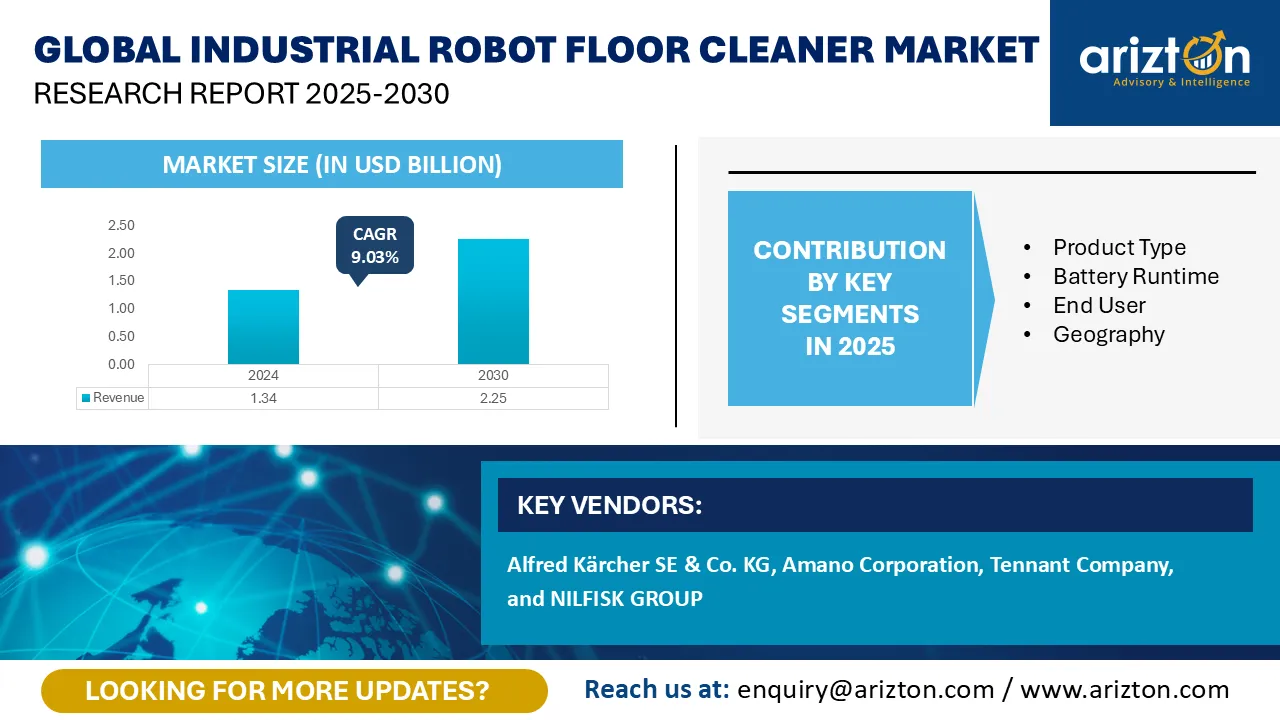
THE GLOBAL INDUSTRIAL ROBOT FLOOR CLEANER MARKET SIZE IS EXPECTED TO REACH USD 2.25 BILLION BY 2030 FROM USD 1.34 BILLION IN 2024, GROWING AT A CAGR OF 9.03% DURING THE FORECAST PERIOD.
The Global Industrial Robot Floor Cleaner Market Size, Share, & Trends Analysis Report By
- Product Type: Robotic Floor Scrubber and All-in-One
- Battery Runtime: Less Than 4 HRS and Above 4 HRS
- End User: Retail & Shopping, Manufacturing, Transport, Healthcare, Warehouse & Logistics, Education, and Others
- Geography: North America, Europe, APAC, Latin America, and Middle East & Africa
Industry Analysis Report, Regional Outlook, Growth Potential, Price Trends, Competitive Market Share & Forecast 2025–2030.
This report includes market data points, ranging from trend
analyses to market estimates & forecasts that you can customize
INDUSTRIAL ROBOT FLOOR CLEANER MARKET REPORT SCOPE
| REPORT ATTRIBUTE | DETAILS |
|---|---|
| Market Size (2030) | USD 2.25 Billion |
| Market Size (2024) | USD 1.34 Billion |
| CAGR (2024-2030) | 9.03% |
| HISTORIC YEAR | 2021-2023 |
| BASE YEAR | 2024 |
| FORECAST YEAR | 2025-2030 |
| LARGEST REGION (2024) | North America |
| SEGMENTS BY | Product Type, Battery Runtime, End User, and Geography |
| GEOGRAPHIC ANALYSIS | North America, Europe, APAC, Latin America, and Middle East & Africa |
| KEY PLAYERS | Alfred Kärcher SE & Co. KG, Amano Corporation, Tennant Company, and NILFISK GROUP |
INDUSTRIAL ROBOT FLOOR CLEANER MARKET
The global industrial robot floor cleaner market was valued at USD 1.34 billion in 2024 and is projected to reach USD 2.25 billion by 2030, expanding at a CAGR of 9.03% during the forecast period. Continuous advancements in robotics, artificial intelligence (AI), sensor fusion, and autonomous navigation systems are significantly enhancing the performance and reliability of robotic floor cleaning solutions. Modern systems now incorporate intelligent mapping, real-time obstacle avoidance, predictive maintenance alerts, and cloud-enabled fleet management, enabling businesses to improve operational efficiency while reducing downtime and total cost of ownership.
The growing emphasis on labor optimization and cost-efficient facility management is accelerating adoption across industries such as warehousing, healthcare, airports, retail, manufacturing, and educational institutions. As labor shortages intensify and hygiene regulations become more stringent, robotic floor cleaners are increasingly viewed as essential operational assets rather than optional upgrades. Additionally, the shift toward smart buildings and sustainable infrastructure is further driving market growth. Most robotic cleaners are electrically powered, engineered for reduced water and detergent consumption, and designed for low-noise, low-emission operation—aligning well with green building certifications and environmental compliance standards.
IMPACT OF TARIFF
The impact of the tariff on the industrial robot floor cleaner market will be moderate. Global tariff fluctuations on key raw materials are driving companies to diversify sourcing, strengthen regional manufacturing, and expand supplier networks to manage costs in the industrial robot floor cleaner market.
INDUSTRIAL ROBOT FLOOR CLEANER MARKET TRENDS & DRIVERS
Integration of AI and Machine Learning
AI and machine learning technologies are playing a pivotal role in improving autonomous cleaning efficiency. Deployments such as Avidbots’ Neo 2W for warehouse operations, TASKI’s autonomous Ecobot solutions, and hospital implementations in Singapore, where infection rates have declined, highlight the transformative impact of AI-driven cleaning robots across retail, healthcare, and manufacturing environments.
Rising Demand for All-in-One Cleaning Solutions
The market is increasingly shifting toward compact, modular, and multifunctional robotic systems capable of sweeping, scrubbing, vacuuming, and drying within a single platform. Products such as Gaussian Robotics’ Phantas, launched in 2023, address space limitations, diverse floor surfaces, and evolving facility layouts in sectors including healthcare, education, and retail.
Advanced Navigation and Sustainability Focus
Manufacturers are prioritizing advanced navigation technologies using LiDAR, ultrasonic sensors, and AI-powered vision systems to enable dynamic route adaptation and precise coverage. Deployments like Nilfisk’s Liberty SC50 in German logistics hubs and Gaussian Robotics’ Scrubber 50 Pro in Dutch hospitals demonstrate improvements in efficiency and sustainability. Features such as automated path updates, multi-mode operations, intelligent battery management, optimized water usage, and compliance with EU eco-design and RoHS standards have helped reduce the total cost of ownership by up to 25%.
Expanding Global Infrastructure
The rapid development of smart cities, airport expansions, and investments in healthcare, education, and hospitality infrastructure are increasing demand for scalable and automated cleaning solutions. Larger and more complex facilities require consistent, high-efficiency floor maintenance, driving adoption of industrial robotic cleaners.
Growth of E-Commerce and Warehouse Automation
The global e-commerce market is expected to reach USD 6.88 trillion by 2025, is fueling warehouse expansion and automation. High-growth regions such as Asia (USD 1.97 trillion in 2024), the U.S. (USD 1.44 trillion), and Europe (USD 632.7 billion) are increasingly deploying robotic floor cleaners to maintain hygiene standards, address labor shortages, and support 24/7 logistics operations.
Government Support for Automation
Public-sector initiatives are accelerating automation adoption. Programs such as the U.S. Department of Energy’s AMMTO and Smart Manufacturing Leadership Program, India’s Production Linked Incentive (PLI) scheme, and Europe’s Horizon Europe AI-robotics funding are driving demand for robotic cleaning solutions as part of smart manufacturing and sustainable facility management strategies.
INDUSTRY RESTRAINTS
High Initial Investment
The high upfront cost of industrial robotic floor cleaners—often around £10,000 compared to £2,500 for conventional equipment—remains a major adoption barrier, particularly for SMEs in hospitality, retail, and healthcare sectors across emerging markets.
Competition from Traditional Equipment
Conventional walk-behind and ride-on scrubbers continue to dominate in cost-sensitive and labor-abundant regions due to their lower purchase costs, widespread availability, and minimal training requirements, limiting the transition to fully autonomous systems.
SEGMENTATION INSIGHTS
By Product Type
The market is segmented into robotic floor scrubbers and all-in-one systems, with robotic scrubbers generating the highest revenue in 2024. Autonomous mobile robots (AMRs) equipped with AI capabilities enable infrastructure-free navigation and collaborative human-robot workflows. This aligns with forecasts indicating that collaborative robots will account for nearly one-third of industrial robot sales by 2025.
By Battery Runtime
Robotic cleaners with less than 4 hours of battery runtime dominated the market in 2024 and are expected to achieve an absolute growth rate of over 67.5% during the forecast period. These systems are well-suited for mid-sized facilities with time-bound cleaning requirements in retail, healthcare, education, and transport terminals.
By End User
The retail and shopping segment led the market in 2024, generating over USD 320 million, driven by high foot traffic and consistent hygiene standards. Deployments such as Albert’s BrainOS-powered Tennant scrubbers in the Czech Republic demonstrate measurable efficiency gains.
The manufacturing sector ranked second, supported by automation initiatives and strict environmental controls, particularly in semiconductor and high-tech manufacturing facilities under programs like the CHIPS and Science Act in the U.S.
REGIONAL ANALYSIS
The global industrial robot floor cleaner market size was valued at USD 1.34 billion in 2024 and is projected to reach USD 2.25 billion by 2030, growing at a CAGR of 9.03% during the forecast period. This growth reflects the rising demand for industrial robot floor cleaners, industrial floor cleaning robots, and autonomous floor cleaning robots across commercial and industrial environments. Continuous advancements in robotics, sensor technologies, navigation systems, and AI-driven automation are reshaping the robotics floor cleaning market, enabling smarter, more efficient cleaning operations.
Modern industrial robot floor scrubbers, robotic floor sweepers for industry, and commercial floor cleaning robots now feature advanced mapping, obstacle avoidance, real-time performance monitoring, and cloud-based fleet management. These innovations support industrial robotics cleaning solutions that enhance cleaning precision, reduce downtime, and lower total operating costs, driving strong momentum in the industrial cleaning robot market and the broader cleaning robot market.
The global shift toward labor-efficient and cost-effective facility maintenance is accelerating industrial cleaning robot adoption, particularly in sectors such as warehousing, healthcare, airports, retail, manufacturing, and education. As hygiene regulations tighten and labor shortages persist, autonomous cleaning robots for warehouses and large facilities are becoming a strategic necessity. This trend is directly influencing industrial floor cleaner robot demand, reinforcing long-term industrial cleaning robots’ growth and improving market shares for industrial floor robots worldwide.
Additionally, the transition toward smart infrastructure and sustainable operations is strengthening the outlook for smart industrial cleaners. Many industrial cleaning robots are electrically powered and optimized for reduced water and chemical consumption, supporting green building certifications and regulatory compliance. As a result, industrial robot floor cleaner industry trends continue to favor sustainability, automation, and intelligence—key factors shaping the industrial floor cleaning robot market forecast and overall robotic cleaning market analysis through 2030.
VENDOR LANDSCAPE
The global industrial robot floor cleaner market remains highly fragmented, with the top five vendors accounting for only around 13% of the total Cleaning Robot Industry share. This fragmentation reflects the presence of a diverse mix of multinational manufacturers and regional innovators competing across the broader industrial cleaning robot market and robotics floor cleaning market. Vendors target varied end-user segments, including airports, warehouses, factories, hospitals, and shopping malls, driving demand for commercial floor cleaning robots, smart industrial cleaners, and robotic floor sweepers for industry.
In this competitive cleaning robot market, manufacturers are emphasizing product differentiation through rapid technological innovation. Key advancements include AI-powered navigation, LiDAR-based mapping, remote monitoring, app-based control, and seamless integration with building management systems (BMS). Buyers increasingly prioritize autonomous floor cleaning robots with automated docking and refilling, low energy consumption, multi-surface compatibility, and extended battery life to support large-scale industrial operations. These innovations are accelerating industrial cleaning robot adoption and strengthening industrial robotics cleaning solutions across sectors.
To expand their presence and capture greater industrial robot floor cleaner market share, leading companies are increasing R&D investments and launching application-specific solutions. For instance, in 2023, Avidbots Corp. introduced the Neo 2W—an industrial robot floor scrubber engineered for warehouses and logistics facilities. Designed as an autonomous cleaning robot for warehouses, the Neo 2W features enhanced obstacle detection, optimized navigation, and higher floor coverage, supporting rising industrial floor cleaner robot demand and reinforcing positive industrial robot floor cleaner industry trends.
SNAPSHOT
The global industrial robot floor cleaner market size is expected to grow at a CAGR of approximately 9.03% from 2024 to 2030.
The following factors are likely to contribute to the growth of the global industrial robot floor cleaner market during the forecast period:
- Growing Infrastructure
- Growing E-commerce Industry
- Government Incentives For Automation and Smart Manufacturing
Base Year: 2024
Forecast Year: 2025-2030
The report considers the present scenario of the global industrial robot floor cleaner market and its market dynamics for 2025−2030. It covers a detailed overview of several market growth enablers, restraints, and trends. The study covers both the demand and supply sides of the industry. It also profiles and analyzes leading companies and several other prominent companies operating in the industry.
Key Company Profiles
- Alfred Kärcher SE & Co. KG
- Business Overview
- Product Offerings
- Key Developments
- Key Strategies
- Key Strengths
- Key Opportunities
- Amano Corporation
- Tennant Company
- NILFISK GROUP
Other Prominent Company Profiles
- Avidbots Corp.
- Business Overview
- Product Offerings
- Gaussian Robotics
- ICE Cobotics
- ADLATUS Robotics GmbH
- Hako GmbH
- Comac S.p.A.
- Beijing Idriverplus Technology Co., Ltd
- Floorbotics
- Chancee Global
- Pudu Technology Inc.
- Cleanfix Reinigungssysteme AG
Segmentation by Product Type
- Robotic Floor Scrubber
- All-in-One
Segmentation by Battery Runtime
- Less Than 4 HRS
- Above 4 HRS
Segmentation by End User
- Retail & Shopping
- Manufacturing
- Transport
- Healthcare
- Warehouse & Logistics
- Education
- Others
Segmentation by Geography
- North America
- The U.S.
- Canada
- Europe
- Germany
- The U.K.
- France
- Italy
- Spain
- Poland
- Sweden
- APAC
- China
- Japan
- India
- South Korea
- Australia
- Singapore
- Latin America
- Brazil
- Mexico
- Argentina
- Middle East & Africa
- UAE
- Saudi Arabia
- Turkey
- South Africa
INDUSTRIAL ROBOT FLOOR CLEANER MARKET FAQs
How big is the global industrial robot floor cleaner market?
What are the significant trends in the industrial robot floor cleaner market?
What is the growth rate of the global industrial robot floor cleaner market?
Which region dominates the global industrial robot floor cleaner market share?
Who are the key players in the global industrial robot floor cleaner market?
For more details, please reach us at [email protected]
1. Scope & Coverage
- Market Definition
- Inclusions
- Exclusions
- Market Estimation Caveats
- Market Size & Forecast Periods
- Historic Period: 2021-2023
- Base Year: 2024
- Forecast Period: 2025-2030
- Market Size (2021-2030)
- Revenue
- Market Segments
- Market Segmentation by Product
- Market Segmentation by Battery Runtime
- Market Segmentation by End User
2. Opportunity Pockets
3. Introduction
- Impact Of Tariff
4. Market Opportunities & Trends
- Integration Of AI and Machine Learning
- Growing Outlook of All-in-One Solutions
- Advanced Navigation and Sustainability
5. Market Growth Enablers
- Growing Infrastructure
- Surge in E-Commerce & Warehouse Automation
- Government Incentives for Automation and Smart Manufacturing
6. Market Restraints
- High Initial Cost
- Challenge From Alternative Products
7. Market Landscape
Five Forces Analysis
8. Product Type (Market Size & Forecast: 2021-2030)
- Robotic Floor Scrubber
- All-in-One
9. Battery Runtime (Market Size & Forecast: 2021-2030)
- LESS THAN 4 HRS
- ABOVE 4 HRS
10. End User (Market Size & Forecast: 2021-2030)
- Retail & Shopping
- Manufacturing
- Transport
- Healthcare
- Warehouse & Logistics
- Education
- Others
11. Geography
- North America
- Europe
- APAC
- Middle East & Africa
- Latin America
13. Competitive Landscape
14. Competitive Overview
15. Key Company Profiles
- Alfred Kärcher SE & Co. KG
- Amano Corporation
- Tennant Company
- NILFISK GROUP
16. Other Prominent Company Profiles
- Avidbots Corp.
- Gaussian Robotics
- ICE Cobotics
- ADLATUS Robotics GmbH
- DoorHan
- Hako GmbH
- Comac S.p.A.
- Beijing Idriverplus Technology Co., Ltd
- Floorbotics
- Chancee Global
- Pudu Technology Inc.
- Cleanfix Reinigungssysteme AG
17. Report Summary
- Key Takeaways
- Strategic Recommendations
Select a license type that suits your business needs
Single User Licence
- Report accessible by one user only
- Free 10% or 3 days of customization
- Free post-sale service assistance
- Continuous support through email
5 User Licence
- Report accessible by 5 users within the organization
- Free 15% or 4.5 days of customization
- Continuous support through email and telephone
- Free analyst hour
- Free Upgrade: If an updated report published within 180 days of purchase, you will get the revised report free of charge
Corporate Licence
- Free Datasheet worth $1500
- Report accessible by the entire organization
- Free 20% or 6 days of customization
- Free post-sale service assistance
- Continuous support through email and telephone
- Direct access to lead analysts
- Free analyst hour
- Free Upgrade: If an updated report published within 180 days of purchase, you will get the revised report free of charge
Datasheet Licence
- Report accessible by 1 user only
- Free 15% or 32 hours of customization
- Free post-sale service assistance
- Direct access to lead analysts
Frequently Asked Questions
How big is the global industrial robot floor cleaner market?
What are the significant trends in the industrial robot floor cleaner market?
What is the growth rate of the global industrial robot floor cleaner market?
Which region dominates the global industrial robot floor cleaner market share?
Who are the key players in the global industrial robot floor cleaner market?
Other RELATED Reports