
Global Intellectual Property (IP) Economy Market Research Report 2026-2031

Intellectual Property Economy Market Growth Insights – Driven by Increasing Innovation, Digital Asset Monetization, and Stronger IP Protection Frameworks, & Supported by Expanding Global Regulatory Compliance and Cross-Industry Adoption (2026–2031)
Published Date : May 2026
Last Updated : September 2026
format: PDF

197 pages

25 company

4 segments

5 region

28 countries
Purchase Options
Global Intellectual Property (IP) Economy Market Research Report 2026-2031
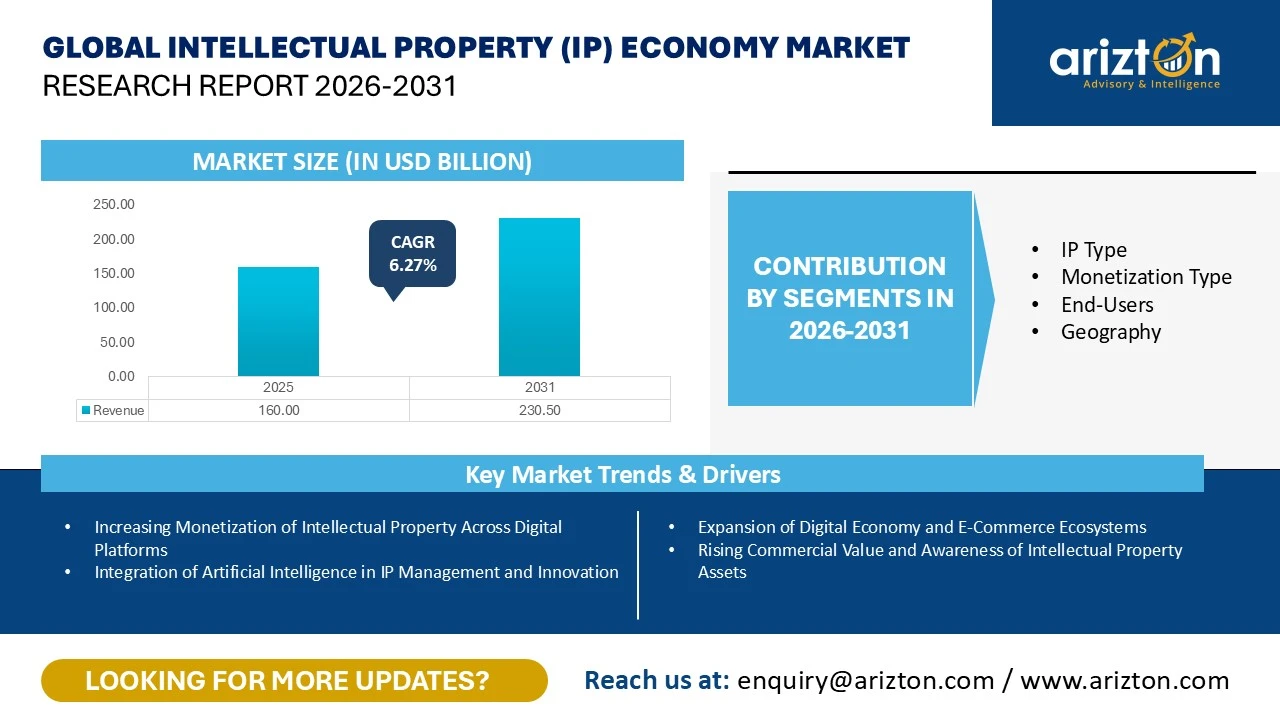
THE GLOBAL INTELLECTUAL PROPERTY ECONOMY MARKET WAS VALUED AT USD 160 BILLION IN 2025 AND IS EXPECTED TO REACH USD 230.50 BILLION BY 2031, GROWING AT A CAGR OF 6.27% FROM 2025 TO 2031.
The Intellectual Property Economy Market Size, Share & Trends Analysis Report By
- IP Type: Copyrights, Trademarks, Patents, Designs, and Others
- Monetization Type: Gaming Monetization, Content Monetization, Licensing, Merchandising, and Others
- End-Users: Media & Entertainment, Gaming Platforms, Consumer Goods & Retail, IT & Telecom, Healthcare, and Others
- Geography: North America, Europe, APAC, Latin America, & Middle East & Africa
Industry Analysis Report, Regional Outlook, Growth Potential, Price Trends, Competitive Market Share & Forecast 2026–2031.
This report includes market data points, ranging from trend
analyses to market estimates & forecasts that you can customize
INTELLECTUAL PROPERTY ECONOMY MARKET REPORT SCOPE
| REPORT ATTRIBUTE | DETAILS |
|---|---|
| MARKET SIZE (2031) | USD 230.50 Billion |
| MARKET SIZE (2025) | USD 160 Billion |
| CAGR (2025-2031) | 6.27% |
| HISTORIC YEAR | 2022-2024 |
| BASE YEAR | 2025 |
| FORECAST YEAR | 2026-2031 |
| SEGMENTS BY | IP Type, Monetization Type, End-User, and Geography |
| GEOGRAPHIC ANALYSIS | North America, Europe, APAC, Latin America, & Middle East & Africa |
| KEY PLAYERS | Anaqua, Inc., Kirkland & Ellis LLP, IIPRD (Intellectual Property Research & Development), Clarivate, and Patrix AB |
INTELLECTUAL PROPERTY ECONOMY MARKET SIZE & SHARE
The global intellectual property economy market size was valued at USD 160 billion in 2025 and is expected to reach USD 230.50 billion by 2031, growing at a CAGR of 6.27% during the forecast period. The IP Economy Market is a critical component of the global knowledge-driven and innovation-based economic ecosystem. It focuses on the creation, protection, management, and monetization of intangible assets such as patents, copyrights, trademarks, designs, and digital IP across industries, including technology, media, healthcare, consumer goods, and manufacturing. In this domain, legal protection, enforceability, scalability of monetization, and global regulatory compliance are essential; even minor gaps in IP enforcement, ownership clarity, or licensing structures can significantly impact revenue generation, competitive advantage, brand value, and long-term business sustainability.
Unlike traditional asset-driven markets, the IP economy operates on intangible value creation, where innovation, creativity, and brand identity drive growth. Companies must adhere to complex international IP laws, trade agreements, and digital rights frameworks while ensuring protection across multiple jurisdictions. Additionally, businesses are increasingly required to manage risks related to infringement, piracy, and unauthorized use, making strong IP governance and legal infrastructure a necessity for sustained growth.
KEY TAKEAWAYS
- IP Type: The copyrights segment dominates the IP economy market share by a significant margin of 29%.
- Monetization Type: The gaming monetization segment leads the IP economy market share of the global market in 2025.
- End-Users: The media & entertainment segment shows the highest growth, with a CAGR of 7.44% during the forecast period.
- Geography: North America dominates the global IP economy market share by geography.
Recent developments in the Intellectual Property Economy Industry
- In 2025, Anaqua, Inc. introduced advanced AI-driven capabilities within its IP management platform, including automated docketing, patent classification, and AI-based document analysis to improve efficiency and decision-making.
- In 2024, Clarivate released a global IP operations report highlighting the integration of AI, data analytics, and KPI-driven strategies to optimize IP portfolio management and business alignment.
- In 2024–2025, Wipro expanded its digital and consulting capabilities in areas such as AI, data analytics, and engineering R&D services, which directly support IP creation, patent development, and innovation lifecycle management.
- In recent years, LexisNexis has expanded its IP analytics and legal research platforms, integrating advanced data tools to improve patent search, litigation analysis, and risk assessment capabilities.
- Kirkland & Ellis LLP has continued expanding its intellectual property litigation and advisory capabilities, particularly in high-value patent disputes, technology transactions, and cross-border IP enforcement.
- Marks & Clerk has expanded its international presence and advisory services, focusing on patent filings, trademark protection, and cross-border IP strategy for global clients.
IP ECONOMY MARKET GROWTH DRIVERS
Rapid Expansion of the Creator Economy
- The rise of digital platforms has fundamentally shifted IP creation from large corporations to individuals, enabling millions of creators to generate, own, and monetize intellectual property at scale. Platforms like YouTube, TikTok, and Spotify have created ecosystems where content such as videos, music, and podcasts becomes monetizable IP through ads, subscriptions, and royalties.
- For example, independent musicians can now distribute music globally via Spotify without record labels, while YouTube creators earn through ad revenue, memberships, and brand deals. This shift is massively increasing the volume of copyright-protected content and turning IP into a decentralized, high-frequency revenue engine rather than a studio-controlled asset.
Growth of Digital and Virtual Assets
- The IP economy is expanding beyond physical and traditional digital formats into virtual environments, where ownership and monetization of digital assets are becoming mainstream. Technologies such as blockchain have enabled the creation of NFTs (non-fungible tokens), allowing creators to sell unique digital assets with verified ownership. Platforms like OpenSea have facilitated billion-dollar transactions in digital art, collectables, and virtual goods.
- In gaming ecosystems such as Fortnite and Roblox, virtual skins, characters, and in-game assets are now major revenue drivers. These assets are protected as IP and monetized continuously, proving that digital ownership is no longer theoretical—it’s a scalable business model.
Rising Importance of Patent-Driven Innovation
- Patent activity is accelerating due to intense global competition in advanced technologies such as artificial intelligence, semiconductors, telecommunications, and biotechnology. Companies like Qualcomm generate billions in revenue purely from patent licensing in 5G technologies, while pharmaceutical firms such as Pfizer rely on patents to secure exclusivity for drug innovations.
- In the tech sector, companies like IBM and Samsung Electronics consistently rank among the top patent filers globally. This shows a clear reality: patents are no longer just protection tools—they are revenue assets and strategic weapons in global competition.
IP ECONOMY MARKET TRENDS
Increasing Monetization of IP Across Digital Platforms
- The expansion of streaming and subscription-based business models is driving IP-based revenue growth, with companies such as Netflix and Disney investing in original content and turning copyrights into long-term revenue-generating assets through global distribution.
- During 2025–2026, streaming platforms are expanding into emerging markets, creating new monetization opportunities for regional content, including Asian dramas, Latin American series, and localized entertainment formats.
Integration of AI in IP Management and Innovation
- AI is transforming IP management by automating time-consuming processes such as patent searches, prior art analysis, trademark monitoring, and infringement detection. Companies such as Clarivate and LexisNexis are integrating AI into their IP platforms to analyze large patent and trademark databases and streamline workflows.
- AI-powered IP solutions help enterprises improve research efficiency, reduce manual effort, identify potential risks earlier, and enhance the speed and accuracy of intellectual property decision-making.
Growth of Digital Content and Creator-Driven IP Ecosystems
- The adoption of monetization tools such as advertising revenue sharing, subscriptions, and brand collaborations is turning digital content into a scalable income source. Platforms such as YouTube, TikTok, and Spotify help creators and artists earn through ads, sponsorships, digital products, and royalties.
- This trend is gaining momentum across APAC and Latin America, supported by rising digital adoption and increasing consumption of regional content, creating new opportunities for content creators and rights holders.
IP ECONOMY MARKET SEGMENTATION INSIGHTS
INSIGHT BY IP TYPE
The copyrights segment dominates the global intellectual property (IP) economy market share by a significant margin of 29%, reflecting its central role in the creation, protection, and monetization of digital and creative assets across modern industries. This dominance is structurally driven by the rapid expansion of IP-intensive industries such as media & entertainment, gaming, software, digital publishing, and online education, where content itself is the primary product and revenue driver.
Unlike patents and trademarks, copyrights apply to a vast and continuously growing volume of assets, including videos, music, films, gaming content, software code, digital designs, and written materials, resulting in a significantly larger addressable base and faster monetization cycles.
The widespread adoption of digital platforms, including OTT streaming services, social media ecosystems, and creator-driven marketplaces, has dramatically increased the production and consumption of copyright-protected content. This has enabled continuous and recurring revenue streams through subscriptions, advertising, licensing, and royalties, making copyrights far more scalable compared to other IP types that often rely on one-time or long-cycle monetization.
INSIGHT BY MONETIZATION TYPE
The gaming monetization leads the intellectual property (IP) economy market share in the global market in 2025, due to its unmatched ability to convert IP assets into continuous, high-frequency revenue streams. Despite this data issue, the segment’s dominance is structurally driven by the scale, engagement intensity, and monetization depth of the global gaming industry, where IP is not just protected but actively consumed and transacted in real time.
Gaming monetization operates on a fundamentally different model compared to traditional IP revenue streams. Instead of one-time licensing or delayed commercialization, gaming IP such as characters, skins, virtual goods, storylines, and environments, is monetized continuously through in-game purchases, microtransactions, subscriptions, battle passes, and live-service models. This creates a recurring revenue ecosystem with high user retention and lifetime value. The widespread adoption of mobile gaming, free-to-play models, and cross-platform ecosystems has further expanded the user base, particularly in high-growth regions such as Asia-Pacific and Latin America.
INSIGHT BY END-USERS
The media & entertainment segment dominates & shows the highest growth, with a CAGR of 7.44% during the forecast period. The media & entertainment dominance in the global intellectual property (IP) economy market is structurally embedded in the nature of the industry, where every core asset, films, television content, music, digital media, scripts, and streaming libraries, is inherently protected and monetized through intellectual property frameworks. Unlike other sectors where IP acts as a supporting asset, in media & entertainment, IP itself is the primary product and revenue driver.
The growth of this segment is fueled by the rapid expansion of OTT platforms, digital streaming services, and global content distribution networks, which have significantly increased both the volume and velocity of IP creation and consumption. Companies are continuously investing in original content production to secure exclusive rights, drive subscriptions, and maintain competitive advantage, leading to higher copyright registrations and licensing activities.
Additionally, the globalization of content—through multi-language releases, regional adaptations, and cross-border streaming—has expanded the commercial lifespan and geographic reach of IP assets, further strengthening revenue potential.
IP ECONOMY MARKET GEOGRAPHICAL ANALYSIS
North America dominates the global intellectual property (IP) economy market share by geography, driven by its highly developed innovation ecosystem, strong legal enforcement frameworks, and the global concentration of IP-intensive industries. This dominance is structurally anchored in the presence of leading technology companies, media conglomerates, pharmaceutical giants, and gaming firms that heavily rely on copyrights, patents, and trademarks as core business assets.
The region benefits from a mature and enforceable IP regulatory environment, particularly in the United States and Canada, where strong patent protection laws, copyright enforcement mechanisms, and litigation systems provide high confidence for IP commercialization. This encourages continuous investment in research & development, content creation, and brand development, significantly increasing both the volume and value of IP assets.
Europe’s IP economy market is undergoing a structural transformation, driven by strong regulatory frameworks, cross-border IP protection systems, rising digitalization, and increasing emphasis on innovation-led growth. Across the region, industries such as technology, pharmaceuticals, automotive, media, and clean energy are actively leveraging patents, trademarks, and copyrights to strengthen competitiveness and global positioning.
With increasing focus on data protection, sustainability, and digital sovereignty, Europe is integrating IP into broader economic strategies, enabling businesses to scale innovation while ensuring compliance with strict regulatory standards. The region’s mature legal ecosystem and coordinated EU-wide policies are making it a high-quality, regulation-driven IP market.
The Asia Pacific (APAC) region is emerging as one of the fastest-growing intellectual property (IP) economics markets, driven by rapid digital transformation, expanding startup ecosystems, strong government innovation policies, and increasing global integration of technology and creative industries. Countries such as China, India, Japan, South Korea, Singapore, Australia, and Taiwan are leading this growth through strong patent activity, digital IP expansion, and commercialization of innovation-driven assets.
IP ECONOMY MARKET VENDOR LANDSCAPE
The global intellectual property (IP) economy market is becoming increasingly competitive and structurally complex, driven by the rapid expansion of digital IP creation, cross-industry monetization models, and tightening global IP enforcement frameworks. Competition is no longer limited to legal ownership of IP assets, but extends to ecosystem control, licensing networks, monetization scalability, and platform dominance across industries such as media, gaming, technology, healthcare, and consumer goods.
Market participants are evolving from traditional IP owners into integrated IP ecosystem operators, combining content creation, distribution, licensing, and monetization under unified digital platforms. This shift is intensifying competition across both developed and emerging markets, particularly as AI, cloud infrastructure, and digital content platforms redefine how intellectual property is created and commercialized.
Key Competitive Dimensions
- Competitive strength is built on deep expertise in managing, valuing, and expanding multi-layered IP portfolios across patents, trademarks, copyrights, and digital assets. Firms like Clarivate and LexisNexis strengthen this dimension through advanced IP intelligence, patent databases, and analytics that help organizations optimize global IP portfolios. Legal firms such as Anand and Anand further reinforce portfolio protection through litigation and prosecution services across high-value IP assets.
- Competitive advantage is increasingly driven by digital IP platforms that enable search, monitoring, analytics, and lifecycle management of intellectual property. Clarivate and LexisNexis dominate this space by providing AI-powered IP intelligence, patent tracking, and global legal data infrastructure. These platforms enable enterprises to identify innovation trends, reduce infringement risk, and optimize global IP monetization strategies.
SNAPSHOT
The global intellectual property (IP) economy market size is expected to grow at a CAGR of approximately 6.27% from 2025 to 2031.
The following factors are likely to contribute to the growth of the global intellectual property (IP) economy market during the forecast period:
- Rising Commercial Value and Awareness of Intellectual Property Assets
- Expansion of Digital Economy and E-Commerce Ecosystems
- Rising Complexity in Global IP Management Drives Demand for Advanced Solutions
- Innovation Boom Across Industries Fuels Global Patent Activity
Base Year: 2025
Forecast Year: 2026-2031
The report examines the current state of the global intellectual property (IP) economy market and its market dynamics through 2026−2031. It covers a detailed overview of several market growth enablers, restraints, and trends. The study covers both the demand and supply sides of the market. It also profiles and analyses leading companies and several other prominent companies operating in the market.
- Key Developments
Key Company Profiles
- Anaqua, Inc
- Business Overview
- Product Offerings
- Key Developments
- Key Strategies
- Key Strengths
- Key Opportunities
- Kirkland & Ellis LLP
- IIPRD
- CLARIVATE
- Patrix AB
Other Prominent Company Profiles
- Acumen Intellectual Property
- Business Overview
- Product Offerings
- Venable LLP
- Murgitroyd & Company
- Zacco A/S
- ABG Intellectual Property Law S.L.
- KIPB
- Anand and Anand
- LexisNexis
- Marks & Clerk
- Wipro
- Questel
- Dennemeyer
- Maxval Group
- IFI Claims Patent Services
- RWS Group
- Lighthouse IP
- IamIP Platform
- ALT Legal
- Unified Patents
- Dolcera
Segmentation by IP Type
- Copyrights
- Trademarks
- Patents
- Designs
- Others
Segmentation by Monetization
- Gaming Monetization
- Content Monetization
- Licensing
- Merchandising
- Others
Segmentation by End-Users
- Media & Entertainment
- Gaming Platforms
- Consumer Goods & Retail
- IT & Telecom
- Healthcare
- Others
Segmentation by Geography
- North America
- U.S.
- Canada
- Europe
- Germany
- UK
- France
- Italy
- Spain
- Netherlands
- Sweden
- Switzerland
- Denmark
- Russia
- Rest of Europe
- APAC
- China
- India
- Japan
- South Korea
- Australia
- Thailand
- Singapore
- Rest of APAC
- Latin America
- Brazil
- Mexico
- Argentina
- Colombia
- Chile
- Rest of Latin America
- Middle East & Africa
- Saudi Arabia
- UAE
- South Africa
- Egypt
- Rest of MEA
INTELLECTUAL PROPERTY ECONOMY MARKET FAQs
How big is the global intellectual property (IP) economy market?
What is the growth rate of the global intellectual property (IP) economy market?
Which region dominates the global intellectual property (IP) economy market?
What are the growth drivers of the global intellectual property (IP) economy market?
Who are the major players in the global intellectual property (IP) economy market?
For more details, please reach us at [email protected]
1. Scope & Coverage
- Market Definition
- Inclusions
- Exclusions
- Market Estimation Caveats
- Market Size & Forecast Periods
- Historic Period: 2022-2024
- Base Year: 2025
- Forecast Period: 2026-2031
- Market Size (2022-2031) Revenue
- Market Segments
- Market Segmentation by IP Type
- Market Segmentation by Monetization Type
- Market Segmentation by End - users
2. Opportunity Pockets
3. Introduction
- Major Factors Driving Growth in The IP economy Market
- Recent Developments in the Wall Pannel Industry
- Role Of IP economy in The Global Construction Ecosystem
- Technology Integration & Smart Features the Global IP economy Market
- Dominant Segments in The Global IP economy Market
- Parameters Impacting Market Growth
4. Market Opportunities & Trends
- Increasing Monetization of Intellectual Property Across Digital Platforms
- Integration of Artificial Intelligence in IP Management and Innovation
- Growth of Digital Content and Creator-Driven IP Ecosystems
- Strengthening Global IP Regulations and Cross-Border Protection Frameworks
5. Market Growth Enablers
- Rising Commercial Value and Awareness of Intellectual Property Assets
- Expansion of Digital Economy and E-Commerce Ecosystems
- Rising Complexity in Global IP Management Drives Demand for Advanced Solutions
- Innovation Boom Across Industries Fuels Global Patent Activity
6. Market Restraints
- High Cost of IP Protection and Litigation
- Inconsistent IP Enforcement Across Regions
- Complexity of Multi-Jurisdictional IP Regulations
- Rising Risk of Digital Piracy and IP Infringement
7. Market Landscape
8. Five Forces Analysis
9. IP Type Covered: (Market Size & Forecast: 2022-2031)
- Copyrights
- Trademarks
- Patents
- Designs
- Others
10. Monetization Type Covered: (Market Size & Forecast: 2022-2031)
- Gaming Monetization
- Content Monetization
- Licensing
- Merchandising
- Others
11. End - users Covered: (Market Size & Forecast: 2022-2031)
- Media & Entertainment
- Gaming Platforms
- Consumer Goods & Retail
- IT & Telecom
- Healthcare
- Others
12. Geography (Market Size & Forecast: 2022-2031)
Regional Analysis within North America
- US
- CANADA
Regional Analysis within Europe
- Germany
- UK
- France
- Italy
- Spain
- Netherlands
- Sweden
- Switzerland
- Denmark
- Russia
- RoEurope
Regional Analysis within APAC
- China
- India
- Japan
- South Korea
- Australia
- Thailand
- Singapore
- RoAPAC
Regional Analysis within Latin America
- Brazil
- Mexico
- Argentina
- Colombia
- Chile
- RoLA
Regional Analysis within Middle East Africa
- Saudi Arabia
- UAE
- South Africa
- Egypt
- RoMEA
13. Competitive Landscape
14. Competitive Overview
- Key Developments
15. Key Company Profiles
- Anaqua, Inc
- Kirkland & Ellis LLP
- IIPRD
- CLARIVATE
- Patrix AB
16. Other Prominent Company Profiles
- Acumen Intellectual Property
- Venable LLP
- Murgitroyd & Company
- Zacco A/S
- ABG Intellectual Property Law S.L.
- KIPB
- Anand and Anand
- LexisNexis
- Marks & Clerk
- Wipro
17. Report Summary
- Key Takeaways
- Strategic Recommendations
Select a license type that suits your business needs
Single User Licence
- Report accessible by one user only
- Free 10% or 3 days of customization
- Free post-sale service assistance
- Continuous support through email
5 User Licence
- Report accessible by 5 users within the organization
- Free 15% or 4.5 days of customization
- Continuous support through email and telephone
- Free analyst hour
- Free Upgrade: If an updated report published within 180 days of purchase, you will get the revised report free of charge
Corporate Licence
- Free Datasheet worth $1500
- Report accessible by the entire organization
- Free 20% or 6 days of customization
- Free post-sale service assistance
- Continuous support through email and telephone
- Direct access to lead analysts
- Free analyst hour
- Free Upgrade: If an updated report published within 180 days of purchase, you will get the revised report free of charge
Datasheet Licence
- Report accessible by 1 user only
- Free 15% or 32 hours of customization
- Free post-sale service assistance
- Direct access to lead analysts
Frequently Asked Questions
How big is the global intellectual property (IP) economy market?
What is the growth rate of the global intellectual property (IP) economy market?
Which region dominates the global intellectual property (IP) economy market?
What are the growth drivers of the global intellectual property (IP) economy market?
Who are the major players in the global intellectual property (IP) economy market?