
Latin America Data Center Colocation Market – Industry Outlook & Forecast 2026-2031


Latin America Data Center Colocation Market – Industry Outlook & Forecast 2026-2031
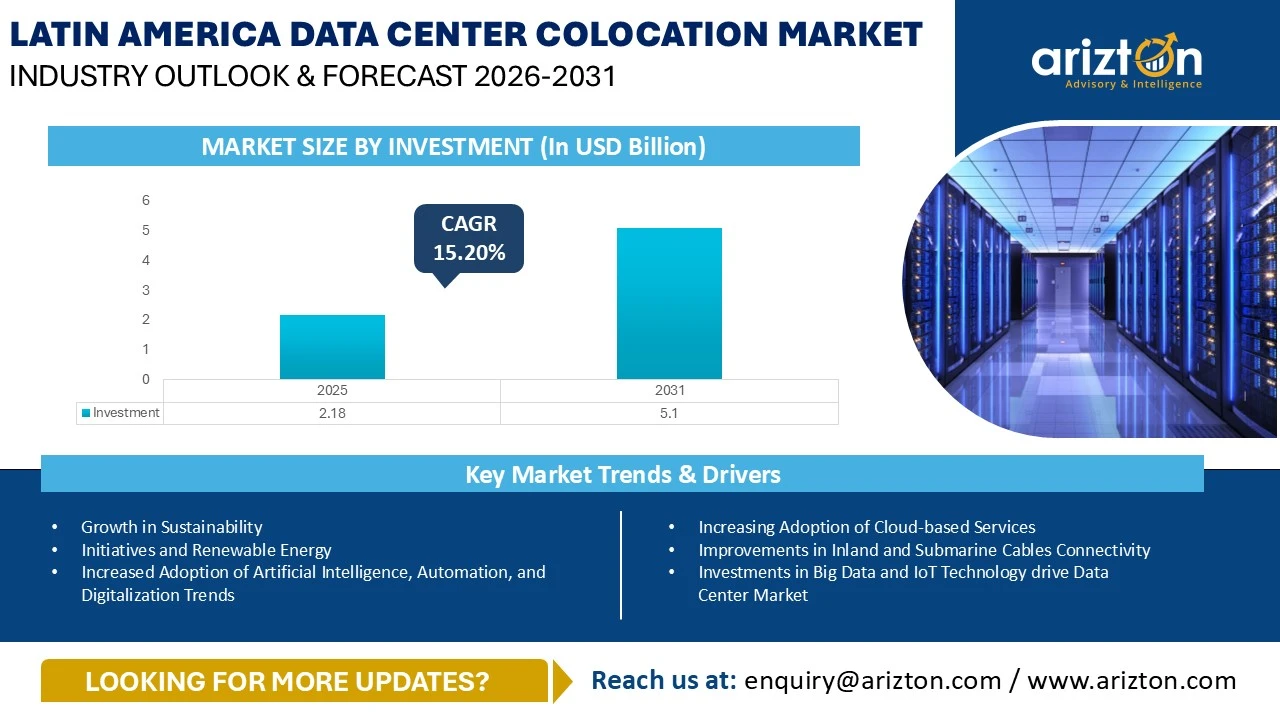
LATIN AMERICA DATA CENTER COLOCATION MARKET SIZE BY INVESTMENT WAS VALUED AT USD 2.18 BILLION IN 2025 AND IS EXPECTED TO REACH USD 5.10 BILLION BY 2031, GROWING AT A CAGR OF 15.20% DURING THE FORECAST PERIOD.
The Latin America Data Center Colocation Market Report Includes
- Colocation Type: Retail Colocation and Wholesale Colocation
- Infrastructure: Electrical Infrastructure, Mechanical Infrastructure, and General Construction
- Electrical Infrastructure: UPS Systems, Generators, Transfer Switches & Switchgear, PDUs, and Other Electrical Infrastructure
- Mechanical Infrastructure: Cooling Systems, Racks, and Other Mechanical Infrastructure
- Cooling Systems: CRAC & CRAH Units, Chiller Units, Cooling Towers, Condensers & Dry Coolers, Economizers & Evaporative Coolers, and Other Cooling Units
- Cooling Techniques: Air-based Cooling and Liquid-based Cooling
- General Construction: Core & Shell Development, Installation & Commissioning Services, Engineering & Building Design, Fire Detection & Suppression, Physical Security, and DCIM/BMS Solutions
- Tier Standard: Tier I & II, Tier III, and Tier IV
- Geography: Brazil, Mexico, Chile, Colombia, Argentina, and Rest of Latin America
Get Insights on 260 Existing Data Center Facilities and 78 Upcoming Facilities across Latin America
This report includes market data points, ranging from trend
analyses to market estimates & forecasts that you can customize
LATIN AMERICA DATA CENTER COLOCATION MARKET REPORT SCOPE
| REPORT ATTRIBUTE | DETAILS |
|---|---|
| MARKET SIZE BY INVESTMENT 2031 | USD 5.10 Billion |
| MARKET SIZE BY INVESTMENT 2025 | USD 2.18 Billion |
| CAGR - INVESTMENT (2025-2031) | 15.20% |
| MARKET SIZE - COLOCATION REVENUE 2031 | USD 4.51 Billion |
| MARKET SIZE AREA (2031) | 1.54 million sq. feet |
| POWER CAPACITY (2031) | 389 MW (2030) |
| BASE YEAR | 2025 |
| FORECAST YEAR | 2026-2031 |
| MARKET SEGMENTS | Colocation Service, Infrastructure, Electrical Infrastructure, Mechanical Infrastructure, Cooling Systems, Cooling Techniques, General Construction, Tier Standards, and Geography |
| GEOGRAPHICAL ANALYSIS | Brazil, Mexico, Chile, Colombia, Argentina, and Rest of Latin America |
LATIN AMERICA DATA CENTER COLOCATION MARKET SIZE ANALYSIS
The Latin America data center colocation market is forecast to grow from USD 2.18 billion in 2025 to USD 5.10 billion by 2031, at a CAGR of 15.20%. The region is expected to attract USD 23.15 billion in cumulative data center investment between 2026 and 2031, with Brazil accounting for USD 11.53 billion, or 49.8% of the total. This concentration of investment highlights Brazil’s position in the region’s expansion, while leaving the distribution of investment across other Latin American markets an important consideration.
AI workloads, cloud adoption, and hyperscale expansion are driving demand for data center colocation capacity. However, construction costs range from USD 7 million to USD 10 million per MW, depending on location. Land availability, labor costs, inflation, and access to power influence these costs and add to the considerations involved in developing new data center infrastructure across the region.
The Latin America data center colocation market outlook through 2031 examines market growth, regional investment patterns, and construction costs, offering insight into the factors shaping colocation infrastructure development across Latin America.
Download the free sample to explore Latin America’s data center investment outlook through 2031
LATIN AMERICA DATA CENTER COLOCATION MARKET OPPORTUNITIES & TRENDS
AI Transforming the Landscape of the Data Center Market
- Brazil – Digital Scale and AI Infrastructure: Brazil’s internet penetration exceeded 86.5% in 2025, representing more than 184 million users. This large digital base supports the expansion of cloud computing and AI applications. The key market consideration is how this digital demand translates into additional computing capacity and colocation requirements.
- Colombia – Fiber Investment for AI Readiness: Claro Colombia is investing more than USD 200 million to expand its fiber-optic network and prepare its infrastructure for advanced technologies, including AI. This investment highlights the role of connectivity in supporting data-intensive workloads and the wider development of digital infrastructure.
- Chile – Digital Policy and Technology Investment: Chile’s Digital Transformation Strategy 2035 prioritizes digital skills, cybersecurity, and technology-enabled public services. Combined with efforts to attract global technology partnerships, these initiatives could strengthen the country’s position in regional digital infrastructure development.
- Mexico – Digital Adoption and Future Capacity Demand: Mexico recorded 99 million active social media user identities and 83.5% internet penetration at the end of 2025. As AI applications and enterprise cloud services expand, the extent to which this digital market generates additional colocation demand will depend on local computing and infrastructure requirements.
- Argentina – Competing for AI Infrastructure Investment: In May 2025, Argentina’s government promoted its ambition to become a global AI hub, highlighting minimal regulation, land availability, and low energy costs to attract technology companies. Whether these advantages translate into new data center projects will influence the country’s future role in Latin America’s AI infrastructure landscape.
Renewable Energy and Sustainability Initiatives by Data Center Operators
- The Latin America data center colocation market is increasingly integrating sustainability and renewable energy practices into infrastructure development, supported by strong government policies and corporate commitments to reduce carbon emissions. Countries across the region are setting ambitious renewable energy and carbon-neutrality targets while encouraging energy-efficient digital infrastructure and green power adoption for hyperscale and colocation facilities.
- The Argentine government has outlined a clear roadmap to expand the use of renewable energy as part of its national energy transition strategy. It has set ambitious targets to ensure that 20% of the total electricity consumption of the country comes from renewable sources by 2025, and to further increase this share to 35% by 2030. The Argentine government has also established the National Energy Efficiency Plan, which aims to reduce energy consumption and promote energy efficiency.
- The Brazilian data center market increasingly prioritizes sustainability, with many operators investing in energy-efficient infrastructure and renewable energy sources. Data centers continue to adopt green practices such as using solar and wind energy, implementing advanced cooling technologies, and optimizing PUE.
- Mexico has committed to achieving net-zero emissions by 2050. Several data center operators have been actively working toward the sustainability of data center facilities by powering them with renewable energy, adopting efficient electrical and mechanical infrastructure, and using several power monitoring systems.
- Chile has set an ambitious vision to prevent climate change and promote sustainability. The goals of the country include achieving peak greenhouse gas emissions by 2030, reaching carbon neutrality by 2050, and attaining net-zero greenhouse gas emissions by 2065. This vision aligns with global efforts to mitigate climate change and underscores Chile’s commitment to a sustainable future.
- Colombia has a diverse array of renewable energy sources, including wind, hydropower, biomass, geothermal, and solar energy. The country aims to produce 70% of energy through renewable sources by 2030. The renewable energy expansion goals of the country include a target of 6 GW of solar and wind energy by 2026. It aims to achieve carbon neutrality by 2050. In November 2025, Colombia made over 5,000 MW of space available on its electricity grid by clearing stalled or inactive connection requests. This allows new solar and wind projects to connect and start delivering power.
LATIN AMERICA DATA CENTER COLOCATION MARKET SEGMENTATION INSIGHTS
- The electrical infrastructure is witnessing several innovations in the UPS systems, generators, transfer switches & switchgears and other electrical equipment. Most data centers adopt N+1 diesel generators, providing backup fuel for up to 24 hours or more. For instance, Equinix’s MX2 data center is backed by the dual 1,939 kW diesel generators for main electrical bus support.
- Additionally, several innovative UPS batteries such as Nickel-Zinc (NiZn) and Sodium-Ion batteries are gaining traction in the market due to their high-power density, safety, sustainability, and other factors.
- AI workloads are changing cooling standards in US data centers, as traditional air cooling is insufficient to manage the heat output from GPU-dense clusters. The market is observing an increasing number of partnerships among data center operators, cooling technology vendors, chip manufacturers, and energy innovators, for instance, KIO Data Centers’ MEX 6 data center is equipped with 2N redundant chillers. It uses frozen water-cooling type solutions and N+2 redundant humidity controllers.
LATIN AMERICA DATA CENTER COLOCATION MARKET GEOGRAPHICAL ANALYSIS
- The Latin America data center market is currently experiencing significant growth, driven largely by the increasing adoption of technologies, particularly Artificial Intelligence (AI).
- Brazil holds a significant market share in the data center growth of Latin America. Digital transformation policies, coupled with the widespread adoption of IoT and big data, support major investments in data center infrastructure.
- Local and established providers play a significant role in offering tailored services for Brazilian businesses. In February 2026, Legrand acquired Green4T, a São Paulo-based data center infrastructure services provider with approx. 750 employees and about $53 million in annual revenue, further expanding its Latin American data center portfolio.
- The Mexico data center market is driven by factors such as the growing adoption of digital platforms, advanced technologies, including AI, IoT, and big data, and other factors. In November 2025, Telmex announced its plans to build a new data center in Northeastern Mexico, which is expected to become operational in 2026.
- As of December 2025, Chile hosted 39 operational data center facilities, spanning a total of 1,152.2 thousand square feet of white floor space, along with 9 upcoming facilities covering around 1,984.4 thousand square feet.
- Colombia is the fourth-largest economy in Latin America, playing an important role in the expansion of data centers across the region. In August 2025, Colombia launched ACOLDC, the Colombian Association of Data Centers and Data Technology, a non-profit organization that brings together key companies in the data center industry of Colombia.
- Data Center Power costs in South America vary widely by country, shaping data center location decisions. Chile has some of the highest electricity rates in the region, driving up operational costs; on the other hand, countries, including Argentina and Brazil, offer lower power prices, making them more appealing for cost-effective data center growth.
LATIN AMERICA DATA CENTER COLOCATION MARKET VENDOR LANDSCAPE
- The Latin America data center market has the presence of key investors such as Ascenty, Cirion Technologies, Claro, EdgeConneX, Elea Data Centers, Equinix, GTD, HostDime, IPXON Networks, KIO Data Centers, NextStream (Actis), ODATA (Aligned Data Centers), Quantico Data Center, Scala Data Centers, Takoda Data Centers, Tecto Data Centers, and others.
- In April 2026, I Squared Capital, a global infrastructure investor, announced its acquisition of a majority stake in Elea Data Centers, which is one of Brazil’s largest carrier-neutral data center platforms.
- In August 2025, ODATA (Aligned Data Centers) announced the launch of the first phase of its QR04 data center facility in Querétaro, Mexico, which will initially have an IT power capacity of 12 MW. Once fully constructed, the data center is expected to support a total capacity of 24 MW.
- New entrants in the region include 247 Data Centers, Ada Infrastructure, Atlantic Data Centers, Ava Telecom, CloudHQ, Fermaca Networks, Layer 9 Data Centers, MDC Data Centers, OpenAI & Sur Energy, Surfix Data Center, and Terranova.
- In October 2025, the Argentinian government introduced the Stargate Argentina initiative to support a large-scale facility, which would host OpenAI’s future AI workloads. OpenAI and Sur Energy signed a Letter of Intent for a project targeting up to 500 MW of capacity with an estimated $25 billion investment, with the initial 100 MW phase expected to become operational in 2027.
SNAPSHOT
The Latin America data center colocation market by investment is projected to reach USD 5.10 billion by 2031, growing at a CAGR of 15.20% from 2025 to 2031.
The following factors are likely to contribute to the growth of the Latin America data center colocation market during the forecast period:
- Rising Adoption of Cloud-based Services
- Government Support & Digital Economy Push
- Improvement in Connectivity via Submarine Cables
Base Year: 2025
Forecast Year: 2026-2031
The report considers the present scenario of the Latin America data center colocation market and its market dynamics for 2026−2031. It covers a detailed overview of several market growth enablers, restraints, and trends. The study includes the demand and supply aspects of the Latin America data center colocation industry.
Key Data Center Investors
- Ascenty
- Cirion Technologies
- Elea Data Centers
- Equinix
- KIO Data Centers
- NextStream (Actis)
- ODATA (Aligned Data Centers)
- Scala Data Centers
Other Data Center Investors
- Angola Cables
- Claro
- DHAmericas
- Edge Uno
- EdgeConneX
- EMPATEL SAPEM
- Etix Everywhere
- EVEO
- G2K
- GlobeNet International Corp.
- Gtd
- HostDime
- IPXON Networks
- Iplan
- InterNexa
- Mexico Telecom Partners
- NetGlobalis
- OneX Data Center
- PowerHost
- Quantico Data Center
- SONDA
- Takoda Data Centers
- Telecentro Empresas
- Telecom Argentina
- Tecto Data Centers
New Entrants
- 247 Data Centers
- Ada Infrastructure
- Atlantic Data Centers
- Ava Telecom
- CloudHQ
- Fermaca Networks
- Layer 9 Data Centers
- MDC Data Centers
- OpenAI and Sur Energy
- Surfix Data Center
- Terranova
- TECfusions
Segmentation by Colocation Type
- Retail Colocation
- Wholesale Colocation
Segmentation by Infrastructure
- Electrical Infrastructure
- Mechanical Infrastructure
- General Construction
Segmentation by Electrical Infrastructure
- UPS Systems
- Generators
- Transfer Switches & Switchgear
- PDUs
- Other Electrical Infrastructure
Segmentation by Mechanical Infrastructure
- Cooling Systems
- Racks
- Other Mechanical Infrastructure
Segmentation by Cooling Systems
- CRAC & CRAH Units
- Chiller Units
- Cooling Towers, Condensers & Dry Coolers
- Economizers & Evaporative Coolers
- Other Cooling Units
Segmentation by Cooling Techniques
- Air-based Cooling
- Liquid-based Cooling
Segmentation by General Construction
- Core & Shell Development
- Installation & Commissioning Services
- Engineering & Building Design
- Fire Detection & Suppression
- Physical Security
- DCIM/BMS Solutions
Segmentation by Tier Standard
- Tier I & II
- Tier III
- Tier IV
Segmentation by Geography
- Latin America
- Brazil
- Mexico
- Chile
- Colombia
- Argentina
- Rest of Latin America
LATIN AMERICA DATA CENTER COLOCATION MARKET FAQs
How big is the Latin America data center colocation market?
What is the growth rate of the Latin America data center colocation market?
What are the key trends in the Latin America data center colocation market?
What is the estimated market size in terms of area in the Latin America data center colocation market by 2031?
How much MW of power capacity is expected to reach the Latin America data center colocation market by 2031?
What is the estimated market size in terms of area in the Latin America data center colocation market by 2031?
For more details, please reach us at [email protected]
1. ABOUT ARIZTON
2. ABOUT OUR DATA CENTER CAPABILITIES
3. WHAT’S INCLUDED
4. SEGMENTS INCLUDED
5. RESEARCH METHODOLOGY
6. MARKET AT GLANCE
7. PREMIUM INSIGHTS
8. INTRODUCTION
9. INVESTMENT OPPORTUNITIES
9.1. INVESTMENT: MARKET SIZE & FORECAST
9.2. AREA: MARKET SIZE & FORECAST
9.3. POWER CAPACITY: MARKET SIZE & FORECAST
10. MARKET DYNAMICS
10.1. MARKET OPPORTUNITIES & TRENDS
10.2. MARKET GROWTH ENABLERS
10.3. MARKET RESTRAINTS
10.4. SITE SELECTION CRITERIA
11. INFRASTRUCTURE SEGMENTATION
11.1. COLOCATION SERVICE
11.2. ELECTRICAL INFRASTRUCTURE
11.3. MECHANICAL INFRASTRUCTURE
11.4. COOLING SYSTEMS
11.5. COOLING TECHNIQUES
11.6. GENERAL CONSTRUCTION
12. TIER STANDARDS SEGMENTATION
13. GEOGRAPHY SEGMENTATION
14. LATIN AMERICA
14.1. MARKET SNAPSHOT & KEY HIGHLIGHTS
14.2. DATA CENTER MARKET BY SUPPORT INFRASTRUCTURE
15. BRAZIL
15.1. IMPACT OF AI ON THE DATA CENTER INDUSTRY IN BRAZIL
15.2. GOVERNMENT RULES AND REGULATIONS FOR DATA CENTERS
15.3. MARKET BY INVESTMENT
15.4. MARKET BY AREA
15.5. MARKET BY POWER CAPACITY
15.6. COLOCATION REVENUE
15.7. KEY SUPPORT INFRASTRUCTURE ADOPTION
15.8. LIST OF UPCOMING DATA CENTER PROJECTS IN BRAZIL
16. CHILE
16.1. IMPACT OF AI ON THE DATA CENTER INDUSTRY IN CHILE
16.2. GOVERNMENT RULE AND REGULATION FOR DATA CENTER
16.3. MARKET BY INVESTMENT
16.4. MARKET BY AREA
16.5. MARKET BY POWER CAPACITY
16.6. COLOCATION REVENUE
16.7. KEY SUPPORT INFRASTRUCTURE ADOPTION
16.8. LIST OF UPCOMING DATA CENTER PROJECTS IN CHILE
17. MEXICO
17.1. IMPACT OF AI ON THE DATA CENTER INDUSTRY IN MEXICO
17.2. GOVERNMENT RULE AND REGULATION FOR DATA CENTER
17.3. MARKET BY INVESTMENT
17.4. MARKET BY AREA
17.5. MARKET BY POWER CAPACITY
17.6. COLOCATION REVENUE
17.7. KEY SUPPORT INFRASTRUCTURE ADOPTION
17.8. LIST OF UPCOMING DATA CENTER PROJECTS IN MEXICO
18. COLOMBIA
18.1. IMPACT OF AI ON THE DATA CENTER INDUSTRY IN COLOMBIA
18.2. GOVERNMENT RULE AND REGULATION FOR DATA CENTER
18.3. MARKET BY INVESTMENT
18.4. MARKET BY AREA
18.5. MARKET BY POWER CAPACITY
18.6. COLOCATION REVENUE
18.7. KEY SUPPORT INFRASTRUCTURE ADOPTION
18.8. LIST OF UPCOMING DATA CENTER PROJECTS IN COLOMBIA
19. ARGENTINA
19.1. IMPACT OF AI ON THE DATA CENTER INDUSTRY IN ARGENTINA
19.2. GOVERNMENT RULE AND REGULATION FOR DATA CENTER
19.3. MARKET BY INVESTMENT
19.4. MARKET BY AREA
19.5. MARKET BY POWER CAPACITY
19.6. KEY SUPPORT INFRASTRUCTURE ADOPTION
19.7. LIST OF UPCOMING DATA CENTER PROJECTS IN ARGENTINA
20. REST OF LATIN AMERICA
20.1. MARKET BY INVESTMENT
20.2. MARKET BY AREA
20.3. MARKET BY POWER CAPACITY
20.4. COLOCATION REVENUE
20.5. KEY SUPPORT INFRASTRUCTURE ADOPTION
21. COMPETITVE LANDSCAPE
21.1. MARKETSHARE BY COLOCATION POWER CAPACITY
21.2. MARKETSHARE BY COLOCATION REVENUE
22. MARKET PARTICIPANTS
22.1. KEY DATA CENTER COLOCATION OPERATORS
22.2. OTHER KEY DATA CENTER COLOCATION OPERATORS
22.3. NEW ENTRANTS
23. QUANTITATIVE SUMMARY
24. APPENDIX
24.1. ABBREVIATIONS
24.2. DEFINITIONS
24.3. SEGMENTAL COVERAGE
Select a license type that suits your business needs
Single User Licence
- Report accessible by one user only
- Free 10% or 3 days of customization
- Free post-sale service assistance
- Continuous support through email
5 User Licence
- Report accessible by 5 users within the organization
- Free 15% or 4.5 days of customization
- Continuous support through email and telephone
- Free analyst hour
- Free Upgrade: If an updated report published within 180 days of purchase, you will get the revised report free of charge
Corporate Licence
- Free Datasheet worth $1500
- Report accessible by the entire organization
- Free 20% or 6 days of customization
- Free post-sale service assistance
- Continuous support through email and telephone
- Direct access to lead analysts
- Free analyst hour
- Free Upgrade: If an updated report published within 180 days of purchase, you will get the revised report free of charge
Datasheet Licence
- Report accessible by 1 user only
- Free 15% or 32 hours of customization
- Free post-sale service assistance
- Direct access to lead analysts
Frequently Asked Questions
How big is the Latin America data center colocation market?
What is the growth rate of the Latin America data center colocation market?
What are the key trends in the Latin America data center colocation market?
What is the estimated market size in terms of area in the Latin America data center colocation market by 2031?
How much MW of power capacity is expected to reach the Latin America data center colocation market by 2031?
What is the estimated market size in terms of area in the Latin America data center colocation market by 2031?
Other RELATED Reports

Latin America Data Center Construction Market – Industry Outlook & Forecast 2026-2031
Published : April 2026
Argentina Data Center Market – Investment Analysis & Growth Opportunities 2026-2031
Published : March 2026