
Global Life Science Precision Parts Market Research Report 2025–2030


190 pages

28 company

04 segments

5 region

25 countries
Purchase Options
Global Life Science Precision Parts Market Research Report 2025–2030
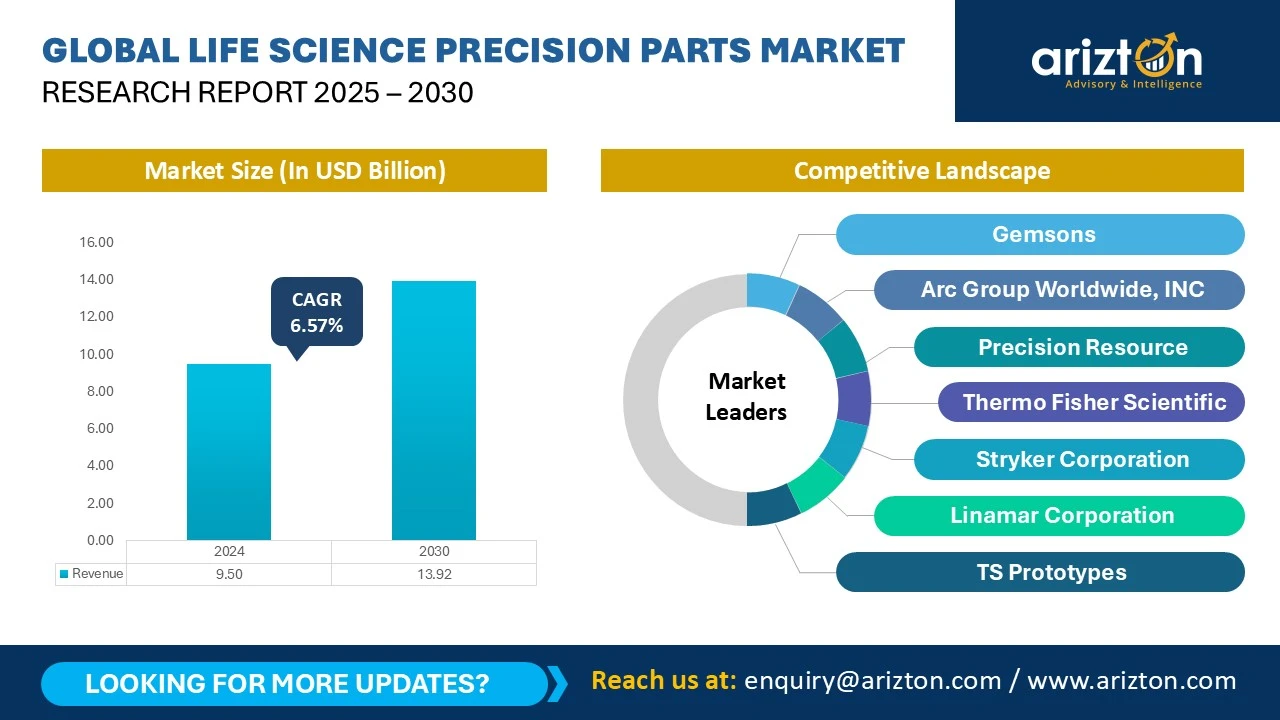
THE GLOBAL LIFE SCIENCE PRECISION PARTS MARKET WAS VALUED AT USD 9.50 BILLION IN 2024 AND IS EXPECTED TO REACH USD 13.92 BILLION BY 2030, GROWING AT A CAGR OF 6.57% DURING THE FORECAST PERIOD.
The Life Science Precision Parts Market Size, Share, & Trends Analysis Report By
- Product Type: Injection‑Molded Components, CNC Machined Parts, Swiss Turned Components, Cold‑Formed Microcomponents, Metal Stamping, and Others
- Material Type: Metal, Plastic, and Other Materials
- Application: Diagnostic Devices, Lab Automation Equipment, Fluid Handling Systems, and Other Applications
- Geography: North America, Europe, APAC, Latin America, and Middle East & Africa
Industry Analysis Report, Regional Outlook, Growth Potential, Price Trends, Competitive Market Share & Forecast 2025–2030.
This report includes market data points, ranging from trend
analyses to market estimates & forecasts that you can customize
LIFE SCIENCE PRECISION PARTS MARKET REPORT SCOPE
| REPORT ATTRIBUTE | DETAILS |
|---|---|
| Market Size (2030) | USD 13.92 Billion |
| Market Size (2024) | USD 9.50 Billion |
| CAGR (2024-2030) | 6.57% |
| HISTORIC YEAR | 2021-2023 |
| BASE YEAR | 2024 |
| FORECAST YEAR | 2025-2030 |
| SEGMENTS BY | Product Type, Material Type, Application, and Geography |
| GEOGRAPHIC ANALYSIS | North America, Europe, APAC, Latin America, and Middle East & Africa |
LIFE SCIENCE PRECISION PARTS MARKET SIZE & SHARE
The global life science precision parts market size was valued at USD 9.50 billion in 2024 and is expected to reach USD 13.92 billion by 2030, growing at a CAGR of 6.57% during the forecast period. The market industry is witnessing rapid evolution due to technological advancements, rising demand for advanced laboratory instrumentation, and growing emphasis on data accuracy in diagnostics and research. This industry caters to the production of ultra-precise components used in high-performance life science equipment, including analytical instruments, automated liquid handlers, DNA sequencers, and bioreactors.
The Life Sciences precision parts market is a vital sub-segment of the broader precision engineering industry. It focuses on the design, manufacturing, and integration of micro- and nano-scale components used in biotechnology, pharmaceuticals, diagnostics, and laboratory research. In these areas, tolerances are extremely tight, often in the range of microns or sub-microns, because even the slightest dimensional error can affect experimental outcomes, patient safety, or product quality.
LIFE SCIENCE PRECISION PARTS MARKET NEWS
- Knowles Corporation (2024): Expanded into medtech miniaturization services, offering micro-stamping, micro-molding, ultra-fine wire coil winding, and precision machining for compact medical devices.
- Precipart & Accumold: Specialized in micro-manufacturing for implants, hearing aids, and diagnostic devices.
- Thermo Fisher & Danaher: Continuously investing in precision-engineered instrument components for genomics and molecular diagnostics.
LIFE SCIENCE PRECISION PARTS MARKET TRENDS & DRIVERS
Automation Driving Laboratory And Biotech Research
Automation is transforming laboratory and biotech research, driving significant growth in the life sciences precision parts industry by replacing labor-intensive tasks such as pipetting, liquid transfer, mixing, and sequencing with high-throughput, reproducible, and error-free workflows. This shift has created a strong demand for ultra-reliable precision components, including microvalves, pipetting heads, dispensing nozzles, microfluidic cartridges, and flow regulators that enable the consistent handling of microliter to nanoliter volumes in critical applications such as next-generation sequencing (NGS), qPCR, and cell-based assays. Leading platforms such as Illumina’s NovaSeq, which integrates advanced fluidics with precision micro-valves and flow cells to process thousands of DNA samples simultaneously, and Hamilton Robotics’ Microlab STAR, which leverages high-precision pipetting heads for genomic and proteomic workflows, highlight how automation is reshaping research efficiency and accuracy. Ultimately, as automation continues to advance, the precision parts industry will remain at the core of enabling faster discoveries, greater scalability, and more reliable outcomes in the life sciences sector.
Growth in Life Sciences & Laboratory Automation
The growth of genomics, personalized medicine, and biopharmaceutical automation is driving strong demand for ultra-precise, biocompatible, and traceable precision parts, which are essential for advanced laboratory instruments and sterile manufacturing systems. Companies like Thermo Fisher, Beckman Coulter, Pfizer, and Roche rely on these components for accuracy, cleanliness, and compliance with stringent FDA and ISO 13485 standards. Meanwhile, AI- and IoT-enabled platforms from PerkinElmer and Hamilton further increase dependence on smart precision parts for real-time monitoring and enhanced efficiency. As a result, the precision parts industry is becoming a vital enabler of innovation, quality, and scalability in life sciences research and healthcare.
LIFE SCIENCE PRECISION PARTS MARKET SEGMENTATION INSIGHTS
INSIGHTS BY PRODUCT TYPE
The global life science precision parts market by product type is segmented into injection‑molded components, CNC-machined parts, swiss turned components, cold‑formed microcomponents, metal stamping, and others. Injection-molded components dominate the global life sciences precision parts market, holding the largest share of over 28%. This dominance is driven by their cost-effectiveness, scalability, and ability to produce complex, high-volume parts with tight tolerances that are critical in applications like diagnostic cartridges, pipette tips, microfluidic devices, and drug delivery systems.
Additionally, injection molding supports the use of biocompatible and sterilizable polymers, meeting stringent regulatory standards required for medical and life sciences applications. As automation, genomics, and personalized medicine accelerate demand for disposable and high-precision consumables, injection-molded components remain the preferred choice for OEMs and researchers, ensuring their continued leadership in the precision parts landscape.
INSIGHTS BY MATERIAL TYPE
In the material type, the metal segment holds the largest share in the global life science precision parts market and is projected to grow steadily, expanding at a CAGR of 6.91% during the forecast period. The segment's growth is driven by its superior strength, durability, and ability to withstand extreme operating conditions.
Metals are widely preferred for critical components such as micro-valves, gears, surgical instruments, bioreactor fittings, and sterile filling line parts, where high mechanical strength, precision, and corrosion resistance are essential. Stainless steel, titanium, and specialty alloys ensure biocompatibility, longevity, and compliance with stringent FDA and ISO standards, making them indispensable in biopharmaceutical manufacturing, laboratory automation, and diagnostic equipment. As automation advances and regulatory requirements tighten, the demand for high-quality metal precision parts continues to rise, solidifying metals as the leading material in the life sciences precision parts market.
INSIGHTS BY APPLICATION
By application, the diagnostic devices segment accounted for the largest global life sciences precision parts market share in 2024. This dominance is driven by the rising global demand for advanced diagnostics in areas such as molecular testing, point-of-care devices, and next-generation sequencing (NGS).
Precision parts like micro-valves, nozzles, cartridges, and microfluidic chips are critical in ensuring accuracy, reproducibility, and miniaturization of diagnostic platforms. The increasing prevalence of chronic diseases, infectious disease outbreaks, and the growing focus on personalized medicine further amplify the need for highly reliable diagnostic devices.
Additionally, regulatory emphasis on precision, biocompatibility, and traceability enhances the importance of precision components in this segment. As healthcare systems worldwide prioritize early detection and rapid testing, diagnostic devices will continue to lead growth in the life sciences precision parts market.
LIFE SCIENCE PRECISION PARTS MARKET GEOGRAPHICAL ANALYSIS
In 2024, North America dominates the geography segment of the life sciences precision parts market, and is projected to grow steadily from 2024 to 2030 at a CAGR of 5.26%, supported by the region’s advanced healthcare infrastructure, strong presence of leading life sciences companies, and high adoption of laboratory automation and biopharmaceutical manufacturing technologies.
The United States, in particular, is home to major OEMs and research institutions such as Thermo Fisher Scientific, Illumina, and Pfizer, which drive consistent demand for precision parts in diagnostic devices, lab automation platforms, and bioprocessing systems. Furthermore, stringent regulatory frameworks from the FDA, coupled with widespread compliance with ISO standards, push manufacturers to rely on high-quality, traceable precision components. Ongoing investments in genomics, personalized medicine, and biotechnology R&D, along with the integration of AI- and IoT-enabled lab automation, further strengthen North America’s leadership position in the global life sciences precision parts market.
Europe is a key market for life sciences precision parts, driven by investments in advanced biomanufacturing, healthcare modernization, and AI-powered drug development. The region’s focus on sustainable, automated processes is boosting the demand for high-precision components across pharmaceutical, biotech, and healthcare sectors. The rapid scale-up of biomanufacturing sites, healthcare modernization programs, and AI-enabled R&D hubs in Europe is creating a steady, high-value demand for precision parts, particularly in sterile assemblies, microfluidic dosing, and modular process systems. These infrastructure and production investments across Germany, France, Ireland, and the UK will reinforce Europe’s leadership in life sciences manufacturing while driving new opportunities for precision parts suppliers in 2025 and beyond.
The APAC region is experiencing rapid industrial growth and urbanization, especially in countries such as China, India, Japan, and South Korea, which is driving the demand for precision parts across various sectors. The expansion of advanced manufacturing, automotive, electronics, and healthcare industries is fueling the need for high-quality precision components that support efficiency and innovation.
Rapid urbanization in megacities such as Shanghai, Mumbai, Tokyo, and Seoul is leading to increased infrastructure development, including smart factories and automated production lines, which rely heavily on precision parts to ensure reliability and performance. This is significantly boosting the market in these urban centers.
LIFE SCIENCE PRECISION PARTS MARKET VENDOR LANDSCAPE
The global life sciences precision parts market is characterized by high regulatory oversight, stringent quality standards, and the need for consistent traceability across global supply chains. Established multinational players maintain dominance through scale, certifications, and advanced engineering capabilities, while mid-sized and emerging vendors carve out market space by offering specialized designs, rapid prototyping, and cost-optimized manufacturing for niche medical applications. Competitive differentiation is primarily driven by micro-tolerance capability, compliance with ISO 13485 and FDA requirements, and the ability to scale production without compromising biocompatibility or sterilization standards.
Recent Developments in the Global Life Sciences Precision Parts Market
- In March 2025, MedTech Innovations launches an advanced calibrated syringe, featuring integrated smart sensors for real-time dosage monitoring. This innovation enhances drug delivery accuracy and patient safety, positioning the company as a leader in smart medical devices. It is driving the industry toward more connected healthcare solutions and expanding market opportunities in clinical care.
- In July 2024, BioValve Corp. introduces a new line of micro-valves engineered for minimally invasive surgeries using biocompatible materials. This launch meets growing demand for less invasive treatments, accelerating the adoption of precision components in surgical instruments, and boosting global market growth by improving patient outcomes.
- In January 2025, LabParts Technologies released a modular valve system for bioreactors that enables customizable and precise flow control for cell culture and fermentation. This supports the expansion of biopharmaceutical manufacturing, improving process efficiency and product quality, and fueling growth driven by rising biologics demand.
SNAPSHOT
The global life sciences precision parts market size is expected to grow at a CAGR of approximately 6.57% from 2024 to 2030.
The following factors are likely to contribute to the growth of the global life sciences precision parts market during the forecast period:
- Growth Of Cleanroom Manufacturing
- Increasing Demand For High-Precision Medical Devices
- Growth In Life Sciences & Laboratory Automation
- Advanced Scanning Technology Enhances Precision Part Inspection
Base Year: 2024
Forecast Year: 2025-2030
The report considers the present scenario of the global life sciences precision parts market and its market dynamics for 2025−2030. It covers a detailed overview of several market growth enablers, restraints, and trends. The study covers both the demand and supply sides of the market. It also profiles and analyzes leading companies and several other prominent companies operating in the market.
Key Vendors
- Gemsons
- Business Overview
- Product Offerings
- Key Developments
- Key Strategies
- Key Strengths
- Key Opportunities
- Arc Group Worldwide, INC
- Precision Resource
- Thermo Fisher Scientific
- Stryker Corporation
- Linamar Corporation
- TS Prototypes
Other Prominent Vendors
- SK Technologies
- Business Overview
- Product Offerings
- Reeds Precision
- Saint-Gobain
- Multisource
- ELOS
- SeaskyMedical
- MMT INC.
- NN INC.
- JACO Machine Works
- ARCH Medical Solutions
- GREE‑GE
- Abbott Laboratories
- Beyonics Technology Ltd.
- SeaskyMedical
- Coler Supply Solutions
- Datron Technology Ltd
- E-FAB INC.
- Carclo
- ACCUROUNDS INC
- Shine Precision Engineering Pte Ltd
- Helbling Technik
- ZELTWANGER
- Röchling Medical
- MJ Enterprises
- APPORO
- PRECIPART
- Shenzhen Dek Manufacturing Co., Ltd.
- GABRIL
- Rapid Direct
- Advanced Mrico Precision
- Micro Precision Components
Segmentation by Product Type
- Injection‑Molded Components
- CNC Machined Parts
- Swiss Turned Components
- Cold‑Formed Microcomponents
- Metal Stamping
- Others
Segmentation by Material Type
- Metal
- Plastic
- Others
Segmentation by Application
- Diagnostic Devices
- Lab Automation Equipment
- Fluid Handling Systems
- Other Applications
Segmentation by Geography
- North America
- The U.S.
- Canada
- Europe
- Germany
- France
- Russia
- The U.K.
- Norway
- Denmark
- Italy
- Poland
- Spain
- APAC
- China
- India
- Japan
- South Korea
- Australia
- Singapore
- Latin America
- Brazil
- Mexico
- Argentina
- Chile
- Middle East & Africa
- Saudi Arabia
- UAE
- South Africa
- Israel
LIFE SCIENCE PRECISION PARTS MARKET FAQs
How big is the global life sciences precision parts market?
What are the key trends in the global life sciences precision parts market?
What is the growth rate of the global life sciences precision parts market?
Which region dominates the global life sciences precision parts market?
Who are the major players in the global life sciences precision parts market?
For more details, please reach us at [email protected]
1. Scope & Coverage
- Market Definition
- Inclusions
- Exclusions
- Market Estimation Caveats
- Market Size & Forecast Periods
- Historic Period: 2021-2023
- Base Year: 2024
- Forecast Period: 2025-2030
- Market Size (2021-2030)
- Revenue
- Market Segments
- Market Segmentation by Product Type
- Market Segmentation by Material Type
- Market Segmentation by Application
2. Opportunity Pockets
3. Introduction
- Key Drivers of the 2024 Market Surge
- Impact of The Ongoing Tariff War
4. Market Opportunities & Trends
- Automation is driving laboratory and biotech research.
- Adoption of lab-on-a-chip platforms and miniaturized precision components
- Integration of smart sensors in analytical instruments
- Biocompatible and advanced materials adoption.
5. Market Growth Enablers
- Growth of cleanroom manufacturing
- Increasing demand for high-precision medical devices
- Growth in life sciences & laboratory automation
- Advanced scanning technology enhances precision part inspection.
6. Market Restraints
- Supply chain disruptions and raw materials shortages
- High production costs for ultra-precision components in the life sciences precision parts industry
- Economic uncertainties & inflationary pressures
- Complexity in maintaining micro-tolerances at scale.
7. Market Landscape
8. Five Forces Analysis
9. Product Type Covered: (Market Size & Forecast: 2021-2030)
- Injection‑Molded Components
- CNC Machined Parts
- Swiss Turned Components
- Cold‑Formed Microcomponents
- Metal Stamping
- Others
10. Material Type Covered: (Market Size & Forecast: 2021-2030)
- Metal
- Plastic
- Others
11. Application Type Covered: (Market Size & Forecast: 2021-2030)
- Diagnostic Devices
- Lab Automation Equipment
- Fluid Handling Systems
- Other Applications
12. Geography (Market Size & Forecast: 2021-2030)
- North America
- Europe
- Asia Pacific
- Latin America
- Middle East & Africa
13. Competitive Landscape
14. Competitive Overview
- Key Developments
15. Key Company Profiles
- GEMSONS
- ARC GROUP WORLDWIDE, INC
- PRECISION RESOURCE
- THERMO FISHER SCIENTIFIC
- STRYKER CORPORATION
- LINAMAR CORPORATION
- TS PROTOTYPES
16. Other Prominent Company Profiles
- SK Technologies
- Reeds Precision
- Saint-Gobain
- Multisource
- ELOS
- SeaskyMedical
- MMT INC.
- NN INC.
- JACO Machine Works
- ARCH Medical Solutions
- GREE‑GE
- Abbott Laboratories
- Beyonics Technology Ltd.
- SeaskyMedical
- Coler Supply Solutions
- Datron Technology Ltd
- E-FAB INC.
- Carclo
- ACCUROUNDS INC
- Shine Precision Engineering Pte Ltd
- Helbling Technik
- ZELTWANGER
- Röchling Medical
- MJ Enterprises
- APPORO
- PRECIPART
- Shenzhen Dek Manufacturing Co., Ltd.
- GABRIL
- Rapid Direct
- Advanced Mrico Precision
- Micro Precision Components
17. Report Summary
- Key Takeaways
- Strategic Recommendations
Select a license type that suits your business needs
Single User Licence
- Report accessible by one user only
- Free 10% or 3 days of customization
- Free post-sale service assistance
- Continuous support through email
5 User Licence
- Report accessible by 5 users within the organization
- Free 15% or 4.5 days of customization
- Continuous support through email and telephone
- Free analyst hour
- Free Upgrade: If an updated report published within 180 days of purchase, you will get the revised report free of charge
Corporate Licence
- Free Datasheet worth $1500
- Report accessible by the entire organization
- Free 20% or 6 days of customization
- Free post-sale service assistance
- Continuous support through email and telephone
- Direct access to lead analysts
- Free analyst hour
- Free Upgrade: If an updated report published within 180 days of purchase, you will get the revised report free of charge
Datasheet Licence
- Report accessible by 1 user only
- Free 15% or 32 hours of customization
- Free post-sale service assistance
- Direct access to lead analysts
Frequently Asked Questions
How big is the global life sciences precision parts market?
What are the key trends in the global life sciences precision parts market?
What is the growth rate of the global life sciences precision parts market?
Which region dominates the global life sciences precision parts market?
Who are the major players in the global life sciences precision parts market?
Other RELATED Reports



Laboratory Equipment Services Market – Global Outlook & Forecast 2023-2028
Published : September 2023