
The Maternity Apparel Market Report is Segmented by Product Type (Daywear, Nightwear, and Innerwear), Fabric Material (Cotton, Polyester, Spandex, and Others), Distribution Channel (Online and Offline), and Geography (APAC, North America, Europe, Latin America, and Middle East & Africa).
To Be Published : September 2026
Last Updated : September 2026
format: PDF
edition : Second Edition

188 pages

21 company

4 segments

5 region

30 countries
Purchase Options
Global Maternity Apparel Market Research Report 2026-2031
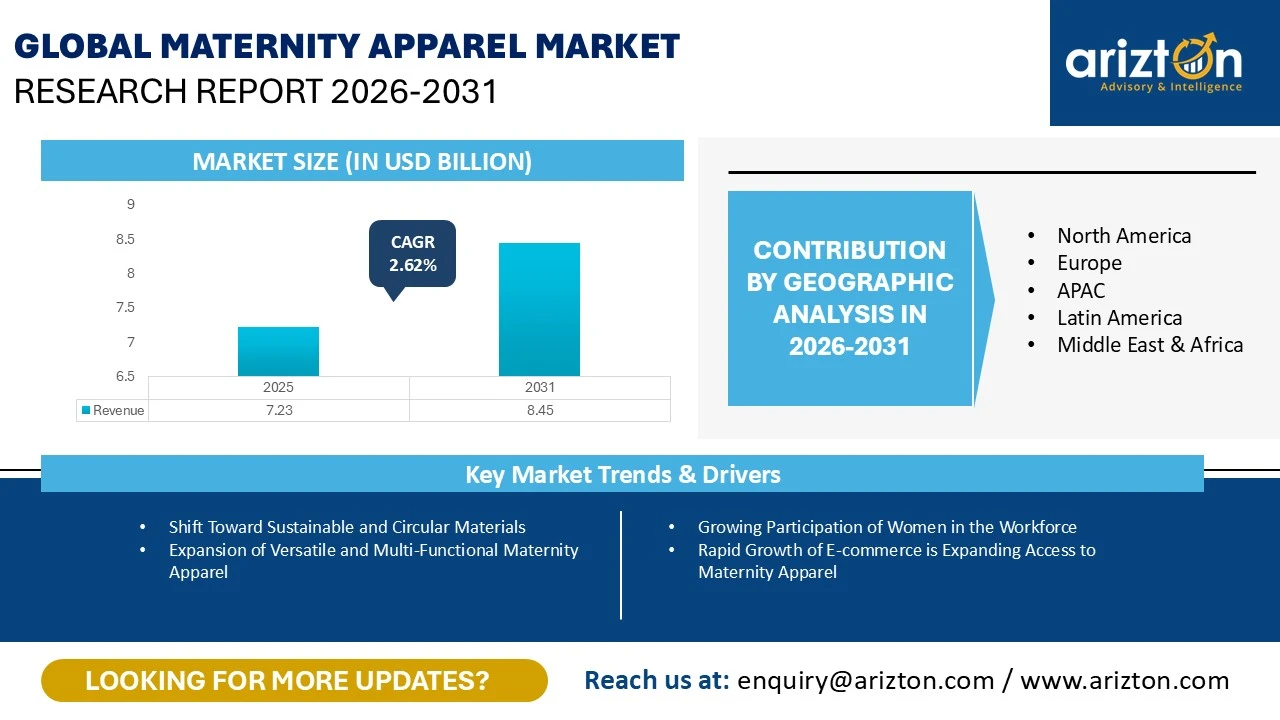
THE GLOBAL MATERNITY APPAREL MARKET WAS VALUED AT USD 7.23 BILLION IN 2025 AND IS EXPECTED TO REACH USD 8.45 BILLION BY 2031, GROWING AT A CAGR OF 2.62% DURING FORECAST PERIOD.
The Maternity Apparel Market Size, Share & Trends Analysis Report By
- Product Type: Daywear, Nightwear, and Innerwear
- Fabric Material Type: Cotton, Polyester, Spandex, and Others
- Distribution Channel: Online and Offline
- Geography: APAC, North America, Europe, Latin America, and Middle East & Africa
Industry Analysis Report, Regional Outlook, Growth Potential, Price Trends, Competitive Market Share & Forecast 2026–2031.
This report includes market data points, ranging from trend
analyses to market estimates & forecasts that you can customize
GLOBAL MATERNITY APPAREL MARKET REPORT SCOPE
| REPORT ATTRIBUTE | DETAILS |
|---|---|
| MARKET SIZE (2031) | USD 8.45 Billion |
| MARKET SIZE (2025) | USD 7.23 Billion |
| CAGR (2025-2031) | 2.62% |
| HISTORIC YEAR | 2022-2024 |
| BASE YEAR | 2025 |
| HISTORIC YEAR | 2026-2031 |
| SEGMENTS BY | Product Type, Fabric Material Type, Distribution Channel, and Geography |
| GEOGRAPHIC ANALYSIS | APAC, North America, Europe, Latin America, and Middle East & Africa |
| KEY PLAYERS | Gap Inc., H&M Group, ASOS plc, NEXT plc, Levi Strauss & Co, Debenhams Group, and Marks & Spencer Group plc |
MATERNITY APPAREL MARKET ANALYSIS
The global maternity apparel market was valued at USD 7.23 billion in 2025 and is projected to reach USD 8.45 billion by 2031, expanding at a CAGR of 2.62% during the forecast period. Market growth is supported by increasing female workforce participation, rising fashion consciousness among pregnant women, and the continued expansion of e-commerce platforms. Consumers are increasingly seeking maternity apparel that offers a combination of comfort, functionality, and contemporary fashion across categories such as daywear, nightwear, workwear, and innerwear. This shift in consumer preferences is encouraging brands and retailers to introduce premium-quality, versatile, and comfortable products that can be used throughout pregnancy and, in some cases, after childbirth, thereby supporting product value and sustained market demand.
The maternity apparel market is expected to witness moderate growth in mature markets such as North America and Western Europe in 2026, while Asia-Pacific and Latin America are likely to experience stronger expansion, supported by rising consumer spending, growing awareness of maternity fashion, and improvements in retail and e-commerce infrastructure.
Market growth in 2026 is expected to be driven by the expansion of organized retail across emerging economies, increasing adoption of online shopping, rising demand for premium maternity daywear and innerwear, and greater focus on sustainable apparel production. Brands are increasingly investing in responsibly sourced and environmentally conscious fabrics, while also developing products that provide improved comfort, durability, and versatility to meet the evolving needs of expectant mothers.
KEY HIGHLIGHTS
- Product Type: Daywear accounts for the largest market share, at around 63% in 2025.
- Fabric Material Type: Spandex is expected to be the fastest-growing fabric segment, with a CAGR of 3.20% from 2025 to 2031.
- Distribution Channel: The offline segment accounted for the largest global maternity apparel market share in 2025.
- Geography: North America dominates the global maternity apparel market, accounting for around 30% in 2025.
RECENT DEVELOPMENTS IN THE MATERNITY APPAREL MARKET
- In 2025, Old Navy partnered with RADAR to deploy an AI-powered RFID inventory management platform across its U.S. store network. Technology combines RFID, artificial intelligence (AI), and computer vision to provide real-time inventory visibility, enabling store associates to quickly locate products and improve inventory accuracy.
- Gap Inc. announced its entry into the beauty and personal care category, beginning with its Old Navy brand. The initial rollout includes beauty products in 150 Old Navy stores, supported by dedicated beauty associates and shop-in-shop formats in 2025. Following the pilot phase, the company plans to expand the beauty business and introduce similar brand-aligned offerings across its portfolio, including other Gap Inc. brands, in the following year.
- In 2026, the Gap Inc company partnered with fashion designer Victoria Beckham to launch a new multi-season collaboration, beginning with a Spring collection. The collection reimagines Gap's classic wardrobe essentials with modern designs, refined silhouettes, and premium detailing, combining Gap's iconic styles with Victoria Beckham's contemporary design approach to offer versatile and sophisticated apparel.
MATERNITY APPAREL MARKET OPPORTUNITIES
Expansion in Emerging and Underserved Markets
Emerging markets offer significant opportunities for maternity apparel brands due to rising disposable incomes, urbanization, and growing awareness of specialized maternity clothing. Companies can further expand by offering products tailored to local preferences, body types, climates, and underserved consumer segments.
Growth of Digital-First and Direct-to-Consumer Sales
Digital channels offer brands an opportunity to reach a wider customer base without relying heavily on physical retail. Personalized recommendations, improved sizing tools, virtual fitting solutions, and social commerce can further enhance the online maternity apparel shopping experience.
Opportunities in Premium and Specialized Categories
Growing demand for specialized products creates opportunities in categories such as maternity workwear, activewear, occasion wear, nursing, and postpartum apparel. Brands can differentiate through better functionality, premium materials, and products designed for specific lifestyle needs.
GLOBAL MATERNITY APPAREL MARKET TRENDS
Shift Toward Sustainable and Circular Materials
Sustainability is becoming a key trend in the global maternity apparel market as consumers increasingly prefer clothing made from organic, recycled, and responsibly sourced fabrics. Leading companies are expanding the use of sustainable materials to reduce environmental impact. In 2025, H&M Group partnered with Recover to increase recycled cotton usage, while Gap Inc. collaborated with Syre to source recycled polyester for brands including Old Navy and Athleta. Indian brand House of Zelena also introduced maternity apparel made from sustainable fabrics such as TENCEL and Lenzing Modal.
Rising Adoption of Rental and Resale Models in the Global Maternity
Rental and resale models are becoming an important trend in the global maternity apparel market as consumers seek affordable, flexible, and sustainable alternatives to buying new clothing. Since maternity garments are worn for a limited period, platforms such as Rent the Runway, Nuuly, and Armoire offer rental subscriptions that provide access to premium maternity fashion at lower costs. Growing awareness of circular fashion and increasing demand for cost-effective, environmentally friendly clothing are expected to drive further growth of rental and resale services.
MATERNITY APPAREL MARKET DRIVERS
Growing Participation of Women in the Workforce
Rising female workforce participation is a key driver of the global maternity apparel market, as more women continue working throughout pregnancy and require clothing that combines comfort with professional style. This has increased demand for maternity workwear such as tailored trousers, dresses, and blouses. Retailers including ASOS, Old Navy (Gap Inc.), and NEXT plc are expanding their office-friendly maternity collections to meet this need. As workplace support for pregnant employees improves, demand for stylish and functional maternity workwear is expected to continue growing.
Rapid Growth of E-commerce is Expanding Access to Maternity Apparel
The rapid growth of e-commerce is a major driver of the global maternity apparel market, offering consumers a convenient way to shop for maternity clothing with greater product variety, size availability, and home delivery. Leading retailers such as ASOS, JoJo Maman Bébé, and Gap Inc. are strengthening their digital platforms and expanding online maternity collections. As internet access, smartphone usage, and digital payment adoption continue to increase globally, online shopping is expected to remain the preferred channel for purchasing maternity apparel.
Strategic Brand Portfolio Expansion by Major Apparel Retailers
Strategic acquisitions, partnerships, and portfolio expansion by major apparel retailers are creating new growth opportunities in the global maternity apparel market. Companies are strengthening their presence by acquiring established maternity brands, expanding specialized product offerings, and combining complementary expertise across maternity, nursing, postpartum, and lifestyle categories. These initiatives are expected to improve product availability, strengthen brand visibility, accelerate innovation, and expand the reach of maternity apparel among a wider consumer base.
MATERNITY APPAREL MARKET RESTRAINTS
Supply Chain and Geopolitical Challenges
Supply chain disruptions, geopolitical tensions, and changing trade policies are increasing sourcing, production, and logistics costs for maternity apparel companies. These challenges create uncertainty in inventory planning and put additional pressure on profit margins.
Declining Fertility and Birth Rates
Declining birth rates and delayed parenthood in several markets are reducing the potential customer base for maternity apparel. As demand is closely linked to the number of pregnancies, this remains a key challenge for long-term market growth.
Limited Repeat Purchases and Profitability Challenges
The short usage period of maternity clothing can limit repeat purchases and customer retention. Combined with rising operational costs and cautious consumer spending, this creates profitability challenges for brands focused primarily on maternity apparel.
SEGMENTATION INSIGHTS
INSIGHT BY PRODUCT TYPE
The global maternity apparel market by product type is segmented into daywear, nightwear, and innerwear. Daywear accounts for the largest market share of around 63% in 2025. The segment is growing as it fulfils the everyday clothing needs of pregnant women throughout pregnancy. This category includes maternity tops, dresses, trousers, denim, leggings, and workwear that are worn for office, casual outings, and social occasions.
Consumers are also willing to invest more in daywear because these garments are used frequently and remain essential during most stages of pregnancy.
Innerwear is expected to be the fastest-growing product category due to its strong functional value and increasing focus on maternal comfort and health. Products such as maternity bras, nursing bras, support belts, shapewear, and postpartum recovery garments provide essential support during pregnancy and after childbirth. Growing awareness of proper maternity care, rising breastfeeding rates, and increasing demand for specialized garments designed for changing body shapes are driving adoption.
INSIGHT BY FABRIC MATERIAL TYPE
Based on the fabric material type, cotton holds the largest share of the maternity apparel market due to its superior comfort, breathability, and softness, making it ideal for sensitive skin during pregnancy. The segment also benefits from abundant raw material availability and strong cotton production in countries such as India and the United States, helping manufacturers maintain competitive pricing.
Sustainability is also becoming an important factor in fabric selection. Many apparel companies are increasing their use of organic and responsibly sourced cotton to reduce environmental impact.
Spandex is expected to be the fastest-growing fabric segment, with a CAGR of 3.20% from 2025 to 2031, as demand increases for highly stretchable and body-adaptive maternity clothing. Blended with cotton or polyester, spandex provides flexibility, shape retention, and freedom of movement while accommodating the body's changing shape throughout pregnancy.
INSIGHT BY DISTRIBUTION CHANNEL
Based on the distribution channel, the offline segment accounted for the largest global maternity apparel market share in 2025, as many expectant mothers prefer to try on garments before purchasing due to frequent body shape changes during pregnancy. Department stores, specialty maternity boutiques, and mass-market retailers allow customers to assess fit, comfort, and fabric quality while receiving personalized assistance from in-store staff.
Online retail is the fastest-growing distribution channel, driven by increasing e-commerce adoption and changing consumer shopping habits. The convenience of home delivery, wider product selection, competitive pricing, and easy product comparisons make online platforms highly attractive for pregnant women, especially those with limited mobility or busy lifestyles.
Traditional department stores and specialty retailers have generally experienced slower growth than digital-first retailers.
As a result, companies such as Debenhams Group have moved to a fully online business model, while retailers including NEXT plc and Marks & Spencer continue to optimize their store networks and invest in omnichannel strategies that combine the benefits of physical stores with the convenience of e-commerce.
GLOBAL MATERNITY APPAREL MARKET GEOGRAPHICAL ANALYSIS
North America Maternity Apparel Market
North America dominates the global maternity apparel market, emerging as the largest regional hub. It accounts for over 30% of the market share. The growth is supported by high consumer spending, well-developed retail infrastructure, and strong awareness of maternity fashion.
The region benefits from a large, organized retail sector, widespread e-commerce adoption, and the presence of several global and specialty maternity brands.
Although birth rates have gradually declined in both the US and Canada, the region continues to generate strong demand due to high spending per consumer, increasing preference for premium products, and growing demand for multifunctional maternity clothing.
The US accounts for the largest portion of regional revenue, while Canada contributes a smaller but steadily expanding market supported by immigration-driven population growth and rising online retail penetration.
Consumer preferences across North America are shifting from basic maternity clothing toward fashionable, comfortable, and versatile apparel.
APAC Maternity Apparel Market
APAC is expected to become the fastest-growing in the global maternity apparel market during the forecast period. Online retail has become a major growth driver, offering wider product selection, competitive pricing, and convenient home delivery. Physical stores remain important for fit-sensitive products such as maternity innerwear.
Consumers increasingly prefer comfortable, breathable, and multifunctional maternity apparel. Demand is also rising for premium fabrics, nursing-friendly designs, sustainable materials, and clothing that can be worn during and after pregnancy.
The Asia-Pacific market is expected to maintain the highest growth rate in 2026, supported by the expansion of organized retail, rising online shopping, rising consumer spending, and growing demand for stylish, functional, and affordable maternity apparel.
China and India lead the regional market due to their large populations, growing e-commerce ecosystems, and strong presence of domestic maternity apparel brands, while Southeast Asia continues to emerge as a high-growth market.
MATERNITY APPAREL MARKET COMPETITIVE LANDSCAPE
The global maternity apparel market is highly competitive, with most leading companies offering maternity collections as part of their broader women's apparel portfolios rather than operating as maternity-only brands.
Large retailers such as H&M Group, Gap Inc., Next plc, and Marks & Spencer benefit from strong brand recognition, extensive retail networks, well-established supply chains, and multi-channel sales capabilities, enabling them to reach a broad customer base and offer maternity products at competitive prices.
H&M Group and Gap Inc. maintain strong market positions through their affordable, fashion-oriented maternity collections integrated within their core brands, supported by global store networks and robust e-commerce platforms.
Next plc, Marks & Spencer, and Debenhams Group have strengthened their competitiveness through omnichannel strategies, with Next and Debenhams driving growth through online and marketplace sales, while Marks & Spencer combines a strong physical retail presence with an expanding digital business.
ASOS differentiates itself as a digital-first retailer, targeting younger and value-conscious consumers with trend-led maternity fashion. wear, and fit-focused products.
MATERNITY APPAREL INDUSTRY LEADERS
- Gap Inc
- H&M
- ASOS
- Next Plc
- Levi Strauss & Co
- Debenhams Group Plc
- Marks & Spencer Group Plc
MATERNITY APPAREL MARKET REPORT SUMMARY/ KEY TAKEAWAYS
- Daywear dominates the market, driven by rising female workforce participation and growing demand for comfortable, fashionable maternity clothing.
- Innerwear is the fastest-growing product segment, supported by increasing demand for maternity bras, nursing bras, support belts, and postpartum recovery garments.
- Multi-functional maternity apparel is gaining traction, with manufacturers developing garments that can be worn during pregnancy and after childbirth, increasing product value and extending the purchasing cycle.
- Cotton remains the preferred fabric due to its breathability, softness, skin-friendly properties, and availability, while spandex-based blends are witnessing the fastest growth as consumers seek greater flexibility and stretch.
- Offline retail continues to lead, as consumers value the ability to try garments before purchase. However, e-commerce is expanding rapidly, supported by AI-powered size recommendations, virtual fitting tools, social media marketing, subscriptions, and convenient home delivery.
MATERNITY APPAREL MARKET REPORT SCOPE
The global maternity apparel market encompasses clothing designed to meet the evolving comfort, support, flexibility, and style requirements of women during pregnancy and the postpartum period. The market includes products developed to accommodate changing body shapes while addressing functional needs across different stages of pregnancy and post-childbirth recovery.
The scope covers maternity apparel for everyday wear, workwear, sleepwear, nursing, and intimate wear. These products are manufactured using a wide range of materials, including cotton, polyester, spandex, modal, viscose, linen, lyocell, nylon, wool, and other textile fabrics. Maternity apparel is distributed through both online and offline channels, including mass-market retailers, specialty maternity brands, department stores, and online marketplaces.
RESEARCH METHODOLOGY
The research methodology for this report is based on a combination of primary and secondary research, followed by data validation and expert analysis.
- Project Scope & Research Design: Understanding client requirements, defining the research scope, objectives, market segments, and key areas of analysis.
- Secondary Research: Analysis of company annual reports, industry publications, journals, government and regulatory bodies, associations, press releases, and other credible sources.
- Primary Research: Discussions and interviews with industry experts, manufacturers, suppliers, distributors, and other key market stakeholders.
- Market Analysis & Estimation: Assessment of market dynamics, including key growth drivers, restraints, trends, opportunities, and competitive developments, supported by historical and current market data.
- Data Validation & Triangulation: Cross-verification of data through multiple sources and industry inputs to ensure accuracy, reliability, and consistency.
- Market Forecasting: Development of market estimates and forecasts based on historical trends, current market conditions, and expected industry developments.
- Expert Review & Finalization: Final findings are reviewed by industry experts and analysts to provide reliable insights into market size, segmentation, competitive landscape, and future growth opportunities.
SNAPSHOT
The global maternity apparel market size is expected to grow at a CAGR of approximately 2.62% from 2025 to 2031.
The following factors are likely to contribute to the growth of the global maternity apparel market during the forecast period:
- Growing Participation of Women in the Workforce
- Rapid Growth of E-commerce is Expanding Access to Maternity Apparel
- Strategic Brand Portfolio Expansion by Major Apparel Retailers
Base Year: 2025
Forecast Year: 2026-2031
The report examines the current state of the global maternity apparel market and its market dynamics through 2026−2031. It covers a detailed overview of several market growth enablers, restraints, and trends. The study covers both the demand and supply sides of the market. It also profiles and analyses leading companies and several other prominent companies operating in the market.
Key Vendors
- Gap Inc
- Business Overview
- Product Offerings
- Key Developments
- Key Strategies
- Key Strengths
- Key Opportunities
- H&M
- ASOS
- Next Plc
- Levi Strauss & Co
- Debenhams Group Plc
- Marks & Spencer Group Plc
Other Prominent Vendors
- PinkBlush Maternity
- Business Overview
- Product Offerings
- Kindred Bravely
- Hatch Collection
- Ripe Maternity
- Ingrid & Isabel
- C &A
- Boob Design
- Noppies
- MamaCouture
- Hotmilk Lingerie
- BelaBumBum
- FirstCry
- Tiffancy Rose
- Mamalicious
Segmentation by Product Type
- Daywear
- Nightwear
- Innerwear
Segmentation by Fabric Material Type
- Cotton
- Polyester
- Spandex
- Others
Segmentation by Distribution Channel
- Online
- Offline
Segmentation by Geography
- North America
- US
- Canada
- Europe
- Germany
- France
- UK
- Italy
- Spain
- Poland
- Netherlands
- Rest of Europe
- APAC
- China
- India
- Japan
- Indonesia
- Thailand
- South Korea
- Australia
- Latin America
- Brazil
- Mexico
- Argentina
- Middle East & Africa
- Türkiye
- South Africa
- Israel
GLOBAL MATERNITY APPAREL MARKET FAQs
What will be the global maternity apparel market size by 2031?
What is the growth rate of the global maternity apparel market?
What are the key trends in the global maternity apparel market?
Which region dominates the global maternity apparel market?
Who are the key vendors in the global maternity apparel market?
For more details, please reach us at [email protected]
For more details, please reach us at [email protected]
Select a license type that suits your business needs
Single User Licence
- Report accessible by one user only
- Free 10% or 3 days of customization
- Free post-sale service assistance
- Continuous support through email
5 User Licence
- Report accessible by 5 users within the organization
- Free 15% or 4.5 days of customization
- Continuous support through email and telephone
- Free analyst hour
- Free Upgrade: If an updated report published within 180 days of purchase, you will get the revised report free of charge
Corporate Licence
- Free Datasheet worth $1500
- Report accessible by the entire organization
- Free 20% or 6 days of customization
- Free post-sale service assistance
- Continuous support through email and telephone
- Direct access to lead analysts
- Free analyst hour
- Free Upgrade: If an updated report published within 180 days of purchase, you will get the revised report free of charge
Datasheet Licence
- Report accessible by 1 user only
- Free 15% or 32 hours of customization
- Free post-sale service assistance
- Direct access to lead analysts
Frequently Asked Questions
What will be the global maternity apparel market size by 2031?
What is the growth rate of the global maternity apparel market?
What are the key trends in the global maternity apparel market?
Which region dominates the global maternity apparel market?
Who are the key vendors in the global maternity apparel market?