
Middle East Data Center Colocation Market – Industry Outlook & Forecast 2025-2030

The Middle East Data Center Colocation Market Report: Investment, Area, Power Capacity, and Share Analysis. Get Insights By Colocation Type, By Infrastructure, By Electrical Infrastructure, By Mechanical Infrastructure, By Cooling Systems, By Cooling Tech
Published Date : November 2025
Last Updated : November 2025
format: PDF
edition : Second Edition

195 pages

33 company

9 segments

1 region

8 countries
Purchase Options
Middle East Data Center Colocation Market – Industry Outlook & Forecast 2025-2030
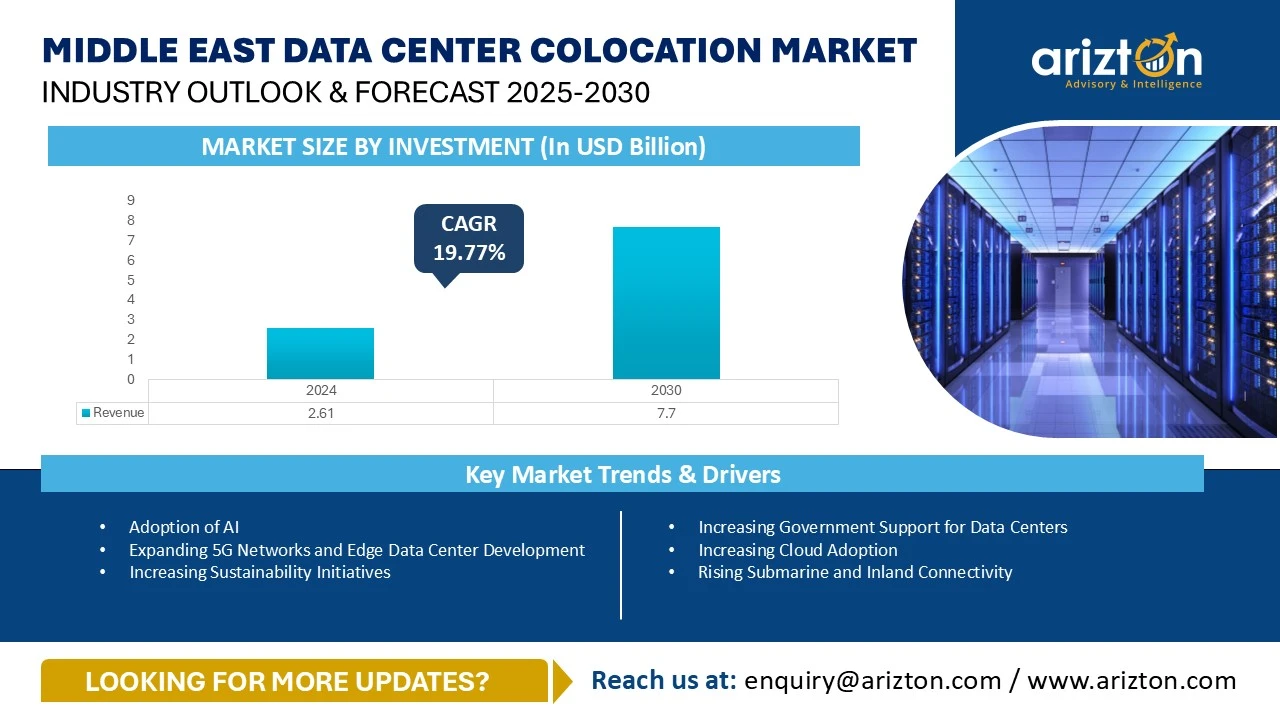
MIDDLE EAST DATA CENTER COLOCATION MARKET SIZE BY INVESTMENT WAS VALUED AT USD 2.61 BILLION IN 2024 AND IS EXPECTED TO REACH USD 7.70 BILLION BY 2030, GROWING AT A CAGR OF 19.77% DURING THE FORECAST PERIOD
The Middle East Data Center Colocation Market Report Includes
- Colocation Type: Retail Colocation and Wholesale Colocation
- Infrastructure: Electrical Infrastructure, Mechanical Infrastructure, and General Construction
- Electrical Infrastructure: UPS Systems, Generators, Transfer Switches & Switchgear, PDUs, and Other Electrical Infrastructure
- Mechanical Infrastructure: Cooling Systems, Racks, and Other Mechanical Infrastructure
- Cooling Systems: CRAC & CRAH Units, Chiller Units, Cooling Towers, Condensers & Dry Coolers, and Other Cooling Units
- Cooling Techniques: Air-based Cooling and Liquid-based Cooling
- General Construction: Core & Shell Development, Installation & Commissioning Services, Engineering & Building Design, Fire Detection & Suppression, Physical Security, and DCIM/BMS Solutions
- Tier Standard: Tier I & II, Tier III, and Tier IV
- Geography: Middle East (UAE, Saudi Arabia, Israel, Oman, Qatar, Kuwait, Turkey, Bahrain)
Get Insights on 175 Existing Data Center Facilities and 97 Upcoming Facilities across Middle East
This report includes market data points, ranging from trend
analyses to market estimates & forecasts that you can customize
MIDDLE EAST DATA CENTER COLOCATION MARKET REPORT SCOPE
| REPORT ATTRIBUTE | DETAILS |
|---|---|
| MARKET SIZE BY INVESTMENT 2030 | USD 7.70 Billion |
| MARKET SIZE BY INVESTMENT 2024 | USD 2.61 Billion |
| CAGR - INVESTMENT (2024-2030) | 19.77% |
| MARKET SIZE - COLOCATION REVENUE (2030) | USD 5.24 Billion |
| MARKET SIZE AREA (2030) | 2.84 million sq. feet |
| POWER CAPACITY (2030) | 681.5 MW (2030) |
| BASE YEAR | 2024 |
| FORECAST YEAR | 2025-2030 |
| MARKET SEGMENTS | Colocation Service, Infrastructure, Electrical Infrastructure, Mechanical Infrastructure, Cooling Systems, Cooling Techniques, General Construction, Tier Standards, and Geography |
| GEOGRAPHICAL ANALYSIS | UAE, Saudi Arabia, Israel, Oman, Qatar, Kuwait, Turkey, Bahrain |
MIDDLE EAST DATA CENTER COLOCATION MARKET SIZE
The Middle East data center colocation market size by investment was valued at USD 2.61 billion in 2024 and is expected to reach USD 7.70 billion by 2030, growing at a CAGR of 19.77% during the forecast period. The market is experiencing significant growth, driven by several growth factors, such as increasing adoption of artificial intelligence, rapid digitalization, surge in smart city development projects, increasing adoption of sustainability practices among data center operators, government support for data center industries, surge in cloud adoption, rising submarine and inland connectivity, increasing adoption of big data, machine learning and Internet of Things and others.
KEY HIGHLIGHTS
Adoption of Artificial Intelligence has become one of the most crucial factors driving data center investments across the Middle Eastern countries, and most of these countries, like the UAE, Saudi Arabia, Qatar, Kuwait, and others, have also adopted national strategies to promote the development of an ethical artificial intelligence framework.
Cumulatively from 2025 to 2030, the Middle East data center colocation market is expected to witness investments of approximately $33.79 billion, of which Saudi Arabia is slated to account for around $13.17 billion, representing around 39% of the overall investment share in the Middle East region. From 2024 to 2030, the Middle East data center colocation market is expected to grow with an absolute growth rate of around 195.21%.
Some of the leading colocation operators in the market include Khazna Data Centers, Gulf Data Hub, center3 (stc), Equinix, Mobily, EdgeConneX, DAMAC Digital, Quantum Switch, MedOne, Turkcell, Compass Datacenters, MEEZA, Serverfarm and several others. The market also witnessed new entrants such as Anan, DataVolt, Desert Dragon Data Centers, ezditek, Mega Data Centers, NED, Sahayeb Data Centers, Techtonic and others.
The Middle East region comprises abundant desert land, making data center operators to find suitable areas for data center construction with efficient infrastructure, power and water availability, specifically in well-established locations like Abu Dhabi, Dubai, and Riyadh, due to the rapid data center development leading to an increase in the costs of industrial land. The countries like Israel, Turkey, Oman, Kuwait and others are gaining momentum for the development of data centers as these countries offer suitable land at affordable prices. The governments across the Middle Eastern nations are supporting data center firms to establish their facilities by expanding the network of Free Trade Zones, Special Economic Zones, and Industrial Parks.
MARKET OPPORTUNITIES & TRENDS
Adoption of Artificial Intelligence
- In the Middle East region, the enterprises across wide range of sectors, including healthcare, finance, transport, and public, are significantly adopting artificial intelligence to boost their productivity. Therefore, the global hyperscale companies are investing significantly to expand artificial infrastructure across Middle Eastern countries.
- In May 2025, Oracle planned to invest approximately $14 billion to expand its cloud and artificial intelligence service offerings over the next 10 years in Saudi Arabia.
- The rise in adoption of artificial intelligence is leading to an increase the demand for advanced digital infrastructure in the Middle Eastern countries, which is expected to increase the investments for the construction of AI-ready data centers across Middle Eastern countries to store and process the massive volumes of data that artificial intelligence applications generate.
Increasing Sustainability Initiatives
- The data center facilities across the Middle Eastern countries are rapidly adopting sustainability practices as the demand for environmentally friendly digital infrastructure is gaining significant importance in the region. To support the Middle Eastern countries’ climate-neutral targets, data center operators are under pressure to minimize their carbon emissions, improve energy efficiency, enhance waste management, and integrate renewable energy to power their data center operations. Therefore, the colocation firms are incorporating efficient cooling systems, water-saving technologies, and renewable sources to power their data centers.
- In March 2025, Pure Data Centres announced that the company had equipped its Abu Dhabi data center facility with HVO-powered generators to reduce its environmental impact and promote sustainability.
- In July 2024, Khazna Data Centers, one of the leading colocation data center operators in the UAE, announced that the company has equipped it is all its data centers with biofuel-powered generators, instead of diesel-powered generators, to reduce its carbon emissions. The company started to adopt biofuel to power the backup generators in its data centers in October 2023.
Increasing Smart City Developments and Digital Economy
- The rapid expansion of smart city projects is reshaping urban infrastructure across the Middle East. The nations such as the UAE and Saudi Arabia are making substantial investments in smart city projects that leverage technologies like Internet of Things, Artificial Intelligence, big data and others to improve public services, sustainability, and overall living standards.
- Abu Dhabi and Dubai are among the smartest cities in the world, which have achieved global ranks of fourth and fifth positions globally in the IMD Smart City Index 2025.
- The surge in investments for the development of smart city projects across the Middle Eastern countries is fuelling the demand for digital infrastructure across the region. Additionally, the expanding digital economy is increasing data traffic and business reliance on digital services.
SEGMENTATION INSIGHTS
- In the Middle East region, the data center operators are adopting innovative construction technologies, such as, installing advanced cooling technologies in data centers to manage excess heat loads generated in data center facilities, replacing diesel generators with hydrogenated vegetable oil powered generators, designing data centers to leverage renewable energy for their operations to minimize electricity consumption, installing solar panels on data center roofs to power data centers with solar energy, incorporating advanced softwares like BMS and DCIM to minimize OPEX and power usage in data centers, while focusing on boosting data center performance.
- In July 2025, ICS Arabia, a Saudi Arabia-based data center services provider, partnered with XDS, a UK-based cooling company, to develop two immersion-cooled data center facilities in Riyadh, Saudi Arabia, to reduce electricity consumption in data center and to dissipate vast amounts of heat generated in the facility to support processing artificial intelligence workloads efficiently
- In March 2025, an Israel-based renewable energy firm, Enlight Renewables, announced its plans for the development of an integrated solar-powered data center and renewable energy complex in Ashalim, Israel, with an investment of around $1.1 billion, featuring a solar and energy storage facility integrated with the data center.
- Equinix has equipped its MC1 data center facility in Oman with hybrid cooling technology, combining air-based cooling systems as well as liquid-based cooling systems to enhance thermal management in the data center to dissipate vast amounts of heat loads generated by complex workloads. Moreover, the company has also invested in installing advanced liquid cooling technology in its AD1 data center in Abu Dhabi, the UAE
GEOGRAPHICAL ANALYSIS
- As of March 2025, there were around 170 existing third-party data center facilities across the Middle region, operated by more than 71 data center operators. Saudi Arabia accounts for around 36 data centers, and around 38 data centers are in the UAE. Additionally, around 111 new data center facilities are currently in planning and development stages, with contributions from around 27 companies; these data centers are expected to get operational within the next 3 to 5 years.
- UAE and Saudi Arabia are well-established and developed data center markets in the Middle East region. Saudi Arabia and the UAE have contributed around 50% and 39% of overall colocation investments in the Middle East region in 2024. The markets are among the most preferred destinations for data center development. However, Israel, Turkey, Oman, and other countries are emerging and developing markets that are slated to witness higher investments for data center development in the forthcoming years.
- Data center construction costs differ widely across Middle Eastern countries, with the UAE and Saudi Arabia among the costliest markets. As of 2024, the data center construction cost in Saudi Arabia ranged between $10 to $12 per watt, and it ranged between $8 to $10 per watt in the UAE in the same period. These high costs are due to factors like scarce land availability, expensive labour, and others.
- The Free Trade Zones, Special Economic Zones, and Industrial Parks in the Middle Eastern countries provide a wide range of benefits to the data center operators to establish and operate their data centers within these zones. The UAE alone hosts around 47 Free Trade Zones, and Turkey consists of approximately 20 Free Trade Zones. These zones offer data center companies VAT exemptions, 100% foreign ownership, and other benefits.
VENDOR LANDSCAPE
- The Middle East data center colocation market consists of several prominent colocation operators such as Khazna Data Centers, Gulf Data Hub, Equinix, center3 (stc), DAMAC Digital, Pure Data Centres, EdgeConneX, Batelco by Beyon, MedOne, Global Technical Realty, Serverfarm, Compass Datacenters, MEEZA, Quantum Switch, Ooredoo Group, Mobily, and others
- The region is also witnessing the entry of several new entrants that are expanding their footprints into the Middle Eastern countries to develop and operate their data centers for addressing the growing demand for colocation services across these countries. Some of the new entrants in Middle East data center colocation market include Sahayeb Data Centers, ezditek, DataVolt, Desert Dragon Data Centers, Mega Data Centers, NED, Anan, Keystone Infra, ZEUUS and others.
- In the Middle East region, Khazna Data Centers leads the market in terms of power capacity with an existing core and shell power capacity of approximately 210 MW, followed by center3, which hosts an existing power capacity of around 145 MW with its 14 operational data center facilities
- Gulf Data Hub is one of the prominent data center operators in the Middle East region that operates around seven existing data centers in Saudi Arabia and the UAE, with a combined core and shell power capacity of around 78 MW, followed by EdgeConneX, which boasts approximately 65 MW of existing power capacity across its four operational data center facilities.
SNAPSHOT
The Middle East data center colocation market by investment is projected to reach USD 7.70 billion by 2030, growing at a CAGR of 19.77% from 2024 to 2030.
The following factor are likely to contribute to the growth of the Middle East data center colocation market during the forecast period:
- Increasing Government Support for Data Centers
- Increasing Cloud Adoption
- Rising Submarine and Inland Connectivity
- Big Data and IoT Driving Data Center Investments
Base Year: 2024
Forecast Year: 2025-2030
The report considers the present scenario of the Middle East data center colocation market and its market dynamics for 2025−2030. It covers a detailed overview of several market growth enablers, restraints, and trends. The study includes the demand and supply aspects of the Middle East data center colocation industry.
Key Data Center Colocation Operators
- Agility Logistics Parks
- Business Overview
- Product Offerings
- Batelco by Beyon
- DAMAC Digital
- EdgeConneX
- Equinix
- Gulf Data Hub
- Khazna Data Centers
- MedOne
- Mobily
- Quantum Switch
- center3
- SDS Data Center
- Turkcell
- Ooredoo Group
- Compass Datacenters
- TONOMUS
- MEEZA
- Bynet Data Communications
- Pure Data Centres Group
- Global Technical Realty
- Turk Telekom
New Entrants
- Alfanar Projects
- Business Overview
- Product Offerings
- Anan
- DataVolt
- Desert Dragon Data Centers
- ezditek
- Geva Real Estate + Kardan Real Estate
- Keystone Infra
- Mega Data Centers
- NED
- Sahayeb Data Centers
- Techtonic
- ZEUUS
Segmentation by Colocation Type
- Retail Colocation
- Wholesale Colocation
Segmentation by Infrastructure
- Electrical Infrastructure
- Mechanical Infrastructure
- General Construction
Segmentation by Electrical Infrastructure
- UPS Systems
- Generators
- Transfer Switches & Switchgear
- PDUs
- Other Electrical Infrastructure
Segmentation by Mechanical Infrastructure
- Cooling Systems
- Racks
- Other Mechanical Infrastructure
Segmentation by Cooling Systems
- CRAC & CRAH Units
- Chiller Units
- Cooling Towers, Condensers & Dry Coolers
- Other Cooling Units
Segmentation by Cooling Techniques
- Air-based Cooling
- Liquid-based Cooling
Segmentation by General Construction
- Core & Shell Development
- Installation & Commissioning Services
- Engineering & Building Design
- Fire Detection & Suppression
- Physical Security
- DCIM/BMS Solutions
Segmentation by Tier Standard
- Tier I & II
- Tier III
- Tier IV
Segmentation by Geography
- Middle East
- UAE
- Saudi Arabia
- Israel
- Oman
- Qatar
- Kuwait
- Turkey
- Bahrain
MIDDLE EAST DATA CENTER COLOCATION MARKET FAQs
How big is the Middle East data center colocation market?
What is the estimated market size in terms of area in the Middle East data center colocation market by 2030?
What are the key trends in the Middle East data center colocation market?
What is the growth rate of the Middle East data center colocation market?
How many MW of power capacity is expected to reach the Middle East data center colocation market by 2030?
For more details, please reach us at [email protected]
For more details, please reach us at [email protected]
Select a license type that suits your business needs
Single User Licence
- Report accessible by one user only
- Free 10% or 3 days of customization
- Free post-sale service assistance
- Continuous support through email
5 User Licence
- Report accessible by 5 users within the organization
- Free 15% or 4.5 days of customization
- Continuous support through email and telephone
- Free analyst hour
- Free Upgrade: If an updated report published within 180 days of purchase, you will get the revised report free of charge
Corporate Licence
- Free Datasheet worth $1500
- Report accessible by the entire organization
- Free 20% or 6 days of customization
- Free post-sale service assistance
- Continuous support through email and telephone
- Direct access to lead analysts
- Free analyst hour
- Free Upgrade: If an updated report published within 180 days of purchase, you will get the revised report free of charge
Datasheet Licence
- Report accessible by 1 user only
- Free 15% or 32 hours of customization
- Free post-sale service assistance
- Direct access to lead analysts
Frequently Asked Questions
How big is the Middle East data center colocation market?
What is the estimated market size in terms of area in the Middle East data center colocation market by 2030?
What are the key trends in the Middle East data center colocation market?
What is the growth rate of the Middle East data center colocation market?
How many MW of power capacity is expected to reach the Middle East data center colocation market by 2030?
Other RELATED Reports
South Africa Data Center Colocation Market – Supply & Demand Analysis 2025-2030
Published : November 2025

Middle East Data Center Construction Market - Industry Outlook & Forecast 2025–2030
Published : February 2025
Saudi Arabia Data Center Colocation Market - Supply & Demand Analysis 2025-2030
Published : September 2025