
Norway Data Center Market - Investment Analysis & Growth Opportunities 2026-2031


127 pages

84 company

6 segments

1 region

1 countries
Purchase Options
Norway Data Center Market - Investment Analysis & Growth Opportunities 2026-2031
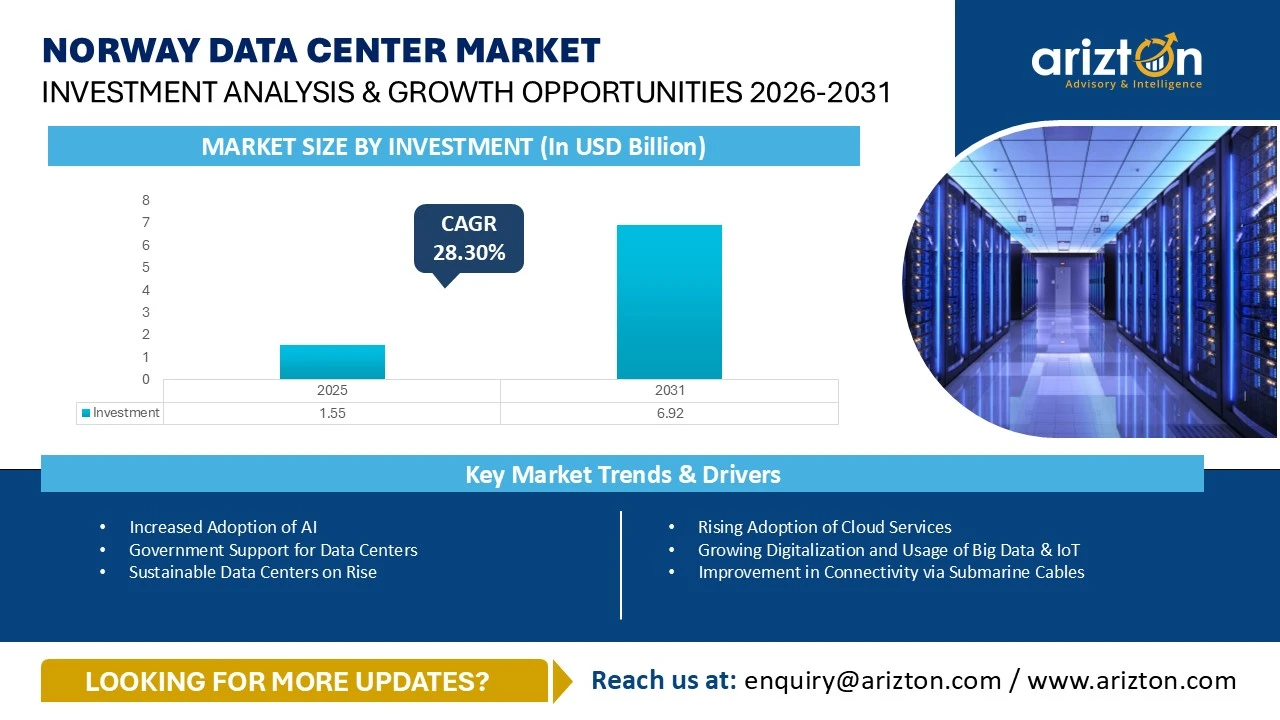
THE NORWAY DATA CENTER MARKET SIZE WAS VALUED AT USD 1.55 BILLION IN 2025 AND IS EXPECTED TO REACH USD 6.92 BILLION BY 2031, GROWING AT A CAGR OF 28.30% DURING THE FORECAST PERIOD.
The Norway Data Center Market Report Includes Size in Terms of
- IT Infrastructure: Servers, Storage Systems, and Network Infrastructure
- Electrical Infrastructure: UPS Systems, Generators, Transfer Switches & Switchgears, PDUs, and Other Electrical Infrastructure
- Mechanical Infrastructure: Cooling Systems, Rack Cabinets, and Other Mechanical Infrastructure
- Cooling Systems: CRAC & CRAH Units, Chiller Units, Cooling Towers, Condensers & Dry Coolers, and Other Cooling Units
- General Construction: Core & Shell Development, Installation & Commissioning Services, Engineering & Building Design, Fire Detection & Suppression Systems, Physical Security, and Data Center Infrastructure Management (DCIM)
- Tier Standard: Tier I & Tier II, Tier III, and Tier IV
Get Insights on 30 Existing Data Centers and 16 Upcoming Facilities across Norway
This report includes market data points, ranging from trend
analyses to market estimates & forecasts that you can customize
NORWAY DATA CENTER MARKET REPORT SCOPE
| REPORT ATTRIBUTE | DETAILS |
|---|---|
| MARKET SIZE (INVESTMENT) | USD 6.92 Billion (2031) |
| MARKET SIZE (AREA) | 1,050 Thousand Sq. feet (2031) |
| MARKET SIZE (POWER CAPACITY) | 300 MW (2031) |
| CAGR - INVESTMENT (2025-2031) | 28.30% |
| COLOCATION MARKET SIZE (REVENUE) | USD 1.74 Billion (2031) |
| HISTORIC YEAR | 2022-2024 |
| BASE YEAR | 2025 |
| FORECAST YEAR | 2026-2031 |
NORWAY DATA CENTER MARKET ANALYSIS
The Norway data center market size was valued at USD 1.55 billion in 2025 and is expected to reach USD 6.92 billion by 2031, growing at a CAGR of 28.30% during the forecast period. Norway is emerging as one of the most attractive data center destinations in Europe, supported by abundant renewable hydropower, a cold climate suitable for free cooling, strong fiber connectivity, and a stable regulatory environment. The market is expected to witness robust growth during 2026-2031, driven by hyperscale cloud expansion, increasing AI and High-Performance Computing (HPC) deployments, and rising enterprise colocation demand.
The continued expansion of global cloud providers including Microsoft and Google is a major growth catalyst. These operators are scaling their Nordic footprints to support data sovereignty, low-latency services, and sustainable cloud regions, positioning Norway as a strategic secondary availability zone for Europe.
As of Q4 2025, the cost of industrial electricity in Norway ranged between $0.14 and $0.16 per kWh. The industrial power costs in Norway vary by city; these prices are expected to increase significantly to over $0.13 per kWh by 2030 as the demand for industrial electricity is expected to increase significantly, driven by the development of hyperscale and large colocation data centers, which require more electricity for operations.
In Norway, personal data protection is primarily governed by the Personal Data Act, which implements the EU General Data Protection Regulation (GDPR) into national law, ensuring lawful processing, strong privacy rights, and strict breach notification requirements. Compliance is enforced by the Norwegian Data Protection Authority, with significant penalties for violations to safeguard individuals and digital systems.
In data center facilities, traditional air-cooling technologies struggle to manage the heat generated by high-density AI racks; thus, the newly built data centers are being deployed with liquid cooling technologies. For instance, in March 2025, Nscale added a 30 MW liquid-cooled modular facility next to its existing Glomfjord data center, doubling the site’s capacity to 60 MW for AI GPU workloads. The prefabricated design enables rapid deployment while supporting next-generation high-density, liquid-cooled infrastructure powered by hydropower.
Norway is one of the developing data center hubs in the Nordic region, hosting around 30 existing data center facilities. Oslo consists of around 17 existing data centers. Green Mountain, STACK Infrastructure, and Bulk Infrastructure are the major providers in the country.
The country consists of around 13 existing submarine cables, such as Bodo-Rost Cable, Eviny Digital, Havsil, NOr5ke Viking, NO-UK, Norfest, Polar Circle Cable, Skagenfiber West, Svalbard Undersea Cable System, and Tverrlinken, which connect Norway with other European countries such as the UK, Denmark, Sweden, and Ireland. For instance, in January 2026, Space Norway partnered with the Norwegian Ministry of Defence to develop the first cable landing station on Jan Mayen for the Arctic Way subsea system. The cable, spanning 1,460.2 miles and manufactured by SubCom, will connect mainland Norway with Jan Mayen and Svalbard by 2028.
NORWAY DATA CENTER MARKET INSIGHTS BY AREA
The Norway data center market by area is expected to reach 1,050 thousand sq. ft. by 2031, reflecting the country's expanding data center infrastructure and increasing demand for digital capacity. Oslo is the key destination for the development of data center facilities, supported by its strong connectivity, established digital infrastructure, and concentration of businesses and cloud service demand.
Beyond Oslo, cities including Gromstul, Stavanger, Skien, Trondheim, Telemark, Maloy, Glomfjord, and Kalberg are gaining momentum as emerging data center locations. This growth is driven by rising nationwide demand for digital infrastructure, availability of suitable land, access to reliable power, and the presence of several industrial parks across these locations.
NORWAY DATA CENTER MARKET INSIGHTS BY POWER CAPACITY
The Norway data center market by power capacity is expected to reach 300 MW by 2031, supported by the expansion of high-capacity power infrastructure and rising electricity demand from hyperscale and large colocation data centers. As of Q4 2025, industrial electricity prices in Norway ranged from $0.14 to $0.16 per kWh, with costs varying across cities.
These prices are expected to rise further by 2030 as increasing data center power requirements place greater pressure on industrial electricity supply. At the same time, investments in high-capacity power infrastructure are facilitating the development of new data center facilities across the country.
LIST OF FACILITIES IN NORWAY
Norway Data Center Landscape at a Glance
- Facilities Covered (Existing): 3
- Facilities Identified (Upcoming): 16
- Coverage: 8+ Cities
- Existing vs. Upcoming (Data Center Area)
- Existing vs. Upcoming (IT Load Capacity)
Data center colocation market in Norway
- Colocation Market Revenue & Forecast (2022-2031)
- Retail & Wholesale Colocation Revenue (2022-2031)
- Retail & Wholesale Colocation Pricing
KEY TAKEAWAYS
- IT Infrastructure: The server infrastructure segment dominated the Norway data center market, accounting for approximately 66% of the market share in 2025.
- Electrical Infrastructure: The cooling systems segment led the Norway data center market in 2025.
- Mechanical Infrastructure: In 2025, Generator systems dominated the Norway data center market with the largest share.
- General Construction: The core & shell development segment contributes around 58% of the market share
- Tier Standard: Tier III standard dominates the Norway data center market with the largest share.
- Colocation: Wholesale colocation services dominate Norway’s colocation market.
RECENT DEVELOPMENTS & NEWS IN THE NORWAY DATA CENTER MARKET
- In February 2025, Microsoft Azure experienced outages in Norway that disrupted businesses and caused several government service websites to become unavailable.
- In January 2025, the U.S. introduced new export restrictions on advanced AI chips, limiting access for countries outside its group of allies. Norway was included among approximately 18 allied countries eligible to purchase more than 1,700 advanced AI chips without special authorization, supporting the country’s efforts to strengthen its AI capabilities.
- In February 2025, Norway strengthened its commitment to sustainable AI development by joining the newly established “Coalition for Sustainable AI,” announced at the AI Action Summit in Paris. Major data center operators, including Equinix, Data4, and Telehouse, also joined the coalition, which aims to support sustainable AI development across countries such as France, Denmark, Norway, Germany, the UK, and Italy.
- In February 2025, Space Norway partnered with SubCom to develop the Arctic Way subsea cable system, spanning more than 1,460 miles. The system is designed to connect Bodø and Jan Mayen in Norway with Longyearbyen in Svalbard, strengthening digital connectivity across the Arctic region.
- In January 2026, Space Norway partnered with the Norwegian Ministry of Defence to develop the first cable landing station on Jan Mayen for the Arctic Way subsea cable system. Manufactured by SubCom, the approximately 1,460-mile cable is planned to connect mainland Norway with Jan Mayen and Svalbard by 2028, enhancing the country’s Arctic communications infrastructure.
NORWAY DATA CENTER MARKET DRIVERS
Rising Adoption of Cloud Services
Norway is witnessing a rapid surge in the adoption of cloud services as businesses and public institutions increasingly embrace digital transformation. As part of this shift, organizations across diverse industries, including finance, healthcare, manufacturing, and telecommunications, are continuously migrating to cloud platforms to improve scalability, enhance data accessibility, and increase operational efficiency, thereby driving the growth of Norway’s cloud computing market.
In January 2026, UpCloud launched a new cloud region in Stavanger, hosted at a Green Mountain facility powered by renewable energy and cooled using deep-water fjord systems. This expansion strengthens UpCloud’s pan-Nordic presence, enhances its sustainable cloud infrastructure capabilities, and brings its total number of European locations to ten.
Growing Digitalization and Usage of Big Data & IoT
Norway is significantly advancing its digitalization efforts by adopting technologies such as big data and the Internet of Things (IoT) to drive innovation across industries, including finance, retail, manufacturing, and education. This digital transformation is further supported by investments in high-performance computing infrastructure, such as the Olivia supercomputer, which was inaugurated in June 2025 at Lefdal Mine Data center.
The system delivers 13.2 petaflops of sustained performance for AI, climate, ocean, and health research workloads and combines Nvidia GH200 GPUs and AMD EPYC CPUs with highly energy-efficient fjord-based cooling to strengthen Norway’s national big-data capabilities.
NORWAY DATA CENTER MARKET TRENDS
Increased Adoption of AI
Norway is witnessing a steady increase in the adoption of Artificial Intelligence (AI) across various industries, driven by advancements in cloud computing, big data analytics, and automation. The expansion of cloud infrastructure is further accelerating AI adoption, with major cloud service providers such as Microsoft Azure, Google, and AWS strengthening their presence in the country. This growth is also encouraging the development of energy-efficient AI infrastructure.
In August 2025, Terakraft selected its hydro-powered facility to host Neurophos optical AI chips as part of a pilot program for a next-generation ultra-energy-efficient AI inference platform scheduled to launch in 2027. The deployment is expected to support high-density, sustainable AI infrastructure while significantly reducing energy consumption compared with traditional GPU-based workloads.
Government Support for Data Centers
The Norwegian government is supporting the data center industry through investments in digital infrastructure, while implementing various measures to promote digitalization and increase the use of renewable energy in data center operations. Recognizing the sector’s role in driving digital transformation and economic growth, the government has introduced several initiatives to attract both international and domestic data center operators to establish facilities across Norway.
In February 2025, the Norwegian government also partnered with several governments and major digital infrastructure companies, including Equinix, Data4, and Telehouse, to support the newly established “Coalition for Sustainable AI,” announced at the AI Action Summit in Paris. The initiative aims to promote the development of AI infrastructure across countries including France, Norway, Denmark, Germany, the UK, and Italy.
NORWAY DATA CENTER MARKET RESTRAINTS
Location Constraints in the Market
Norway has become an attractive destination for data center development due to its abundant renewable energy, political stability, and cool climate. However, certain location constraints continue to challenge data center construction, particularly in terms of land, water, power, and network infrastructure. Land availability is a key challenge, as strict zoning regulations and environmental policies restrict the development of large data centers.
While urban areas often have limited space, rural locations face development restrictions aimed at protecting natural resources, while sustainability priorities can further extend industrial approval processes. Operational reliability has also emerged as a concern, as demonstrated by Microsoft Azure outages in Norway in February 2025, which disrupted businesses and caused several government service websites to go offline.
Security Challenges in the Market
The Norway data center industry is expanding rapidly owing to strong government support and advanced digital infrastructure; however, this growth is also increasing security challenges and the need for compliance with national and international regulations.
The country has experienced a significant rise in cyberattacks targeting critical infrastructure, with threats such as ransomware and Distributed Denial-of-Service (DDoS) attacks posing major risks to data integrity and service availability. As data centers store and process sensitive government, corporate, and personal information, they have become prime targets for cyberattacks, highlighting the growing need for robust cybersecurity measures and regulatory compliance.
NORWAY DATA CENTER MARKET SEGMENTATION INSIGHTS
INSIGHT BY IT INFRASTRUCTURE
Based on the infrastructure, the server infrastructure segment dominated Norway’s data center market, accounting for approximately 46% of the market share in 2025. This dominance is supported by the rising adoption of digital transformation strategies, enterprise cloud computing, and 5G network deployment, which are driving demand for high-performance, scalable, and reliable server infrastructure. As businesses increasingly migrate workloads to cloud environments, the adoption of cloud servers is expected to grow, further supported by the expansion of AI, data analytics, IoT, and other data-intensive applications that require advanced computing and storage capabilities.
The growing demand is also supported by major server and technology vendors, including Dell Technologies, Cisco Systems, Hewlett Packard Enterprise, IBM, and NetApp, which provide servers, storage systems, networking solutions, and other data center infrastructure to help enterprises and operators improve scalability, efficiency, and support for increasingly complex workloads.
INSIGHT BY ELECTRICAL INFRASTRUCTURE
Based on the electrical infrastructure, the cooling segment dominated Norway’s data center market in 2025, accounting for approximately 25% of the market share, reflecting the growing focus on reliable and resilient power infrastructure. Data centers in Norway are increasingly adopting advanced backup generator systems with at least N+1 redundancy configurations to ensure uninterrupted operations and enhance energy resilience during power outages.
These systems provide additional power redundancy and help minimize the risk of downtime in mission-critical facilities. For instance, Lefdal Mine Data Centers has equipped its facility in Måløy, Norway, with N+1 redundant generators with a capacity rating of 2 MW, supporting reliable backup power and continuous data center operations.
INSIGHT BY MECHANICAL INFRASTRUCTURE
Based on the mechanical infrastructure segmentation, the Cooling segment dominated Norway’s data center market in 2025, accounting for approximately 25% of the market share. This strong market position is supported by the growing adoption of advanced cooling infrastructure to manage increasing heat loads and maintain optimal operating conditions. Data center facilities in Norway utilize both water-based and air-based cooling systems, with most operators implementing N+1 redundancy in Tier III facilities to enhance reliability and operational continuity.
In addition, data center operators deploy evaporative coolers and coolant distribution units (CDUs) alongside indoor CRAC and CRAH units to improve cooling efficiency and effectively manage the thermal requirements of their facilities.
INSIGHT BY GENERAL CONSTRUCTION
Based on the electrical infrastructure, the Generator segment dominated Norway’s data center market in 2025, accounting for approximately 66% of the market share, reflecting the importance of reliable power infrastructure for data center operations. The construction landscape also plays a key role in supporting the expansion of data center capacity in the country. The cost of core and shell construction in Norway is relatively moderate compared with other European countries, supported by rising investments in hyperscale and modular data centers.
The Norwegian market is primarily driven by greenfield construction, while modular data center projects are also gaining momentum. In addition, the integration of on-site renewable energy sources, including solar and wind power installations, increases the scope of construction activities and can extend project timelines for contractors.
INSIGHT BY TIER STANDARD
Based on the Tier segmentation, the Tier III segment dominated Norway’s data center market in 2025, accounting for approximately 41% of the market share, reflecting the strong demand for reliable and resilient data center infrastructure. This dominance is supported by the widespread adoption of Tier III standards across data center facilities in the country. According to the Uptime Institute, Norway has more than six data center facilities that have received Tier III certification, either at the design or construction stage.
These include facilities operated by Basefarm, DigiPlex Fet AS, Green Mountain AS, and Lefdal Mine Datacenters. Most data center facilities in Norway are designed to meet at least Tier III standards, typically incorporating a minimum of N+1 redundancy across critical infrastructure to enhance operational continuity and minimize downtime.
INSIGHT BY COLOCATION
Based on colocation, wholesale colocation services dominate Norway’s colocation market, with their share projected to increase to over 94.6% by 2031. This strong market position is supported by Norway’s growing data center ecosystem, which hosts around 30 existing data center facilities, including approximately 17 in Oslo. Major providers such as Green Mountain, STACK Infrastructure, and Bulk Infrastructure are driving the country’s colocation capacity.
The growth in wholesale colocation is further supported by increasing investments in the country, driven by government support for data center development, rising cloud adoption, rapid digitalization, AI deployment, expanding submarine and inland connectivity, and Norway’s favorable climate conditions for free cooling. These factors are expected to strengthen colocation investments and further drive demand for wholesale facilities over the next five years.
NORWAY DATA CENTER MARKET VENDOR LANDSCAPE
IT infrastructure providers play a critical role in supporting Norway’s high-density and cloud-driven data center ecosystem, supplying servers, storage, networking, and AI-optimized hardware.
Engineering firms focus on modular construction, prefabrication, and accelerated build timelines to meet tight capacity rollout schedules. Collaboration between contractors, consultants, and government authorities ensures compliance with planning, environmental, and power allocation regulations.
Leading Support infrastructure providers such as ABB, Alfa Laval, Caterpillar, Cummins, Delta Electronics, Eaton, Johnson Controls, Legrand, Schneider Electric, STULZ, Vertiv and others maintain a strong presence through local service teams, long-term maintenance contracts, and regional manufacturing hubs.
The Norway colocation market is shaped by several well-established operators including, Green Mountain, Vaultica Data Centers, STORESPEED, Telia, and Nscale. In addition, new entrants such as Google, Greenscale Data Centres, and Fossefall are gaining traction, signaling rising demand for colocation capacity and more advanced, flexible data center offerings. This evolving competitive landscape encourages innovation and continuous improvement in service quality and technology deployment.
GreenScale is one of the major companies in the country. For instance, in June 2025, GreenScale acquired the Tonstad DataPark site with 300 MW of approved grid capacity, one of the largest planned data center campuses in Southern Norway. The €2.5 billion ($2.85 billion) development will be delivered in phases, with the first capacity being targeted for 2027.
NORWAY DATA CENTER MARKET – KEY HIGHLIGHTS
The Norway data center market is emerging as a major Nordic hub, with around 30 operational facilities, many of which are concentrated in Oslo. Leading colocation providers in Norway, such as Green Mountain, STACK Infrastructure, and Bulk Infrastructure, are actively expanding capacity across the country.
Strong connectivity via submarine cables continues to drive growth in Norway's cloud data centers, reinforcing Norway’s position as a strategic European data hub. Ongoing investments in subsea and fiber infrastructure are further strengthening the Norway data center infrastructure.
Sustainability remains a defining advantage, with renewable energy usage and heat reuse initiatives making operations more efficient and environmentally friendly. This strengthens the appeal of cloud hosting in Norway for global enterprises.
At the same time, the rise of AI and HPC workloads is accelerating the adoption of high-density racks and advanced cooling technologies in Norway hyperscale data centers, supporting the next generation of digital infrastructure.
EXISTING VS. UPCOMING DATA CENTERS
- Existing Facilities in the region (Area and Power Capacity)
- Oslo
- Other Cities
- List of Upcoming Facilities in the region (Area and Power Capacity)
- Oslo
- Other Cities
- Snapshot of existing and upcoming third-party data center facilities in Norway
- Facilities Covered (Existing): 30
- Facilities Identified (Upcoming): 16
- Coverage: 8+ Cities
- Existing vs. Upcoming (Data Center Area)
- Existing vs. Upcoming (IT Load Capacity)
REPORT COVERAGE:
This report analyses the Norway data center market share. It elaboratively analyses the existing and upcoming facilities and investments in IT, electrical, mechanical infrastructure, cooling systems, general construction, and tier standards. It discusses market sizing and investment estimation for different segments. The segmentation includes:
- IT Infrastructure
- Server Infrastructure
- Storage Infrastructure
- Network Infrastructure
- Electrical Infrastructure
- UPS Systems
- Generators
- Switches & Switchgears
- PDUs
- Other Electrical Infrastructure
- Mechanical Infrastructure
- Cooling Systems
- Rack Cabinets
- Other Mechanical Infrastructure
- Cooling Systems
- CRAC and CRAH
- Chillers
- Cooling Towers, Condensers and Dry Coolers
- Other Cooling Units
- General Construction
- Core & Shell Development
- Installation & commissioning Services
- Building & Engineering Design
- Fire Detection & Suppression Systems
- Physical Security
- Data Center Infrastructure Management (DCIM)
- Tier Standard
- Tier I & Tier II
- Tier III
- Tier IV
DATA CENTER PROVIDERS/INVESTORS IN NORWAY
- IT INFRASTRUCTURE PROVIDERS: Arista Networks, Cisco Systems, Dell Technologies, Hewlett Packard Enterprise, Hitachi Vantara, Huawei Technologies, IBM, Juniper Networks, Lenovo, NetApp, NetNordic Group AS, Oracle, Pure Storage, and Super Micro Computer.
- DATA CENTER CONSTRUCTION CONTRACTORS & SUB-CONTRACTORS: AECOM, Arup, Coromatic AB, COWI, CTS Group, Designer Group, Elecnor Group, HDR Architecture, Keysource, Kirby Group Engineering, Marsh, Mecwide, Mercury, Olaris AS, Ramboll, RED Engineering Design, Rider Levett Bucknall RLB, Skanska, Sweco, Turner & Townsend, and YIT.
- SUPPORT INFRASTRUCTURE PROVIDERS: ABB, Alfa Laval, Austin Hughes Electronics, Carrier, Caterpillar, Comsys, Condair Group, Cummins, DEIF, Delta Electronics, Eaton, FläktGroup, GE Vernova, HITEC Power Protection, Johnson Controls, Rehlko, Legrand, Mitsubishi Electric, Perkins Engine, Piller Power Systems, Rittal, Rolls-Royce, Schneider Electric, Siemens, Socomec Group, STULZ, Swegon, Trane Technologies, and Vertiv.
- DATA CENTER INVESTORS: AQ Compute, ASP Data Center, Blix Solutions AS, Bluefjords, Bulk Infrastructure, Gigahost AS, Green Mountain, Itsjefen, Lefdal Mine Data Centers, Lunar Digital, Nscale, Orange Business, STACK Infrastructure, STORESPEED, Telia, Terakraft, and Vaultica Data Centers.
- NEW ENTRANTS: Fossefall, Google, Greenscale Data Centres, and Keysource & Namsos DataSenter.
MARKET DEFINITIONS
- Investment — total capital deployed across IT, electrical, mechanical, and general construction infrastructure for a data center facility, measured in USD.
- Area (White Floor Space) — the usable raised-floor area allocated to IT equipment within a facility, measured in square feet.
- Power Capacity — the total IT load a facility is designed to support, measured in megawatts (MW).
- Tier Standard — the Uptime Institute classification (Tier I–IV) describing a facility's redundancy and fault tolerance.
- Colocation Type — retail colocation serves tenants requiring smaller rack or cage footprints; wholesale colocation serves tenants leasing dedicated suites or halls.
RESEARCH METHODOLOGY
- Primary Research: Interviews/interactions with data center developers, colocation providers, contractors, system integrators, and infrastructure providers.
- Secondary Research: Analysis of annual reports, financial filings, press releases, data sheets, white papers, industry blogs, and tender documents.
- Historical Period: 2022–2024
- Base Year: 2025
- Forecast Period: 2026–2031
- Approach: Market data is validated using primary industry inputs and secondary sources, with 2025 representing actual values and 2026–2031 representing forecast estimates.
SNAPSHOT
The Norway data center market size is projected to reach USD 6.92 billion by 2031, growing at a CAGR of 28.30% from 2025 to 2031.
The following factors are likely to contribute to the growth of the Norway data center market
- Rising Adoption of Cloud Services
- Growing Digitalization and Usage of Big Data & IoT
- Improvement in Connectivity via Submarine Cables
- Growing Submarine and Inland Connectivity
Base Year: 2025
Forecast Year: 2026-2031
The report considers the present scenario of the Norway data center market and its market dynamics for 2026-2031. It covers a detailed overview of several market growth enablers, restraints, and trends. The study includes the demand and supply aspects of the market.
This report also analyses the Norway data center market share. It elaborately analyses the existing and upcoming facilities and investments in IT, electrical, mechanical infrastructure, general construction, and tier standards. It discusses market sizing and investment estimation for different segments.
The segmentation includes:
- IT Infrastructure
- Servers
- Storage Systems
- Network Infrastructure
- Electrical Infrastructure
- UPS Systems
- Generators
- Transfer Switches & Switchgears
- PDUs
- Other Electrical Infrastructure
- Mechanical Infrastructure
- Cooling Systems
- Rack Cabinets
- Other Mechanical Infrastructure
- Cooling Systems
- CRAC & CRAH Units
- Chiller Units
- Cooling Towers, Condensers & Dry Coolers
- Other Cooling Units
- General Construction
- Core & Shell Development
- Installation & Commissioning Services
- Engineering & Building Design
- Fire Detection & Suppression Systems
- Physical Security
- Data Center Infrastructure Management (DCIM)
- Tier Standard
- Tier I & Tier II
- Tier III
- Tier IV
VENDOR LANDSCAPE
IT Infrastructure Providers
- Arista Networks
- Cisco Systems
- Dell Technologies
- Hewlett Packard Enterprise
- Hitachi Vantara
- Huawei Technologies
- IBM
- Juniper Networks
- Lenovo
- NetApp
- NetNordic Group AS
- Oracle
- Pure Storage
- Super Micro Computer
Data Center Construction Contractors & Sub-Contractors
- AECOM
- Arup
- Coromatic AB
- COWI
- CTS Group
- Designer Group
- Elecnor Group
- HDR Architecture
- Keysource
- Kirby Group Engineering
- Marsh
- Mecwide
- Mercury
- Olaris AS
- Ramboll
- RED Engineering Design
- Rider Levett Bucknall RLB
- Skanska
- Sweco
- Turner & Townsend
- YIT
Support Infrastructure Providers
- ABB
- Alfa Laval
- Austin Hughes Electronics
- Carrier
- Caterpillar
- Comsys
- Condair Group
- Cummins
- DEIF
- Delta Electronics
- Eaton
- FläktGroup
- GE Vernova
- HITEC Power Protection
- Johnson Controls
- Rehlko
- Legrand
- Mitsubishi Electric
- Perkins Engine
- Piller Power Systems
- Rittal
- Rolls-Royce
- Schneider Electric
- Siemens
- Socomec Group
- STULZ
- Swegon
- Trane Technologies
- Vertiv
Data Center Investors
- AQ Compute
- ASP Data Center
- Blix Solutions AS
- Bluefjords
- Bulk Infrastructure
- Gigahost AS
- Green Mountain
- Itsjefen
- Lefdal Mine Data Centers
- Lunar Digital
- Nscale
- Orange Business
- STACK Infrastructure
- STORESPEED
- Telia
- Terakraft
- Vaultica Data Centers
New Entrants
- Fossefall
- Greenscale Data Centres
- Keysource & Namsos DataSenter
NORWAY DATA CENTER MARKET FAQs
How big is the Norway data center market?
How much MW of power capacity will be added across Norway during 2026-2031?
What factors are driving the Norway data center market?
Which cities are included in Norway center market report?
For more details, please reach us at [email protected]
For more details, please reach us at [email protected]
Select a license type that suits your business needs
Single User Licence
- Report accessible by one user only
- Free 10% or 3 days of customization
- Free post-sale service assistance
- Continuous support through email
5 User Licence
- Report accessible by 5 users within the organization
- Free 15% or 4.5 days of customization
- Continuous support through email and telephone
- Free analyst hour
- Free Upgrade: If an updated report published within 180 days of purchase, you will get the revised report free of charge
Corporate Licence
- Free Datasheet worth $1500
- Report accessible by the entire organization
- Free 20% or 6 days of customization
- Free post-sale service assistance
- Continuous support through email and telephone
- Direct access to lead analysts
- Free analyst hour
- Free Upgrade: If an updated report published within 180 days of purchase, you will get the revised report free of charge
Datasheet Licence
- Report accessible by 1 user only
- Free 15% or 32 hours of customization
- Free post-sale service assistance
- Direct access to lead analysts
Frequently Asked Questions
How big is the Norway data center market?
How much MW of power capacity will be added across Norway during 2026-2031?
What factors are driving the Norway data center market?
Which cities are included in Norway center market report?
Other RELATED Reports
Iceland Data Center Market – Investment Analysis & Growth Opportunities 2026-2031
Published : April 2026
Denmark Data Center Market – Investment Analysis & Growth Opportunities 2026-2031
Published : April 2026

United Kingdom Data Center Market - Investment Analysis & Growth Opportunities 2025-2030
Published : February 2025
Switzerland Data Center Colocation Market – Supply & Demand Analysis 2025-2030
Published : November 2025