


193 pages

30 company

07 segments

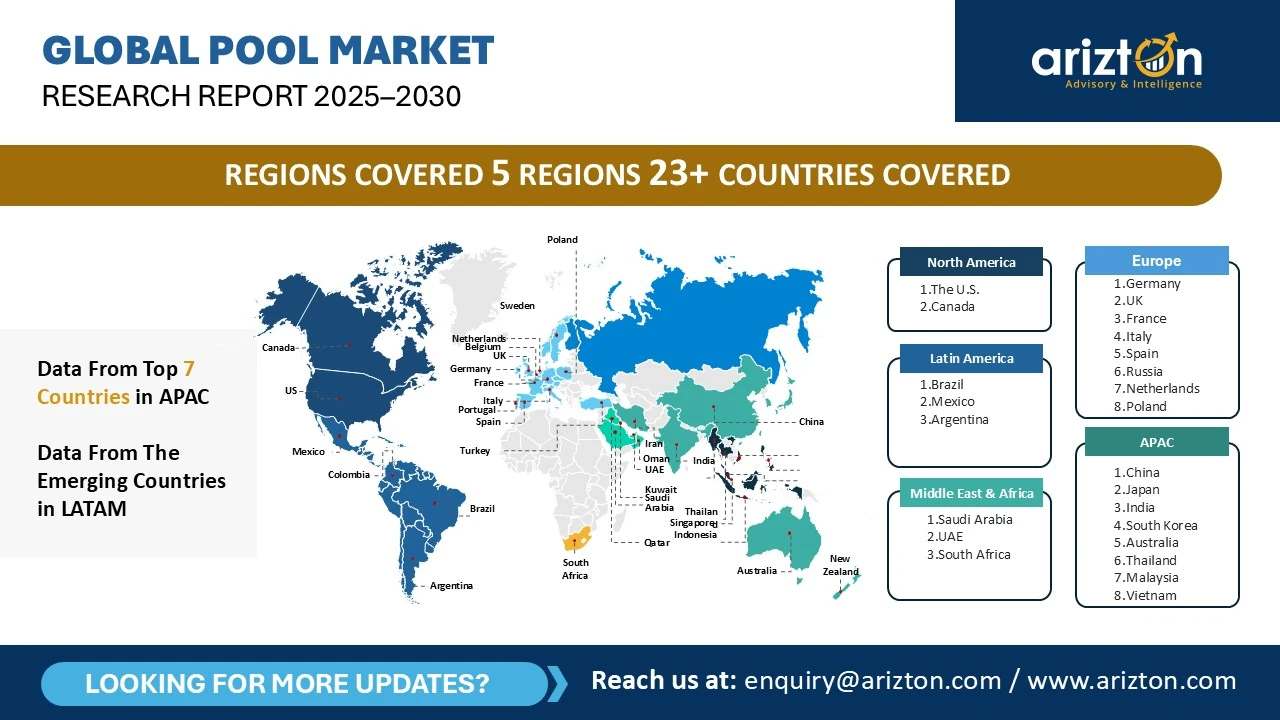
5 region

24 countries
Purchase Options
Global Pool Market Research Report 2025–2030
THE GLOBAL POOL MARKET WAS VALUED AT USD 17.75 BILLION IN 2024 AND IS PROJECTED TO REACH USD 23.30 BILLION BY 2030, EXPANDING AT A CAGR OF 4.64%.
The Pool Market Size, Share, & Trends Analysis Report By
- Build Type: In-Ground, Above-Ground, and Others
- End User: Residential and Commercial
- Residential End User by Type: New Build Pools, Renovation / Remodel, and Aftermarkets / Consumables
- Residential New Build Pool by Material: Concrete, Fiberglass, Vinyl Liners, and Others
- Commercial End User by Type: New Build Pools, Renovation / Remodel, and Aftermarkets / Consumables
- Commercial New Build Pool by Material: Concrete, Fiberglass, Vinyl Liners, and Others
- Geography: North America, Europe, APAC, Latin America, and Middle East & Africa
Industry Analysis Report, Regional Outlook, Growth Potential, Price Trends, Competitive Market Share & Forecast 2025–2030.
This report includes market data points, ranging from trend
analyses to market estimates & forecasts that you can customize
POOL MARKET REPORT SCOPE
| REPORT ATTRIBUTE | DETAILS |
|---|---|
| Market Size (2030) | USD 23.30 Billion |
| Market Size (2024) | USD 17.75 Billion |
| CAGR (2024-2030) | 4.64% |
| HISTORIC YEAR | 2021-2023 |
| BASE YEAR | 2024 |
| FORECAST YEAR | 2025-2030 |
| SEGMENTS BY | Build Type, End User, Residential End User by Type, Residential New Build Pool by Material, Commercial End User by Type, Commercial New Build Pool by Material, and Geography |
| GEOGRAPHIC ANALYSIS | North America, Europe, APAC, Latin America, and Middle East & Africa |
| KEY PLAYERS | Pentair plc, Fluidra, Hayward, Maytronics, Latham Pool Products, Intex Recreation Corp, Waterco, Emaux, Gecko Alliance, and Xylem Inc. |
POOL MARKET ANALYSIS
The global pool market was estimated at USD 17.75 billion in 2024 and is projected to reach USD 23.30 billion by 2030, expanding at a CAGR of 4.64% during the forecast period. Steady market growth is being driven by increased investment in residential and hospitality construction, rising renovation activity, and a growing preference for smart, energy-efficient pool systems across both developed and emerging economies. Swimming pools are increasingly viewed as lifestyle assets- enhancing property value while creating dedicated spaces for relaxation, fitness, and social engagement- leading to higher installation rates worldwide.
Pools also support a wide range of uses, from recreational and competitive swimming to hydrotherapy and wellness applications. This versatility is expanding their appeal across residential, commercial, and hospitality segments, strengthening overall demand.
The adoption of smart pool technologies is further accelerating growth. Features such as automated cleaning, temperature regulation, and real-time water-quality monitoring significantly reduce maintenance requirements, while integration with mobile apps and smart-home ecosystems enhances user convenience. These capabilities are encouraging homeowners and facility operators to invest in modern, technology-enabled pool solutions.
Urbanization and rising disposable incomes continue to support new installations in residential communities, villas, and hospitality properties. Meanwhile, in mature markets such as the US, France, and Spain, pool renovation cycles are increasingly focused on upgrading materials, automation systems, and energy-efficient technologies—driving consistent replacement demand and supporting long-term market expansion.
IMPACT OF US & CHINA TRADE WAR
The escalation of the US-China trade war in January 2025 increased tariffs on construction materials, electronic components, and pool-related equipment, disrupting the global pool market. The new duties affected the supply of pumps, filtration systems, PVC piping, lighting modules, and smart control units sourced from China.
Higher import duties raised procurement costs for OEMs, contractors, and distributors dependent on Chinese suppliers. The prices of heaters, chlorinators, fiberglass shells, and automated cleaning units increased, pushing project budgets upward and extending delivery timelines across major regional markets.
US and European pool system manufacturers shifted sourcing to Vietnam, Thailand, and Mexico to manage tariff exposure. These transitions created temporary shortages, certification delays, and logistics challenges for both smart and traditional pool components.
Trade restrictions also affected building materials such as tiles, coping stones, and composite decking used in pool construction. Builders and suppliers faced higher landed costs and were forced to renegotiate installation contracts to offset rising material prices.
In August 2025, the US raised tariffs on Indian and Taiwanese exports of filtration housings, valves, and heat exchanger units used in pool systems. This led to cost escalation for American importers and reduced competitiveness for mid-sized regional integrators.
Overall, the global pool market in 2025 faced elevated input costs, shipment delays, and growing reliance on Southeast Asian and Latin American suppliers. These pressures reshaped pricing strategies, slowed renovation activities, and temporarily limited the availability of advanced, energy-efficient pool systems.
POOL MARKET TRENDS & DRIVERS
- Industries are increasingly adopting smart pool technologies that enhance control, safety, and efficiency. Connected filtration, lighting, and heating systems with IoT-based monitoring and predictive maintenance are transforming pool management across residential and commercial applications.
- Energy-efficient and sustainable equipment such as variable-speed pumps, inverter heat pumps, and solar-powered systems are gaining traction. These innovations lower operational costs while aligning with global energy-efficiency regulations and consumer preferences for eco-friendly lifestyles.
- Wellness-oriented pool features, including hydrotherapy jets, temperature zoning, and salt-water chlorination, are being integrated into luxury housing and hospitality projects. The focus on health, relaxation, and holistic well-being is redefining pools as wellness hubs rather than leisure amenities alone.
- The use of modular and composite construction materials such as prefabricated fiberglass shells, composite decking, and lightweight panels is simplifying installation and renovation. These materials improve durability, reduce maintenance needs, and enable faster project execution across both new and retrofit installations.
- Urbanization and rising disposable incomes in developing regions are expanding investment in private and community pool facilities. The trend is supported by architectural innovation and sustainability certification programs that promote efficient water and energy use.
INDUSTRY RESTRAINTS
- High upfront costs and operational burden continue to restrict widespread pool adoption. The expenses associated with installation, filtration, heating, and automation systems create affordability challenges for homeowners and small commercial operators. Additionally, high electricity consumption and recurring maintenance costs add to lifecycle expenses.
- Regulatory, seasonal, and lifestyle constraints further limit market growth. Strict water-use regulations in drought-prone areas, safety compliance norms, and short swimming seasons in colder climates reduce utilization rates. Changing lifestyle patterns and limited availability of trained service professionals also hinder consistent upkeep and customer satisfaction.
POOL MARKET - SEGMENTATION INSIGHTS
INSIGHT BY BUILD TYPE
The global pool market by build type is segmented into in-ground, above-ground, and others. The in-ground segment accounted for the largest market share of around 58%. Their dominance is supported by higher installation in permanent residential properties, resorts, and luxury developments where structural integration and long-term durability are prioritized. In-ground pools are favoured for luxury homes, resorts, hotels, and sports facilities where permanence and appeal are critical. Demand is strongest across North America, Europe, and wealthy parts of Asia like Australia, particularly in commercial projects.
INSIGHT BY END-USER
The global pool market by end-user is segregated into residential and commercial. The commercial pool market segment shows significant growth, with the fastest-growing CAGR of 5.32% during the forecast period. Growth is driven by new investments in hotels, resorts, wellness centers, and sports facilities that rely on pools as revenue-enhancing amenities. Commercial pools are designed for institutional, recreational, and therapeutic use. They support various functions, including athletic training, wellness services, hospitality branding, and urban amenities. Their designs aim to balance the needs of many users with strict technical, environmental, and regulatory standards across global markets. Consistent refurbishment cycles, along with higher safety and hygiene standards, further accelerate demand for new commercial installations and upgraded water-management systems.
INSIGHT BY RESIDENTIAL END USER BY TYPE
The new build pools by residential end user by type dominate and hold the largest global pool market share. The demand for residential pools rises with housing cycles and income growth. New pools are popular in Asia, the Middle East, and Latin America, where urban expansion drives installations.
In Asia Pacific and the Middle East, new builds benefit from suburban expansion and villa-oriented masterplans where pools are marketed as lifestyle anchors that differentiate communities. Developers bundle designs with landscaping and outdoor kitchens, which speeds decisions and secures procurement and installation scale advantages.
INSIGHT BY RESIDENTIAL END USER BY MATERIAL
Based on the material, the fibreglass segment shows the highest growth during the forecast period. Fiberglass pools are prefabricated one-piece shells manufactured in controlled factory environments using resin and glass-fibre composites. Their seamless structure ensures watertight integrity, consistent quality, and quick installation, making them highly suitable for residential projects where homeowners seek fast commissioning and minimal site disruption. The smooth, non-porous interior prevents algae buildup, reduces chemical usage, and delivers long-term durability with low maintenance effort compared to traditional concrete systems.
These pools are particularly popular among mid-range and upper-middle-income households looking for reliable performance and modern design within shorter construction timelines. Built-in steps, ledges, and seating areas are moulded directly into the structure, offering ready-to-use features that balance comfort and style. Fiberglass pools are extensively adopted in North America, Australia, and parts of Europe, where their lightweight design and quick setup meet suburban housing preferences and space constraints.
INSIGHT BY COMMERCIAL END USER BY TYPE
The new build pools by commercial end user by type dominate and holds the largest global pool market share. Commercial pools are large installations located in hotels, resorts, universities, gyms, municipal facilities, and leisure centers. They serve recreation, wellness, and sports purposes. These pools are usually made from reinforced concrete or prefabricated stainless steel, which makes them durable and capable of supporting large numbers of users in tourism and community developments.
INSIGHT BY COMMERCIAL END USER BY MATERIAL
The concrete segment dominates and holds the largest global pool market share. Concrete remains the foundation of commercial pool construction, valued for its strength, formability, and ability to support heavy mechanical loads. It is widely used in Olympic venues, hotel resorts, wellness centers, and public aquatic complexes that require large-capacity, durable basins capable of operating continuously. Shotcrete and rebar reinforcement enable deep structures, irregular layouts, and integrated hydraulic systems for filtration, overflow, or wave generation. These capabilities make concrete indispensable in facilities designed for long service life and high footfall.
The material allows designers to combine function and aesthetics within strict safety and accessibility codes. Developers favour concrete for projects demanding precise depth control, accessible ramps, and multi-level configurations suited for therapy, recreation, or training. Its mass stability ensures low vibration and noise in indoor complexes, while dense finishes such as quartz aggregate or epoxy coatings resist chemical exposure and maintain hygiene standards.
POOL MARKET GEOGRAPHICAL ANALYSIS
North America held the largest global pool market share of over 45% in 2024, supported by a vast base of in-ground residential and commercial pools. Market growth is fueled by modernization of existing installations and the adoption of inverter-based heat pumps, variable-speed drives, and smart control systems. A mature aftermarket for maintenance and upgrades sustains recurring revenues, reinforcing regional dominance.
Europe ranked second in 2024, supported by steady demand across residential, hospitality, and wellness sectors. Energy-efficiency regulations are accelerating the replacement of conventional systems with advanced, low-consumption equipment. Southern Europe, especially Spain, France, and Italy, benefits from favourable climates and strong tourism investment. Italy is the fastest-growing market with rising adoption of saltwater treatment and inverter-based heating in villas and boutique hotels.
APAC is the fastest-growing region, projected to record a CAGR of 5.99% during 2025–2030. This growth is led by expanding residential and resort construction, rising incomes, and wellness-oriented outdoor amenities. China and Japan contribute nearly 50% of regional revenues, driven by China’s premium housing demand and Japan’s focus on compact, technology-enabled pool systems with advanced heating and automation.
India shows the highest-growth market in APAC. This expansion stems from rapid urban housing development, upscale hospitality projects, and the inclusion of recreational amenities in premium townships. Rising disposable incomes and wider availability of prefabricated pool systems are driving installations across key metros, including Mumbai, Bengaluru, and Delhi NCR.
POOL MARKET VENDOR LANDSCAPE
The global pool market includes well-known companies like Pentair, Fluidra, Hayward, Maytronics, and Latham Pool Products. There are also specialized and regional manufacturers, such as Waterco, Emaux Water Tech, LASWIM, and Compass Europe. This variety creates a competitive environment with different levels of competition.
Market leaders stand out with their product offerings, which include pumps, filters, automation systems, and structural pool solutions. These offerings benefit from global distribution networks and ongoing investment in smart pool technologies.
Companies like Pentair, Fluidra, and Hayward set industry standards through their research and development, integration of automation, and adherence to strong regulatory measures.
Specialized companies such as Maytronics lead the robotic pool cleaner category while Latham Pool Products concentrates on pool structures with a focus on fiberglass and vinyl-liner solutions.
Regional companies like Waterco and Emaux strengthen their market positions by meeting local climate needs and offering cost-effective options. They also build solid relationships with distributors in APAC, EMEA, and emerging markets.
Chinese manufacturers, including LASWIM and Ming Aqua Machinery, are growing internationally with their filtration, heating, and circulation products. Turnkey providers like GreatPool focus on delivering projects in an EPC style, fitting well into the expanding urban pool infrastructure sector.
The competitive landscape is influenced by consolidation as groups such as Compass Europe and niche players like Speck Pumps-Pool Products expand through brand-driven strategies and partnerships. Product development is driven by the increasing demand for energy-efficient equipment, IoT-enabled automation, and sustainable pool systems.
Recent Developments in the Pool Market
- In May 2025, Pentair Pool announced its role as a Gold Partner and Official Swimming Sponsor of the 2026 Special Olympics USA Games. This collaboration encourages intelligent green water approaches and promotes inclusion, equity, wellness and community with event participation and volunteer initiatives.
- In June 2025, Fluidra expanded its presence in luxury tourism by securing $ 5.35 million in projects across Egypt, Dubai, and Mexico. This improved the Commercial Pool Division, which now makes up 9% of total group sales.
- In May 2025, Fluidra obtained four major aquatic sports projects valued at over €10 million, or roughly $10.8 million. The Olympic Aquatic Center in Paraguay includes multiple pools and modern amenities.
- Two competition pools were built for the 2026 Mediterranean Games in Italy, and a seven-pool aquatic complex was developed in Targu Secuiesc, Romania. They also completed a competition pool at Wahiajer Stadium in India. All sites received full design, installation, commissioning, and maintenance services.
- In November 2024, Waterco launched the Electroheat PRO 60 kW Inverter Heat Pump in Australia. This commercial unit offers quick pool heating and cooling with a strong 60 kW output. It is constructed of titanium and aluminium with inverter technology to enhance energy efficiency and reduce operating costs.
- In September 2023, Xylem Inc. and LORENTZ formed a global distribution agreement to promote solar-powered and solar grid hybrid pumping systems. The agreement aims to increase renewable pumping solutions for agricultural irrigation and drinking water. It also supports decarbonization and water resilience in remote communities.
SNAPSHOT
The global pool market size is expected to grow at a CAGR of approximately 4.64% from 2024 to 2030.
The following factors are likely to contribute to the growth of the global pool market during the forecast period:
- Rising Wellness & Lifestyle Focus
- Growth in Residential Real Estate & Luxury Housing
- Tourism & Hospitality Expansion
- Aging Infrastructure & Renovation Demand
Base Year: 2024
Forecast Year: 2025-2030
The report considers the present scenario of the global pool market and its market dynamics for 2025−2030. It covers a detailed overview of several market growth enablers, restraints, and trends. The study covers both the demand and supply sides of the market. It also profiles and analyzes leading companies and several other prominent companies operating in the market.
Key Company Profile
- Pentair plc
- Business Overview
- Product Offerings
- Key Developments
- Key Strategies
- Key Strengths
- Key Opportunities
- Fluidra
- Hayward
- Maytronics
- Latham Pool Products
- Intex Recreation Corp
- Waterco
- Emaux
- Gecko Alliance
- Xylem Inc.
Other Prominent Company Profiles
- Supreme Pools Pty. Ltd.
- Business Overview
- Product Offerings
- Starmatrix Group Inc.
- Explore Industries
- Poolking
- Ming Aqua Machinery
- Blue Wave Products, Inc.
- SPRSUN
- GreatPool
- FibroPool MEA
- Abatec Pools
- Speck Pumps-Pool Products, Inc.
- Val-Pak Products
- Gecko Pool & Spa
- SmartPool Systems Ltd
- Arrdev Prefab Pvt. Ltd.
- Compass Europe, S.R.O.
- Valterra Products, Inc.
- Halbert Pool & Spa
- Poolmaster, Inc.
- Guangdong LASWIM Water Environment Equipment Co., Ltd.
Segmentation by Build Type
- In-Ground
- Above-Ground
- Others
Segmentation by End User
- Residential
- Commercial
Segmentation by Residential End user by Type
- New Build Pools
- Renovation / Remodel
- Aftermarkets / Consumables
Segmentation by Residential New Build Pool by Material
- Concrete
- Fiberglass
- Vinyl Liners
- Others
Segmentation by Commercial End user by Type
- New Build Pools
- Renovation / Remodel
- Aftermarkets / Consumables
Segmentation by Commercial New Build Pool by Material
- Concrete
- Fiberglass
- Vinyl Liners
- Others
Segmentation by Geography
- North America
- US
- Canada
- Europe
- Germany
- UK
- France
- Italy
- Spain
- Russia
- Netherlands
- Poland
- APAC
- China
- Japan
- India
- South Korea
- Australia
- Thailand
- Malaysia
- Vietnam
- Latin America
- Brazil
- Mexico
- Argentina
- Middle East & Africa
- Saudi Arabia
- UAE
- South Africa
POOL MARKET FAQs
How big is the global pool market?
Which region holds the largest share of the global pool market?
Who are the major vendors in the global pool market?
What is the growth rate of the global pool market?
What are the key trends in the global pool market?
For more details, please reach us at [email protected]
- Chapter 1- Scope & Coverage
- Market Definition
- Inclusion
- Exclusions
- Market Estimation Caveats
- Market Derivation
- Market Segmentation by Build Type
- Market Segmentation by End User
- Market Segmentation by Residential End user by Type
- Market Segmentation by Residential New Build Pool by Material
- Market Segmentation by Commercial End user by Type
- Market Segmentation by Commercial New Build Pool by Material
- Chapter 2- Premium Insights
- Chapter 3- Market Dynamics
- Introduction
- Lifecycle of a Pool
- Product categories and Functions
- Value Chanin Analysis
- Commercial Pool Applications
- Residential Pool Applications
- Impact of The Ongoing Tariff War
- Market Opportunities & Trends
- Adoption of Smart Pool Technologies
- Energy-Efficient Equipment Adoption
- Wellness-Driven Pool Features
- Emergence of Modular & Composite Materials
- Market Growth Enablers
- Rising Wellness & Lifestyle Focus
- Growth in Residential Real Estate & Luxury Housing
- Tourism & Hospitality Expansion
- Aging Infrastructure & Renovation Demand
- Market Restraints
- High Costs and Operational Burden
- Regulatory, Seasonal, and Lifestyle Pressures
- Market Landscape
- Five Forces Analysis
- Chapter 4- Market Segmentation
- Build Type (Market Size & Forecast: 2021-2030)
- In-Ground
- Above-Ground
- Others
- End User (Market Size & Forecast: 2021-2030)
- Residential
- Commercial
- Residential End user by Type (Market Size & Forecast: 2021-2030)
- New Build Pools
- Renovation / Remodel
- Aftermarkets / Consumables
- Residential New Build Pool by Material (Market Size & Forecast: 2021-2030)
- Concrete
- Fiberglass
- Vinyl Liners
- Others
- Commercial End user by Type (Market Size & Forecast: 2021-2030)
- New Build Pools
- Renovation / Remodel
- Aftermarkets / Consumables
- Commercial New Build Pool by Material (Market Size & Forecast: 2021-2030)
- Concrete
- Fiberglass
- Vinyl Liners
- Others
- Chapter 5- Geography Segmentation
- Geography Segmentation (Market Size & Forecast: 2021-2030)
- Geographic Overview – Market Maturity Index
- APAC
- China
- Japan
- India
- South Korea
- Australia
- Thailand
- Malaysia
- Vietnam
- North America
- US
- Canada
- Europe
- Germany
- UK
- France
- Italy
- Spain
- Russia
- Netherlands
- Poland
- Latin America
- Brazil
- Mexico
- Argentina
- MEA
- Saudi Arabia
- UAE
- South Africa
- Chapter 6- Competitive Landscape
- Competitive Landscape
- Competition Overview
- Key Developments
- Key Company Profiles
- Other Prominent Company Profiles
- Report Summary
- Key Takeaways
- Strategic Recommendations
Select a license type that suits your business needs
Single User Licence
- Report accessible by one user only
- Free 10% or 3 days of customization
- Free post-sale service assistance
- Continuous support through email
5 User Licence
- Report accessible by 5 users within the organization
- Free 15% or 4.5 days of customization
- Continuous support through email and telephone
- Free analyst hour
- Free Upgrade: If an updated report published within 180 days of purchase, you will get the revised report free of charge
Corporate Licence
- Free Datasheet worth $1500
- Report accessible by the entire organization
- Free 20% or 6 days of customization
- Free post-sale service assistance
- Continuous support through email and telephone
- Direct access to lead analysts
- Free analyst hour
- Free Upgrade: If an updated report published within 180 days of purchase, you will get the revised report free of charge
Datasheet Licence
- Report accessible by 1 user only
- Free 15% or 32 hours of customization
- Free post-sale service assistance
- Direct access to lead analysts
Frequently Asked Questions
How big is the global pool market?
Which region holds the largest share of the global pool market?
Who are the major vendors in the global pool market?
What is the growth rate of the global pool market?
What are the key trends in the global pool market?
Other RELATED Reports




U.S. Pool Maintenance & Cleaning Services Market – Focused Insights 2024-2029
Published : June 2024