

Recreational Boat Market Growth Insights – Market Volume to Reach 816.2 Thousand Units by 2031, Driven by Demand for Larger & Higher-Value Boats, Advanced Propulsion and Control Systems, Integrated Navigation & Electronics, Premium Interiors, and Multifunctional Boat Configurations (2026–2031)
Published Date : September 2026
Last Updated : October 2026
format: PDF
edition : Sixth Edition

272 pages

44 company

5 segments

5 region

23 countries
Purchase Options
Global Recreational Boat Market Research Report 2026-2031
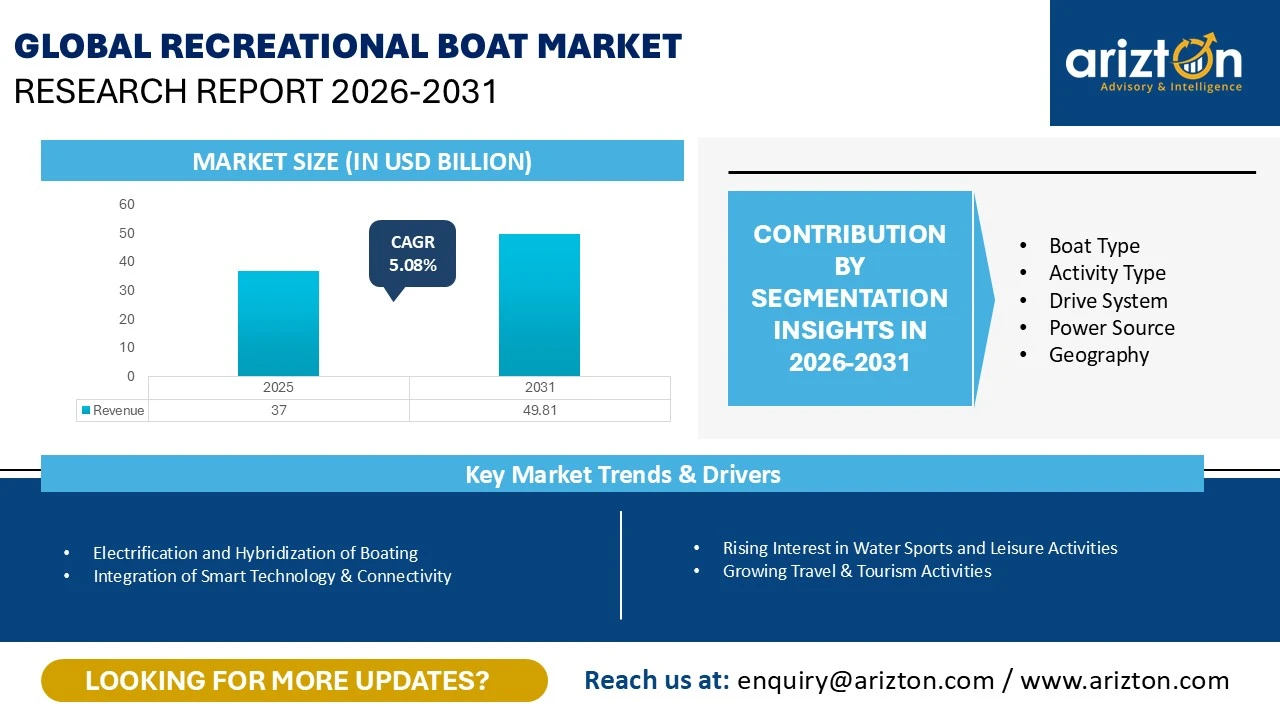
THE GLOBAL RECREATIONAL BOAT MARKET WAS VALUED AT USD 37 BILLION IN 2025 AND IS PROJECTED TO REACH USD 49.81 BILLION BY 2031, REGISTERING A CAGR OF 5.08%.
The Recreational Boat Market Size, Share & Trends Analysis Report By
- Boat Type: Motorboats, Cruisers & Yachts, Personal Watercraft, Sailboats, Pontoon & Inflatable Boats, and Others
- Activity Type: Cruising & Leisure, Water Sports & Adventure, and Fishing
- Drive System: Outboard Drive, Inboard Drive, Sterndrive, Jet Drive, and Others
- Power Source: Fuel-Powered Boats, Sail-Propelled Boats, Electric Boats, Man-Powered Boats, and Hybrid Boats
- Geography: North America, Europe, APAC, Latin America, and Middle East and Africa
Industry Analysis Report, Regional Outlook, Growth Potential, Price Trends, Competitive Market Share & Forecast 2026–2031.
This report includes market data points, ranging from trend
analyses to market estimates & forecasts that you can customize
GLOBAL RECREATIONAL BOAT MARKET REPORT SCOPE
| REPORT ATTRIBUTE | DETAILS |
|---|---|
| MARKET SIZE (2031) | USD 49.81 Billion |
| MARKET SIZE (2025) | USD 37 Billion |
| CAGR (2025-2031) | 5.08% |
| MARKET SIZE- VOLUME (2031) | 816.2 Thousand units |
| HISTORIC YEAR | 2022-2024 |
| BASE YEAR | 2025 |
| FORECAST YEAR | 2026-2031 |
| SEGMENTS BY | Boat Type, Activity Type, Drive System, Power Source, and Geography |
| GEOGRAPHIC ANALYSIS | North America, Europe, APAC, Latin America, and the Middle East and Africa |
| KEY PLAYERS | Azimut-Benetti Group, BENETEAU, Brunswick Corporation, Ferretti Group, Yamaha Motor Co., Ltd., and White River Marine Group |
RECREATIONAL BOAT MARKET SIZE & SHARE
The global recreational boat market size was valued at USD 37 billion in 2025 and is projected to reach USD 49.81 billion by 2031, registering a CAGR of 5.08% during the forecast period. This revenue growth will be supported by upgrades to larger and higher-value boats, increasing adoption of advanced propulsion and control systems, greater integration of navigation and onboard electronics, and stronger demand for premium interiors, multifunctional layouts, and higher-specification configurations.
Recreational boating benefits from a large established outdoor leisure base. The US Bureau of Economic Analysis (BEA), a federal economic statistics agency, reported boating and fishing at $38.4 billion in 2024, making it the largest conventional outdoor recreation activity in the country. The scale of participation supports recurring purchases across fishing boats, pontoons, motorboats, personal watercraft, cruisers, and other recreational boats.
RECREATIONAL BOAT MARKET INSIGHTS BY VOLUME
The global recreational boat market by volume is expected to reach 816.2 thousand units by 2031. This unit growth will be supported by the replacement of aging recreational boats, expansion of the private boating population in developing markets, and wider availability of compact personal watercraft, smaller motorboats, pontoons, inflatables, and man-powered craft that provide more accessible entry points into recreational boating.
Europe has an extensive recreational boating base that supports recurring ownership, replacement, and upgrade demand. European Boating Industry (EBI), the European recreational marine industry association, reported in 2025 that Europe had approximately 6.5 million boats and 10,000 marinas, providing dedicated facilities for recreational boat docking, storage, launching, and waterfront access. The established boat base and supporting marina infrastructure facilitate continued boating participation and vessel ownership, supporting demand across motorboats, sailboats, cruisers and yachts, inflatables, and other recreational boats.
KEY TAKEAWAYS
- Boat Type: Motorboats accounted for the largest revenue share of 46% in 2025.
- Activity Type: Cruising & leisure accounted for the largest share in the activity type of the global recreational boat market.
- Drive System: The outboard drive shows the highest growth with a CAGR of 5.62% during the forecast period.
- Power Source: The fuel-powered boats accounted for the largest share of the global recreational boat market in 2025.
- Geography: North America accounted for the largest regional revenue share of around 43% in 2025.
RECENT DEVELOPMENTS IN THE RECREATIONAL BOAT MARKET
- In May 2026, MasterCraft Boat Holdings, a US manufacturer of premium performance and leisure powerboats, completed its acquisition of Marine Products Corporation. The transaction added Chaparral and Robalo to MasterCraft, Crest, and Balise, broadening the company’s participation across recreational and sport-fishing powerboats and increasing its ability to address different powered-boat customer groups through a wider brand portfolio.
- In May 2026, Axopar Boats, a Finnish recreational powerboat manufacturer, introduced the Axopar 38 Sun Top, the second model in its new 38 range. The model combines an open-air configuration with flexible cockpit and onboard social areas, strengthening Axopar’s portfolio of multifunctional adventure-oriented boats designed to support driving, dining, relaxation, and other recreational activities within the same platform.
- In September 2025, Malibu Boats, a recreational performance-powerboat manufacturer, launched the 2026 Wakesetter 22 LSV with an advanced 15.8-inch touchscreen control system for managing key boat functions, redesigned helm seating, upgraded wireless charging, and enhanced wake and wave functionality. The launch demonstrates how watersports-boat manufacturers are combining performance systems with digital controls, onboard comfort, and personalization to increase product differentiation in higher-value recreational boat categories.
- In October 2025, Fountaine Pajot, a French recreational sailing-catamaran manufacturer, released the first official images and specifications of the FP44, incorporating up to 2,300 W of solar generation and an optional ODSea+ package combining hybrid propulsion, hydrogeneration, intelligent energy management, real-time monitoring, and connected maintenance. The development expands the use of energy-management and lower-emission technologies within premium recreational cruising boats.
RECREATIONAL BOAT MARKET TRENDS
Integration of Smart Technology & Connectivity
Integration of smart technology & connectivity remains a significant trend in the global recreational boat market as buyers expect boats to be easier to operate, monitor, and manage. The trend is visible through digital helm displays, GPS chart plotters, engine telematics, battery and bilge alerts, app-based controls, joystick piloting, auto-levelling systems, remote monitoring, and onboard diagnostics across motorboats, pontoons, cruisers, and premium leisure boats.
These features improve trip planning and operating confidence by helping owners check route conditions, weather alerts, engine temperature, battery health, fuel use, and maintenance needs before or during trips.
Electrification and Hybridization of Boating
Electric and hybrid propulsion are becoming more practical for recreational boating as manufacturers improve range, charging capability, propulsion efficiency, and onboard energy management. For instance, Candela, a Swedish electric-boat manufacturer, offers the C-8 electric hydrofoil with an estimated range of 57 nautical miles at 22 knots. Improving operating capability is widening the recreational applications that electric boats can address, particularly across day boating and shorter-distance leisure cruising.
RECREATIONAL BOAT MARKET DRIVERS
Rising Interest in Water Sports and Leisure Activities
Consumer interest in outdoor recreation is supporting demand for boats used for family day trips, fishing, cruising, tubing, wakeboarding, wakesurfing, paddle support, and social gatherings. This driver is visible across pontoons, fishing boats, personal watercraft, bowriders, wake boats, and small cruisers, as buyers select recreational boats around activity needs, comfort, storage, seating flexibility, and easy access to water for weekend use and holidays globally annually.
Watersports are also encouraging new purchases and upgrades as buyers look for better performance, safer boarding, and more enjoyable onboard experiences. Wake-shaping systems, ballast controls, tow towers, swim platforms, board storage, upgraded audio, and safer deck layouts are becoming stronger selection factors for wakeboarding, wakesurfing, tubing, and other tow-sport activities, while social media visibility makes these experiences more aspirational for younger buyers and families worldwide.
Growing Travel & Tourism Activities
Growing travel & tourism activities are significant drivers for the global recreational boat market. They are driven by several factors that include development of marine tourism infrastructure, government initiatives, rising popularity of water sports, increased inspiration & awareness, economic growth, and increased focus on the purchase of boats from tourism companies. Over 970 million tourists traveled internationally in 2023.
Tourism companies, local authorities, and resorts are taking more interest in the purchase of boats such as watersport boats, pontoons, etc. It helps to meet the increased demand for leasing to tourists. Rising consumer preference for spending more on leisure activities is fueling the market growth for recreational boating.
INDUSTRY RESTRAINTS
High Purchase and Ownership Costs
High purchase and ownership costs remain a major constraint in the global recreational boat market because boats are discretionary, capital-intensive products. New boats carry higher prices due to marine-grade materials, engines, electronics, safety systems, specialized construction, dealer margins, and limited production volumes. When household budgets, credit conditions, or economic confidence weaken, buyers may delay upgrades, downsize purchases, purchase used boats, or rely on rental and shared-access alternatives rather than committing to a new boat purchase.
Environmental Concerns and Regulatory Pressure
Environmental concerns and regulatory pressure remain a significant constraint in the global recreational boat market because boats operate close to sensitive waterways, marinas, coastal habitats, and residential waterfronts. Regulators and local authorities increasingly focus on engine emissions, noise limits, fuel leakage, wastewater discharge, antifouling coatings, anchoring impacts, and marina waste handling, creating compliance requirements that can raise design, certification, operating, and ownership costs for manufacturers.
The pressure is already directly relevant to recreational craft rather than only commercial boats. The EU Recreational Craft Directive, the European regulatory framework for recreational craft and personal watercraft, covers boats with hull lengths from 2.5m to 24m and includes exhaust and noise requirements, showing that new boats must address environmental compliance at the product-design and market-entry stage in a major boating region like Europe.
RECREATIONAL BOAT MARKET SEGMENTATION INSIGHTS
INSIGHTS BY BOAT TYPE
The global recreational boat market by boat type is segmented into motorboats, cruisers & yachts, personal watercraft, sailboats, pontoon & inflatable boats, and others. Motorboats accounted for the largest revenue share of approximately 46% in 2025, supported by their broad application across family leisure, recreational fishing, water sports, day cruising, and coastal and inland boating. Motorboats also generate higher revenue per unit than many smaller recreational craft, as buyers can opt for larger hulls, multiple or high-output engines, advanced navigation systems, digital controls, entertainment features, premium seating, and upgraded interior and exterior configurations.
North America and Europe remain major markets due to established boat ownership, extensive dealer networks, access to lakes and coastal waterways, and strong recreational boating cultures. Meanwhile, demand in APAC and parts of the Middle East is increasing as first-time ownership expands and waterfront development, tourism, marinas, and recreational infrastructure improve.
INSIGHTS BY DRIVE SYSTEM
Based on drive system, outboard drive accounted for the largest share of the global recreational boat market and is expected to register the highest growth, with a CAGR of 5.62% during the forecast period. Outboard propulsion systems are widely used in small and mid-sized motorboats, fishing boats, pontoons, inflatables, day boats, and family leisure craft designed for cruising, fishing, coastal recreation, and inland water activities.
The broad compatibility of outboard systems with high-volume recreational boat categories continues to support demand. First-time buyers, fishing enthusiasts, pontoon owners, families, and coastal leisure users favor outboard-powered boats due to their practical performance, maneuverability, ease of maintenance, and relatively lower ownership burden compared with integrated propulsion systems.
INSIGHTS BY POWER SOURCE
Based on power source, fuel-powered boats accounted for the largest share of the global recreational boat market in 2025. Conventional fuel propulsion remains widely preferred because it provides higher speeds, extended cruising ranges, greater load-carrying capabilities, and flexibility across inland, coastal, and offshore applications.
Demand is primarily supported by recreational users seeking dependable performance for cruising, fishing, water sports, and family outings. Buyers also value quick refueling, towing capabilities, offshore operating capability, and longer operating durations. Established boat manufacturers, marine dealers, and service providers benefit from the mature ecosystem surrounding fuel-powered boats and their broad model availability. While fuel-powered boats are expected to remain a major revenue contributor, manufacturers are increasingly focusing on fuel efficiency, regulatory compliance, and lower-emission technologies to maintain competitiveness.
INSIGHTS BY ACTIVITY TYPE
Cruising & leisure accounted for the largest share of the global recreational boat market by activity type, driven by the broad range of recreational uses associated with this category. Cruising and leisure boats are primarily used for family outings, social boating, sightseeing, day cruising, marina-based recreation, and lifestyle-oriented private boating.
Demand is supported by consumers seeking versatile boats suitable for multiple leisure activities. Families, retirees, second-home owners, boating enthusiasts, and affluent consumers use these boats for social gatherings, entertaining guests, weekend trips, sightseeing, and coastal recreation. Their multi-purpose functionality gives cruising and leisure boats a broader customer base than vessels designed for a single activity.
North America remains a leading market for cruising and leisure boats, supported by high boat ownership, extensive inland waterways, marina infrastructure, and established boating communities.
RECREATIONAL BOAT MARKET GEOGRAPHICAL ANALYSIS
North America Recreational Boat Market
North America accounted for the largest regional revenue share of approximately 43% in 2025, supported by high recreational boat ownership, extensive freshwater and coastal access, a strong domestic manufacturing base, established dealer networks, and demand across pontoons, fishing boats, personal watercraft, wake boats, cruisers, and other powered recreational craft. Mature replacement demand and relatively high consumer spending per boat further strengthen the region’s revenue position.
The U.S. represents the largest demand market within North America, supported by its large consumer and manufacturing base, extensive dealer networks, widespread freshwater and coastal boating opportunities, and strong demand across multiple boat categories. According to the National Marine Manufacturers Association (NMMA), approximately 95% of boats sold in the U.S. are manufactured domestically, highlighting the strength of the country's local manufacturing and supply ecosystem.
Middle East & Africa Recreational Boat Market
The Middle East & Africa is expected to record the highest regional revenue CAGR during 2025–2031, supported by expanding recreational marine infrastructure, waterfront development, increasing availability of international boat brands, and rising demand for motorboats, personal watercraft, cruisers, and premium yachts. The region's relatively smaller installed base provides significant room for new ownership, supporting faster growth as marina infrastructure and recreational boating activities expand.
APAC Recreational Boat Market
India is expected to register the highest volume CAGR among major APAC recreational boat markets during 2025–2031. Growth is expected to be supported by expanding coastal and inland leisure boating, increasing availability of domestic and international boat brands, marina and waterfront development, and rising expenditure on outdoor recreation among higher-income consumers. India's relatively small existing recreational boat base provides substantial headroom for new ownership compared with more mature APAC markets such as Australia and Japan.
RECREATIONAL BOAT MARKET VENDOR LANDSCAPE
The global recreational boat market is moderately fragmented, with competition among diversified recreational marine groups, specialist motorboat manufacturers, sailboat builders, personal watercraft suppliers, pontoon manufacturers, and premium yacht companies. Vendors compete through hull design, propulsion performance, reliability, onboard space, customization, technology integration, brand positioning, dealer coverage, warranty support, and the frequency with which new or redesigned models are introduced.
Brunswick Corporation, Groupe Beneteau, and Yamaha Motor participate through broad recreational marine portfolios and established international distribution, while MasterCraft Boat Holdings and Malibu Boats maintain stronger positions across performance and leisure powerboats. Premium builders such as Ferretti Group and Azimut-Benetti Group compete through larger yachts, design, craftsmanship, onboard accommodation, customization, and international dealer and service networks.
Competition is increasingly centered on the complete boating experience rather than basic vessel performance. Advanced helm systems, assisted docking, integrated navigation, connected displays, premium audio, multifunctional seating, configurable cockpits, efficient hulls, and upgraded propulsion systems allow manufacturers to differentiate models while making boats easier to use. These features are also supporting premiumization by increasing the value of technology and comfort content incorporated into each new boat.
Portfolio breadth and dealer reach remain important because recreational boat preferences vary considerably by activity, waterways, geography, and customer budget. Manufacturers with multiple brands or broad model ranges can serve fishing, family leisure, water sports, cruising, pontoon, personal watercraft, and premium applications while sharing manufacturing, procurement, technology, and distribution capabilities. Acquisitions and portfolio expansion can therefore strengthen competitive reach without requiring manufacturers to develop every boat category internally.
SNAPSHOT
The global recreational boat market size is expected to grow at a CAGR of approximately 5.08% from 2025 to 2031.
The following factors are likely to contribute to the growth of the global recreational boat market during the forecast period:
- Rising Interest in Water Sports and Leisure Activities
- Growing Travel & Tourism Activities
- Growth of Subscription-Based Boat Access Models
- Government Initiatives and Infrastructure Development
Base Year: 2025
Forecast Year: 2026-2031
The report examines the current state of the global recreational boat market and its market dynamics through 2026−2031. It covers a detailed overview of several market growth enablers, restraints, and trends. The study covers both the demand and supply sides of the market. It also profiles and analyses leading companies and several other prominent companies operating in the market.
Key Company Profile
- Azimut-Benetti Group
- Business Overview
- Product Offerings
- Key Developments
- Key Strategies
- Key Strengths
- Key Opportunities
- BENETEAU
- Brunswick Corporation
- Ferretti Group
- Yamaha Motor Co., Ltd.
- White River Marine Group
Other Prominent Vendors
- Bavaria Yachts
- Business Overview
- Product Offerings
- BRP
- Baja Marine, Inc.
- Hobie Cat Company
- Malibu Boats, Inc.
- Marine Products Corporation
- MasterCraft Boat Holdings, Inc.
- Polaris Inc.
- Sunseeker
- Albemarle Boats
- Bertram Yachts
- Candela Technology AB
- Tiara Yachts
- Custom Weld Boats
- Duckworth Boats
- Explorer Industries
- Grady-White Boats, Inc.
- Grand Banks Yachts
- HanseYachts
- High Caliber
- Lund Boats Company
- Maverick Boat Group, Inc.
- Nordhavn
- Formula Boats
- Princess Yachts
- Vision Marine Technologies
- Sanlorenzo S.p.A
- Viking Yacht
- Fountaine Pajot
- Zodiac Nautic
- Oyster Yachts
- Axopar Boats
- Highfield Boats
- Feadship
- Galeon Yachts
- Sunreef Yachts
- Astondoa
- Riviera Australia
Segmentation by Boat Type
- Motorboats
- Cruisers & Yachts
- Personal Watercraft
- Sailboats
- Pontoon & Inflatable Boats
- Others
Segmentation by Activity Type
- Cruising & Leisure
- Water Sports & Adventure
- Fishing
Segmentation by Drive System
- Outboard Drive
- Inboard Drive
- Sterndrive
- Jet Drive
- Others
Segmentation by Power Source
- Fuel-Powered Boats
- Sail-Propelled Boats
- Electric Boats
- Man-Powered Boats
- Hybrid Boats
Segmentation by Geography
- North America
- US
- Canada
- Europe
- Germany
- France
- UK
- Italy
- Spain
- Netherlands
- Sweden
- Norway
- APAC
- China
- Japan
- Australia
- South Korea
- India
- Thailand
- New Zealand
- Latin America
- Brazil
- Mexico
- Argentina
- MEA
- South Africa
- UAE
- Saudi Arabia
RECREATIONAL BOAT MARKET FAQs
What is the growth rate of the global recreational boat market?
How big is the global recreational boat market?
What are the key trends in the global recreational boat market?
Which region dominates the global recreational boat market?
Who are the major players in the global recreational boat market?
For more details, please reach us at [email protected]
- Chapter 1- Scope & Coverage
- Market Definition
- Inclusion
- Exclusions
- Market Estimation Caveats
- Market Derivation
- Market Segmentation by Drive System
- Market Segmentation by Power Source
- Market Segmentation by Boat Type
- Market Segmentation by Activity Type
- Chapter 2- Premium Insights
- Chapter 3- Market Dynamics
- Introduction
- Value Chain Analysis
- Consistent Technological Advancements
- Pricing Analysis by Product Category
- Consumer Satisfaction Benchmarking
- Innovation Pipeline Assessment
- Market Opportunities & Trends
- Integration of Smart Technology & Connectivity
- Electrification and Hybridization of Boating
- Personalization & Customization
- Demand for Eco-friendly Boating Solutions
- Market Growth Enablers
- Rising Interest in Water Sports and Leisure Activities
- Growing Travel & Tourism Activities
- Growth of Subscription-Based Boat Access Models
- Government Initiatives and Infrastructure Development
- Market Restraints
- High Purchase and Ownership Costs
- Environmental Concerns and Regulatory Pressure
- Health and Safety Concerns
- Market Landscape
- Five Forces Analysis
- Chapter 4- Market Segmentation
- Boat Type (Market Size & Forecast: 2022-2031)
- Motorboats
- Cruisers & Yachts
- Personal Watercraft
- Sailboats
- Pontoon & Inflatable Boats
- Others
- Activity Type (Market Size & Forecast: 2022-2031)
- Cruising & Leisure
- Water Sports & Adventure
- Fishing
- Drive System (Market Size & Forecast: 2022-2031)
- Outboard Drive
- Inboard Drive
- Sterndrive
- Jet Drive
- Others
- Power Source (Market Size & Forecast: 2022-2031)
- Fuel-Powered Boats
- Sail-Propelled Boats
- Electric Boats
- Man-Powered Boats
- Hybrid Boats
- Chapter 5- Geography Segmentation
- Geography Segmentation (Market Size & Forecast: 2022-2031)
- Geographic Overview – Market Maturity Index
- North America
- US
- Canada
- Europe
- Germany
- France
- UK
- Italy
- Spain
- Netherlands
- Sweden
- Norway
- APAC
- China
- Japan
- Australia
- South Korea
- India
- Thailand
- New Zealand
- Latin America
- Brazil
- Mexico
- Argentina
- MEA
- South Africa
- UAE
- Saudi Arabia
- Chapter 6- Competitive Landscape
- Competitive Landscape
- Competition Overview
- Key Developments
- Key Company Profiles
- Other Prominent Company Profiles
- Report Summary
- Key Takeaways
- Strategic Recommendations
Select a license type that suits your business needs
Single User Licence
- Report accessible by one user only
- Free 10% or 3 days of customization
- Free post-sale service assistance
- Continuous support through email
5 User Licence
- Report accessible by 5 users within the organization
- Free 15% or 4.5 days of customization
- Continuous support through email and telephone
- Free analyst hour
- Free Upgrade: If an updated report published within 180 days of purchase, you will get the revised report free of charge
Corporate Licence
- Free Datasheet worth $1500
- Report accessible by the entire organization
- Free 20% or 6 days of customization
- Free post-sale service assistance
- Continuous support through email and telephone
- Direct access to lead analysts
- Free analyst hour
- Free Upgrade: If an updated report published within 180 days of purchase, you will get the revised report free of charge
Datasheet Licence
- Report accessible by 1 user only
- Free 15% or 32 hours of customization
- Free post-sale service assistance
- Direct access to lead analysts
Frequently Asked Questions
What is the growth rate of the global recreational boat market?
How big is the global recreational boat market?
What are the key trends in the global recreational boat market?
Which region dominates the global recreational boat market?
Who are the major players in the global recreational boat market?

