

Track South Korea Data Centers at the Facility Level, from Operational Sites and their Physical Infrastructure to Upcoming Projects, Investment Pipelines, Capacity Additions, Operators, Locations, and Colocation Pricing.
Published Date : June 2026
Last Updated : September 2026
format: PDF
edition : Ninth Edition

62 Existing Data Centers

49 Upcoming Data Centers

37 Data Center Operators

21 No. of Cities
Purchase Options
South Korea Existing & Upcoming Data Center Portfolio
DISCOVER INSIGHTS ON 111 DATA CENTER FACILITIES ACROSS 21 KEY REGIONS IN SOUTH KOREA
Existing & Upcoming Data Centers, Facility-Level Capacity, Operators, Investments & Colocation Intelligence
This report covers the South Korea data center facilities analysis, which will provide the following information on the colocation data centers:
- Detailed profiles of 62 existing data centers
- In-depth review of 49 upcoming data centers
- Locations covered: Ansan, Anyang, Bucheon-si, Busan, Cheongju, Daegu, Gangnam, Geumcheon-gu, Gimhae, Gimpo, Goyang, Guro, Gwangju, Hanam, Incheon, Jeollanam-do, Pohang, Pyeongchon, Seongnam, Seoul, Yongin.
This report includes market data points, ranging from trend
analyses to market estimates & forecasts that you can customize
DATA CENTERS IN SOUTH KOREA
| REPORT ATTRIBUTE | DETAILS |
|---|---|
| Total Facilities Profiled | 111 |
| Existing Data Centers | 62 |
| Upcoming Data Centers | 49 |
| Operators & Investors Covered | 37 |
| Locations Covered | 21 |
| Existing IT Load | 981 MW |
| Upcoming Pipeline | 6.9 GW+ |
| Held by the top 3 operators (LG Uplus, KT Cloud, SK broadband) | 480 MW |
| Colocation Pricing | Retail & Wholesale |
DATA CENTERS IN SOUTH KOREA
South Korea's upcoming data center pipeline is now roughly seven times its installed base. This Excel database puts it all in one workbook: every existing and upcoming colocation facility, who operates it, how much power and white space it has, what it costs to build, when it opens, and what a rack or megawatt sells for. It is built for teams that need facility-level numbers, not market averages.
Our South Korea Data Center Portfolio provides a structured view of 111 data center facilities, including 62 existing and 49 upcoming facilities across 21 key locations. The database is designed to help data center operators, investors, developers, infrastructure providers, consultants, and enterprises understand where capacity exists today, where new capacity is being developed, and how the competitive landscape is evolving.
SOUTH KOREA DATA CENTERS: AT A GLANCE
- Installed base vs pipeline: 62 existing facilities hold about 981 MW of IT load. 49 upcoming facilities would add more than 6.9 GW.
- Concentrated supply: LG Uplus, KT Cloud and SK broadband together hold about 480 MW, close to half of today's IT load.
- Geography is shifting: Since 2024, the government has pushed new capacity away from power-constrained Seoul. Gyeonggi Province and Incheon now dominate the pipeline, with Ansan, Busan, Gimhae, Goyang and Seongnam also gaining momentum.
- AI is reshaping the pipeline: AWS has planned AI-ready data centers across Incheon and Gyeonggi (about USD 5 billion, October 2025) and a facility with SK Group for roughly 60,000 GPUs (September 2025). OpenAI-linked projects with Samsung and SK Telecom are also in the tracked pipeline.
- Cost and compliance: Build cost averages USD 10-11 million per MW, below Singapore, Japan and Australia, while the Personal Information Protection Act keeps data-residency demand high.
OPERATORS & CLOUD PROVIDERS IN SOUTH KOREA - LIST
The database covers 37 operators and investors, from domestic telecom groups to global colocation platforms and cloud and AI investors.
- Domestic telecom, IT-services and platform groups: LG Uplus, KT Cloud, SK broadband, LG CNS, Lotte Innovate, Shinsegae I&C, Kakao
- Global colocation platforms: Equinix, Digital Realty, Digital Edge, Telehouse (KDDI), Macquarie Telecom Group, ST Telemedia Global Data Centres, STACK Infrastructure & ESR Group, Empyrion Digital
- Cloud and AI investors: Amazon Web Services (AWS), Open AI & Samsung, Open AI & SK Telecom, Okestro
- New entrants and developers: DCI Data Centers, Fir Hills, Inuverse, KORAMCO Assets Management, Metavisio Thomson Computing & BKB Energy, OneAsia Network, and others
FULL LIST OF INVESTORS/OPERATORS IN SOUTH KOREA

DAOU IDC, DCI Data Centers, Digital Edge, Digital Realty, Dreammark1 Corporation, Empyrion Digital, Equinix, Equinix & GIC, Epoch Digital, Fir Hills Inc., Hostway, Inuverse, Kakao, KINX, KORAMCO Assets Management, KT Cloud, KT Cloud (Capstone Asset Management), LG CNS, LG KEPCO and Hanwha, LG Uplus, Lotte Innovate, Macquarie Telecom Group, Metavisio Thomson Computing & BKB Energy, Okestro, OneAsia Network, SEJONG Networks, Shinsegae I&C, SK broadband, SK Ecoplant DCT Telecom and KB Asset Management, STACK Infrastructure & ESR Group Limited, ST Telemedia Global Data Centres & Samsung SRA Asset Management, Telehouse (KDDI), Changhae Development, KOSCOM, Amazon Web Services (AWS), Open AI & Samsung, Open AI & SK Telecom.
FACILITY-LEVEL DATA CENTER COVERAGE
A facility-level view of South Korea's digital infrastructure
The portfolio goes beyond a simple list of data centers in South Korea.
Each facility is assessed across its location, ownership/operator, physical footprint, IT capacity, rack capacity, redundancy design, Tier standard, operational status, development timeline, investment profile, and other infrastructure attributes.
For upcoming facilities, the database moves further into the project pipeline, capturing investor, planned area, power capacity, investment value, infrastructure investment split, announcement year, construction status, and expected operational year.
SOUTH KOREA DATA CENTER MARKET PORTFOLIO (EXCEL DATABASE)
This Excel database product provides a comprehensive portfolio analysis of the South Korea data center market, offering detailed insights into colocation facilities, including:
- Detailed Analysis of 62 existing data centers
- Detailed Analysis of 49 upcoming data centers
- Locations covered: Ansan, Anyang, Bucheon-si, Busan, Cheongju, Daegu, Gangnam, Geumcheon-gu, Gimhae, Gimpo, Goyang, Guro, Gwangju, Hanam, Incheon, Jeollanam-do, Pohang, Pyeongchon, Seongnam, Seoul, Yongin.
- Existing white-floor space (square feet)
- Upcoming white-floor space (square feet)
- Current IT load capacity (2026)
- Future capacity additions (2026-2031)
- Retail Colocation Pricing
- Quarter Rack (1/4)
- Half Rack Cabinets (1/2)
- Full Rack Cabinet (42U/45U/47U/etc.)
- Wholesale colocation (per kW) pricing
DATA POINTS COVERED
The data points covered in the database across each facility are mentioned below:
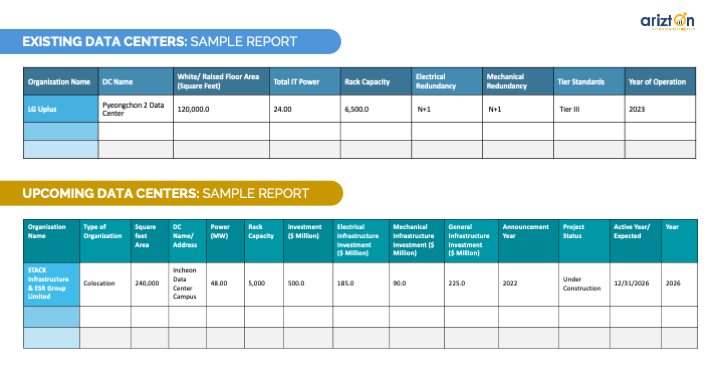
EXISTING DATA CENTERS (62 Facilities)
- Market Snapshot
- Location (Region/Country/City)
- Facility Address
- Operator/Owner Name
- Data Center Name, i.e., (Seocho 1 Data Center or Bundang Data Center)
- Core & Shell Area (White-Floor Area)
- Core & Shell Power Capacity (IT Load Capacity)
- Rack Capacity
- Year of Operations
- Design Standards (Tier I - IV)
- Power/Cooling Redundancy
UPCOMING DATA CENTERS IN SOUTH KOREA
Track the pipeline before capacity comes online
South Korea's next wave of data center development is captured through 49 upcoming facilities, providing visibility into projects that are announced, planned, under construction, or moving toward operation.
- Investment Snapshot
- Location (Region/Country/City)
- Investor Name
- Area (White-Floor Area)
- Power Capacity (IT Load Capacity)
- Investment ($ Million)
- Electrical Infrastructure Investment ($ Million)
- Mechanical Infrastructure Investment ($ Million)
- General Construction Services Investment ($ Million)
- Announcement Year
- Project Status (Opened/Under Construction/Announced & Planned)
- Active or Expected Year of Opening
Sample Record of Existing & Upcoming Data Center facilities:
UPCOMING DATA CENTER PROJECTS IN SOUTH KOREA
A key advantage of the portfolio is the ability to analyze existing versus upcoming infrastructure rather than looking at the market as a static facility count.
The database supports analysis across:
Facilities → Locations → Operators → White-Floor Area → IT Load → Rack Capacity → Investment → Development Status → Expected Opening
This is particularly relevant as South Korea's data center development expands beyond Seoul. Arizton's current market research identifies increasing activity across locations including Ansan, Busan, Cheonan, Daejeon, Gimhae, Goyang, Incheon, and Seongnam, alongside the established Seoul market.
Where are Data Centers Being Built in South Korea?
From Seoul to the wider metropolitan and regional market: The portfolio maps data center facilities across 21 South Korean locations, providing a clear view of the geographic distribution of both existing and upcoming infrastructure.
Key Locations Covered
Seoul | Incheon | Seongnam | Anyang | Goyang | Yongin | Gimpo | Hanam | Bucheon-si | Guro | Gangnam | Geumcheon-gu | Pyeongchon | Ansan | Busan | Daegu | Gwangju | Gimhae | Cheongju | Jeollanam-do | Pohang
This geographic view helps identify:
- Established data center clusters
- Emerging development locations
- Operator expansion patterns
- New capacity outside Seoul
- Potential markets for market entry
- Areas attracting new investment
DATA CENTER CAPACITY & INFRASTRUCTURE
Counting data centers alone does not explain the scale of a market. The database therefore captures three important facility-level capacity indicators:
- White-Floor Area: Understand the physical IT space available or planned at each facility.
- IT Load Capacity: Compare current and planned IT power capacity in MW.
- Rack Capacity: Assess the number of racks supported by individual facilities where available. Together, these metrics provide a more useful view of data center scale and capacity distribution across South Korea. The current portfolio specifically highlights white-floor area, IT load, and rack capacity as core database attributes. Compare current and planned IT power capacity in MW.
INFRASTRUCTURE & RESILIENCY DETAILS
For existing facilities, the database captures Tier standards and power/cooling redundancy, helping users understand differences in facility design and resiliency.
Coverage includes:
- Tier I–IV classification
- Electrical redundancy
- Mechanical/cooling redundancy
- IT load capacity
- Rack capacity
- White-floor area
- Year of operation
SOUTH KOREA COLOCATION PRICING INTELLIGENCE
The portfolio also includes retail and wholesale colocation pricing, extending the database beyond physical infrastructure.
Coverage includes:
- Quarter rack / 1⁄4 rack pricing
- Half rack cabinet pricing
- Full rack cabinet pricing
- Full cabinet configurations such as 42U / 45U / 47U
- Wholesale colocation pricing per kW
WHAT CAN YOU DO WITH THE SOUTH KOREA DATA CENTER PORTFOLIO?
- Identify existing facilities: Build a structured list of operational data centers by city, operator, capacity, and infrastructure characteristics.
- Track upcoming projects: Monitor the pipeline of announced, planned, and under-construction facilities.
- Compare operators: Benchmark operators based on facility footprint, IT capacity, rack capacity, and geographic presence.
- Map new investment: Identify where new capital is being directed and which organizations are expanding their footprint.
- Assess market capacity: Compare existing and upcoming white-floor area, IT load, and rack capacity.
- Evaluate locations: Identify established and emerging data center locations across South Korea.
- Benchmark colocation: Use retail and wholesale pricing data to understand local commercial conditions.
- Support market entry: Identify operators, investors, locations, projects, and competitive opportunities relevant to expansion strategies.
RESEARCH METHODOLOGY
- Primary sources: data center contractors and subcontractors, system integrators (power, cooling, physical security, fire suppression), developers and infrastructure providers.
- Secondary sources: Arizton monitors 500+ colocation operators across about 50 countries through press releases, annual reports, investor presentations, industry reports, and news.
- Clean counting: phase-wise expansions sit in existing facilities. Ground-up builds sit in upcoming. Campuses count only operational buildings. Capacity colocated inside another provider's facility is not double-counted.
- Actual and estimated values: investment figures blend reported and estimated values, with estimates based on the average data center build cost in South Korea.
SNAPSHOT
INVESTORS/OPERATORS COVERED
DAOU IDC, DCI Data Centers, Digital Edge, Digital Realty, Dreammark1 Corporation, Empyrion Digital, Equinix, Equinix & GIC, Epoch Digital, Fir Hills Inc., Hostway, Inuverse, Kakao, KINX, KORAMCO Assets Management, KT Cloud, KT Cloud (Capstone Asset Management), LG CNS, LG KEPCO and Hanwha, LG Uplus, Lotte Innovate, Macquarie Telecom Group, Metavisio Thomson Computing & BKB Energy, Okestro, OneAsia Network, SEJONG Networks, Shinsegae I&C, SK broadband, SK Ecoplant DCT Telecom and KB Asset Management, STACK Infrastructure & ESR Group Limited, ST Telemedia Global Data Centres & Samsung SRA Asset Management, Telehouse (KDDI), Changhae Development, KOSCOM, Amazon Web Services (AWS), Open AI & Samsung, Open AI & SK Telecom.
SOUTH KOREA DATA CENTERS - FAQs
How many data centers are there in South Korea?
How many existing data centers are there in South Korea?
How many upcoming data centers are there in South Korea?
Are enterprise and hyperscale self-built data centers included?
What does the South Korea data center database include, and in what format?
Does it include colocation pricing?
How often is the portfolio updated, and can it be customized?
For more details, please reach us at [email protected]
1. ABOUT THE DATABASE
2. SCOPE & ASSUMPTIONS
3. DEFINITIONS
4. SNAPSHOT: EXISTING & UPCOMING DATA CENTER FACILITY
5. EXISTING DATA CENTER DATABASE
6. UPCOMING DATA CENTER FACILITY
7. EXISTING VS UPCOMING CAPACITY (INFOGRAPHICS)
8. COLOCATION PRICING
9. EXPLORE OUR COMPREHENSIVE PORTFOLIO
Select a license type that suits your business needs
ONE TIME SUBSCRIPTION
- Free 10% or 3 days of customization
- Free post-sale service assistance
- Continuous support through email
YEARLY SUBSCRIPTION
- Free updated report every quarter for 1 year
- Free 20% or 6 days of customization
- Free post-sale service assistance
- Continuous support through email and telephone
- Direct access to lead analysts
Frequently Asked Questions
How many data centers are there in South Korea?
How many existing data centers are there in South Korea?
How many upcoming data centers are there in South Korea?
Are enterprise and hyperscale self-built data centers included?
What does the South Korea data center database include, and in what format?
Does it include colocation pricing?
How often is the portfolio updated, and can it be customized?