


163 pages

31 company

5 segments

5 region

26 countries
Purchase Options
Global Stock Music Market Research Report 2025–2030
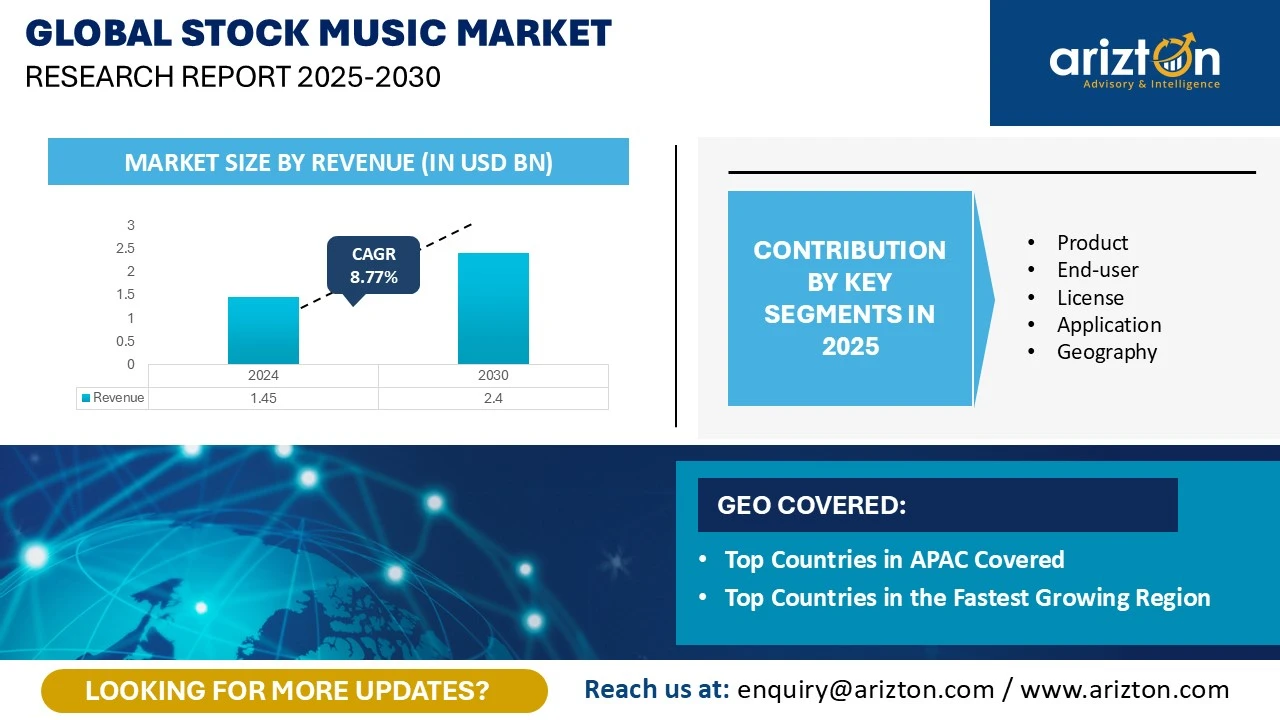
THE GLOBAL STOCK MUSIC MARKET IS VALUED AT USD 1.45 BILLION IN 2024 AND IS EXPECTED TO REACH USD 2.40 BILLION BY 2030, GROWING AT A CAGR OF 8.77%
The Stock Music Market Size, Share, & Trends Analysis Report By
- Product: Track and Sound Effect
- End-User: Large Business, SME, and Individual Content Creators
- License: Licensed and Royalty-Free
- Application: Digital Content, Traditional Media, Corporate Communications, and Others
- Geography: North America, Europe, APAC, Latin America, and Middle East & Africa
Industry Analysis Report, Regional Outlook, Growth Potential, Price Trends, Competitive Market Share & Forecast 2025–2030.
This report includes market data points, ranging from trend
analyses to market estimates & forecasts that you can customize
STOCK MUSIC MARKET REPORT SCOPE
| REPORT ATTRIBUTE | DETAILS |
|---|---|
| Market Size (2030) | USD 2.40 Billion |
| Market Size (2024) | USD 1.45 Billion |
| CAGR (2024-2030) | 8.77% |
| HISTORIC YEAR | 2021-2023 |
| BASE YEAR | 2024 |
| FORECAST YEAR | 2025-2030 |
| SEGMENTS BY | Product, End-User, License, Application, and Geography |
| GEOGRAPHIC ANALYSIS | North America, Europe, APAC, Latin America, and Middle East & Africa |
STOCK MUSIC MARKET SIZE & SHARE
The global stock music market size is valued at USD 1.45 billion in 2024 and is expected to reach USD 2.40 billion by 2030, growing at a CAGR of 8.77% during the forecast period. This growth comes from rising demand for licensed music across digital content, especially in advertising, social media, gaming, and podcasts. Businesses, creators, and agencies increasingly rely on ready-to-use music libraries to speed up production, simplify licensing, and maintain consistent brand sound across platforms.
Stock music has now become a core part of creative workflows. Companies use it to support video campaigns, corporate communications, mobile content, and online tutorials, while creators depend on it for YouTube videos, social posts, and podcasts. This growing reliance is strengthened by large catalogs, searchable libraries, and clear commercial-use licensing that allow both professionals and beginners to find suitable tracks quickly.
The stock music industry is also shaped by the rise of AI-generated and customizable music. These options expand catalog variety and help customers get music that fits their exact tone or timing. Users benefit from faster turnaround, more personalized options, and access to original tracks without traditional production costs.
IMPACT OF US & CHINA TRADE WAR
In 2025, global trade policies affected technology infrastructure more than digital content, yet these changes still produced indirect impacts on the stock music market. The United States increased tariffs on several technology-related imports from China and India, including servers, networking equipment, and IT-support services. While these measures did not target digital licensing or online content platforms, they raised backend infrastructure costs for stock music providers that rely on large cloud libraries to host and deliver audio tracks.
Trade tensions between India and the United States in August 2025 further increased duties on selected IT services. As a result, some technology firms reconsidered outsourcing and support agreements. Stock music platforms that work with Indian partners for tasks such as metadata tagging, AI-assisted music classification, or customer support saw slight cost adjustments and slower vendor negotiations. However, licensing operations, catalog availability, track delivery speeds, and creator onboarding continued normally.
Overall, 2025 trade policies introduced moderate cost pressure on cloud and technical operations, but the core functioning of the global stock music ecosystem remained stable.
STOCK MUSIC MARKET TRENDS & DRIVERS
AI-enhanced music creation is becoming a major catalyst for catalog expansion and creative differentiation. Platforms are increasingly adopting assisted composition tools to generate mood-specific variations, adaptive stems, and genre-consistent tracks at scale. These capabilities strengthen library depth, accelerate production cycles, and unlock fresh creative possibilities for agencies, brands, and independent creators seeking faster turnaround without compromising quality.
Subscription-led access models are redefining customer acquisition and long-term engagement. Bundled plans that combine music, sound effects, and complementary creative tools offer predictable value, simplify procurement, and reduce workflow fragmentation. As enterprises, marketing teams, and creators shift toward consolidated creative ecosystems, subscription adoption continues to rise, supporting stable recurring revenue and stronger retention across global markets.
Growing interest in culturally authentic and region-specific soundscapes is expanding opportunities for diverse composers and global catalog development. Demand for local instruments, regional rhythms, and culturally rooted styles is accelerating across advertising, social media storytelling, and multinational campaigns. Platforms that invest in multicultural catalog representation and collaborate with regional creators are gaining a competitive edge in meeting global content requirements.
Advanced discovery tools and enhanced search intelligence are elevating the user experience across growing music catalogs. AI-supported tagging, contextual audio suggestions, sentiment-led filters, and improved organization help creators identify suitable tracks quickly, reducing search fatigue and improving creative decision-making. These enhancements are becoming central to platform differentiation as catalogs grow and users expect more intuitive navigation.
The rise of independent creators, podcasters, live streamers, and sound-led digital experiences is broadening the customer base for stock music. Growth in short-form video, branded communication, mobile-first content, and immersive app experiences is driving sustained demand for rights-cleared, flexible audio. As brands and creators prioritize consistent sound identity across platforms, stock music becomes an essential component of modern digital production.
INDUSTRY RESTRAINTS
The stock music market faces increasing complexity due to the overwhelming volume of available tracks and sound assets. As libraries expand rapidly, creators often encounter difficulty identifying high-quality, distinctive audio that matches project needs. This oversupply increases discovery time and raises the importance of stronger curation and metadata accuracy.
The growing similarity among widely used stock compositions is creating challenges around differentiation. Repetitive tonal structures, harmonic patterns, and uniform production styles reduce the uniqueness of content produced by brands or creators. This uniformity limits the perceived value of standard libraries and encourages some users to seek more distinctive audio alternatives.
STOCK MUSIC MARKET SEGMENTATION INSIGHTS
INSIGHT BY PRODUCT
The global stock music market by product is segmented into tracks and sound effects. The track segment accounted for the largest market share of over 77%. The segment represents the largest revenue stream in stock music, spanning genres such as corporate pop, cinematic scores, and electronic hybrids. These compositions are widely used in advertising, branded content, film, and creator-driven digital platforms. It is also driven by their suitability for long-form storytelling, promotional videos, branded digital assets, and OTT content. Their structured composition, genre diversity, and professional mix quality make them the preferred choice for creators seeking consistency and emotional continuity across projects.
The market is evolving toward providing complete end-to-end music solutions, with companies delivering branded soundtracks for commercial spaces such as hotels, exhibitions, and retail, while managing licensing, scheduling, updates, and technical operations for convenience.
INSIGHT BY END-USER
Based on the end-user, the small and medium enterprise (SME) accounted for a significant global stock music market share. The growth is supported by the rising need for frequent digital campaigns, explainer videos, and social media communication. Affordable licensing, ready-to-use tracks, and subscription bundles allow SMEs to achieve professional audio identity without commissioning custom compositions.
SMEs prefer intuitive platforms with simple interfaces and localized content. Demand for culturally relevant music is growing in India, China, and Africa, where SMEs need affordable stock tracks in native languages to connect authentically with audiences.
Individual content creators are projected to grow at a CAGR of 10.04% during the forecast period, driven by the surge in YouTube channels, TikTok videos, podcasts, and educational content. Copyright-safe libraries simplified global usage, and creator-focused subscription models encourage steady adoption among vloggers, streamers, and independent filmmakers.
INSIGHT BY LICENSE
By license, the royalty-free music segment shows the fastest-growing CAGR during the forecast period, supported by predictable pricing, global usage flexibility, and the elimination of recurring royalty payments. Royalty-free music has evolved from being associated with low-quality tracks to offering polished, professional-grade catalogs. This shift has made it a credible and cost-effective option for SMEs, creators, and independent producers seeking accessible sound solutions.
Pricing is transparent and scalable, with personal licenses averaging $10–20 and commercial or broadcast use rising to $50–100 or more. This clarity allows small businesses and creators to align budgets with campaign scope.
Free sources like YouTube Audio Library and Free Music Archive continue to challenge paid providers by drawing budget-conscious creators. To compete, commercial platforms emphasize superior quality, advanced search tools, and bundled creative assets.
INSIGHT BY APPLICATION
The global stock music market by application is segregated into digital content, traditional media, corporate communications, and others. The digital content segment dominates and holds the largest share in 2024. Digital content refers to stock music used in creator-led platforms such as YouTube, TikTok, Instagram, and podcasts, where tracks are integrated into vlogs, tutorials, shorts, and livestreams to enhance storytelling, identity, and audience engagement.
Market dynamics show a continuous need for fresh tracks aligned with viral trends, since algorithms on short-form platforms rapidly elevate specific sounds. This cycle pressures libraries to update catalogs frequently with loopable stems and mood-based playlists.
User behavior is defined by frequent publishing schedules, with many creators uploading content daily or weekly. Their priority is securing pre-cleared music that avoids takedowns and enables monetization across multiple channels without legal complexity.
STOCK MUSIC MARKET GEOGRAPHICAL ANALYSIS
North America accounted for the largest share of over 50% of global stock music market revenues in 2024, supported by the presence of major licensing platforms such as Shutterstock, Adobe Stock, Getty Images, and Musicbed. High digital advertising intensity, strong enterprise video production, and a mature creator economy drive consistent licensing demand. Advanced integrations with editing software and cloud-based creative tools streamline music usage across agencies, studios, and corporate teams, reinforcing North America’s position as the largest commercial hub for stock music.
In North America, the US is projected to show significant growth, supported by continuous production of marketing videos, online campaigns, podcasts, and branded content. Agencies, enterprises, and creators rely on licensed libraries for quick turnaround and reliable copyright compliance, making the US the primary revenue contributor in North America.
Asia-Pacific is the fastest-growing region, projected to record a 9.43% CAGR as video, streaming, gaming, and online marketing expand across major countries. High content creation volumes in India, China, and Southeast Asia increase demand for affordable, rights-cleared tracks. Although pricing levels are lower than North America, the region’s large audience base, rising professional content output, and growing awareness of proper licensing make APAC a strong long-term growth engine for the stock music market.
STOCK MUSIC MARKET VENDOR LANDSCAPE
The global stock music market includes leading platforms such as Shutterstock, Getty Images, Envato, Pond5, and Musicbed. Subscription-based providers like Epidemic Sound and Artlist also add to the landscape, creating a consolidated yet diverse competitive environment.
Agencies in the market continue to fall under single artist, community-based, or mass contributor models. A fourth hybrid model has emerged, seen with platforms like Artlist and Epidemic Sound, where AI tagging and human curation combine to accelerate catalog growth and improve user discovery.
Key players differentiate through asset scale, subscription pricing, curated libraries, and contributor engagement. Platforms compete to balance royalty-free access, exclusivity, and premium custom licensing as customer needs evolve toward multi-asset bundles across music, video, and design.
Independent and community-driven platforms strengthen positions by offering curated catalogs and transparent contributor payouts. They also target specialized segments such as cinematic scoring or game-ready soundtracks, catering to professional creators seeking quality over volume in a highly competitive environment.
Groups operating multiple brands expand reach by merging marketplaces and learning platforms. Integrations like Shutterstock–Envato combine stock libraries, education tools, and community networks to secure recurring subscriber bases and global creative relevance.
Licensing clarity, copyright protection, and contributor revenue sharing drive innovation across the market. Platforms enhance search engines, expand AI-driven tools, and invest in personalization features that streamline the process of finding tracks aligned with creative projects.
Epidemic Sound and Artlist maintain strong positions with subscription-only models. They compete through large-scale original catalogs, predictable pricing, and transparent royalty handling, positioning themselves as alternatives to consolidated global platforms.
Recent Developments in the Global Stock Music Market
- Getty Images, which also manages iStock and Unsplash, operates one of the world’s largest commercial visual-media libraries. In January 2025, Getty Images and Shutterstock announced a merger valued at approximately $3.7 billion, creating one of the most extensive combined content platforms in the creative industry.
- Shutterstock completed the acquisition of Envato in July 2024, integrating Envato Elements into its platform and expanding its subscriber base to approximately 1.15 million. Envato’s platform brought a large library of creative assets, including design templates, audio, video, and stock-media content.
- Before acquisition, Envato operated a global marketplace spanning digital assets, templates, audio, and video, supported by its widely used learning platform Envato Tuts+, which serves a large international audience of creators and learners.
- Pond5, acquired by Shutterstock, retained its strong identity as a specialist in stock video and audio stock, supported by over 115,000 contributors across 180 countries and generating about 2.5 million fresh uploads every month into the combined platform.
- Musicbed remains an independent, premium music-licensing platform offering a curated catalog of over 70,000 pre-cleared songs and global licensing reach across 167 countries. It targets filmmakers, advertisers, agencies, and production studios, positioning itself as a high-quality, brand-trusted alternative to generic stock-music libraries.
SNAPSHOT
The global stock music market size is expected to grow at a CAGR of approximately 8.77% from 2024 to 2030.
The following factors are likely to contribute to the growth of the global stock music market during the forecast period:
- Rise of Independent Content Creators
- The Podcast Renaissance
- Audio-based User Experiences Gaining Traction
- Growing Popularity of a Sound Design-first Approach
Base Year: 2024
Forecast Year: 2025-2030
The report considers the present scenario of the global stock music market and its market dynamics for 2025−2030. It covers a detailed overview of several market growth enablers, restraints, and trends. The study covers both the demand and supply sides of the market. It also profiles and analyzes leading companies and several other prominent companies operating in the market.
Key Company Profile
- Shutterstock
- Business Overview
- Product Offerings
- Key Developments
- Key Strategies
- Key Strengths
- Key Opportunities
- Artlist
- Getty Images
- Musicbed
- Epidemic Sound
Other Prominent Company Profiles
- Tribe of Noise
- Business Overview
- Product Offerings
- Media Music Now
- SoundCloud
- 123RF
- Envato
- Audiosocket
- Bensound
- Dreamstime
- FyrFly
- Jamendo
- Motion Array
- Music Vine
- Videvo
- Storyblocks
- Soundsnap
- Earmotion Audio Creation
- Pond5
- YouTube
- Marmoset
- Soundstripe
- Neosounds
- PremiumBeat
- ALIBI Music
- NoCopyrightSounds (NCS)
- Music Rightz
- The Music Case
Segmentation by Product
- Track
- Sound Effect
Segmentation by End-User
- Large Business
- SME
- Individual Content Creators
Segmentation by License
- Licensed
- Royalty-Free
Segmentation by Application
- Digital Content
- Traditional Media
- Corporate Communications
- Others
Segmentation by Geography
- North America
- US
- Canada
- APAC
- China
- Japan
- India
- South Korea
- Australia
- Indonesia
- Philippines
- Taiwan
- Malaysia
- Europe
- Germany
- France
- Russia
- UK
- Italy
- Spain
- Sweden
- Switzerland
- Netherlands
- Middle East & Africa
- Saudi Arabia
- South Africa
- UAE
- Latin America
- Brazil
- Mexico
- Argentina
STOCK MUSIC MARKET FAQs
What are the key trends in the global stock music market?
How big is the global stock music market?
What is the growth rate of the global stock music market?
Who are the major players in the global stock music market?
Which region dominates the global stock music market?
For more details, please reach us at [email protected]
- Chapter 1- Scope & Coverage
- Market Definition
- Inclusion
- Exclusions
- Market Estimation Caveats
- Market Derivation
- Market Segmentation by Product
- Market Segmentation by End-User
- Market Segmentation by License
- Market Segmentation by Application
- Chapter 2- Premium Insights
- Chapter 3- Market Dynamics
- Introduction
- Market Dynamics and Growth Drivers
- Technology, Trends & Licensing
- Expanding Applications of Stock Music
- Impact of The Ongoing Tariff War
- Market Opportunities & Trends
- AI-Crafted Music and Assisted Creation
- Subscription Models and Bundled Creative Access
- Authenticity and Multicultural Music Demand
- Integrated Discovery and Smarter Search Tools
- Market Growth Enablers
- Rise of Independent Content Creators
- The Podcast Renaissance
- Audio-based User Experiences Gaining Traction
- Growing Popularity of a Sound Design-first Approach
- Market Restraints
- Stories without Sound
- Massive Profusion of Choice
- Generic Music Sweeping the Market
- Increasing Interest in Custom Music
- Market Landscape
- Five Forces Analysis
- Chapter 4- Market Segmentation
- Product (Market Size & Forecast: 2021-2030)
- Track
- Sound Effect
- End-User (Market Size & Forecast: 2021-2030)
- Large Business
- SME
- Individual Content Creators
- License (Market Size & Forecast: 2021-2030)
- Licensed
- Royalty-Free
- Application (Market Size & Forecast: 2021-2030)
- Digital Content
- Traditional Media
- Corporate Communications
- Others
- Chapter 5- Geography Segmentation
- Geography Segmentation (Market Size & Forecast: 2021-2030)
- Geographic Overview – Market Maturity Index
- APAC
- China
- Japan
- India
- South Korea
- Australia
- Indonesia
- Philippines
- Taiwan
- Malaysia
- Europe
- Germany
- France
- Russia
- UK
- Italy
- Spain
- Sweden
- Switzerland
- Netherlands
- North America
- US
- Canada
- MIDDLE EAST & AFRICA
- Saudi Arabia
- South Africa
- UAE
- Latin America
- Brazil
- Mexico
- Argentina
- Chapter 6- Competitive Landscape
- Competitive Landscape
- Competition Overview
- Key Developments
- Key Company Profiles
- Other Prominent Company Profiles
- Report Summary
- Key Takeaways
- Strategic Recommendations
Select a license type that suits your business needs
Single User Licence
- Report accessible by one user only
- Free 10% or 3 days of customization
- Free post-sale service assistance
- Continuous support through email
5 User Licence
- Report accessible by 5 users within the organization
- Free 15% or 4.5 days of customization
- Continuous support through email and telephone
- Free analyst hour
- Free Upgrade: If an updated report published within 180 days of purchase, you will get the revised report free of charge
Corporate Licence
- Free Datasheet worth $1500
- Report accessible by the entire organization
- Free 20% or 6 days of customization
- Free post-sale service assistance
- Continuous support through email and telephone
- Direct access to lead analysts
- Free analyst hour
- Free Upgrade: If an updated report published within 180 days of purchase, you will get the revised report free of charge
Datasheet Licence
- Report accessible by 1 user only
- Free 15% or 32 hours of customization
- Free post-sale service assistance
- Direct access to lead analysts
Frequently Asked Questions
What are the key trends in the global stock music market?
How big is the global stock music market?
What is the growth rate of the global stock music market?
Who are the major players in the global stock music market?
Which region dominates the global stock music market?


