




Global Walk Assist Robot Market Research Report 2026-2031
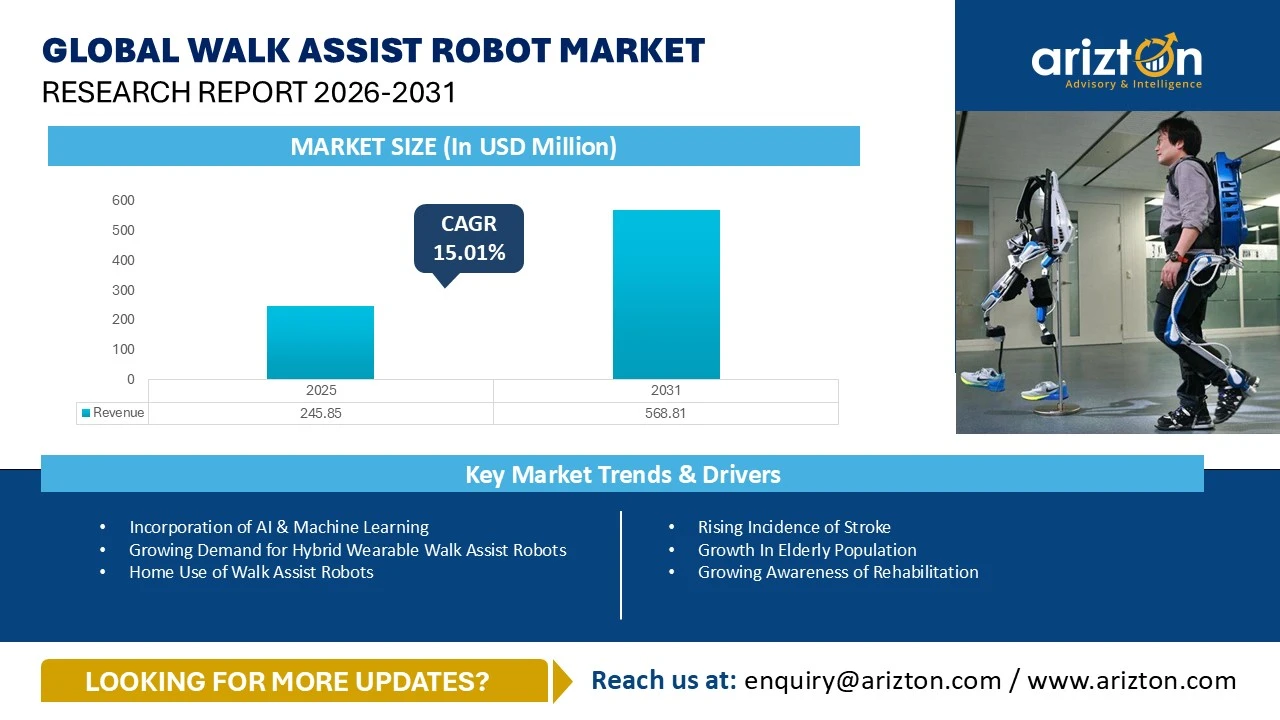
THE GLOBAL WALK ASSIST ROBOT MARKET WAS VALUED AT USD 245.85 MILLION IN 2025 AND IS EXPECTED TO REACH USD 568.81 MILLION BY 2031, GROWING AT A CAGR OF 15.01%.
The Walk Assist Robot Market Size, Share & Trends Analysis Report By
- Product Type: Wearable Exoskeleton, Robot Gait Trainer, and Soft Exosuits
- Application: Neuro- Rehabilitation, Post- Surgical Rehabilitation, and Elderly Mobility Assistance
- End-User: Rehabilitation Center, Hospital, and Home Care Users
- Geography: North America, Europe, APAC, and Rest of the World
Industry Analysis Report, Regional Outlook, Growth Potential, Price Trends, Competitive Market Share & Forecast 2026–2031.
This report includes market data points, ranging from trend
analyses to market estimates & forecasts that you can customize
GLOBAL WALK ASSIST ROBOT MARKET REPORT SCOPE
| REPORT ATTRIBUTE | DETAILS |
|---|---|
| MARKET SIZE (2031) | USD 568.81 Million |
| MARKET SIZE (2025) | USD 245.85 Million |
| CAGR (2025-2031) | 15.01% |
| HISTORIC YEAR | 2022-2024 |
| BASE YEAR | 2025 |
| FORECAST YEAR | 2026-2031 |
| SEGMENTS BY | Product Type, Application, End-User, and Geography |
| GEOGRAPHIC ANALYSIS | North America, Europe, APAC, and Rest of the World |
| KEY PLAYERS | Ekso Bionics, Lifeward, Cyberdyne Inc., DIH Medical, and Ottobock SE & Co. KGaA |
WALK ASSIST ROBOT MARKET ANALYSIS
The global walk assist robot market was valued at USD 245.85 million in 2025 and is projected to reach USD 568.81 million by 2031, growing at a CAGR of 15.01% during the forecast period. Market growth is primarily driven by the rapidly ageing population, which is contributing to a higher prevalence of neurological disorders such as stroke, Parkinson's disease, and spinal cord injuries. Rising awareness of structured rehabilitation programs following surgery, along with increasing adoption of robotic mobility solutions in rehabilitation centers, is further accelerating demand. In addition, continuous advancements in artificial intelligence (AI), sensor technologies, lightweight materials, and growing healthcare investments across emerging economies are expected to support long-term market expansion.
KEY TAKEAWAYS
- By Product Type: The wearable exoskeleton segment accounted for the largest market share in 2025.
- By Application: Post-surgical rehabilitation is projected to register the fastest growth, with a CAGR of 15.18% during the forecast period.
- By End User: Rehabilitation centers remain the leading end-user segment.
- By Region: North America dominated the global market, accounting for over 39% of revenue in 2025.
WALK ASSIST ROBOT MARKET DEMAND & INVESTMENT OPPORTUNITY
The investment outlook for the walk assist robot market remains strong as several long-term healthcare and demographic trends continue to expand the addressable market.
Government-backed rehabilitation initiatives across North America, Europe, and Asia-Pacific are increasing investments in neurological rehabilitation, elderly care, and veteran support programs. Public healthcare agencies and organizations such as the WHO are encouraging the adoption of robotic mobility technologies to improve rehabilitation outcomes.
Growing demand for stroke recovery and post-surgical rehabilitation is another major growth driver. The increasing number of orthopedic procedures, including hip and knee replacements, has created sustained demand for robotic gait training solutions that support early mobility and faster recovery.
Healthcare infrastructure development across emerging economies, including China, India, Brazil, the UAE, and Saudi Arabia, is further creating procurement opportunities for hospitals and specialized rehabilitation centers investing in advanced mobility technologies.
Industry consolidation through strategic partnerships, acquisitions, and regulatory approvals is also strengthening market confidence. Companies such as Ekso Bionics, Cyberdyne Inc., and Lifeward Ltd. continue to expand their clinical presence through new rehabilitation partnerships, product approvals, and broader institutional adoption.
WALK ASSIST ROBOT MARKET TRENDS
Integration of AI and Machine Learning
Artificial intelligence and machine learning are transforming walk assist robots by making rehabilitation more adaptive, personalized, and efficient. Modern systems can analyze patient movement in real time, automatically adjust assistance levels, optimize gait patterns, and provide data-driven rehabilitation programs. Compared with earlier robotic systems that relied on fixed control mechanisms, AI-enabled devices improve clinical outcomes, enhance patient safety, and support wider adoption across rehabilitation facilities and home-care environments.
Growing Adoption of Hybrid Wearable Walk Assist Robots
Hybrid wearable walk assist robots are gaining popularity as they combine rigid structural components that deliver strength and stability with soft, flexible materials that improve comfort and natural movement. This combination enhances usability during long rehabilitation sessions while expanding applications beyond hospitals into home rehabilitation and daily mobility assistance.
MARKET DRIVERS
Rising Incidence of Stroke
The increasing prevalence of stroke remains one of the strongest drivers for the walk assist robot market. Stroke is a leading cause of long-term disability and frequently results in impaired gait, muscle weakness, and balance disorders. Robotic gait training systems and wearable exoskeletons provide repetitive, task-oriented rehabilitation that helps patients regain walking ability more effectively, increasing adoption across acute and post-acute rehabilitation settings.
Growing Elderly Population
Rapid population ageing continues to expand demand for robotic mobility solutions worldwide. Older adults commonly experience reduced muscle strength, joint degeneration, balance impairment, arthritis, and neurological conditions that limit mobility. Walk assist robots help elderly individuals maintain independence, reduce fall risks, and improve quality of life while also lowering the physical burden on caregivers and healthcare professionals. As life expectancy increases globally, demand is expected to continue rising across hospitals, rehabilitation centers, and home-care settings.
INDUSTRY RESTRAINTS
High Purchase & Operating Costs
High purchase and operating costs are a principal restraint for walk-assist robots, limiting adoption by hospitals & rehabilitation clinics. Typical powered medical exoskeletons and advanced treadmill-based gait trainers has high upfront price. High device cost restricts sales of the walk assist as constrained capital expenditure budgets delay or eliminate purchases by smaller clinics. Uncertain reimbursement makes the business case weak; hospitals hesitate to buy devices without clear payback.
WALK ASSIST ROBOT MARKET SEGMENTATION INSIGHTS
By Product Type
The market is segmented into wearable exoskeletons, robot gait trainers, and soft exosuits.
Wearable exoskeletons accounted for the largest market share in 2025, supported by their proven clinical effectiveness in improving walking speed, lower-limb strength, balance, and overall quality of life for patients recovering from stroke and spinal cord injuries. Their portability, ease of use, and ability to support both rehabilitation therapy and personal mobility have made them the preferred choice among hospitals and rehabilitation centers. Advances in battery technology, lightweight materials, and AI-based motion control are further expanding their adoption into home-based rehabilitation.
By Application
The post-surgical rehabilitation segment is expected to register the highest CAGR of 15.18% during the forecast period.
Walk assist robots are increasingly used following orthopedic procedures such as hip replacement, knee replacement, and spinal surgeries, where structured gait rehabilitation is essential for recovery. These systems facilitate early, guided mobilization while promoting correct walking patterns, reducing muscle weakness, joint stiffness, and post-operative complications. Growing surgical volumes, ageing populations, and healthcare providers' focus on reducing hospital stays are accelerating adoption in this segment.
By End User
Rehabilitation centers represent the largest end-user segment in the global market.
These facilities provide long-term therapy for patients recovering from stroke, spinal cord injuries, traumatic brain injuries, and other neurological disorders requiring intensive gait training. Robotic systems enable repetitive, standardized therapy while reducing physical strain on therapists and allowing clinicians to monitor patient progress through real-time performance data. Increasing numbers of stroke survivors, ageing populations, and growing patient volumes continue to strengthen demand within rehabilitation centers.
WALK ASSIST ROBOT MARKET GEOGRAPHICAL ANALYSIS
North America accounted for the largest market share, contributing more than 39% of global revenue in 2025. Market growth is driven by an ageing population, increasing prevalence of lower-body mobility disorders, high healthcare spending, and early adoption of advanced medical technologies. Hospitals and rehabilitation centers are increasingly adopting robotic rehabilitation systems to improve patient outcomes while addressing workforce shortages and rising healthcare costs. The United States remains the region's largest market, supported by favorable reimbursement initiatives, strong rehabilitation infrastructure, and extensive veterans' rehabilitation programs.
Europe continues to experience steady market growth due to its ageing population, expanding rehabilitation requirements, and strong collaboration between research institutions and healthcare providers. Wearable exoskeletons and robotic gait trainers are widely used for neurological rehabilitation following stroke and spinal cord injuries, supported by growing investments in rehabilitation technologies.
The Asia-Pacific market is expected to witness robust growth during the forecast period, driven by rapidly ageing populations, increasing rehabilitation needs, and substantial investments in healthcare robotics. Countries such as Japan, China, South Korea, and Singapore are experiencing significant demographic shifts, resulting in growing demand for assistive mobility technologies. Government support, expanding healthcare infrastructure, and increasing awareness of robotic rehabilitation are expected to further accelerate market adoption across the region.
WALK ASSIST ROBOT MARKET VENDOR LANDSCAPE
The global walk assist robot market is moderately competitive, with a combination of established medical robotics companies and specialized wearable exoskeleton developers.
Leading companies, including Lifeward Ltd., Ekso Bionics, Cyberdyne Inc., Ottobock SE & Co. KGaA, and DIH Medical, collectively account for a significant share of the global market.
Among these, Lifeward Ltd. holds the leading position, driven by the widespread adoption of its ReWalk powered exoskeleton system, which enables individuals with spinal cord injuries to stand, walk, and climb stairs. Regulatory approvals and increasing adoption across rehabilitation institutions have further strengthened the company's market leadership.
Ekso Bionics also maintains a strong market presence through its portfolio of FDA-cleared robotic exoskeleton systems used in stroke and spinal cord rehabilitation. Strategic partnerships with rehabilitation centers, continuous product innovation, and the development of advanced gait-training technologies continue to enhance the company's competitive position in the global market.
SNAPSHOT
The global walk assist robot market size is expected to grow at a CAGR of approximately 4.40% from 2025 to 2031.
The following factors are likely to contribute to the growth of global walk assist robot market during the forecast period:
- Rising Incidence of Stroke
- Growth In Elderly Population
- Growing Awareness of Rehabilitation
Base Year: 2025
Forecast Year: 2026-2031
The report examines the current state of the global walk assist robot market and its market dynamics through 2026−2031. It covers a detailed overview of several market growth enablers, restraints, and trends. The study covers both the demand and supply sides of the market. It also profiles and analyses leading companies and several other prominent companies operating in the market.
Key Company Profiles
- Ekso Bionics
- Business Overview
- Product Offerings
- Key Developments
- Key Strategies
- Key Strengths
- Key Opportunities
- Lifeward
- Cyberdyne Inc.
- DIH Medical
- Ottobock SE & Co. KGaA
Other Prominent Company Profiles
- Bionik Laboratories
- Business Overview
- Product Offerings
- Rex Bionics
- Wandercraft
- Tyromotion GmbH
- Toyota Motor Corp
- ExoAtlet
- Wearable Robotics
- Gogoa Mobility
- Panasonic Corp
- B-Temia Inc.
- Bionic Power Inc.
- Angel Robotics
- Axosuits
- BAMA Technology
- Biomotum Inc.
- Bioservo AB
- Marsi Bionics
- Fourier Intelligence
- FREE Bionics Inc
- BTL Robotics
- Hexar Humancare
- Human in Motion
- InteSpring B.V.
Segmentation by Product Type
- Wearable Exoskeleton
- Robot Gait Trainer
- Soft Exosuits
Segmentation by Application
- Neuro- Rehabilitation
- Post- Surgical Rehabilitation
- Elderly Mobility Assistance
Segmentation by End-User
- Rehabilitation Center
- Hospital
- Home Care Users
Segmentation by Geography
- APAC
- China
- Japan
- South Korea
- Australia
- India
- New Zealand
- Singapore
- Europe
- Germany
- UK
- France
- Italy
- Spain
- Netherlands
- Nordics
- Switzerland
- North America
- U.S.
- Canada
- Rest of the World
GLOBAL WALK ASSIST ROBOT MARKET FAQs
How big is the global walk assist robot market?
Who are the major players in the global walk assist robot market?
What are the growth trends in the global walk assist robot market?
Which region dominates the global walk assist robot market?
What is the growth rate of the global walk assist robot market?
For more details, please reach us at [email protected]
1. SCOPE & COVERAGE
- Market Definition
- Inclusions
- Exclusions
- Market Estimation Caveats
- Market Size & Forecast Periods
- Historic Period: 2022-2024
- Base Year: 2025
- Forecast Period: 2026-2031
- Market Size (2022-2031)
- Revenue
- Market Segments
- Market Segmentation by Product Type
- Market Segmentation by Application
- Market Segmentation by End-User
2.OPPORTUNITY POCKETS
- Key Market Highlights
- Regional Insights
3. MARKET DYNAMICS
- Introduction
- Market Opportunities & Trends
- Incorporation of AI & Machine Learning
- Growing Demand for Hybrid Wearable Walk Assist Robots
- Home Use of Walk Assist Robots
- Market Growth Enablers
- Rising Incidence of Stroke
- Growth In Elderly Population
- Growing Awareness of Rehabilitation
- Market Restraints
- High Purchase & Operating Costs
- Supply Chain Challenges Due to Geopolitical Situation
- Regulatory Hurdles
- Market Landscape
3. MARKET SEGEMENTATION
- Product Type (Market Size & Forecast: 2022-2031)
- Wearable Exoskeleton
- Robot Gait Trainer
- Soft Exosuits
- By Application (Market Size & Forecast: 2022-2031)
- Neuro- Rehabilitation
- Post- Surgical Rehabilitation
- Elderly Mobility Assistance
- By End-User (Market Size & Forecast: 2022-2031)
- Rehabilitation Center
- Hospital
- Home Care Users
5. GEOGRAPHICAL SEGMENTATION
- North America
- Europe
- APAC
- Rest of World
6. COMPETITIVE LANDSCAPE
- Competitive Overview & Market Share
- Key Company Profiles
- Ekso Bionics
- Lifeward
- Cyberdyne Inc
- DIH Medical
- Ottobock SE
- Other Prominent Company Profiles
- Bionik Laboratories
- Rex Bionics
- Wandercraft
- Tyromotion
- Toyota Motor Corporation
- ExoAtlet
- Wearable Robotics
- GoGoa Mobility
- Panasonic Corporation
- B-Temia
- Bionic Power INC
- Angel Robotics
- Axosuits
- Bama Technology
- Biomotum
- Bioservo AB
- Marsi Bionics
- Fourier Intelligence
- Free Bionics
- BTL Robotics
- Hexar Humancare
- Human In Motion
- Interspring B.V.
- Report Summary
- Key Takeaways
- Strategic Recommendations
Select a license type that suits your business needs
Single User Licence
- Report accessible by one user only
- Free 10% or 3 days of customization
- Free post-sale service assistance
- Continuous support through email
5 User Licence
- Report accessible by 5 users within the organization
- Free 15% or 4.5 days of customization
- Continuous support through email and telephone
- Free analyst hour
- Free Upgrade: If an updated report published within 180 days of purchase, you will get the revised report free of charge
Corporate Licence
- Free Datasheet worth $1500
- Report accessible by the entire organization
- Free 20% or 6 days of customization
- Free post-sale service assistance
- Continuous support through email and telephone
- Direct access to lead analysts
- Free analyst hour
- Free Upgrade: If an updated report published within 180 days of purchase, you will get the revised report free of charge
Datasheet Licence
- Report accessible by 1 user only
- Free 15% or 32 hours of customization
- Free post-sale service assistance
- Direct access to lead analysts
Frequently Asked Questions
How big is the global walk assist robot market?
Who are the major players in the global walk assist robot market?
What are the growth trends in the global walk assist robot market?
Which region dominates the global walk assist robot market?
What is the growth rate of the global walk assist robot market?
Other RELATED Reports


Orthopedic Splints and Casts Market - Global Outlook & Forecast 2022-2027
Published : February 2023