Battery Separator Market: From $8B to $17B - What's Driving the Surge
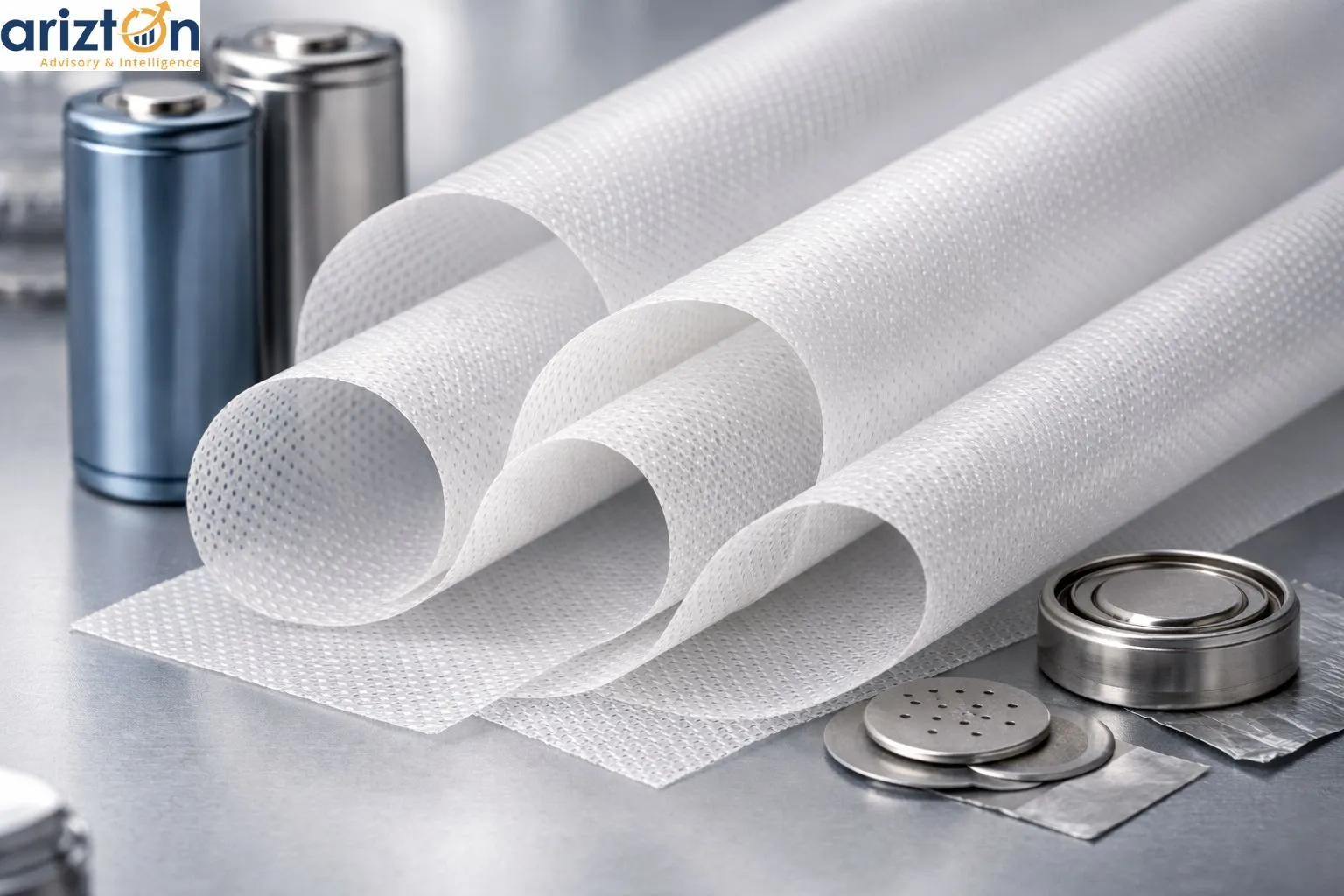
Battery separators are becoming an increasingly important component in the lithium-ion battery supply chain as electric vehicles and energy storage deployments expand worldwide. As batteries move toward higher energy density, faster charging, and stronger safety requirements, separator performance is playing a larger role in overall battery reliability and efficiency.
The global battery separator market was valued at USD 8.00 billion in 2025 and is projected to reach USD 17.15 billion by 2031, growing at a CAGR of 13.55% as per Arizton recent research. This growth reflects rising demand for advanced battery materials, where manufacturing quality, material stability, and consistent performance are becoming key competitive factors for suppliers.
Battery Separators Emerge as a Critical Layer in the EV Battery Supply Chain
Electric vehicle adoption is rapidly increasing demand for battery separators as global battery production scales to support new EV platforms and energy storage systems. Battery manufacturers are prioritizing suppliers that can deliver high-volume output, consistent quality, and reliable performance. At the same time, next-generation batteries designed for faster charging and higher energy density are raising performance expectations for separators. The shift toward nickel-rich cathodes and silicon-based anodes is also increasing internal cell stress, driving greater demand for coated and reinforced separator materials. As the market evolves, manufacturing scale, process control, and material engineering are becoming key competitive advantages, making separator technology a critical part of the global EV battery supply chain.
Lithium-Ion Batteries Continue to Anchor Global Separator Demand
Lithium-ion batteries account for more than 65% of global separator demand, driven largely by the rapid expansion of electric vehicles and grid-scale energy storage. But the opportunity for separator suppliers is no longer just about volume. As automakers move toward higher energy density, faster charging, and longer battery life, the performance requirements for separators are increasing significantly. Large-format EV cells now require separators with strong thermal stability, precise thickness control, and consistent pore structures to maintain safety and efficiency at scale. As a result, battery manufacturers are placing greater emphasis on material reliability and manufacturing consistency, creating a clear advantage for separator suppliers that can deliver high-performance materials with scalable production.
Customization of Battery Separators Becomes Critical for Next-Generation Cells
As lithium-ion batteries move toward higher energy density and faster charging, separator design is becoming more application-specific. Thinner separators help improve battery performance while maintaining the mechanical strength required for compact and high-pressure cell designs. At the same time, thickness and porosity must be carefully balanced to support stable ion flow and structural stability. More uniform pore structures also help reduce risks such as lithium plating during fast charging. As battery technologies evolve, precision manufacturing, stronger puncture resistance, and tighter dimensional control are becoming increasingly important, making high-performance separators a critical component in next-generation EV and energy storage batteries.
Coated and Multilayer Separators Gain Importance as Battery Safety Standards Tighten
Stricter battery safety standards are accelerating the adoption of coated and multilayer separator technologies across the battery industry. As EV batteries become larger and more energy-dense, separators must deliver greater thermal stability and stronger protection against internal short circuits. Ceramic-coated and multilayer designs are gaining traction because they improve safety under high-stress operating conditions and support tighter global testing requirements. As a result, these advanced separator technologies are emerging as an important differentiator in the market, shaping supplier selection and the next phase of battery design.
APAC Strengthens Its Leadership in the Battery Separator Market
Asia-Pacific accounts for around 55% of the global battery separator market, supported by its deep integration across the EV and battery manufacturing ecosystem.
China continues to expand large-scale separator production alongside rapid battery capacity growth, creating strong demand across multiple cell formats. At the same time, Japan and South Korea maintain a competitive edge through advanced film engineering, coating technologies, and high-precision manufacturing.
As EV batteries move toward higher energy density and stricter safety standards, separator performance requirements are increasing, particularly around thermal stability, puncture resistance, and defect control. This combination of manufacturing scale and technical expertise continues to reinforce APAC’s leadership in high-performance separator production.
Leading Manufacturers and Strategic Investments in the Battery Separator Market
The battery separator market remains relatively concentrated, led by Semcorp, Asahi Kasei, and SK ie technology, which benefit from large-scale production and long-standing approvals with major battery cell manufacturers. Because separators play a critical role in battery safety, suppliers that are already qualified tend to retain volumes as new EV and energy storage capacity expands.
Competition is also shifting toward coated and advanced separators, where safety, durability, and long cycle life are essential requirements. Recent strategic developments highlight growing investment in performance-focused separator technologies.
- In December 2025, Kingswood Capital Management acquired Daramic from Asahi Kasei, strengthening Daramic’s position as a focused supplier of lead-acid battery separators for automotive and industrial markets.
- In September 2025, I Squared Capital acquired a majority stake in Entek to support the reshoring of battery manufacturing in the United States, enabling the company to expand domestic separator production and support localized battery supply chains.
Further insights and detailed forecasts are available in the full report