Thailand's Elevator Market Is Expanding - Here's Where Growth Is Heading Next
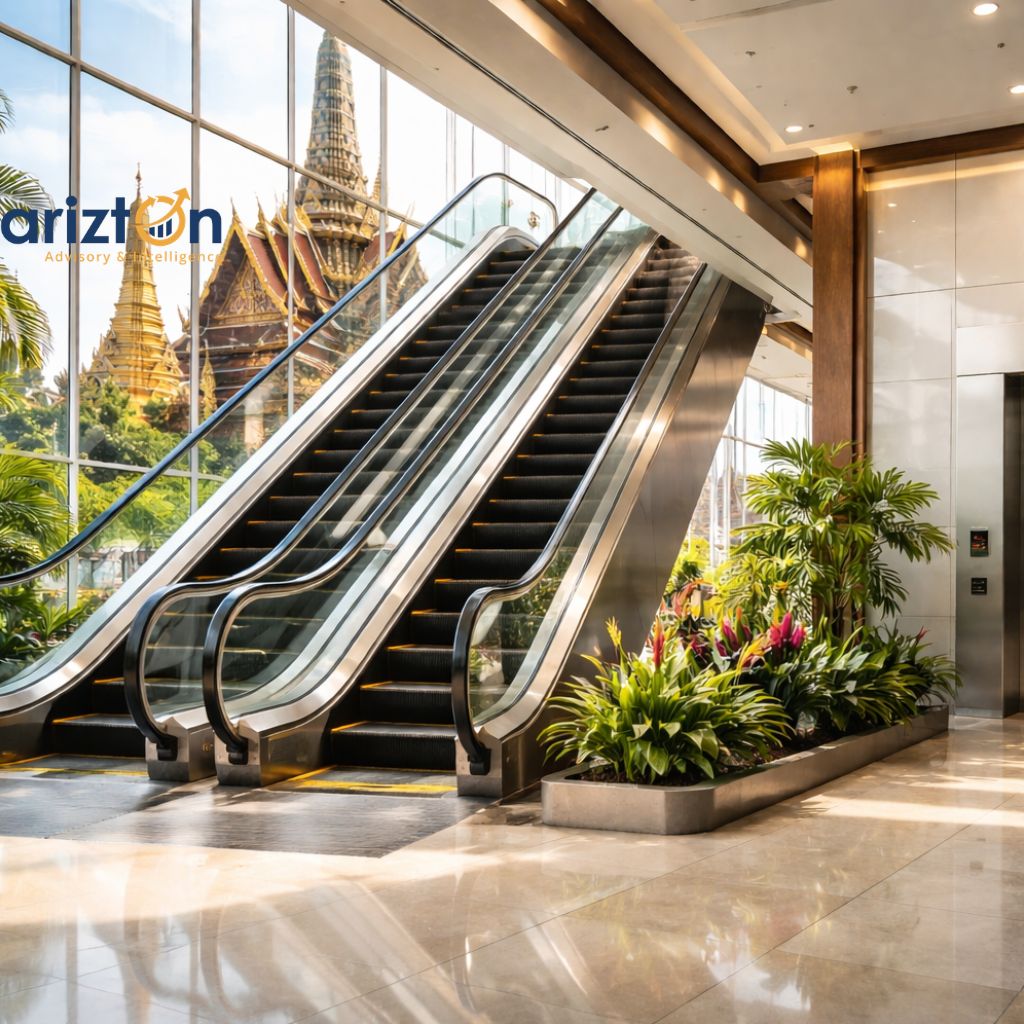
The Thailand elevator and escalator market is entering a new growth phase as urban density increases, and infrastructure investment expands across the country. Rising high-rise building construction in Thailand, mixed-use developments, and new digital infrastructure projects are changing how modern buildings are designed and operated.
As cities grow vertically, the Thailand vertical transportation market is becoming increasingly important to support efficient mobility, smarter buildings, and complex urban environments.
Recent insights from Arizton show that construction expansion, technology adoption, and digital infrastructure investments are shaping the next stage of growth in the Thailand elevator market.
Tap Into High-Growth Opportunities in Thailand’s Elevator and Escalator Market
How Big is the Thailand Elevator and Escalator Market?
The Thailand elevator and escalator market is growing steadily as construction activity increases across major cities. According to Arizton research, the market recorded 7.43 thousand elevator installations in 2025 and is expected to reach 8.97 thousand units by 2031.
Growth is mainly driven by residential towers, commercial buildings, and mixed-use developments across the country. Passenger elevators account for the majority of installations, supported by strong Bangkok real estate development and expanding commercial infrastructure.
For manufacturers and technology providers, Thailand remains one of the most stable and steadily growing vertical mobility markets in Southeast Asia.
Machine-Room-Less Elevators Are Becoming the Preferred Choice
One of the key shifts in the Thailand elevator market is the rising adoption of machine-room-less (MRL) elevators. Developers increasingly prefer these systems because they remove the need for a separate machine room, helping save space and improve energy efficiency.
MRL elevators are widely used in mid-rise residential buildings and commercial developments, where efficient use of building space is important.
This trend is also increasing demand for 2–15-person capacity elevators, which are commonly installed in condominium projects and mid-rise commercial buildings.
Smart Monitoring and AI Are Transforming Elevator Operations
Digital technologies are beginning to reshape elevator operations across Thailand. Manufacturers are introducing AI-enabled monitoring systems, cloud platforms, and IoT-based maintenance solutions that allow operators to track elevator performance in real time and detect issues early.
Companies such as KONE, Otis, Schindler, and Mitsubishi Electric are expanding smart elevator solutions designed to improve safety, reduce downtime, and manage building traffic more efficiently.
As a result, elevator modernization and digital maintenance services are emerging as important growth opportunities in the market.
Digital Infrastructure Investments Are Creating New Demand
Thailand’s expanding digital economy is creating new opportunities for the vertical transportation market. Large technology campuses and hyperscale data centers require advanced building infrastructure, including smart building elevators and efficient vertical mobility systems.
Major global technology companies such as Amazon, Google, Microsoft, and TikTok are increasing digital infrastructure investments across the country.
In January 2026, the Thailand Board of Investment approved $3.1 billion in new data center projects, including developments from True Internet Data Center, GSA Data Center, Stellar DC, and Freyr Technology.
These developments show how digital infrastructure is becoming an important new demand driver for elevators and other advanced building systems.
How Will Urban Development Shape Future Elevator Demand?
Thailand’s urban development strategy increasingly focuses on transit-oriented development and smart city planning. Cities such as Bangkok and Chiang Mai are expanding high-density districts around transportation networks, increasing the need for efficient vertical mobility systems.
At the same time, large infrastructure projects within the Eastern Economic Corridor are accelerating construction activity. A THB 1.34 trillion smart city development in Chonburi is expected to stimulate significant residential, commercial, and infrastructure development, further strengthening long-term demand for elevators and escalators.
What Could Shape the Next Phase of Market Growth?
As Thailand’s cities continue to expand vertically, the Thailand elevator and escalator market is gradually evolving beyond traditional installations. Future growth will likely be shaped by modernization demand, smart elevator technologies, and large-scale infrastructure investments, positioning Thailand as a key vertical mobility market in Southeast Asia.