
Thailand Elevator and Escalator Market - Size & Growth Forecast 2026-2031


122 pages

16 company

6 segments

1 region

1 countries
Purchase Options
Thailand Elevator and Escalator Market - Size & Growth Forecast 2026-2031
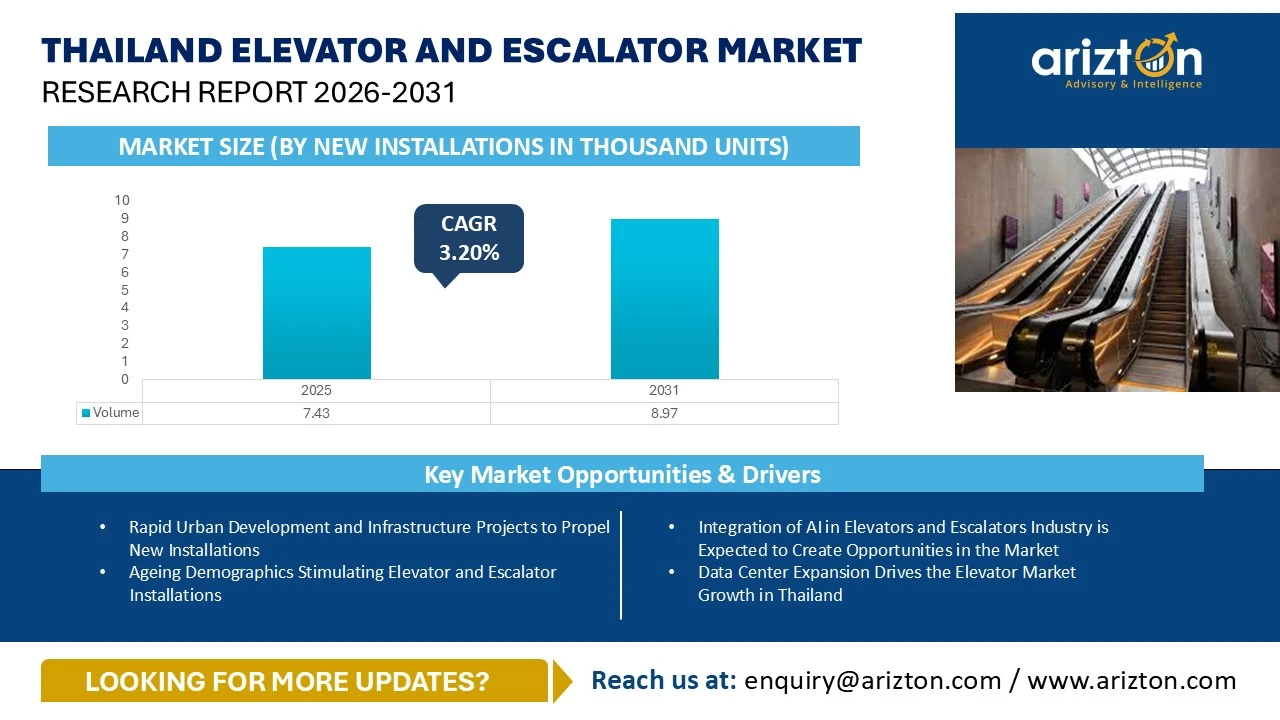
THE THAILAND ELEVATOR AND ESCALATOR MARKET SIZE BY NEW INSTALLATIONS WAS VALUED AT 7.43 THOUSAND UNITS IN 2025 AND IS EXPECTED TO REACH 8.97 THOUSAND UNITS BY 2031, GROWING AT A CAGR OF 3.20% FROM 2025-2031.
Thailand Elevator and Escalator Market Size (Volume)
- Installation Base
- New Installation Type
- Modernization (In Million)
- Maintenance (In Million)
Thailand Elevator Market Size (Volume)
- Installation Base
- New Installation Type
- Modernization & Maintenance (In Million)
Thailand Escalator Market Size by Volume
- Installation Base
- New Installation Type
- Modernization & Maintenance (In Million)
Thailand Elevator and Escalator Size, Share, & Trends Analysis Report by
Elevator Market Segmentation
- Machine Type: Hydraulic and Pneumatic, Machine Room Traction, Machine Room Less Traction, and Others (Climbing Elevators and Industrial Elevators)
- Carriage Type: Passenger and Freight
- Capacity: 2-15 Persons, 16-24 Persons, 25-33 Persons, and 34 Persons and Above
- End-User: Commercial, Residential, Industrial, and Others (Public Transit, Institutional, and Infrastructural)
Escalator Market Segmentation
- Product Type: Parallel, Multi Parallel, Moving Walkway, and Crisscross
- End-User: Public Transit, Commercial, and Others (Institutional Sector, Infrastructure & Industrial)
The Industry Analysis Report Provides Industry Trends, Drivers, Opportunities, Competitive Outlook, Industry Size, Sales, and Growth Forecast for 2026-2031
This report includes market data points, ranging from trend
analyses to market estimates & forecasts that you can customize
THAILAND ELEVATOR AND ESCALATOR MARKET REPORT SCOPE
| REPORT ATTRIBUTE | DETAILS |
|---|---|
| MARKET SIZE BY NEW INSTALLATIONS (2031) | 8.97 Thousand Units |
| MARKET SIZE BY NEW INSTALLATIONS (2025) | 7.43 Thousand Units |
| CAGR - NEW INSTALLATIONS (2025-2031) | 3.20% |
| MARKET SIZE BY INSTALLED BASE (2031) | 171.93 Thousand Units |
| MARKET SIZE BY MODERNIZATION (2031) | USD 68.71 Million |
| HISTORIC YEAR | 2022-2024 |
| BASE YEAR | 2025 |
| FORECAST YEAR | 2026-2031 |
| SEGMENTATION BY CARRIAGE TYPE | Passenger and Freight |
| SEGMENTATION BY CAPACITY | 2-15 Persons, 16-24 Persons, 25-33 Persons, and 34 Persons and Above |
| SEGMENTATION BY END-USER | Commercial, Residential, Industrial, and Others |
| SEGMENTATION BY MACHINE TYPE | Hydraulic and Pneumatic, Machine Room Traction, Machine Room Less Traction, and Others |
| KEY VENDORS | Otis, KONE, TK Elevator, Schindler, Mitsubishi Electric, Hitachi, Hyundai Elevator, and Fujitec |
THAILAND ELEVATOR AND ESCALATOR MARKET SIZE & OVERVIEW
The Thailand elevator and escalator market size by new installations was valued at 7.43 thousand units in 2025 and is expected to reach 8.97 thousand units by 2031, growing at a CAGR of 3.20% from 2025 to 2031. Rise in urbanization and construction industry growth significantly contributes demand for elevators & escalators in the Thailand market.
The Thailand elevator and escalator market has witnessed a steady demand in recent years, supported by sustained urbanization, continued expansion of commercial infrastructure, and ongoing redevelopment activity in key economic zones.
Market performance over the forecast period is likely to be influenced by the stability of public and private sector capital spending, the expansion and strengthening of service networks, and suppliers’ capacity to balance cost competitiveness with system reliability, safety standards, and long-term lifecycle value.
The competitive structure of the Thai market is tiered, largely based on technological capability, brand positioning, and service infrastructure. Low-cost Chinese manufacturers are entering the Thailand elevator industry and still hold less 10% of the overall market.
Despite favorable demand fundamentals, the market faces structural challenges. Pricing pressure remains elevated, particularly in entry-level and mid-market segments, constraining margin expansion. After-sales service capability continues to represent a key competitive differentiator but requires sustained investment in technical personnel, spare parts logistics, and nationwide coverage.
Regulatory compliance related to periodic inspections and certification increases operating complexity. In addition, shortages of skilled technicians present capacity constraints as system complexity increases.
MARKET DRIVERS & OPPORTUNITIES
Rapid Urban Development and Infrastructure Projects to Propel New Installations
- Rapid urban development and large-scale infrastructure expansion across Thailand significantly reshape urban landscapes and accelerate demand for elevators and escalators as essential elements of modern buildings.
- The urbanization approach by the country increasingly prioritizes transit-oriented development (TOD), with compact, mixed-use districts clustered around mass-transit corridors to improve mobility and ease congestion in major cities such as Bangkok and Chiang Mai.
- Beyond development in the capital, the rapid expansion of the Eastern Economic Corridor is also fueling demand, particularly with the development of a THB 1.34 trillion ($32 billion) smart city in Chonburi.
Ageing Demographics Stimulating Elevator and Escalator Installations
- Thailand is undergoing a significant demographic transformation marked by declining birth rates and a rapidly expanding elderly population, officially entering a “fully aged society” in 2024.
- One of the most immediate effects of population ageing is the growing need for barrier-free movement within buildings. As physical mobility declines with age, stairs and steep ramps become major obstacles, particularly in multi-storey condominiums, hospitals, shopping centres, and government facilities.
- The ageing population has also reshaped public transport and urban infrastructure planning. New rail stations, intermodal terminals, and mass-transit extensions are now designed with integrated elevators and escalators to ensure seamless movement between platforms, concourses, and surrounding developments.
Integration of AI in Elevators and Escalators Industry is Expected to Create Opportunities in the Market
- The growing adoption of AI presents a major opportunity for the Thai elevator and escalator market, particularly as the country continues to invest in urban development, infrastructure modernization, and smart-city initiatives.
- Leading international manufacturers operating in Thailand, including KONE, Otis, Schindler, and Mitsubishi Electric, actively leverage this opportunity by introducing AI-driven platforms integrated with cloud and IoT technologies.
- In September 2025, Otis launched the Arise MOD Prime and Arise MOD Plus modernization solutions, enabling phased upgrades of aging elevators. This approach is particularly relevant in Thailand, where many commercial and residential buildings require modernization but face budget constraints.
Data Center Expansion Drives the Elevator Market Growth in Thailand
- The transformation of Thailand into a leading regional center for data storage and cloud computing is opening substantial new opportunities for growth in the elevator and escalator industry of the country.
- Global technology leaders such as Amazon, Google, Microsoft, and TikTok continue to make significant investments in digital infrastructure.
- The appeal by Thailand as a preferred destination for data centers is reinforced by its central location in Southeast Asia, relatively low electricity costs, extensive fiber-optic connectivity, skilled technical workforce, and strong policy support.
- Furthermore, in January 2026, the BOI approved major projects worth $3.1 billion by companies such as True Internet Data Center, GSA Data Center, Stellar DC, and Freyr Technology.
INDUSTRY RESTRAINTS
High Installation and Maintenance Costs
- The high installation and maintenance costs associated with elevators and escalators represent a significant structural restraint to their widespread adoption and modernization in the building sector in Thailand.
- Initial installation costs for elevators in Thailand remain high due to the need for specialized equipment, imported components, customized shaft construction, safety systems, and skilled technical labor.
- In Thailand’s tropical climate, high humidity, dust, and temperature fluctuations accelerate wear and corrosion, increasing the frequency of repairs and part replacements.
- Older buildings in Bangkok and provincial urban centers face particularly high financial burdens. Aging elevators require extensive modernization to comply with updated safety and energy-efficiency standards.
The Real Estate Slump in Thailand Impacts Elevator And Escalator Demand
- The prolonged downturn in the real estate sector of Thailand as of 2026 has emerged as a significant structural constraint on demand for elevators and escalators, representing the most severe housing market contraction since the 1997 financial crisis.
- A key indicator of this slowdown is the rapid accumulation of unsold housing stock, which has become a substantial financial burden for developers.
- The underlying causes of this downturn can be traced to the aggressive expansion strategies adopted during the prolonged low-interest-rate period following the COVID-19 pandemic.
- The growing stock of vacant housing has also reinforced this crisis. In 2025, the Thai Real Estate Research and Valuation Center reported that more than 1.64 million completed housing units nationwide were unoccupied or minimally used, with a combined value of THB 3.45 trillion ($11 billion).
THAILAND ELEVATOR AND ESCALATOR MARKET SEGMENTATION INSIGHTS
Elevator
- Machine-room-less (MRL) elevators accounted for one of the largest shares of the elevator market among the different machine types (hydraulic, pneumatic, machine room traction and others), representing major share in total installations in 2025. The segment is expected to witness steady growth over the forecast period, with new installations, expanding at a CAGR of 3.48%.
- MonoSpace DX machine room-less elevator from KONE is a machine room-less elevator for mid-rise and low-rise buildings with connectivity, improved people flow, and an inspiring elevator experience. Powered by the compact, energy-efficient KONE EcoDisc hoisting motor, the KONE MonoSpace DX is eco-friendly, and it saves valuable space in a building by completely removing the need for a machine room.
- In the carriage type segment, passenger elevators accounted for the largest share of the market in 2025. This dominance is primarily attributed to the high demand for vertical transportation in residential, commercial, and mixed-use buildings, where passenger mobility remains the primary requirement.
- The construction sector in Thailand has been growing steadily and is projected to keep expanding through 2031. The $2.73 billion economic stimulus package by the government has emerged as the primary engine driving the construction sector forward. Residential construction in particular continues to witness strong activity in high‑rise condominiums and urban housing projects, creating direct demand for passenger elevators in new towers.
- In the capacity (person) segment, 2–15 person elevators recorded the largest incremental growth in new installations during the 2025–2031 period. This growth is primarily driven by their widespread application in residential buildings, mid-rise commercial properties, and mixed-use developments, where moderate passenger capacity is sufficient to meet daily traffic requirements.
- Over the next five years (2026-2030), Phuket is set to undergo a multi-billion-dollar transformation, driven by major developments such as new expressways, a light rail system, and smart-city technologies. These investments will reshape urban mobility, improve connectivity, and stimulate large-scale real estate development across residential, commercial, and mixed-use segments.
- In the elevator end-user segment, residential elevators recorded the largest volume of new installations in 2025. This dominance is primarily driven by the rapid development of high-rise residential buildings, apartment complexes, and urban housing projects, particularly in densely populated urban areas where vertical transportation is essential.
- To stimulate housing demand and stabilize the economy during 2025–2026, the Thai government intensified its support for the property sector through targeted policy measures and public investment programs. Initiatives such as the “Homes for Thais” project, which aims to deliver around 300,000 residential units, continue to accelerate large-scale housing construction, particularly in urban and peri-urban areas.
Escalator
- In the product type segment, parallel escalators recorded the largest volume of new installations in 2025. The segment is also expected to experience the highest incremental growth during the 2025–2031 period.
- This growth is largely driven by their widespread adoption in shopping malls, metro stations, airports, and large commercial complexes, where parallel configurations enable efficient passenger movement and higher traffic handling capacity.
- By the escalator end-user segment, commercial escalators recorded the largest volume of new installations in 2025. They are widely used across shopping malls, department stores, airports and transit hubs, hotels, convention centers, office towers, and integrated mixed-use projects.
VENDOR LANDSCAPE
Otis Worldwide Corporation, KONE Corporation, Mitsubishi Electric Corporation, Schindler Group, Hitachi Ltd., and Fujitec Co., Ltd. constitute the top six vendors in the Thai elevator and escalator market. Collectively, these companies account for an estimated over 75% of total market value, highlighting a moderately concentrated competitive structure.
Among the leading players, Otis holds a strong individual position, with an estimated around 13% value share. While this places the company in a leadership position, the margin over its closest competitors remains relatively narrow. Mitsubishi Electric, Hitachi, and KONE follow closely, indicating strong competitive intensity among the top three vendors, particularly in mid- to high-rise commercial and residential segments.
Schindler and Fujitec, represent a well-established second tier of multinational OEMs. The proportion attributed to “Other Vendors” suggests a growing presence of Chinese manufacturers. These players are particularly active in price-sensitive low- to mid-rise residential developments and smaller commercial projects, where cost competitiveness tends to outweigh advanced feature requirements.
Recent Developments in the Thailand Elevator and Escalator Market
- In August 2024, Otis Thailand unveiled its Gen3 digitally connected elevator platform during a “Platform for Possibility” event in Bangkok. This next-generation elevator, which integrates cloud connectivity and the Otis ONE IoT digital monitoring system to improve performance visibility, predictive maintenance, and passenger experience, features enhanced telemetry and building-system integration.
- In 2024, KONE announced the launch of the KONE High-Rise MiniSpace DX elevator in Southeast Asia to better cater to the trends of infrastructure modernization, buildings rising higher, and property owners’ demand for greater customization and sustainability in the region.
- In January 2025, TK Elevator highlighted its Universal Service platform in Thailand, emphasizing its role in supporting metro and railway systems in Bangkok. Under this service solution, TKE currently maintains over 740 elevator and escalator units across metro and railway locations — including equipment supplied by TK Elevator and third-party brands.
- In 2025, Schindler signed a Master Services and Supplies Agreement (MSSA) with Accor, a world-leading hospitality group, to deliver elevators and escalators to the Accor properties. The MSSA covers nine key strategic markets in Asia – Cambodia, Hong Kong, Indonesia, Macau, Malaysia, the Philippines, Singapore, Thailand, and Vietnam – and encompasses all aspects of Schindler’s offering, including new installations, modernizations, maintenance, and servicing.
SNAPSHOT
The Thailand elevator and escalator market size by new installations was valued at 7.43 thousand units in 2025 and is expected to reach 8.97 thousand units by 2031, growing at a CAGR of 3.20% during the forecast period.
The following factors are likely to contribute to the growth of the Thailand elevator and escalator market during the forecast period:
- Rapid Urban Development and Infrastructure Projects to Propel New Installations
- Ageing Demographics Stimulating Elevator and Escalator Installations
- Regulatory and Accessibility Standards Driving Elevator and Escalator Demand in Thailand
Base Year: 2025
Forecast Year: 2026-2031
The report considers the present Thailand elevator and escalator market scenario and market dynamics from 2026 to 2031. It covers a detailed overview of several market growth enablers, restraints, and trends. The study includes the volume and value sales with a segment analysis of the Thailand elevator and escalator market.
Key Vendors
- Otis
- KONE
- TK Elevator
- Schindler
- Mitsubishi Electric
- Hitachi
- Hyundai Elevator
- Fujitec
Other Prominent Vendors
- Cibes Lift AB
- Toshiba Elevator and Building Systems Corporation
- Stannah Lifts
- Thai Ji Elevator Co., Ltd.,
- Kalea Lifts
- Artico Lifts
- Koyo Elevator Co., Ltd.
- Canny Elevator Co., Ltd.
Elevator Market Segmentation by
Machine Type
- Hydraulic and Pneumatic
- Machine Room Traction
- Machine Room Less Traction
- Others
- Climbing
- Elevators
- Industrial Elevators
Carriage Type
- Passenger
- Freight
Capacity
- 2-15 Persons
- 16-24 Persons
- 25-33 Persons
- 34 Persons and Above
End-User
- Commercial
- Residential
- Industrial
- Others
- Public Transit
- Institutional
- Infrastructural
Escalator Market Segmentation by
Product Type
- Parallel
- Multi Parallel
- Walkway
- Crisscross
End-User
- Public Transit
- Commercial
- Others
- Institutional Sector
- Infrastructure
- Industrial
THAILAND ELEVATOR AND ESCALATOR MARKET FAQs
What will be the growth rate of the Thailand elevator and escalator market?
What are the key Thailand elevator and escalator market players?
What is the number of installed bases in the Thailand elevator and escalator market in 2031?
How big is the Thailand elevator and escalator market?
What are the key opportunities in the Thailand elevator and escalator market?
For more details, please reach us at [email protected]
1. Chapter 1: Market Scope
2. Chapter 2: Executive Summary
3. Chapter 3: Introduction
4. Chapter 4: Elevators Market in Thailand
5. Chapter 5: Escalators Market in the Thailand
6. Chapter 6: Elevators and Escalators Market – By Service (Maintenance & Modernization)
7. Chapter 7: Geographic Analysis
8. Chapter 8: Market Dynamics – Market Opportunities, Drivers & Restraints
9. Chapter 9: Technological Development
10. Chapter 10: Competitive Landscape
11. Chapter 11: Report Summary
12. Chapter 12: Appendix (Definition, Inclusions & Exclusions)
Select a license type that suits your business needs
Single User Licence
- Report accessible by one user only
- Free 10% or 3 days of customization
- Free post-sale service assistance
- Continuous support through email
5 User Licence
- Report accessible by 5 users within the organization
- Free 15% or 4.5 days of customization
- Continuous support through email and telephone
- Free analyst hour
- Free Upgrade: If an updated report published within 180 days of purchase, you will get the revised report free of charge
Corporate Licence
- Free Datasheet worth $1500
- Report accessible by the entire organization
- Free 20% or 6 days of customization
- Free post-sale service assistance
- Continuous support through email and telephone
- Direct access to lead analysts
- Free analyst hour
- Free Upgrade: If an updated report published within 180 days of purchase, you will get the revised report free of charge
Datasheet Licence
- Report accessible by 1 user only
- Free 15% or 32 hours of customization
- Free post-sale service assistance
- Direct access to lead analysts
Frequently Asked Questions
What will be the growth rate of the Thailand elevator and escalator market?
What are the key Thailand elevator and escalator market players?
What is the number of installed bases in the Thailand elevator and escalator market in 2031?
How big is the Thailand elevator and escalator market?
What are the key opportunities in the Thailand elevator and escalator market?
Other RELATED Reports
Southeast Asia Elevator and Escalator Market - Size & Growth Forecast 2025-2030
Published : March 2025

Philippines Elevator and Escalator Market Size & Growth Forecast 2025-2030
Published : March 2025

Singapore Elevator and Escalator Market Size & Growth Forecast 2025-2030
Published : March 2025

Indonesia Elevator and Escalator Market Size & Growth Forecast 2025-2030
Published : March 2025