
Global Battery-Powered Lawn Mowers Market Research Report 2026-2031

Global Battery-Powered Lawn Mowers Market Growth Insights – Market Volume To Reach 20.95 Million Units By 2031, Driven By Rising Adoption Of Battery-Powered Alternatives Among Homeowners, Landscaping Contractors, Municipalities, And Commercial Property Managers (2026–2031).
Published Date : September 2026
Last Updated : October 2026
format: PDF

371 pages

48 company

9 segments

5 region

31 countries
Purchase Options
Global Battery-Powered Lawn Mowers Market Research Report 2026-2031
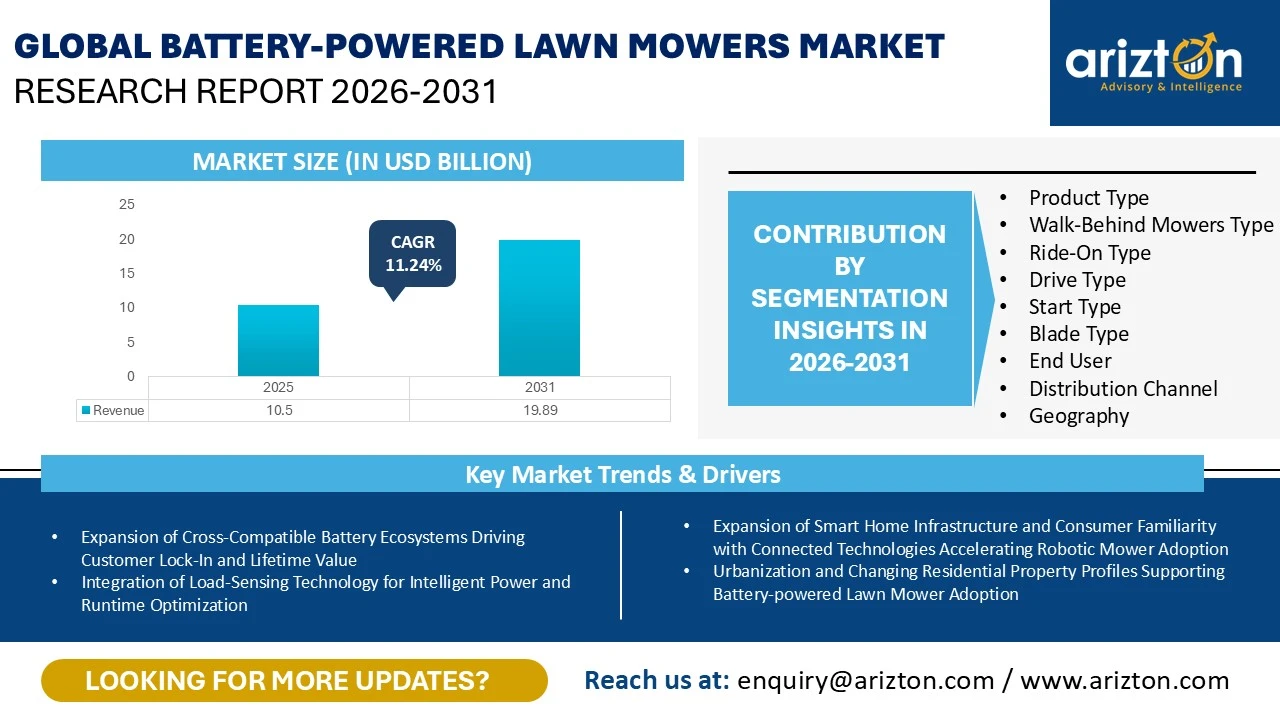
THE GLOBAL BATTERY-POWERED LAWN MOWERS MARKET WAS VALUED AT USD 10.5 BILLION IN 2025 AND IS EXPECTED TO REACH USD 19.89 BILLION BY 2031, GROWING AT A CAGR OF 11.24%.
The Battery Powered Lawn Mowers Market Size, Share & Trends Analysis Report By
- Product Type: Walk-Behind Lawn Mowers, Ride-On Lawn Mowers, and Robotic Lawn Mowers
- Walk-Behind Mowers Type: Push Mowers and Self-Propelled Mowers
- Ride-On Type: Standard Ride-On Mowers, Zero-Turn Mowers, Lawn Tractors, and Garden Tractors
- Drive Type: Rear-Wheel Drive, Front-Wheel Drive, Two-Wheel Drive, and All-Wheel Drive
- Start Type: Push Button Start, Key Start, Smart/App Start, and Others
- Blade Type: Standard Blade, Mulching Blade, Lifting Blade, and Others
- End User: Residential, Professional Landscaping Services, Golf Courses & Sports Arenas, and Others
- Distribution Channel: Offline and Online
- Geography: North America, Europe, APAC, Latin America, and Middle East and Africa
Industry Analysis Report, Regional Outlook, Growth Potential, Price Trends, Competitive Market Share & Forecast 2026–2031.
This report includes market data points, ranging from trend
analyses to market estimates & forecasts that you can customize
GLOBAL BATTERY-POWERED LAWN MOWERS MARKET REPORT SCOPE
| REPORT ATTRIBUTE | DETAILS |
|---|---|
| MARKET SIZE (2031) | USD 19.89 Billion |
| MARKET SIZE (2025) | USD 10.5 Billion |
| CAGR (2025-2031) | 11.24% |
| MARKET SIZE- VOLUME (2031) | 20,950 thousand units |
| HISTORIC YEAR | 2022- 2024 |
| BASE YEAR | 2025 |
| FORECAST YEAR | 2026-2031 |
| SEGMENTS BY | Product Type, Walk-Behind Mowers Type, Ride-On Type, Drive Type, Start Type, Blade Type, End User, Distribution Channel, and Geography |
| GEOGRAPHIC ANALYSIS | North America, Europe, APAC, Latin America, and the Middle East and Africa |
| KEY PLAYERS | Husqvarna Group, Deere & Company, The Toro Company, STIHL, Stanley Black & Decker, Inc., Techtronic Industries Company Limited (TTI), Chervon Group (EGO Power+), Greenworks Tools, Makita Corporation, and Honda Motor Co., Ltd. |
BATTERY POWERED LAWN MOWERS MARKET SIZE & SHARE
The global battery-powered lawn mowers market size was valued at USD 10.5 billion in 2025 and is expected to reach USD 19.89 billion by 2031, growing at a CAGR of 11.24% during the forecast period. The market is witnessing significant growth as homeowners, landscaping contractors, municipalities, and commercial property managers increasingly transition from gasoline-powered equipment to battery-powered alternatives. Rising environmental regulations, advancements in lithium-ion battery technology, and growing demand for low-noise, low-maintenance outdoor power equipment are accelerating market adoption across residential and commercial applications.
The global battery-powered lawn mowers market comprises the design, manufacturing, distribution, and commercialization of cordless lawn mowing equipment powered by rechargeable battery systems, primarily lithium-ion batteries, for residential, commercial, and institutional landscaping applications. The market includes walk-behind lawn mowers, ride-on lawn mowers, and robotic lawn mowers, which provide low-noise, low-maintenance, and zero-direct-emission alternatives to conventional gasoline-powered equipment.
BATTERY POWERED LAWN MOWERS MARKET INSIGHTS BY VOLUME
The global battery-powered lawn mowers market by volume is expected to reach 20,950 thousand units by 2031, driven by growing demand for eco-friendly, low-maintenance, and cordless lawn care equipment. North America remains the largest regional market by volume, supported by strong residential lawn ownership, established landscaping services, consumer purchasing power, labor shortages, and the increasing replacement of gasoline-powered equipment. Europe represents another major market by volume, supported by stringent environmental regulations, carbon-neutral initiatives, and widespread adoption of sustainable landscaping equipment. Meanwhile, Asia-Pacific is benefiting from urbanization, expanding residential development, increasing disposable incomes, and growing adoption of cordless outdoor equipment, which is supporting the rising volume of battery-powered lawn mowers.
KEY TAKEAWAYS
- Product Type: The walk-behind lawn mowers segment accounted for the largest market share of around 39% in 2025.
- Ride-On Type: The standard ride-on segment shows the highest growth by revenue, with a CAGR of 10.45% during the forecast period.
- Drive Type: Rear-wheel drive (RWD) dominates the drive-type segment in the global battery-powered lawn mower market.
- Start Type: The push button accounted for the largest market share in 2025.
- Blade Type: The standard blade segment represents the largest share of the global battery-powered lawn mower market
- End User: Golf courses & sports arenas show the highest growth during the forecast period.
- Distribution Channel: Offline distribution dominates with the largest share in the distribution channel of the global battery-powered lawn mower market.
- Geography: North America held the largest regional share of the global battery-powered lawn mower market.
RECENT DEVELOPMENTS IN THE BATTERY-POWERED LAWN MOWERS MARKET
- In 2026, Husqvarna Group expanded its Automower® portfolio by introducing enhanced wire-free robotic mowing technologies, AI-assisted navigation, and improved RTK-GPS capabilities for residential and commercial users.
- In 2026, AriensCo continued expanding the commercialization of the Gravely Pro-Turn® EV, increasing dealer availability across North America and supporting landscaping contractors transitioning from gasoline-powered fleets to battery-powered equipment.
- In 2026, Deere & Company accelerated the electrification of its professional turf equipment portfolio by integrating advanced battery systems and connected machine technologies into commercial mowing applications, supporting customers transitioning toward sustainable landscape maintenance.
GLOBAL BATTERY-POWERED LAWN MOWERS MARKET DRIVERS
Increasing Replacement of Gasoline-Powered Lawn Mowers
The global lawn mower market is undergoing a significant transition from gasoline-powered equipment toward battery-powered alternatives. Increasing environmental regulations, growing consumer awareness of emissions, and demand for quieter and lower-maintenance equipment are encouraging residential and professional users to replace conventional gasoline mowers with cordless models. Battery-powered lawn mowers provide zero direct emissions during operation, lower maintenance requirements, and reduced operating noise compared with gasoline-powered alternatives.
Advancements in Lithium-Ion Battery Technology
Continuous improvements in lithium-ion battery energy density, charging speed, thermal management, and power output are expanding the application range of battery-powered lawn mowers. High-voltage battery platforms ranging from approximately 40V to 80V and above are increasingly being used across self-propelled, riding, zero-turn, and commercial mower categories. These advancements are helping manufacturers address larger residential lawns and demanding professional landscaping applications.
Growing Adoption of Robotic and Autonomous Mowing
Robotic lawn mowers are becoming an important growth engine for the market as manufacturers integrate GPS/GNSS, RTK positioning, sensors, cameras, navigation software, obstacle detection, automatic charging, and smartphone connectivity. Autonomous mowing reduces manual intervention and labor requirements while improving mowing consistency.
BATTERY-POWERED LAWN MOWERS MARKET TRENDS
Increasing Adoption of Cordless Battery-Powered Lawn Mowers
The global battery-powered lawn mowers market is witnessing a continued shift from gasoline-powered equipment toward cordless battery-powered systems, supported by improvements in lithium-ion battery capacity, brushless motor efficiency, runtime, charging speed, and mower performance. The transition is particularly visible in residential walk-behind mowers, where users increasingly value push-button starting, reduced maintenance, lower operating noise, and the elimination of gasoline and engine oil. Battery platforms have also expanded into self-propelled, commercial walk-behind, zero-turn, and riding mower categories, allowing manufacturers to address a broader range of lawn sizes and applications.
Rising DIY and Residential Lawn-Care Activities
The growing popularity of DIY lawn maintenance and home improvement is supporting demand for battery-powered lawn mowers, particularly among homeowners seeking equipment that is easy to start, operate, store, and maintain. Consumers increasingly prefer lawn-care equipment that eliminates gasoline handling, engine maintenance, and manual starting while providing quieter operation.
INDUSTRY RESTRAINTS
High Upfront Acquisition Costs Limiting Battery-powered Lawn Mower Adoption
Battery-powered lawn mowers generally require lithium-ion battery packs, brushless motors, battery-management systems, power electronics, and electronic controls, increasing manufacturing costs compared with conventional gasoline mowers. These components contribute directly to higher retail prices, particularly in premium self-propelled, riding, and robotic models.
The upfront purchase price of a battery-powered mower can remain higher than that of a comparable gasoline model, especially when the product is sold with a high-capacity battery and dedicated charger. This price gap can discourage cost-sensitive homeowners who primarily evaluate equipment based on initial acquisition cost rather than total ownership cost.
Battery Degradation and Replacement Costs Creating Long-term Ownership Challenges
Lithium-ion batteries naturally lose capacity through repeated charging cycles and prolonged use. As battery health declines, the mower may deliver shorter runtime per charge, requiring more frequent charging and potentially reducing productivity for users with larger lawns.
Battery degradation can become more significant for professional landscapers, golf courses, municipalities, and commercial property operators, where mowers may be used frequently throughout the season. Higher utilization can increase the importance of battery lifecycle management and replacement planning.
Replacing a high-voltage battery pack can represent a significant secondary expense, particularly for 56V, 60V, and 80V commercial mowers. This additional cost can reduce the perceived economic advantage of battery-powered equipment when customers compare the full ownership cycle against gasoline alternatives.
BATTERY-POWERED LAWN MOWERS MARKET SEGMENTATION INSIGHTS
INSIGHT BY PRODUCT TYPE
The global battery-powered lawn mowers market by product type is segmented into walk-behind lawn mowers, ride-on lawn mowers, and robotic lawn mowers. The walk-behind lawn mowers segment accounted for the largest share of around 39% in 2025. Designed primarily for residential users and small-to-medium commercial landscaping applications, these mowers provide an efficient, low-maintenance, and environmentally friendly alternative to conventional gasoline-powered equipment. The segment includes push mowers and self-propelled battery-powered lawn mowers, offering varying levels of automation and user convenience based on lawn size and terrain.
Based on the walk-behind lawn mowers segment, the battery-powered push mowers represent the largest volume segment within the global battery-powered lawn mowers market, serving as the primary entry point for residential consumers transitioning from gasoline-powered lawn care equipment. Designed for small- to medium-sized lawns, push mowers continue to gain popularity due to their affordability, ease of operation, lower maintenance requirements, and compatibility with expanding cordless battery ecosystems.
Unlike premium self-propelled and robotic lawn mowers, push mowers compete primarily on value, efficiency, and accessibility. However, the segment has evolved significantly beyond basic cordless equipment. Manufacturers are increasingly positioning push mowers as high-performance residential products capable of delivering cutting quality comparable to gasoline-powered models while offering quieter operation, zero direct emissions, and significantly lower lifetime operating costs.
INSIGHT BY RIDE-ON TYPE
The standard ride-on segment dominates and shows significant growth by revenue, with the fastest-growing CAGR of 10.45% during the forecast period. The standard ride-on offers an optimal balance between performance, affordability, and operational simplicity. Positioned between walk-behind mowers and premium zero-turn or garden tractors, these machines are designed for medium-sized residential properties, housing communities, educational institutions, hospitality facilities, corporate campuses, and small commercial landscapes that require higher mowing productivity without the complexity or higher capital investment of commercial-grade equipment.
The segment is gaining traction as residential and institutional buyers increasingly transition from gasoline-powered ride-on mowers to battery-powered alternatives that provide lower maintenance requirements, quieter operation, reduced operating costs, and zero direct emissions.
INSIGHT BY DRIVE TYPE
Rear-wheel drive (RWD) dominates the drive-type segment in the global battery-powered lawn mower market. Battery-powered Rear-Wheel Drive (RWD) lawn tractors represent one of the most widely adopted drivetrain configurations within the residential and light-commercial ride-on mower market. Designed to deliver superior traction, improved stability, and consistent power delivery, RWD systems are particularly suited for medium- to large-sized residential properties, lifestyle estates, gated communities, schools, parks, and institutional landscapes where mowing conditions include uneven terrain, gentle slopes, and frequent towing applications.
INSIGHT BY START TYPE
Based on the start type, the push button accounted for the largest global battery-powered lawn mowers market share in 2025. Push button systems improve operator convenience by providing quick and reliable startup while reducing wear associated with conventional ignition components. The integration of electronic safety interlocks—including seat occupancy sensors, brake engagement verification, and blade disengagement systems—ensures safe operation before the mower becomes active.
The growing adoption of cordless outdoor power equipment and advancements in lithium-ion battery technology are further supporting the demand for push-button starting systems by enabling convenient, low-noise, and zero-emission operation. As users transition from gasoline-powered equipment, manufacturers are focusing on battery performance, runtime, charging speed, brushless motors, and smart features to enhance the overall user experience.
INSIGHT BY BLADE TYPE
The standard blade segment represents the largest share and most established blade category in the global battery-powered lawn mower market, driven by its versatility, cost-effectiveness, and compatibility with a broad range of residential and light commercial mowing applications. As battery-powered lawn mowers continue replacing gasoline-powered equipment, standard blades remain the preferred choice for routine lawn maintenance due to their balanced cutting performance, lower power consumption, and ability to maximize battery runtime. Competitive differentiation in this segment is increasingly influenced by blade material quality, cutting precision, aerodynamic design, corrosion resistance, and compatibility with high-speed brushless motor platforms.
INSIGHT BY END USER
Golf courses & sports arenas show the highest growth during the forecast period. The golf courses & sports arenas segment represents one of the highest-value end-user categories, where turf quality, mowing precision, operational reliability, and sustainability are critical performance requirements. Unlike residential and commercial landscaping applications, golf courses and professional sports facilities require equipment capable of maintaining uniform cutting heights, consistent turf density, and championship-quality playing surfaces throughout the year.
North America continues to dominate this segment due to its large concentration of championship golf courses, professional sports leagues, universities, recreational parks, and municipal sports complexes.
INSIGHT BY DISTRIBUTION CHANNEL
Offline distribution with the largest share in the distribution channel remains the primary sales channel for battery-powered ride-on lawn mowers due to the high-value nature of these products and the need for in-person product evaluation. Customers often prefer visiting retail stores, dealer showrooms, and outdoor power equipment outlets to compare mower sizes, cutting performance, battery capacity, comfort features, and overall build quality before making a purchase. Sales representatives also provide product demonstrations, financing options, warranty information, installation guidance, and maintenance support, helping customers make informed purchasing decisions.
GLOBAL BATTERY-POWERED LAWN MOWERS MARKET GEOGRAPHICAL ANALYSIS
North America Battery-Powered Lawn Mowers Market
North America is the largest regional market, supported by its large suburban lawn base, mature landscaping industry, strong DIY culture, high purchasing power, and widespread adoption of cordless outdoor power equipment. The U.S. represents the primary market within the region, while Canada is emerging as an attractive growth market. The region is also a major market for commercial battery-powered equipment, zero-turn mowers, and robotic lawn mowers, supported by labor shortages, fleet electrification, and growing restrictions on gasoline-powered equipment.
Europe Battery-Powered Lawn Mowers Market
Europe is a mature and technology-driven market, supported by stringent environmental regulations, sustainability initiatives, strong gardening culture, and high adoption of robotic lawn mowers. The market is projected to grow at 11.38% CAGR during the forecast period.
Germany, the UK, France, Italy, Spain, Sweden, and the Netherlands represent important country markets, while the region continues to provide strong opportunities for premium connected and autonomous mowing solutions.
APAC Battery-Powered Lawn Mowers Market
Asia-Pacific represents a key growth opportunity as urbanization, residential development, smart-city investments, commercial landscaping, and increasing disposable incomes expand the addressable market. China represents the largest country market in the region, while Japan provides strong opportunities for robotic and automated lawn-care technologies because of labor shortages and its aging population.
Latin America Battery-Powered Lawn Mowers Market
Latin America remains an emerging market, with opportunities concentrated in Brazil and Mexico. Growth is supported by expanding residential development, tourism infrastructure, golf facilities, public parks, and commercial landscaping. Brazil represents the largest country market and is increasingly adopting battery-powered equipment in professional landscaping and residential applications.
GLOBAL BATTERY-POWERED LAWN MOWERS MARKET VENDOR LANDSCAPE
The global battery-powered lawn mowers market is characterized by competition among established outdoor power equipment manufacturers, cordless-tool companies, and robotic lawn mower specialists. Competition is increasingly focused on battery performance, runtime, cutting efficiency, smart connectivity, automation, distribution capabilities, brand reputation, and after-sales service.
Major companies include Husqvarna Group, The Toro Company, Deere & Company, STIHL, Techtronic Industries, Greenworks Tools, EGO Power+, Makita Corporation, Robert Bosch GmbH, Stanley Black & Decker, Mammotion, Positec Group, Yarbo, Generac Power Systems, AriensCo, Ryobi, Yard Force, Litheli, and EcoFlow.
Established manufacturers are strengthening their positions through high-voltage battery platforms, interchangeable battery ecosystems, brushless motors, commercial zero-turn equipment, and expanded dealer networks. Meanwhile, robotic specialists are competing through RTK-GPS navigation, AI-assisted obstacle detection, boundary-free operation, autonomous charging, and smartphone-based controls.
The competitive landscape is therefore shifting from “mower performance alone” toward complete battery-powered and connected lawn-care ecosystems, with companies increasingly competing on technology, automation, battery compatibility, software, and total cost of ownership.
Key Competitors
- Husqvarna Group: Strong in robotic and autonomous mowing through its Automower portfolio, along with battery-powered walk-behind and ride-on equipment. Its key strengths include brand recognition, robotic mowing expertise, dealer network, and connected lawn-care technologies.
- Deere & Company: Strong presence in residential and professional turf equipment, especially riding and zero-turn mowers. Its competitive advantages include the John Deere brand, extensive dealer network, commercial customer base, and growing focus on electrification and smart turf equipment.
- The Toro Company: Offers battery-powered solutions across residential, professional, commercial, riding, walk-behind, and robotic mowing applications. Its 60V Flex-Force and Revolution platforms, along with its strong distribution network, support its market position.
- STIHL: Expanding its battery-powered portfolio across professional landscaping and residential applications. Its strong brand reputation, dealer network, and focus on professional-grade equipment support its position in the growing cordless equipment market.
Know More About Related Report: https://www.arizton.com/market-reports/lawn-mower-attachments-market
SNAPSHOT
The global battery-powered lawn mowers market size is expected to grow at a CAGR of approximately 11.24% from 2025 to 2031.
The following factors are likely to contribute to the growth of the global battery-powered lawn mowers market during the forecast period:
- Tightening Municipal Emissions and Noise Regulations Accelerating the Transition from Gasoline to Battery-powered Lawn Mowers
- Advancements in Battery Energy Density and Declining Battery Costs Accelerating Mower Electrification
- Expansion of Smart Home Infrastructure and Consumer Familiarity with Connected Technologies Accelerating Robotic Mower Adoption
Base Year: 2025
Forecast Year: 2026-2031
The report examines the current state of the global battery-powered lawn mowers market and its market dynamics through 2026−2031. It covers a detailed overview of several market growth enablers, restraints, and trends. The study covers both the demand and supply sides of the market. It also profiles and analyses leading companies and several other prominent companies operating in the market.
Key Company Profile
- Husqvarna Group
- Business Overview
- Product Offerings
- Key Developments
- Key Strategies
- Key Strengths
- Key Opportunities
- Deere & Company
- The Toro Company
- STIHL
- Stanley Black & Decker, Inc.
- Techtronic Industries Company Limited (TTI)
- Chervon Group (EGO Power+)
- Greenworks Tools
- Makita Corporation
- Honda Motor Co., Ltd.
Other Prominent Company Profiles
- Robert Bosch GmbH
- Business Overview
- Product Offerings
- AriensCo
- STIGA Group
- MTD Products Inc.
- Positec Group
- Einhell Germany AG
- Generac Power Systems, Inc.
- Briggs & Stratton Corporation
- Kubota Corporation
- AL-KO GmbH
- Yamabiko Corporation
- Snow Joe, LLC
- Kärcher SE & Co. KG
- Emak S.p.A.
- Bad Boy Mowers
- Hustler Turf Equipment
- Scag Power Equipment
- Koki Holdings Co., Ltd.
- Yard Force
- Mammotion
- Zucchetti Centro Sistemi S.p.A.
- Litheli
- Cobra Garden
- Mean Green Products
- FutureGen Robotics
- Volta Garden
- Worx
- Ryobi
- Craftsman
- ECHO Incorporated
- Orec Corporation
- Sun Joe
- Kress
- Green Machine
- Etesia
- SABO Maschinenfabrik GmbH
- AS-Motor Germany GmbH
- Raymo
Segmentation by Product Type
- Walk-Behind Lawn Mowers
- Ride-On Lawn Mowers
- Robotic Lawn Mowers
Segmentation by Walk-Behind Mowers Type
- Push Mowers
- Self-Propelled Mowers
Segmentation by Ride-On Type
- Standard Ride-On Mowers
- Zero-Turn Mowers
- Lawn Tractors
- Garden Tractors
Segmentation by Drive Type
- Rear-Wheel Drive
- Front-Wheel Drive
- Two-Wheel Drive
- All-Wheel Drive
Segmentation by Start Type
- Push Button Start
- Key Start
- Smart/App Start
- Others
Segmentation by Blade Type
- Standard Blade
- Mulching Blade
- Lifting Blade
- Others
Segmentation by End User
- Residential
- Professional Landscaping Services
- Golf Courses & Sports Arenas
- Others
Segmentation by Distribution Channel
- Offline
- Online
Segmentation by Geography
- North America
- US
- Canada
- Europe
- Germany
- France
- U.K.
- Italy
- Spain
- Sweden
- Netherlands
- Belgium
- Poland
- Switzerland
- Finland
- APAC
- China
- Japan
- India
- Australia
- South Korea
- Indonesia
- Thailand
- Vietnam
- Malaysia
- Taiwan
- Latin America
- Brazil
- Mexico
- Argentina
- Chile
- Colombia
- Middle East & Africa
- Saudi Arabia
- UAE
- South Africa
GLOBAL BATTERY-POWERED LAWN MOWERS MARKET FAQs
How big is the global battery-powered lawn mowers market?
What is the growth rate of the global battery-powered lawn mowers market?
Which region dominates the global battery-powered lawn mowers market?
What are the trends in the global battery-powered lawn mowers market?
Who are the major players in the global battery-powered lawn mowers market?
For more details, please reach us at [email protected]
1. Scope & Coverage
- Market Definition
- Inclusions
- Exclusions
- Market Estimation Caveats
- Market Size & Forecast Periods
- Historic Period: 2022-2024
- Base Year: 2025
- Forecast Period: 2026-2031
- Market Size (2022-2031) Revenue
- Market Segments
- Market Segmentation by Product Type
- Market Segmentation by Walk-Behind Mowers Type
- Market Segmentation by Ride-On Type
- Market Segmentation by Drive Type
- Market Segmentation by Start Type
- Market Segmentation by Blade Type
- Market Segmentation by End User
- Market Segmentation by Distribution Channel
- Market Segmentation by Geography
2. Opportunity Pockets
3. Introduction
- Overview of Battery-Powered Lawn Mowers
- Evolution from Gasoline-Powered to Battery-Powered Lawn Mowers
- Battery Technology Overview
- Lithium-Ion Battery Technology
- Brushless Motor Technology
- Smart & Connected Lawn Mowers
- Robotic & Autonomous Lawn Mowing
- Residential & Commercial Applications
- Key Parameters Impacting Market Growth
4. Market Opportunities & Trends
- Premiumization Through High-voltage & Commercial Mowers
- Accelerating Shift Toward Wire-free, Precision-guided Autonomous Battery Mowing
- Expansion of Cross-Compatible Battery Ecosystems Driving Customer Lock-In and Lifetime Value
- Integration of Load-Sensing Technology for Intelligent Power and Runtime Optimization
5. Market Growth Enablers
- Tightening Municipal Emissions and Noise Regulations Accelerating the Transition from Gasoline to Battery-powered Lawn Mowers
- Advancements in Battery Energy Density and Declining Battery Costs Accelerating Mower Electrification
- Expansion of Smart Home Infrastructure and Consumer Familiarity with Connected Technologies Accelerating Robotic Mower Adoption
- Urbanization and Changing Residential Property Profiles Supporting Battery-powered Lawn Mower Adoption
6. Market Restraints
- High Upfront Acquisition Costs Limiting Battery-powered Lawn Mower Adoption
- Battery Degradation and Replacement Costs Creating Long-term Ownership Challenges
- Intense Competition from Low-Cost and Counterfeit Products
- High Initial Cost of Professional Cordless Tool Ecosystems
7. Market Landscape
8. Five Forces Analysis
9. Product Type Covered: (Market Size & Forecast: 2022-2031)
- Walk-Behind Lawn Mowers
- Ride-On Lawn Mowers
- Robotic Lawn Mowers
10. Walk-Behind Mower Type Covered: (Market Size & Forecast: 2022-2031)
- Push Mowers
- Self-Propelled Mowers
11. Ride-On Type Covered: (Market Size & Forecast: 2022-2031)
- Standard Ride-On Mowers
- Zero-Turn Mowers
- Lawn Tractors
- Garden Tractors
12. Drive Type Covered: (Market Size & Forecast: 2022-2031)
- Rear-Wheel Drive
- Front-Wheel Drive
- Two-Wheel Drive
- All-Wheel Drive
13. Start Type Covered: (Market Size & Forecast: 2022-2031)
- Push Button Start
- Key Start
- Smart/App Start
- Others
14. Blade Type Covered: (Market Size & Forecast: 2022-2031)
- Standard Blade
- Mulching Blade
- Lifting Blade
- Others
15. End User Covered: (Market Size & Forecast: 2022-2031)
- Residential
- Professional Landscaping Services
- Golf Courses & Sports Arenas
- Others
16. Distribution Channel Covered: (Market Size & Forecast: 2022-2031)
- Offline
- Online
17. Geography (Market Size & Forecast: 2022-2031)
Regional Analysis within North America
- US
- CANADA
Regional Analysis within Europe
- Germany
- France
- U.K.
- Italy
- Spain
- Sweden
- Netherlands
- Belgium
- Poland
- Switzerland
- Finland
Regional Analysis within APAC
- China
- Japan
- India
- Australia
- South Korea
- Indonesia
- Thailand
- Vietnam
- Malaysia
- Taiwan
Regional Analysis within Latin America
- Brazil
- Mexico
- Argentina
- Chile
- Colombia
Regional Analysis within Middle East Africa
- Saudi Arabia
- UAE
- South Africa
18. Competitive Landscape
19. Competitive Overview
- Key Developments
20. Key Company Profiles
- Husqvarna Group
- Deere & Company
- The Toro Company
- STIHL
- Stanley Black & Decker, Inc.
- Techtronic Industries Company Limited (TTI)
- Chervon Group (EGO Power+)
- Greenworks Tools
- Makita Corporation
- Honda Motor Co., Ltd.
21. Other Prominent Company Profiles
- Robert Bosch GmbH
- AriensCo
- STIGA Group
- MTD Products Inc.
- Positec Group
- Einhell Germany AG
- Generac Power Systems, Inc.
- Briggs & Stratton Corporation
- Kubota Corporation
- AL-KO GmbH
- Yamabiko Corporation
- Snow Joe, LLC
- Kärcher SE & Co. KG
- Emak S.p.A.
- Bad Boy Mowers
- Hustler Turf Equipment
- Scag Power Equipment
- Koki Holdings Co., Ltd.
- Yard Force
- Mammotion
- Zucchetti Centro Sistemi S.p.A.
- Litheli
- Cobra Garden
- Mean Green Products
- FutureGen Robotics
- Volta Garden
- Worx
- Ryobi
- Craftsman
- ECHO Incorporated
- Orec Corporation
- Sun Joe
- Kress
- Green Machine
- Etesia
- SABO Maschinenfabrik GmbH
- AS-Motor Germany GmbH
- Raymo
22. Report Summary
- Key Takeaways
- Strategic Recommendations
Select a license type that suits your business needs
Single User Licence
- Report accessible by one user only
- Free 10% or 3 days of customization
- Free post-sale service assistance
- Continuous support through email
5 User Licence
- Report accessible by 5 users within the organization
- Free 15% or 4.5 days of customization
- Continuous support through email and telephone
- Free analyst hour
- Free Upgrade: If an updated report published within 180 days of purchase, you will get the revised report free of charge
Corporate Licence
- Free Datasheet worth $1500
- Report accessible by the entire organization
- Free 20% or 6 days of customization
- Free post-sale service assistance
- Continuous support through email and telephone
- Direct access to lead analysts
- Free analyst hour
- Free Upgrade: If an updated report published within 180 days of purchase, you will get the revised report free of charge
Datasheet Licence
- Report accessible by 1 user only
- Free 15% or 32 hours of customization
- Free post-sale service assistance
- Direct access to lead analysts
Frequently Asked Questions
How big is the global battery-powered lawn mowers market?
What is the growth rate of the global battery-powered lawn mowers market?
Which region dominates the global battery-powered lawn mowers market?
What are the trends in the global battery-powered lawn mowers market?
Who are the major players in the global battery-powered lawn mowers market?
Other RELATED Reports