
Canada Point of Care Molecular Diagnostics Market Research Report 2025-2030

The Canada Point of Care Molecular Diagnostics Market Size, Share, & Trends By: Diagnostic, Nucleic Acid Amplification-Based POC, Assay Format, Application Area, End User, & Geography. This Industry Analysis Covers The Market Size (in USD Million).
Published Date : November 2025
Last Updated : November 2025
format: PDF

184 pages

19 company

05 segments

1 region

7 countries
Purchase Options
Canada Point of Care Molecular Diagnostics Market Research Report 2025-2030
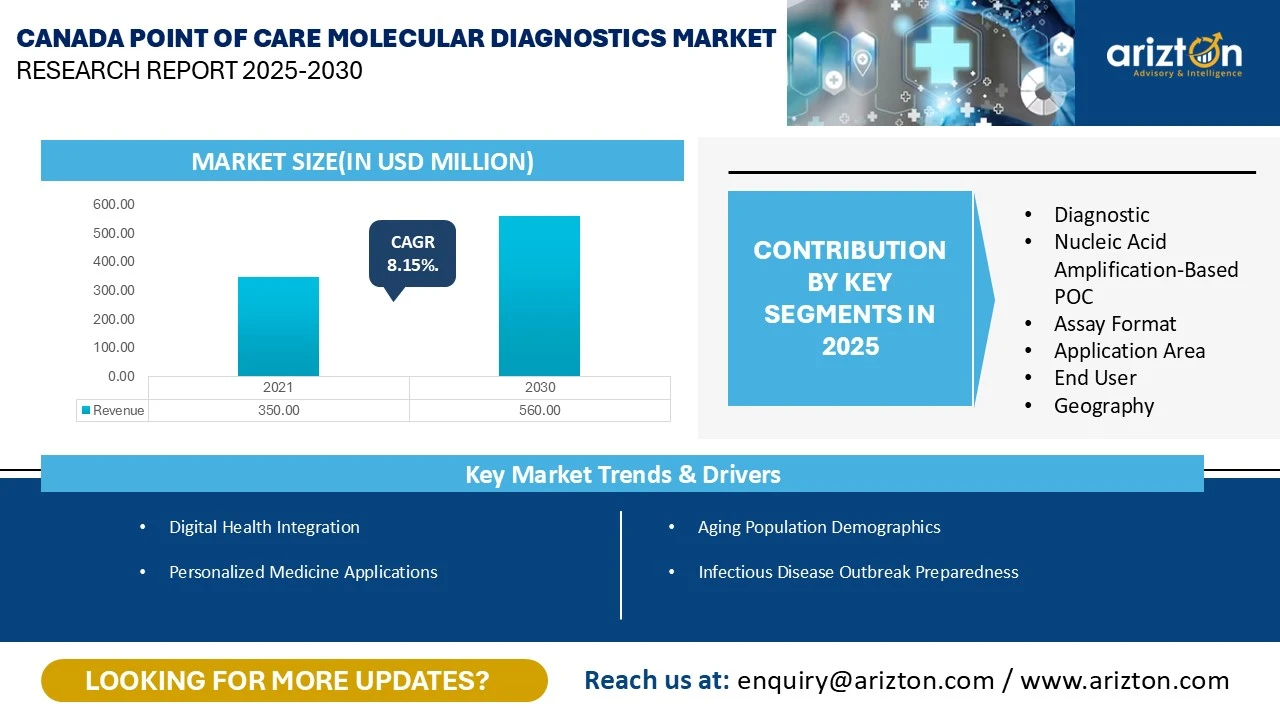
THE CANADA POINT-OF-CARE MOLECULAR DIAGNOSTICS MARKET WAS VALUED AT USD 350 MILLION IN 2024 AND IS EXPECTED TO REACH USD 560 MILLION BY 2030, GROWING AT A CAGR OF 8.15%.
The Canada Point of Care Molecular Diagnostics Market Size, Share, & Trends Analysis Report By
- Diagnostic: Nucleic Acid Amplification Tests, Microfluidics and Lab-on-a-Chip Technologies, CRISPR-based Molecular POC, and Others
- Nucleic Acid Amplification-Based POC: RT-PCR-based Molecular POC and Loop-mediated Isothermal Amplification
- Assay Format: Simplex Assays, Duplex Panels, Triplex Panels, and Multiplex/Syndromic Panels
- Application Area: Respiratory infections, Sexually transmitted infections (STIs & HIV), Tuberculosis (TB) diagnostics, Bloodstream infections (BSI), Hepatitis B & C diagnostics, Urinary tract infections (UTIs), Gastroenteric infections, Blood yeast (fungal BSI) diagnostics, Infectious Diseases Testing, and Others
- End User: Hospitals and Health Systems, Clinical Laboratories, Physician Offices and Outpatient Clinics, Urgent Care and Walk-in Clinics, Long-Term Care Facilities, Remote and Rural Healthcare Settings, Public Health Laboratories, and Others
- Geography: Ontario, Quebec, British Columbia, Alberta, Atlantic Provinces, Northern Territories, and Others
Industry Analysis Report, Regional Outlook, Growth Potential, Price Trends, Competitive Market Share & Forecast 2025–2030.
This report includes market data points, ranging from trend
analyses to market estimates & forecasts that you can customize
CANADA POINT OF CARE MOLECULAR DIAGNOSTICS MARKET REPORT SCOPE
| REPORT ATTRIBUTE | DETAILS |
|---|---|
| Market Size (2030) | USD 560 Million |
| Market Size (2024) | USD 350 Million |
| CAGR (2024-2030) | 8.15%. |
| HISTORIC YEAR | 2021-2023 |
| BASE YEAR | 2024 |
| FORECAST YEAR | 2025-2030 |
| SEGMENTS BY | Diagnostic, Assay Format, Application Area, and End User |
| REGIONAL ANALYSIS | Ontario, Quebec, British Columbia, Alberta, Atlantic Provinces, Northern Territories, and Others |
| KEY PLAYERS | Roche Diagnostics Canada, Abbott Laboratories, BioMérieux, Becton Dickinson and Company (BD), QIAGEN, Cepheid, Hologic, Thermo Fisher Scientific, and DiaSorin S.p.A. |
CANADA POINT OF CARE MOLECULAR DIAGNOSTICS MARKET
The Canada point-of-care molecular diagnostics market size was valued at USD 350 million in 2024 and is expected to reach USD 560 million by 2030, growing at a CAGR of 8.15% during the forecast period. The market is growing rapidly, driven by the rising demand for fast, accurate, and decentralized diagnostic solutions. The advancements in infectious disease detection, personalized medicine, and digital health integration are shaping the market. POC molecular diagnostics are critical for timely patient care, early disease detection, outbreak management, and a reduction in the burden on healthcare systems.
Additionally, strong government support, research initiatives, and biotech hubs in cities including Toronto, Montreal, and Vancouver are fueling market growth. Partnerships among hospitals, diagnostic firms, and digital health providers are accelerating innovation.
For example, in 2025, Ontario launched a pilot program integrating POC molecular tests for sepsis in emergency departments, reducing diagnosis time from 24 hours to under two hours.
CANADA POINT OF CARE MOLECULAR DIAGNOSTICS MARKET TRENDS
Aging Population Demographics
The population in Canada is aging rapidly, and this demographic shift is becoming one of the strongest drivers for the molecular diagnostics Point-of-Care (PoC) testing industry. As life expectancy increases and chronic diseases become more common among older adults, the demand for faster, more accurate, and accessible diagnostic solutions will grow.
According to Statistics Canada, nearly 20% of Canadians are slated to be aged 65 and above by 2025; this share is projected to reach 23% by 2030. This demographic pressure is directly shaping healthcare delivery models, with molecular PoC testing emerging as a critical tool in managing elderly patient care efficiently.
Canada is actively investing in healthcare innovation to meet the needs of its aging population. Federal and provincial programs support technologies that improve care delivery for seniors. For example, funding has been directed toward improving rapid diagnostic testing capacity after the COVID-19 pandemic. This environment encourages the adoption of molecular POC technologies, making them more available across hospitals, pharmacies, and community centers. Such policies accelerate market growth and attract industry players.
Infectious Disease Outbreak Preparedness
In 2025, Canada is experiencing a resurgence of infectious diseases including measles, respiratory viruses, and foodborne illnesses. These outbreaks have highlighted the urgent need for rapid and accurate diagnostic tools to manage and control the spread of infections. Molecular diagnostics at the Point Of Care (POC) have become indispensable in this context, enabling the timely detection, immediate intervention, and effective containment of outbreaks.
Since October 2024, Ontario has reported over 2,000 measles cases; this number is higher than the total reported cases in the US for 2025. This outbreak, which has primarily affected unvaccinated children, has resulted in hospitalizations and, in some cases, fatalities. The situation emphasizes on the importance of having molecular diagnostics at point of care, enabling early detection and reducing the risk of further transmission. Rapid testing in clinics, community centers, and schools ensures that infected individuals can be identified quickly, limiting the spread within vulnerable populations.
In May 2025 a Salmonella outbreak from mini pastries affected several provinces and caused hospitalizations. Point-of-care molecular diagnostics enabled rapid detection and a quick public health response; this shows the importance in managing outbreaks, improving patient care and supporting Canada’s healthcare preparedness.
CANADA POINT OF CARE MOLECULAR DIAGNOSTICS MARKET DRIVERS
Digital Health Integration
Canada is witnessing a significant transformation in its healthcare landscape, driven by the integration of digital health technologies into Point-Of-Care (POC) molecular diagnostics. This convergence is enhancing the efficiency, accessibility, and accuracy of medical testing, aligning with the country's commitment to innovative and patient-centered care.
The demand for at-home diagnostic solutions has surged, reflecting a shift toward decentralized healthcare. For instance, in April 2025, BioSyent Inc. launched a digital platform to distribute at-home diagnostic kits for cholesterol and fertility testing nationwide. This initiative empowers patients to manage their health proactively, reducing the need for frequent clinic visits and alleviating pressure on healthcare facilities.
In March 2025, LifeLabs expanded its molecular diagnostics service offering in Ontario with a new multiplex PCR respiratory panel for RSV, COVID-19, and influenza. This advancement allows healthcare providers to simultaneously detect multiple pathogens from a single sample, facilitating rapid and accurate diagnosis, particularly during peak respiratory illness seasons.
Personalized Medicine Applications
Pharmacogenomics, the study of how genes affect a person's response to drugs, is increasingly being incorporated into clinical practice across Canada. In 2025, several provinces including British Columbia and Alberta have initiated programs integrating pharmacogenomic testing into routine care. These programs allow healthcare providers to prescribe medications based on a patient's genetic profile, enhancing drug efficacy and minimizing adverse reactions. For example, patients with certain genetic variants may receive alternative medications that are more effective or have fewer side effects.
Artificial Intelligence (AI) is revolutionizing personalized medicine by enabling the rapid and accurate analysis of complex molecular data. In 2025, Canadian companies including BioAro Inc. are developing AI-guided software platforms that analyze multi-omics data including genomics, proteomics, and metabolomics to provide real-time insights into patient health. These platforms assist healthcare providers in making informed decisions about personalized treatment plans, improving patient outcomes, and optimizing resource utilization.
The Canadian government is actively supporting the integration of personalized medicine into healthcare through policy development and funding initiatives. In 2025, Health Canada introduced regulatory frameworks to facilitate the approval and reimbursement of personalized diagnostic tests and treatments. These policies aim to streamline the adoption of personalized medicine, making it more accessible to patients across the country. Additionally, funding programs are available to support research and development in this field, fostering innovation and ensuring that Canada remains at the forefront of personalized healthcare.
INDUSTRY RESTRAINTS
Healthcare Budget Constraints
Budget constraints in the Canadian healthcare system can impact the adoption of new in-vitro diagnostic tests. Limited funding may restrict healthcare facilities from investing in advanced diagnostic technologies, affecting market growth. For instance, the capital budgets allocated for molecular diagnostics are limited, with an average annual budget of $1,000,000 for equipment and resources.
A 2025 systematic review flagged infrastructure gaps and staffing shortages as the key barriers to community-based molecular testing. Advanced molecular and digital platforms require specialized operators, yet expertise is unevenly distributed. The certification frameworks advocated by the Canadian Society of Clinical Chemists underscore the training burden for widespread point-of-care deployment.
The shortage of skilled laboratory professionals with expertise in performing and interpreting complex in-vitro diagnostic tests can impede market expansion. Adequate training and education programs are crucial to address this challenge. For example, a 2025 systematic review flagged infrastructure gaps and staffing shortages as the key barriers to community-based molecular testing.
CANADA POINT OF CARE MOLECULAR DIAGNOSTICS MARKET SEGMENTATION INSIGHTS
INSIGHT BY DIAGNOSTIC
The Canada point-of-care molecular diagnostics market by diagnostic is segmented into nucleic acid amplification tests, microfluidics and lab-on-a-chip technologies, crispr-based molecular poc, and others. The nucleic acid amplification tests (NAATs) accounted for the largest market share of around 37%. NAATs constitute the backbone of molecular diagnostics in Canada, enabling rapid and highly sensitive detection of specific nucleic acid sequences from pathogens, genetic disorders, and cancer biomarkers. Within the point-of-care testing (POCT) landscape, NAATs provide clinicians with the ability to perform on-site, near-patient testing that reduces diagnostic turnaround times, improves treatment decisions, and supports outbreak management.
Key NAAT technologies include polymerase chain reaction (PCR) and loop-mediated isothermal amplification (LAMP), which together account for the majority of molecular POCT diagnostics in Canadian hospitals, clinics, and remote healthcare settings.
INSIGHT BY NUCLEIC ACID AMPLIFICATION-BASED POC
By nucleic acid amplification-based POC, the RT-PCR-based molecular POC holds the largest Canada point-of-care molecular diagnostics market share. The is a cornerstone of nucleic acid amplification-based point-of-care diagnostics, enabling the detection of RNA targets from pathogens with high sensitivity and specificity. RT-PCR-based POC tests allow near-patient, rapid testing for infectious diseases, providing critical information for timely clinical decision-making. RT-PCR-based molecular POC also enables highly sensitive detection of RNA viruses and genetic markers. By 2025, advancements in miniaturization, automation, and integration with digital platforms made RT-PCR more accessible in hospitals, clinics, and remote Canadian healthcare settings.
INSIGHT BY ASSAY FORMAT
Based on the assay format, the duplex panels segment shows significant growth, with the fastest-growing CAGR of 9.45% during the forecast period. Duplex assays are nucleic acid amplification tests that detect two targets simultaneously in a single reaction, combining efficiency with high specificity. They are particularly useful in clinical settings where co-infections or multiple pathogens screening is needed, allowing faster diagnostics without increasing sample volume or testing time. By combining two assays into one, these panels speed up diagnosis and save valuable samples, making them ideal for clinical situations where patients may have overlapping or co-occurring infections.
By 2025, duplex panels became a practical and impactful diagnostic tool in Canada. Their ability to detect two targets simultaneously made them indispensable for fast patient triage, efficient lab workflows, and effective public health interventions.
INSIGHT BY APPLICATION AREA
The respiratory infections segment dominates and holds the largest Canada point-of-care molecular diagnostics market share. The segmental growth is driven by their high prevalence, rapid transmissibility, and the need for immediate detection in healthcare and community settings. Molecular PoC assays provide fast and accurate results at patient care sites such as hospitals, urgent care centers, pharmacies, and long-term care facilities. These tests support clinical decisions in influenza, COVID-19, respiratory syncytial virus (RSV), pneumonia-causing pathogens, and emerging viral threats, where timely intervention is critical.
INSIGHT BY END USER
The Canada point-of-care molecular diagnostics market by end user is categorized into hospitals and health systems, clinical laboratories, physician offices and outpatient clinics, urgent care and walk-in clinics, long-term care facilities, remote and rural healthcare settings, public health laboratories, and others. The hospitals and health systems accounted for the largest market share in 2024. Hospitals are experiencing strong growth as they prioritize rapid triage, enhanced infection control, and improved patient outcomes, driving the adoption of advanced healthcare technologies.
By 2025, hospitals and health systems across Canada fully embraced molecular point-of-care (PoC) diagnostics as part of their core operations. The push began during the COVID-19 pandemic but evolved into a long-term strategy to improve emergency response, streamline ICU workflows, and strengthen infection control programs. Platforms from Abbott, Roche, Cepheid, and BioFire became standard tools in Canadian hospitals, transforming how diagnostics supported patient care and hospital efficiency.
CANADA POINT OF CARE MOLECULAR DIAGNOSTICS MARKET REGIONAL ANALYSIS
Canada’s healthcare system is increasingly adopting POC molecular diagnostics to quickly identify infectious agents such as viruses and bacteria. These rapid testing platforms allow hospitals and clinics to reduce turnaround times, manage patient flow more efficiently, and respond promptly to outbreaks, ensuring better patient outcomes and the containment of infectious diseases.
Ontario dominates with the largest share of the Canada point-of-care molecular diagnostics market. Ontario serves as the primary hub for POC molecular diagnostics in Canada owing to the concentration of major hospitals, teaching institutions, and research centers in cities such as Toronto, Ottawa, and Hamilton. The province’s healthcare infrastructure and high patient volumes make it an ideal market for rapid diagnostic adoption.
Ontario is integrating POC molecular diagnostic devices into community clinics, long-term care facilities, and emergency departments. For example, the Abbott ID NOW system is widely used in urgent care centers across Toronto and Ottawa to provide rapid COVID-19 and influenza results, allowing clinicians to make immediate treatment decisions without sending samples to centralized labs.
Hospitals and healthcare networks in Ontario are incorporating POC devices into Electronic Health Record (EHR) systems. The Sunnybrook Health Sciences Centre uses connected GeneXpert systems that automatically upload test results to patient records, enabling the real-time tracking of infectious disease cases as well as improving coordination between testing sites and physicians.
Quebec is rapidly expanding its adoption of Point-Of-Care (POC) molecular diagnostics, supported by a strong provincial healthcare network, research-driven hospitals, and emerging biotech clusters. The province focuses on improving patient care through rapid diagnostics and expanding testing access beyond major urban centers.
CANADA POINT OF CARE TESTING MARKET VENDOR LANDSCAPE
The Canada point-of-care molecular diagnostics market in 2025 was characterized by rapid adoption of decentralized testing, strong emphasis on clinical accuracy, and alignment with Health Canada’s regulatory frameworks.
The shift toward decentralized models has been accelerated by the need for timely diagnosis in both primary care and long-term care facilities, enabling clinicians to make faster treatment decisions and improve patient outcomes. Market growth is primarily driven by infectious disease monitoring, including influenza, RSV, and COVID-19, which remain high-priority areas due to seasonal surges and ongoing pandemic preparedness efforts.
Additionally, while oncology biomarkers and women’s health diagnostics are still emerging within the POCT segment, these areas are gaining attention as technological advancements make rapid, minimally invasive testing more feasible outside centralized laboratories. Multinational players lead with advanced platforms and strong regulatory compliance, while mid-sized and emerging vendors focus on multiplex testing, faster results, and digital health integration.
Recent Developments in the Canada point-of-care molecular diagnostics market
- Thermo Fisher Scientific & Danaher (2024–2025): Expanding investments in precision-engineered components for molecular POC diagnostic platforms, including automated sample handling and microfluidic devices.
- Bioscience Inc. (2024–2025): Expanded its molecular PoC portfolio with next-generation PCR and isothermal amplification platforms, focusing on rapid detection of respiratory and emerging infectious diseases in Canadian clinics and hospitals.
- MedMira Inc. (2024–2025): Received Health Canada approval for its Reveal® G4 Rapid HIV-1/2 Test and launched new RVF-based multiplex assays for infectious disease screening, supporting faster diagnostics in community and remote healthcare settings.
SNAPSHOT
The Canada point-of-care molecular diagnostics market size is expected to grow at a CAGR of approximately 8.15% from 2024 to 2030.
The following factors are likely to contribute to the growth of the Canada point-of-care molecular diagnostics market during the forecast period:
- Digital Health Integration
- Personalized Medicine Applications
- Antimicrobial Resistance Testing
- International Market Expansion
Base Year: 2024
Forecast Year: 2025-2030
The report considers the present scenario of the Canada point-of-care molecular diagnostics market dynamics for 2025−2030. It covers a detailed overview of several market growth enablers, restraints, and trends. The study covers both the demand and supply sides of the market. It also profiles and analyzes leading companies and several other prominent companies operating in the market.
Key Company Profiles
- Roche Diagnostics Canada
- Business Overview
- Product Offerings
- Key Developments
- Key Strategies
- Key Strengths
- Key Opportunities
- Abbott Laboratories
- BioMérieux
- Becton Dickinson and Company (BD)
- QIAGEN
- Cepheid
- Hologic
- Thermo Fisher Scientific
- DiaSorin S.p.A.
Other Prominent Company Profiles
- Bioscience Inc.
- Business Overview
- Product Offerings
- MedMira Inc.
- Bio-Rad Laboratories
- Agilent Technologies
- Illumina, Inc
- Grifols, S.A.
- Siemens Healthineers
- Sysmex Corporation
- LifeLabs
- SQI Diagnostics Inc
Segmentation by Diagnostic
- Nucleic Acid Amplification Tests
- Microfluidics and Lab-on-a-Chip Technologies
- CRISPR-based Molecular POC
- Others
Segmentation by Nucleic Acid Amplification-Based POC
- RT-PCR-based Molecular POC
- Loop-mediated Isothermal Amplification
Segmentation by Assay Format
- Simplex Assays
- Duplex Panels
- Triplex Panels
- Multiplex/Syndromic Panels
Segmentation by Application Area
- Respiratory infections
- Sexually transmitted infections (STIs & HIV)
- Tuberculosis (TB) diagnostics
- Bloodstream infections (BSI)
- Hepatitis B & C diagnostics
- Urinary tract infections (UTIs)
- Gastroenteric infections
- Blood yeast (fungal BSI) diagnostics
- Infectious Diseases Testing
- Others
Segmentation by End User
- Hospitals and Health Systems
- Clinical Laboratories
- Physician Offices and Outpatient Clinics
- Urgent Care and Walk-in Clinics
- Long-Term Care Facilities
- Remote and Rural Healthcare Settings
- Public Health Laboratories
- Others
Segmentation by Geography
- Canada
- Ontario
- Quebec
- British Columbia
- Alberta
- Atlantic Provinces
- Northern Territories
- Others
CANADA POINT OF CARE MOLECULAR DIAGNOSTICS MARKET FAQs
How big is the Canada point-of-care molecular diagnostics market?
What is the growth rate of the Canada point-of-care molecular diagnostics market?
What are the key trends in the Canada point-of-care molecular diagnostics market?
Who are the major players in the Canada point-of-care molecular diagnostics market?
Which region dominates the Canada point-of-care molecular diagnostics market?
For more details, please reach us at [email protected]
1. Scope & Coverage
- Market Definition
- Inclusions
- Exclusions
- Market Estimation Caveats
- Market Size & Forecast Periods
- Historic Period: 2021-2023
- Base Year: 2024
- Forecast Period: 2025-2030
- Market Size (2021-2030)
- Revenue
- Market Segments
- Market Segmentation by Application Area
- Market Segmentation by Diagnostic Method
- Market Segmentation by Nucleic Acid Amplification-Based Poc
- Market Segmentation by Assay Format
- Market Segmentation by End User
2. Opportunity Pockets
3. Introduction
- Traditional vs Modern Diagnostics in Canada
- North American Market Comparison: Canada va US
- Regulatory Landscape
- Technology Assessment
- Current Technology Landscape
- University Partnerships and Collaborations
4. Market Opportunities & Trends
- Aging Population Demographics.
- Infectious Disease Outbreak Preparedness
- Healthcare System Efficiency Demands
- Impact of Technological Advancements.
5. Market Growth Enablers
- Digital Health Integration
- Personalized Medicine Applications
- Antimicrobial Resistance Testing
- International Market Expansion.
6. Market Restraints
- Healthcare Budget Constraints
- Regulatory Complexity
- Training And Adoption Challenges
- Competitive Intensity
- Technology Obsolescence Risk
- Healthcare It Integration.
7. Covid-19 Pandemic Impact Assessment
- Market Acceleration Effects
- Long-Term Behavioral Changes
- Lessons Learned and Applications
8. Market Landscape
9. Five Forces Analysis
10. Diagnostic Method Covered: (Market Size & Forecast: 2021-2030)
- Nucleic Acid Amplification Tests
- Crispr-Based Molecular Poc
- Microfluidics And Lab-On-A-Chip Technologies
- Other Emerging Technologies
11. Nucleic Acid Amplification-Based POC Covered: (Market Size & Forecast: 2021-2030)
- RT-PCR-based Molecular POC
- Loop-mediated Isothermal Amplification
12. Assay Format Covered: (Market Size & Forecast: 2021-2030)
- Simplex Assays
- Duplex Panels
- Triplex Panels
- Multiplex/Syndromic Panels
13. Application Area Covered: (Market Size & Forecast: 2021-2030)
- Respiratory Infections
- Sexually Transmitted Infections (STIS & HIV)
- Tuberculosis (TB) Diagnostics
- Bloodstream Infections (BSI)
- Hepatitis B & C Diagnostics
- Urinary Tract Infections (UTIS)
- Gastroenteric Infections
- Blood Yeast (Fungal BSI) Diagnostics
- Infectious Diseases Testing
- Others
14. End User Covered: (Market Size & Forecast: 2021-2030)
- Hospitals And Health Systems
- Clinical Laboratories
- Physician Offices And Outpatient Clinics
- Urgent Care And Walk-In Clinics
- Long-Term Care Facilities
- Remote And Rural Healthcare Settings
- Public Health Laboratories
- Others
15. Geography (Market Size & Forecast: 2021-2030)
Regional Analysis within Canada
- Ontario
- Quebec
- British Columbia
- Alberta
- Atlantic Provinces
- Northern Territories
- Others
16. Competitive Landscape
17. Competitive Overview
- Key Developments
18. Key Company Profiles
- Roche Canada
- ABBOTT LABORATORIES
- BIOMÉRIEUX
- BD
- QIAGEN
- Cepheid
- Hologic Canada
- THERMO FISHER SCIENTIFIC
- DIASORIN
19. Other Prominent Company Profiles
- Bioscience Inc
- MedMira Inc
- Bio-Rad Laboratories, Inc
- Agilent Technologies, Inc
- Illumina, Inc
- Grifols, S.A.
- Siemens Healthineers
- Sysmex Corporation
- LifeLabs
- SQI Diagnostics Inc
20. Report Summary
- Key Takeaways
- Strategic Recommendations
Select a license type that suits your business needs
Single User Licence
- Report accessible by one user only
- Free 10% or 3 days of customization
- Free post-sale service assistance
- Continuous support through email
5 User Licence
- Report accessible by 5 users within the organization
- Free 15% or 4.5 days of customization
- Continuous support through email and telephone
- Free analyst hour
- Free Upgrade: If an updated report published within 180 days of purchase, you will get the revised report free of charge
Corporate Licence
- Free Datasheet worth $1500
- Report accessible by the entire organization
- Free 20% or 6 days of customization
- Free post-sale service assistance
- Continuous support through email and telephone
- Direct access to lead analysts
- Free analyst hour
- Free Upgrade: If an updated report published within 180 days of purchase, you will get the revised report free of charge
Datasheet Licence
- Report accessible by 1 user only
- Free 15% or 32 hours of customization
- Free post-sale service assistance
- Direct access to lead analysts
Frequently Asked Questions
How big is the Canada point-of-care molecular diagnostics market?
What is the growth rate of the Canada point-of-care molecular diagnostics market?
What are the key trends in the Canada point-of-care molecular diagnostics market?
Who are the major players in the Canada point-of-care molecular diagnostics market?
Which region dominates the Canada point-of-care molecular diagnostics market?


