
Global Decentralized Ventilation System Market Research Report 2026-2031


196 pages

30 company

6 segments

5 region

24 countries
Purchase Options
Global Decentralized Ventilation System Market Research Report 2026-2031
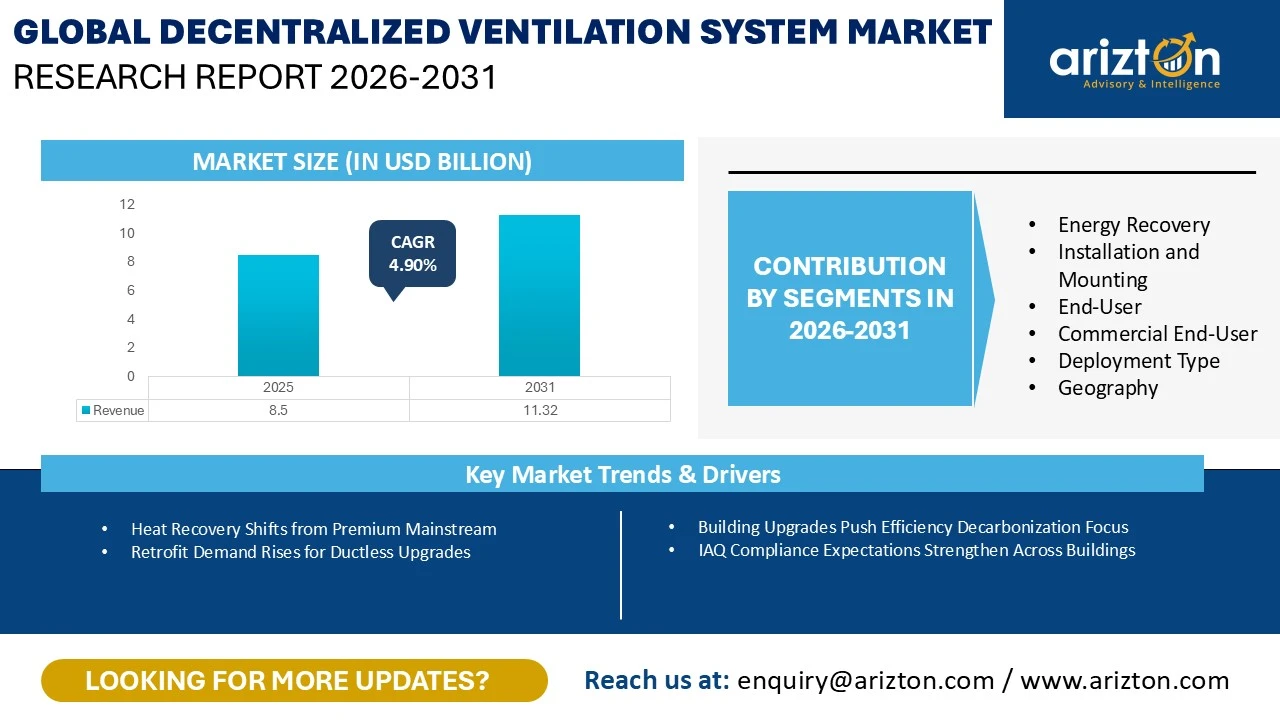
THE GLOBAL DECENTRALIZED VENTILATION SYSTEMS MARKET WAS VALUED AT USD 8.5 BILLION IN 2025 AND IS PROJECTED TO REACH USD 11.32 BILLION BY 2031, GROWING AT A CAGR OF 4.90%.
The Decentralized Ventilation System Market Size, Share & Trends Analysis Report By
- Energy Recovery: With Heat Recovery and Without Heat Recovery
- Installation and Mounting: Wall Mounted, Ceiling Mounted, Window Mounted, Façade Integration, Floor Mounted, and Others
- End-User: Residential, Commercial, and Industrial
- Commercial End-User: Education Institutions, Office Space, Healthcare Facility, Hospitality, Retail Space, Public & Government Utility, and Others
- Deployment Type: Retrofit and Renovation, and New Construction
- Geography: North America, Europe, APAC, Latin America, and Middle East & Africa
Industry Analysis Report, Regional Outlook, Growth Potential, Price Trends, Competitive Market Share & Forecast 2026–2031.
This report includes market data points, ranging from trend
analyses to market estimates & forecasts that you can customize
DECENTRALIZED VENTILATION SYSTEM MARKET REPORT SCOPE
| REPORT ATTRIBUTE | DETAILS |
|---|---|
| MARKET SIZE (2031) | USD 11.32 Billion |
| MARKET SIZE (2025) | USD 8.5 Billion |
| CAGR (2025-2031) | 4.90% |
| HISTORIC YEAR | 2022-2024 |
| BASE YEAR | 2025 |
| FORECAST YEAR | 2026-2031 |
| SEGMENTS BY | Energy Recovery, Installation and Mounting, End-User, Commercial End-User, Deployment Type, and Geography |
| GEOGRAPHIC ANALYSIS | North America, Europe, APAC, Latin America, & Middle East & Africa |
| KEY PLAYERS | Midea, Panasonic, Carrier, Systemair, Volution Group, and Daikin Industries Ltd. |
DECENTRALIZED VENTILATION SYSTEMS MARKET: COMPREHENSIVE ANALYSIS
The global decentralized ventilation systems market is expanding rapidly as room-level ventilation emerges as a highly practical solution to improve indoor air quality (IAQ) without compromising building energy performance.
Market Size, Share, and Growth Trajectory
The global decentralized ventilation systems market size was valued at USD 8.5 billion in 2025 and is projected to reach USD 11.32 billion by 2031. This represents a steady CAGR of 4.90% during the forecast period.
Decentralized ventilation systems deliver supply and extract ventilation directly at the room or zone level via compact wall-mounted, façade-mounted, or window-integrated units. Product selection in this space is heavily centered on:
- Stable airflow delivery
- Low operational noise
- Advanced filtration quality
- Dependable thermal performance
The High-Efficiency Shift
Buyer preference is increasingly shifting toward high-efficiency systems, particularly where heat recovery performance is a primary selection criterion. This trend is reinforced by strict industry benchmarks, such as the Passive House Institute’s August 2025 certification criteria for small ventilation systems, which mandate an effective dry-heat recovery efficiency of at least 75%.
To meet these requirements, manufacturers are innovating with space-saving designs. For example, Rehau’s Geneo Inovent integrates ventilation directly into the window frame, making heat-recovery ventilation easy to apply in space-constrained buildings without losing valuable square footage.
KEY TAKEAWAYS
- Energy Recovery: The systems with heat recovery show the fastest-growing CAGR of 5.20%.
- Installation and Mounting: The wall-mounted segment accounted for the largest market share of around 56% in 2025
- End-User: The commercial segment shows the highest growth in the global decentralized ventilation systems market
- Commercial End-User: The education institutions segment dominates and accounts for the largest market share.
- Deployment Type: The Retrofit and renovation segment accounted for the largest market share in 2025.
- Geography: Europe region accounted for the largest global decentralized ventilation systems market share of around 39%.
Recent Product Developments in the Decentralized Ventilation Systems Market
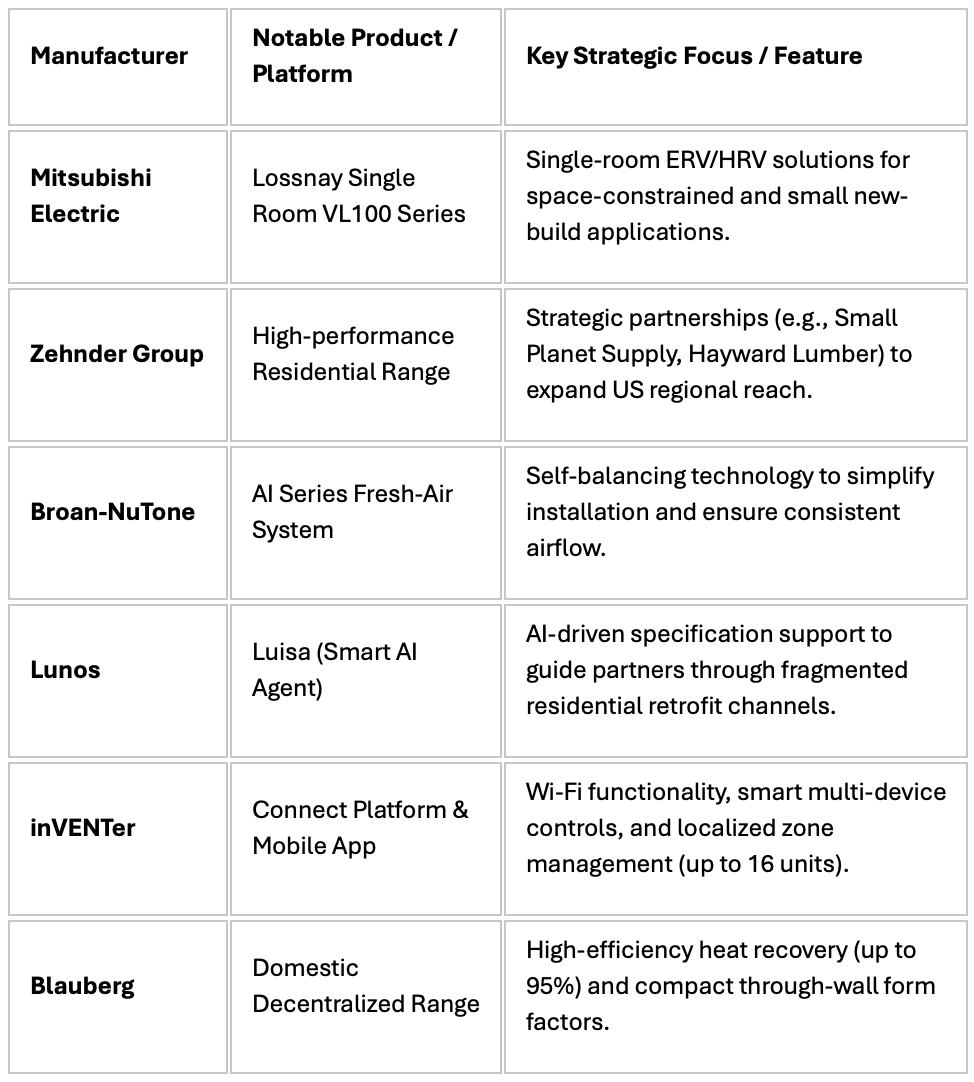
- In 2025, Mitsubishi Electric continued to position its Lossnay Single Room VL100 Series as a single-room energy-recovery ventilation solution for retrofit, small new-build, and space-constrained applications. This supports sustained specifier visibility for Lossnay in the global decentralized ventilation systems market, where single-room HRV and ERV adoption continues to expand.
- In September 2025, Zehnder Group announced a renewed partnership with Small Planet Supply and Hayward Lumber to expand indoor air quality and ventilation solutions across California. This strengthens Zehnder’s regional go-to-market reach and supports wider penetration of high-performance ventilation offerings across residential, builder-led, and room-level upgrade opportunities in the US market.
- In February 2025, Broan-NuTone introduced its AI Series fresh-air system with self-balancing technology at IBS 2025, positioned to simplify installation and improve ventilation performance consistency. This strengthens Broan-NuTone’s competitiveness in residential and multifamily ventilation applications, where easier commissioning and reliable airflow performance can support faster adoption.
- In September 2025, Lunos launched Luisa, a smart AI agent designed to support partners with verified, fact-based guidance across decentralized residential ventilation applications and components. This strengthens Lunos’s specification support and can improve partner decision cycles, supporting decentralized ventilation deployment across fragmented residential retrofit channels.
- In September 2025, Inventer introduced a mobile app update adding Wi-Fi functionality to improve control convenience and usability for connected decentralized ventilation devices. This strengthens the company’s smart-control value proposition and supports adoption in projects where app-based user experience, multi-device control, and room-level operation influence brand selection.
DECENTRALIZED VENTILATION MARKET TRENDS
retrofit demand rises for ductless upgrades
DVS are increasingly being used in retrofit projects because they provide fresh air without requiring new ductwork, making them suitable for buildings where central ventilation upgrades are challenging. Through-wall units with heat or energy recovery are well suited for occupied apartments, offices, and small retail spaces with limited ceiling space. Their room-by-room installation enables phased upgrades, reduces disruption, and supports the growing need for consistent airflow as insulation and window improvements make buildings more airtight.
heat recovery shifts from premium mainstream
Demand is growing for room-level fresh-air ventilation without significantly increasing heating and cooling costs. Compact DVS units recover heat from outgoing air and transfer it to incoming air, helping airtight apartments, clinics, and small offices maintain consistent indoor comfort while ensuring continuous ventilation. Improvements in heat recovery efficiency, lower energy consumption, and easier filter maintenance are further increasing the relevance of heat recovery DVS in both retrofit and new-build projects.
DECENTRALIZED VENTILATION MARKET DRIVERS
building upgrades push efficiency decarbonization focus
- Decarbonization-focused building upgrade programs are driving demand for DVS by linking indoor comfort with energy efficiency. As insulation, window replacement, air sealing, and heating upgrades make buildings more airtight, effective ventilation becomes increasingly important within retrofit projects. This is supporting DVS adoption, as room-level systems can provide fresh air while minimizing heat loss, making them suitable for occupied retrofits, energy-efficient new buildings, and sites where installing central ductwork is challenging.
Strengthening Global IP Regulations and Cross-Border Protection Frameworks
Heat recovery is emerging as a key product trend in DVS, as building owners increasingly seek room-level fresh-air ventilation without significantly increasing heating and cooling costs. Compact DVS units recover heat from outgoing air and transfer it to incoming air, helping airtight apartments, clinics, and small offices maintain comfortable indoor conditions while ensuring continuous ventilation. Advances in heat recovery efficiency, lower power consumption, and easier filter maintenance are further supporting the adoption of heat recovery DVS in both retrofit and new-build projects.
MARKET RESTRAINTS
High Cost of IP Protection and Litigation
- The rising cost of intellectual property protection and litigation is creating a significant barrier, particularly for startups, SMEs, and businesses in emerging markets. Filing, maintaining, and enforcing IP rights, especially patents, can require substantial financial investment, while additional enforcement and litigation expenses can further increase the overall cost.
DECENTRALIZED VENTILATION SYSTEM MARKET SEGMENTATION INSIGHTS
Technology Insight: Energy Recovery
The global decentralized ventilation systems market is divided into two primary technology types: systems with heat recovery and systems without heat recovery.
- The Growth Leader: Systems equipped with heat recovery are expanding at a CAGR of 5.20%, making it the fastest-growing sub-segment in the market.
- The Drivers: Modern residential and light commercial buildings increasingly feature airtight building envelopes. Heat recovery technologies solve the twin challenges of maintaining excellent indoor air quality (IAQ) and minimizing energy loss simultaneously.
Regulatory & Institutional Backing:
- BC Housing’s residential design frameworks explicitly highlight Heat Recovery Ventilators (HRVs) and Energy Recovery Ventilators (ERVs) as foundational components of healthy indoor living environments for both new builds and deep energy retrofits.
- New Zealand's official building guidance emphasizes that decentralized heat recovery units efficiently provide fresh-air exchange while drastically reducing local space-heating demand.
- Commercial Applications: Manufacturers are closely aligning their product portfolios with these strict performance metrics. For example, Blauberg guarantees up to 95% heat recovery efficiency for its domestic decentralized systems. Similarly, TROX targets high-occupancy environments like classrooms and boardrooms with its SCHOOLAIR-D system, a decentralized supply-and-extract unit featuring high-efficiency crossflow heat recovery.
Physical Format: Installation and Mounting
When evaluated by physical deployment and architecture, the wall-mounted segment dominated the industry, capturing a 56% market share in 2025.
- System Design: Wall-mounted decentralized units are through-wall configurations installed directly into a building's external facade. They deliver localized room-level supply, extract, or balanced air exchange. These compact assemblies typically integrate energy-efficient EC (electronically commutated) fans, multi-stage filtration, weatherproof exterior hoods, and either regenerative or recuperative heat recovery cores.
- Application Focus: Residential retrofits and multi-family apartment upgrades rely heavily on wall-mounted systems. They allow contractors to upgrade bedrooms and living areas incrementally on a room-by-room basis without disturbing adjacent spaces.
- Market Catalysts: Rising energy costs and supportive regional building codes are accelerating specification rates in schools and small commercial real estate where direct exterior wall access is available. Furthermore, tightening EU eco-design requirements for ventilation units continue to push the market forward by mandating higher efficiency testing protocols and stricter baseline performance benchmarks.
Sector Analysis: End-User Dynamics
The commercial segment represents the highest-growth vertical across the global decentralized ventilation space.
Commercial Application Footprint:
- Product Footprint: Commercial deployments address a wide variety of public and private premises, including offices, classrooms, meeting rooms, nurseries, retail shops, and restaurants. These environments typically require continuous room-level supply and extract ventilation with robust filtration and optional heat recovery.
- Form Factors: To accommodate higher occupant densities and structural constraints, manufacturers offer alternative physical layouts beyond wall units. Ceiling-suspended and floor-standing configurations are heavily favored by commercial property managers because they support high-density airflow and simplify facility-managed maintenance cycles.
- Industry Standards: Compliance frameworks like ASHRAE Standard 62.1 serve as major market drivers by legally reinforcing the mandatory requirement for acceptable IAQ in non-residential buildings. Key industry solutions include Trox’s specialized façade-integrated ventilation lines for corporate offices and daycare facilities, alongside the Ambientika Office system, which delivers targeted airflows up to for medical waiting rooms and commercial spaces.
Commercial Focus: Educational Institutions
Within the commercial marketplace, the educational institutions sub-segment dominates and commands the largest overall market share.
- Procurement Advantages: School districts and universities shape commercial procurement trends because decentralized units allow indoor air quality performance to be verified room by room and seamlessly replicated across separate building wings.
- Equipment Profile: Educational spaces, including K-12 classrooms, university lecture halls, training labs, and dorm common areas, experience intense, cyclical occupancy patterns. This sector relies heavily on a combination of ceiling-suspended classroom units, floor-standing room ventilators, and facade-linked modules that deliver balanced air exchange, heavy-duty filtration, and thermal energy recovery.
- Public Policy Impact: Government initiatives have directly elevated the profile of localized air management. For instance, the UK Department for Education provided state-funded schools with dedicated monitors to guide manual and mechanical ventilation actions while optimizing energy conservation, highlighting the vital role of zone-specific air controls.
Project Type: Retrofit vs. New Construction
The decentralized ventilation market is divided by project type into new construction, retrofit, and renovation, with the latter accounting for the largest total market share in 2025.
- The Renovation Advantage: Retrofit activities comprise the bulk of decentralized installations, driven by large-scale municipal building modernization programs, apartment refurbishment cycles, and historical building upgrades. Through-wall or façade-adjacent systems utilize localized, room-by-room commissioning, enabling full-scale building upgrades to proceed in a phased, step-by-step manner with minimal disruption to occupants.
- Primary Adopters: Multi-family housing complexes and educational facilities favor this deployment type because phased installations fit tight, room-by-room budgeting cycles while delivering immediate improvements to occupant health. Commercial office towers are also adopting decentralized retrofits in areas where direct façade access simplifies equipment routing, installation, and filter replacements.
- Smart Integration: Advanced, demand-led control technologies are maximizing the operational efficiency of retrofitted systems. Wireless networking platforms now allow facility managers to coordinate distinct ventilation profiles across entire building zones. A prime example is inVENTer’s Connect platform, which can wirelessly coordinate up to 16 individual ventilation units across four distinct zones a design perfectly optimized for corridor-based apartment complexes and multi-classroom school wings.
GEOGRAPHICAL ANALYSIS
Europe: The Market Leader
Europe accounted for the largest global market share at approximately 39%. The region uniquely combines one of the world's strictest building renovation pipelines with a dense concentration of decentralized ventilation suppliers. The Energy Performance of Buildings Directive (EPBD) notes that 85% of EU buildings were constructed before 2000, and 75% suffer from poor energy performance, ensuring a massive, continuous pipeline for room-based energy renovations.
Asia-Pacific (APAC): Rapid Urbanization
Following Europe, APAC demand is primarily driven by China and Japan. The region is characterized by immense urban housing volumes, high-density residential developments, and tightening building-efficiency regulations.
- Demographic Drivers: UN-Habitat projects Asia’s urban population to grow by 50% by 2050 (adding 1.2 billion people), drastically expanding the construction base.
- Japan: New mandatory energy standards enacted for all new houses bolster structured ventilation specifications in residential construction.
- China: Holds a massive share of the regional market, backed by surging indoor air quality awareness and a robust local manufacturing base. Local manufacturers like Holtop market wall-mounted, single-room heat recovery ventilators widely across domestic homes, hotels, and public buildings, aligning local production directly with room-level demand.
COMPETITIVE VENDOR LANDSCAPE
The decentralized ventilation market features a competitive mix of European room-ventilation specialists, diversified ventilation groups, and global HVAC manufacturers expanding into single-room heat and energy recovery portfolios.
Emerging Competitive Priorities
- From Standalone to Connected Systems: Market competition is shifting away from basic air exchange toward intelligent, sensor-led multi-room systems. Leading vendors are integrating sensor-driven automation capable of monitoring occupancy patterns, relative humidity, and real-time volatile organic compounds (VOCs).
- Localization of Product Design: Vendors are heavily adapting product features to regional housing formats. While European specialists prioritize through-wall heat recovery upgrades for historic or tightly packed apartments, North American players like Panasonic focus on compact energy recovery ventilators (ERVs) tailored for targeted spot ventilation applications and local efficiency standards.
SNAPSHOT
The global decentralized ventilation systems market size is expected to grow at a CAGR of approximately 4.90% from 2025 to 2031.
The following factors are likely to contribute to the growth of the global decentralized ventilation systems market during the forecast period:
- Building Upgrades Push Efficiency Decarbonization Focus
- IAQ Compliance Expectations Strengthen Across Buildings
- Reduced Natural Airflow Increases Ventilation Demand
- Space Constraints Favour Room-Based Decentralized Systems
Base Year: 2025
Forecast Year: 2026-2031
The report examines the current state of the global decentralized ventilation systems market and its market dynamics through 2026−2031. It covers a detailed overview of several market growth enablers, restraints, and trends. The study covers both the demand and supply sides of the market. It also profiles and analyses leading companies and several other prominent companies operating in the market.
Key Vendors
- Midea
- Business Overview
- Product Offerings
- Key Developments
- Key Strategies
- Key Strengths
- Key Opportunities
- Panasonic
- Carrier
- Systemair
- Volution Group
- Daikin Industries Ltd.
Other Prominent Vendors
- Gree Electric Appliances, Inc
- Business Overview
- Product Offerings
- Mitsubishi Electric Corporation
- Johnson Controls
- LG Electronics
- Haier
- Zehnder
- Broan NuTone
- RenewAire
- Aldes
- Aereco
- LUNOS
- inVENters
- VENTS
- Blauberg
- Soler & Palau
- Helios
- Meltem
- MAICO Ventilatoren
- Marley
- GetAir
- DUKA
- Vallox
- Brink
- Siegenia
Segmentation by Energy Recovery
- With Heat Recovery
- Without Heat Recovery
Segmentation by Installation and Mounting
- Wall Mounted
- Ceiling Mounted
- Window Mounted
- Façade Integration
- Floor Mounted
- Others
Segmentation by End-User
- Residential
- Commercial
- Industrial
Segmentation by Commercial End-User
- Education Institutions
- Office Space
- Healthcare Facility
- Hospitality
- Retail Space
- Public & Government Utility
- Others
Segmentation by Deployment Type
- Retrofit and Renovation
- New Construction
Segmentation by Geography
- North America
- US
- Canada
- APAC
- China
- Japan
- India
- South Korea
- Australia
- Taiwan
- Singapore
- Europe
- Germany
- UK
- France
- Italy
- Spain
- Poland
- Netherlands
- Switzerland
- Austria
- Latin America
- Brazil
- Mexico
- Chile
- Middle East & Africa
- Saudi Arabia
- UAE
- South Africa
DECENTRALIZED VENTILATION SYSTEM MARKET FAQs
What is the growth rate of the global decentralized ventilation systems market?
What are the key trends in the global decentralized ventilation systems market?
Which region dominates the global decentralized ventilation systems market?
How big is the global decentralized ventilation systems market?
Who are the major players in the global decentralized ventilation systems market?
For more details, please reach us at [email protected]
- Chapter 1- Scope & Coverage
- Market Definition
- Inclusion
- Exclusions
- Market Estimation Caveats
- Market Derivation
- Market Segmentation by Energy Recovery
- Market Segmentation by Installation and Mounting
- Market Segmentation by Deployment type
- Market Segmentation by End-User
- Market Segmentation by Commercial End-User
- Chapter 2- Premium Insights
- Chapter 3- Market Dynamics
- Introduction
- Operating Principle of Decentralized Ventilation Systems
- Innovation Themes Shaping the Next Product Cycle
- Product Category Landscape for Decentralized Ventilation
- Centralized Vs Decentralized System Selection
- Horizontal Vs Vertical Unit Format Selection
- Cost and Pricing Drivers for Decentralized Ventilation Systems
- Product Improvements Driving Today’s Buying Decisions
- Market Opportunities & Trends
- Retrofit Demand Rises for Ductless Upgrades
- Heat Recovery Shifts from Premium Mainstream
- Demand Control Grows Using CO2 Humidity
- Acoustics Drives Differentiation in Urban Housing
- Market Growth Enablers
- Building Upgrades Push Efficiency Decarbonization Focus
- IAQ Compliance Expectations Strengthen Across Buildings
- Reduced Natural Airflow Increases Ventilation Demand
- Space Constraints Favor Room Based Decentralized Systems
- Market Restraints
- Façade Penetrations Need Early Envelope Planning
- Acoustics Depend on Installation and Placement
- Commissioning Capability Required for Verified Airflow
- Filter Maintenance Discipline Shapes Lifecycle Performance
- Market Landscape
- Five Forces Analysis
- Chapter 4- Market Segmentation
- Installation and Mounting (Market Size & Forecast: 2022-2031)
- Wall Mounted
- Ceiling Mounted
- Window Mounted
- Façade Integration
- Floor Mounted
- Others
- End-User (Market Size & Forecast: 2022-2031)
- Residential
- Commercial
- Industrial
- Deployment Type (Market Size & Forecast: 2022-2031)
- Retrofit and Renovation
- New Construction
- Energy Recovery (Market Size & Forecast: 2022-2031)
- With Heat Recovery
- Without Heat Recovery
- Commercial End-User (Market Size & Forecast: 2022-2031)
- Education Institutions
- Office Space
- Healthcare Facility
- Hospitality
- Retail Space
- Public & Government Utility
- Others
- Chapter 5- Geography Segmentation
- Geography Segmentation (Market Size & Forecast: 2022-2031)
- Geographic Overview – Market Maturity Index
- APAC
- China
- Japan
- India
- South Korea
- Australia
- Taiwan
- Singapore
- North America
- US
- Canada
- Europe
- Germany
- UK
- France
- Italy
- Spain
- Poland
- Netherlands
- Switzerland
- Austria
- Latin America
- Brazil
- Mexico
- Chile
- MEA
- Saudi Arabia
- UAE
- South Africa
- Chapter 6- Competitive Landscape
- Competitive Landscape
- Competition Overview
- Key Developments
- Key Company Profiles
- Other Prominent Company Profiles
- Report Summary
- Key Takeaways
- Strategic Recommendations
Select a license type that suits your business needs
Single User Licence
- Report accessible by one user only
- Free 10% or 3 days of customization
- Free post-sale service assistance
- Continuous support through email
5 User Licence
- Report accessible by 5 users within the organization
- Free 15% or 4.5 days of customization
- Continuous support through email and telephone
- Free analyst hour
- Free Upgrade: If an updated report published within 180 days of purchase, you will get the revised report free of charge
Corporate Licence
- Free Datasheet worth $1500
- Report accessible by the entire organization
- Free 20% or 6 days of customization
- Free post-sale service assistance
- Continuous support through email and telephone
- Direct access to lead analysts
- Free analyst hour
- Free Upgrade: If an updated report published within 180 days of purchase, you will get the revised report free of charge
Datasheet Licence
- Report accessible by 1 user only
- Free 15% or 32 hours of customization
- Free post-sale service assistance
- Direct access to lead analysts
Frequently Asked Questions
What is the growth rate of the global decentralized ventilation systems market?
What are the key trends in the global decentralized ventilation systems market?
Which region dominates the global decentralized ventilation systems market?
How big is the global decentralized ventilation systems market?
Who are the major players in the global decentralized ventilation systems market?
Other RELATED Reports


Europe HVAC Maintenance and Services Market - Industry Outlook & Forecast 2024-2029
Published : May 2024
