
Southeast Asia Data Center Colocation Market - Supply & Demand Analysis 2025-2030



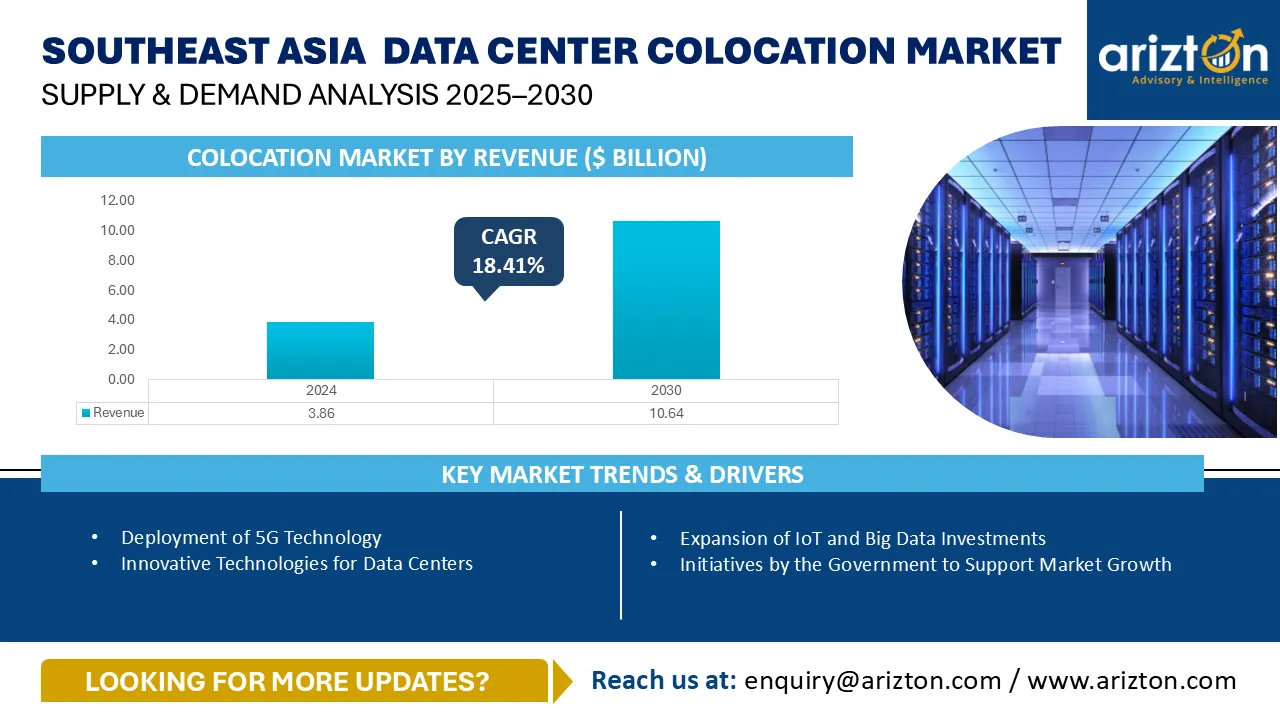
SOUTHEAST ASIA DATA CENTER COLOCATION MARKET SIZE WAS VALUED AT USD 3.86 BILLION IN 2024 AND IS EXPECTED TO REACH USD 10.64 BILLION BY 2030, GROWING AT A CAGR OF 18.41% DURING THE FORECAST PERIOD
The Southeast Asia Data Center Colocation Market Report Includes
- Colocation Supply (MW, Area, Rack Capacity)
- Colocation Demand (MW, Area, Rack Capacity) and by End-User (Cloud/IT, BFSI, etc..)
- Colocation Revenue (Retail & Wholesale Colocation Services)
- Competitive Scenario (Market Share Analysis by Revenue & MW Capacity)
- Geography (Singapore, Malaysia, Indonesia, Thailand, Philippines, and Vietnam)
Get Insights on 270 Existing Colocation Data Center Facilities and 135 Upcoming Facilities across Southeast Asia
This report includes market data points, ranging from trend
analyses to market estimates & forecasts that you can customize
SOUTHEAST ASIA DATA CENTER COLOCATION MARKET REPORT SCOPE
| REPORT ATTRIBUTE | DETAILS |
|---|---|
| MARKET SIZE - COLOCATION REVENUE | USD 10.64 Billion (2030) |
| CAGR - COLOCATION REVENUE | 18.41% (2024-2030) |
| MARKET SIZE - UTILIZED WHITE FLOOR AREA | 35.23 million sq. feet (2030) |
| MARKET SIZE - UTILIZED RACKS | 760.19 thousand units (2030) |
| MARKET SIZE - UTILIZED IT POWER CAPACITY | 7,450 MW (2030) |
| BASE YEAR | 2024 |
| FORECAST YEAR | 2025-2030 |
SOUTHEAST ASIA DATA CENTER COLOCATION DEMAND AND SUPPLY HIGHLIGHTS
The Southeast Asia data center colocation market size was valued at USD 3.86 billion in 2024 and is expected to reach USD 10.64 billion by 2030, growing at a CAGR of 18.41% during the forecast period. Singapore and Malaysia continue to be Southeast Asia’s leading hubs for data center expansion, marked by a concentrated growth in advanced facilities and dedicated cloud regions.
The Southeast Asia data center colocation market, including Singapore, Malaysia, Indonesia, Thailand, Vietnam, and the Philippines, has around 270 operational colocation data centers, and this number will increase over time, as several existing and new companies have planned investments in the region. Furthermore, the Indonesian colocation industry will continue to grow owing to the government’s digitalization vision, the installation of strong infrastructure, and a stable economy. The colocation vacancy rate of Indonesia is around 12%, which is higher than in many other South Asian countries, such as Singapore.
Some of the leading colocation operators in Southeast Asia’s data center colocation market include Bridge Data Centres, ST Telemedia Global Data Centres, AirTrunk, DayOne (GDS Services), Digital Realty, Equinix, DCI Indonesia, Telkom Indonesia, Princeton Digital Group, and others. Also, the region’s increasing shift to digital activities creates a high demand for colocation data centers, presenting significant opportunities for its data center industry.
The growing opportunities in the Southeast Asia data center colocation market have attracted several new entrants, such as BW Digital, CloudHQ, CtrlS Datacenters, DAMAC Digital, Epoch Digital, NEXTDC, Regak Orion, SEAX Global, and STACK Infrastructure, who are rapidly gaining market share, contributing to increased competition and innovation in the region.
Turning to cloud services is crucial in the Southeast Asia region due to its rapidly growing digital economy, large population base, and rising demand for scalable, on-demand computing. The rapid digitalization of businesses, growth in e-commerce, remote work adoption, and increased use of AI-driven applications are fueling strong demand for cloud services across Southeast Asia.
WHAT'S INCLUDED?
- Transparent research methodology and insights on the industry's colocation of demand and supply.
- The industry size is available in terms of utilized white floor area, IT power capacity, and racks.
- The market size available in terms of Core & Shell Vs Installed Vs Utilized IT Power Capacity, along with the occupancy %.
- An assessment and snapshot of the colocation investment in Southeast Asia.
- The study of the existing Southeast Asia data center industry landscape and insightful predictions about industry size during the forecast period.
- An analysis of the current and future colocation demand in Southeast Asia by several industries.
- Impact of AI on the Data Center Industry in Southeast Asia.
- Study on the sustainability status in the region.
- Analysis of current and future cloud operations in the region.
- Snapshot of upcoming submarine cables and existing cloud-on-ramps services in the region.
- Snapshot of existing and upcoming third-party data center facilities in Southeast Asia
- Facilities Covered (Existing): 270
- Facilities Identified (Upcoming): 135
- Coverage: 50+ Locations
- Existing vs. Upcoming (White Floor Area)
- Existing vs. Upcoming (IT Load Capacity)
- Data Center Colocation Market in Southeast Asia
- Colocation Market Revenue & Forecast (2024-2030)
- Retail Colocation Revenue (2024-2030)
- Wholesale Colocation Revenue (2024-2030)
- Retail Colocation Pricing along with Addons
- Wholesale Colocation Pricing, along with the pricing trends.
- An analysis of the latest trends, potential opportunities, growth restraints, and prospects for the Southeast Asia data center colocation market.
- Competitive landscape, including industry share analysis by the colocation operators based on IT power capacity and revenue.
- The vendor landscape of each existing and upcoming colocation operator is based on the existing/ upcoming count of data centers, white floor area, IT power capacity, and data center location.
SNAPSHOT
The Southeast Asia data center colocation market is projected to reach USD 10.64 billion by 2030, growing at a CAGR of 18.41% from 2024 to 2030.
The following factors are likely to contribute to the growth of the Southeast Asia data center colocation market during the forecast period:
- Expansion of IoT and Big Data Investments
- Initiatives by the Government to Support the Data Center Market Growth
Base Year: 2024
Forecast Year: 2025-2030
The report considers the present scenario of the Southeast Asia data center colocation market and its market dynamics for 2025−2030. It covers a detailed overview of several market growth enablers, restraints, and trends. The study includes the demand and supply aspects of the Southeast Asia data center colocation industry.
The report includes:
- Colocation Supply (MW, Area, Rack Capacity)
- Colocation Demand (MW, Area, Rack Capacity) and by End-User (Cloud/IT, BFSI, etc..)
- Colocation Revenue (Retail & Wholesale Colocation Services)
- Competitive Scenario (Share Analysis by Revenue & MW Capacity)
- Geography (Singapore, Malaysia, Indonesia, Thailand, Philippines, Vietnam)
VENDOR LANDSCAPE
Existing Colocation Operators
- Bridge Data Centres
- ST Telemedia Global Data Centres
- Equinix
- AirTrunk
- Keppel DC REIT
- DayOne
- Digital Realty
- DCI Indonesia
- Princeton Digital Group
- K2 Strategic
- NTT DATA
- YTL Data Center Holdings
- ePLDT
- Nxera (Singtel)
- BDx Data Center
- Viettel IDC
- Others
New Operators
- FLOW Digital Infrastructure
- BW Digital
- CloudHQ
- CtrlS Datacenters
- DAMAC Digital
- Digital Halo
- Doma Infrastructure Group
- Epoch Digital
- Evolution Data Centres
- Future Data
- Global Telecommunications
- Infinaxis Data Centre Holdings
- Infracrowd Capital
- Megawide Construction Corporation
- NEXTDC
- SEAX Global
- STACK Infrastructure
SOUTHEAST ASIA DATA CENTER COLOCATION MARKET FAQs
Who are the new entrants in the Southeast Asia data center industry?
How much MW of IT power capacity is likely to be utilized in Southeast Asia by 2030?
What is the count of existing and upcoming colocation data center facilities in Southeast Asia?
What factors are driving the Southeast Asia data center colocation industry?
For more details, please reach us at [email protected]
ABOUT ARIZTON
ABOUT OUR DATA CENTER CAPABILITIES
RESEARCH METHODOLOGY
MARKET SCOPE
MARKET DEFINITIONS
CHAPTER 01 – MARKET SNAPSHOT
Colocation Market Snapshot
Southeast Asia Colocation Market Snapshot
Market By IT Power Capacity
Colocation Market by Revenue
Retail Vs. Wholesale Colocation
Market By Utilized Area
Market By Utilized Racks
CHAPTER 02 – SUPPLY & DEMAND ANALYSIS
Existing Vs. Upcoming Data Center Facilities
CHAPTER 03 – MARKET DYNAMICS
Key Trends
Sustainability Status in Southeast Asia
Key Enablers/Drivers
Cloud Connectivity
Submarine Cables & Inland Connectivity
Key Restraints
CHAPTER 04 – GEOGRAPHY
Singapore
Malaysia
Indonesia
Thailand
Philippines
Vietnam
CHAPTER 05 – COMPETITIVE LANDSCAPE
Competitive Landscape by Colocation Operators
Market Share by Colocation Revenue
Market Share by It Power Capacity
Existing Colocation Operators
New Operators
QUANTITATIVE SUMMARY
Select a license type that suits your business needs
Single User Licence
- Report accessible by one user only
- Free 10% or 3 days of customization
- Free post-sale service assistance
- Continuous support through email
5 User Licence
- Report accessible by 5 users within the organization
- Free 15% or 4.5 days of customization
- Continuous support through email and telephone
- Free analyst hour
- Free Upgrade: If an updated report published within 180 days of purchase, you will get the revised report free of charge
Corporate Licence
- Free Datasheet worth $1500
- Report accessible by the entire organization
- Free 20% or 6 days of customization
- Free post-sale service assistance
- Continuous support through email and telephone
- Direct access to lead analysts
- Free analyst hour
- Free Upgrade: If an updated report published within 180 days of purchase, you will get the revised report free of charge
Datasheet Licence
- Report accessible by 1 user only
- Free 15% or 32 hours of customization
- Free post-sale service assistance
- Direct access to lead analysts
Frequently Asked Questions
Who are the new entrants in the Southeast Asia data center industry?
How much MW of IT power capacity is likely to be utilized in Southeast Asia by 2030?
What is the count of existing and upcoming colocation data center facilities in Southeast Asia?
What factors are driving the Southeast Asia data center colocation industry?
Other RELATED Reports

India Data Center Colocation Market - Supply & Demand Analysis 2025-2030
Published : September 2025
Japan Data Center Colocation Market - Supply & Demand Analysis 2025-2030
Published : August 2025
APAC Data Center Colocation Market - Industry Outlook & Forecast 2025-2030
Published : August 2025
New Zealand Data Center Colocation Market - Supply and Demand Analysis 2025-2030
Published : August 2025