
Southeast Asia Data Center Construction Market – Industry Outlook & Forecast 2026-2031



Southeast Asia Data Center Construction Market – Industry Outlook & Forecast 2026-2031
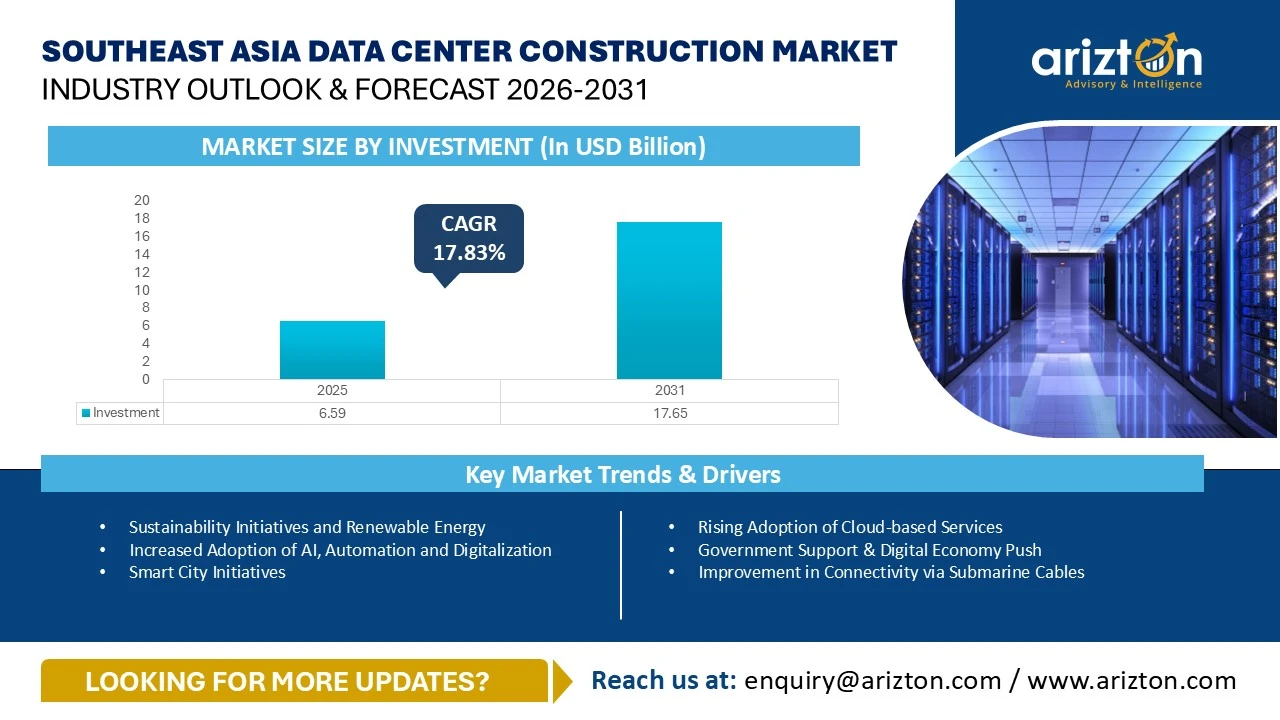
THE SOUTHEAST ASIA DATA CENTER CONSTRUCTION MARKET SIZE WAS VALUED AT USD 6.59 BILLION IN 2025 AND IS EXPECTED TO REACH USD 17.65 BILLION BY 2031, GROWING AT A CAGR OF 17.83%.
The Southeast Asia Data Center Construction Market Research Report Includes Size, Share, and Growth in Terms of
- Facility Type: Hyperscale Data Centers, Colocation Data Centers, and Enterprise Data Centers
- Infrastructure: Electrical Infrastructure, Mechanical Infrastructure, and General Construction
- Electrical Infrastructure: UPS Systems, Generators, Transfer Switches & Switchgears, PDUs, and Other Electrical Infrastructure
- Mechanical Infrastructure: Cooling Systems, Racks, and Other Mechanical Infrastructure
- Cooling System: CRAC & CRAH Units, Chillers Units, Cooling Towers, Condensers, and Dry Coolers, and Other Cooling Units
- Cooling Techniques: Air-based Cooling and Liquid-based Cooling
- General Construction: Core & Shell Development, Installation & Commissioning Services, Engineering & Building Design, Fire Detection & Suppression, Physical Security, and DCIM/BMS Solutions
- Tier Standards: Tier I & Tier II, Tier III, and Tier IV
- Geography: Singapore, Malaysia, Indonesia, Thailand, Philippines, Vietnam, and Other Southeast Asia Countries
Industry Analysis Report, Regional Outlook, Growth Potential, Price Trends, Competitive Market Share & Forecast 2026–2031.
This report includes market data points, ranging from trend
analyses to market estimates & forecasts that you can customize
SOUTHEAST ASIA DATA CENTER CONSTRUCTION MARKET REPORT SCOPE
| REPORT ATTRIBUTE | DETAILS |
|---|---|
| MARKET SIZE BY INVESTMENT (2031) | USD 17.65 Billion |
| MARKET SIZE BY INVESTMENT (2025) | USD 6.59 Billion |
| CAGR BY INVESTMENT (2025-2031) | 17.83% |
| MARKET SIZE - AREA (2031) | 5.83 Million Sq. Ft. |
| POWER CAPACITY (2031) | 1,435 MW |
| HISTORIC YEAR | 2022-2024 |
| BASE YEAR | 2025 |
| FORECAST YEAR | 2026-2031 |
| MARKET SEGMENTS | Facility Type, Infrastructure, Electrical Infrastructure, Mechanical Infrastructure, Cooling Systems, Cooling Technique, General Construction, Tier Standards, and Geography |
| GEOGRAPHICAL ANALYSIS | Singapore, Indonesia, Malaysia, Philippines, Vietnam, Thailand and Other Southeast Asian Countries |
SOUTHEAST ASIA DATA CENTER CONSTRUCTION MARKET SIZE
The Southeast Asia data center construction market by investment was valued at USD 6.59 billion in 2025 and is projected to reach USD 17.65 billion by 2031, growing at a CAGR of 17.83%. Rising demand for cloud computing, AI, 5G, e-commerce, fintech, video streaming, and digital services is driving data center development across the region.
The market is expected to attract USD 86.57 billion in cumulative investments between 2026 and 2031, with Malaysia accounting for approximately USD 43.15 billion (50% of the total). Singapore, Indonesia, and Thailand are also emerging as key investment destinations, supported by digital infrastructure expansion and favorable development initiatives.
Data center construction costs in Southeast Asia range from USD 7 million to USD 11 million per MW, depending on location, land availability, labor costs, and power access. Investors are increasingly exploring locations offering affordable land, reliable power, and supportive regulations to improve project economics.
Leading operators, including Bridge Data Centres, Digital Realty, Equinix, AirTrunk, NTT DATA, Princeton Digital Group, DayOne, ST Telemedia Global Data Centres, and Vantage Data Centers, are strengthening their regional presence through investments and capacity expansion.
SOUTHEAST ASIA DATA CENTER CONSTRUCTION MARKET INSIGHTS BY AREA
The total operational data center area in Southeast Asia is projected to reach approximately 5.83 million sq. ft. by 2031, reflecting the region's expanding digital infrastructure and increasing demand for data center capacity. This growth is supported by rising investments from global and regional operators, along with the growing adoption of cloud computing, artificial intelligence, and other data-intensive technologies.
Several key locations across Southeast Asia are emerging as prominent data center development hubs, attracting investments from major operators and infrastructure developers. These markets are gaining importance due to their connectivity, digital ecosystem, power availability, and growing demand for data storage and processing facilities. However, industrial land prices vary considerably across the region, depending on the location, infrastructure readiness, land availability, and proximity to major business and technology hubs. These differences in land costs play an important role in determining project feasibility, construction expenses, and investment decisions.
SOUTHEAST ASIA DATA CENTER CONSTRUCTION MARKET INSIGHTS BY POWER CAPACITY
The total power capacity of the Southeast Asia data center construction market is projected to reach approximately 1,435 MW by 2031, driven by increasing investments in digital infrastructure and the growing demand for reliable power to support expanding data center operations. As new facilities are developed across the region, securing a stable and sustainable energy supply is becoming a key priority for data center operators.
To address these requirements, several companies are increasingly entering into Power Purchase Agreements (PPAs) to secure long-term electricity supplies for their data centers. These agreements help operators improve energy reliability, manage long-term power costs, and increase the use of renewable energy. PPAs are also becoming an important part of companies' sustainability strategies, supporting their environmental commitments while improving the long-term operational efficiency of data center facilities.
KEY TAKEAWAYS
- Facility Type: The colocation data centers played a significant role in the Southeast Asia data center construction market in 2025
- Infrastructure: The general construction emerged as a major component of the Southeast Asia data center construction market in 2025
- Electrical Infrastructure: Uninterruptible Power Supply (UPS) systems dominated the electrical infrastructure segment of the Southeast Asia data center construction market, accounting for approximately 29% of the total market share
- Mechanical Infrastructure: The cooling systems represented the largest segment of the Southeast Asia data center construction market in 2025.
- Insight by Cooling System: In 2025, CRAC & CRAH Units dominated the cooling infrastructure segment of the Southeast Asia data center construction market
- Insight by Cooling Technique: In 2025, air-based cooling dominated the cooling technique segment of the Southeast Asia data center construction market
- General Construction: In 2025, core & shell development represented the largest segment of the Southeast Asia data center construction market
- Tier Standard: The tier III facilities dominated the Southeast Asia data center construction market in 2025.
RECENT DEVELOPMENTS & NEWS IN THE SOUTHEAST ASIA DATA CENTER CONSTRUCTION MARKET
- February 2025, AirTrunk announced its second data center project in Johor. The proposed JHB2 facility in Iskandar Puteri is expected to deliver more than 270 MW of IT capacity. Together with its existing JHB1 facility, the two projects are expected to provide over 420 MW of IT load, with a combined investment of approximately RM9.7 billion.
- August 2025, IJM Construction secured a RM1.4 billion data center construction contract in Johor Bahru. The project involves a six-storey facility with approximately 62,000 sq. m. of gross floor area and incorporates sustainability features targeting LEED Gold and GreenRE Platinum certifications.
- January 2026, Digital Edge announced a USD 4.5 billion investment in its CGK Campus in Bekasi. The AI-ready hyperscale campus is planned to deliver 500 MW of IT capacity, with potential scalability to 1 GW. Its design includes direct-to-chip liquid cooling, recycled water systems, and renewable energy integration.
- June 2026, Princeton Digital Group (PDG) began construction of its 240 MW JC4 data center in Bekasi. The project is expected to increase PDG's total data center capacity in Indonesia to approximately 400 MW.
SOUTHEAST ASIA DATA CENTER CONSTRUCTION MARKET DRIVERS
Rising Adoption of Cloud-based Services
The adoption of cloud services is becoming increasingly important across Southeast Asia, supported by the region's rapidly expanding digital economy, large population base, and rising demand for scalable, on-demand computing solutions. The rapid digitalization of businesses, continued growth of e-commerce, increasing adoption of remote and hybrid working models, and wider use of AI-driven applications are creating strong demand for cloud-based infrastructure and services across the region.
Several countries in Southeast Asia are witnessing accelerated cloud adoption across multiple industry verticals as businesses increasingly prioritize scalability, cost efficiency, operational flexibility, and digital transformation. Organizations are shifting toward cloud platforms to manage growing data volumes, streamline business operations, improve IT infrastructure flexibility, and support evolving technology requirements. This growing reliance on cloud services is also encouraging investments in data center infrastructure, creating additional opportunities for construction and capacity expansion across the region.
Government Support & Digital Economy Push
Government policies play a significant role in supporting data center development across Southeast Asia by facilitating infrastructure expansion, promoting energy efficiency, attracting investments, and strengthening data sovereignty. As digitalization accelerates across the region, governments are introducing initiatives and regulatory frameworks to encourage technology adoption, improve digital connectivity, and create a supportive environment for data center investments.
Several countries are actively implementing digital-first strategies, with a focus on cloud-first policies, e-governance services, and digital skills development programs. These initiatives are increasing the need for reliable digital infrastructure and expanding demand for data center capacity. For instance, Vietnam's Industry 4.0 framework promotes the development of smart cities and Industry 4.0 projects, supporting the country's broader digital transformation objectives. Similarly, Thailand's Digital Economy Promotion Agency (DEPA) works with public- and private-sector partners to accelerate IoT deployment and encourage the adoption of digital technologies. Such government-led initiatives are contributing to the development of Southeast Asia's digital ecosystem and creating opportunities for data center infrastructure expansion.
SOUTHEAST ASIA DATA CENTER CONSTRUCTION MARKET TRENDS
Sustainability Initiatives and Renewable Energy
Data centers are among the major energy-consuming facilities worldwide, as they require continuous electricity to support servers, cooling systems, networking equipment, and other critical infrastructure. Their growing energy demand also contributes to carbon emissions, increasing the need for more sustainable power solutions. However, the environmental impact of data center operations can be reduced by transitioning toward cleaner energy sources, including solar power, green hydrogen, and other renewable energy alternatives.
With a growing proportion of global data being processed and stored in data centers, electricity consumption is expected to increase significantly in the coming years. Data centers alone are estimated to account for approximately 8% of total global energy consumption by 2030, highlighting the importance of energy-efficient infrastructure and sustainable power procurement. Consequently, data center operators are increasingly focusing on renewable energy adoption and energy optimization strategies to manage their environmental footprint while supporting long-term capacity expansion.
Adoption of Liquid Cooling and Innovative Data Center Technologies
The growing demand for high-density computing, AI-driven workloads, and edge computing deployments across Southeast Asia is encouraging data center operators to adopt advanced infrastructure technologies. These include innovative cooling systems, energy-efficient equipment, and next-generation backup generators designed to support increasing computing requirements while improving operational performance.
The region's hot and humid climatic conditions, combined with rising electricity costs, are making energy efficiency and sustainability critical considerations in data center development. Operators are increasingly focusing on advanced cooling technologies and optimized power management solutions to reduce energy consumption and maintain reliable operating conditions. Furthermore, as uptime expectations and computing demands continue to increase, investments in resilient infrastructure, redundant power systems, and advanced backup solutions are expected to gain importance. These developments will help operators maintain service reliability while addressing their long-term performance and environmental objectives.
SOUTHEAST ASIA DATA CENTER CONSTRUCTION MARKET RESTRAINTS
Skilled Workforce & Technical Talent Constraints
Southeast Asia continues to face a growing shortage of skilled professionals, particularly in artificial intelligence, data science, cloud computing, and other emerging technology fields. The rapid pace of digital transformation across the region is increasing demand for specialized technical expertise, while the development of a suitably trained local workforce is struggling to keep pace. This talent gap is creating challenges for businesses seeking to expand their digital operations, implement advanced technologies, and support innovation.
The situation is further compounded by the migration of highly qualified professionals, particularly from India and, to a lesser extent, Indonesia, to countries such as the US in search of higher salaries, stronger research ecosystems, and better career opportunities. This continued outflow of skilled talent puts additional pressure on the regional workforce and makes it more difficult for local industries to attract and retain experienced professionals. As a result, businesses may face challenges in scaling operations, executing technology-driven projects, and sustaining innovation at the pace required to support Southeast Asia's growing digital economy.
Environmental and Land Use Concerns
Data center development across Southeast Asia faces several site selection challenges due to the region's exposure to natural disasters, including earthquakes, floods, and typhoons. These environmental risks, combined with unstable power supplies and inadequate infrastructure in certain rural areas, make it difficult for operators to identify suitable locations for new facilities. Data center projects require sites with reliable electricity, strong connectivity, resilient infrastructure, and access to essential utilities to ensure uninterrupted operations.
These challenges can increase construction costs, delay project development, and create additional operational risks for data center operators. Facilities located in disaster-prone areas may also require additional investments in structural reinforcement, backup power systems, and disaster recovery infrastructure. Furthermore, limited infrastructure in remote locations can restrict access to reliable power, telecommunications networks, and transportation facilities. Consequently, securing safe, well-connected, and infrastructure-ready sites remains a key challenge for data center developers seeking to expand their presence across Southeast Asia.
SOUTHEAST ASIA DATA CENTER CONSTRUCTION MARKET SEGMENTATION INSIGHTS
INSIGHT BY FACILITY TYPE
In 2025, colocation data centers played a significant role and held the largest share in the Southeast Asia data center construction market, supported by the growing demand for outsourced data center infrastructure among businesses and service providers. Colocation service providers offer data center space and rack cabinets to customers based on their specific requirements, infrastructure needs, and capacity demands. These facilities enable organizations to access reliable data center infrastructure without making substantial investments in developing and maintaining their own facilities.
Colocation services are broadly categorized into two types: retail and wholesale colocation services. Retail colocation primarily caters to small businesses, startups, and government agencies that require flexible data center space to support their IT operations. In contrast, wholesale colocation services are designed for large enterprises and service providers that require substantial infrastructure capacity to accommodate large-scale computing, storage, and networking requirements.
INSIGHT BY INFRASTRUCTURE
In 2025, general construction emerged as a major component of the Southeast Asia data center construction market, providing the essential groundwork for developing secure, reliable, and efficient data center facilities. This segment includes several key activities, such as site preparation, building development, core and shell construction, equipment installation, and commissioning. It also covers architectural and engineering design services that help ensure facilities meet the required infrastructure, safety, and operational standards.
Moreover, general construction involves the implementation of critical security infrastructure, including fire and smoke detection systems, intruder detection, access control, CCTV surveillance, external vehicle crash barriers, security fencing, and mantraps. Data Center Infrastructure Management (DCIM) is also an integral part of this segment, enabling effective monitoring, management, and optimization of facility operations. These combined construction activities and supporting solutions contribute to the development of secure, resilient, and well-managed data center facilities throughout Southeast Asia.
INSIGHT BY ELECTRICAL INFRASTRUCTURE
In 2025, Uninterruptible Power Supply (UPS) systems dominated the electrical infrastructure segment of the Southeast Asia data center construction market, accounting for approximately 29% of the total market share. UPS systems play a critical role in maintaining uninterrupted power supply, protecting sensitive IT equipment, and minimizing downtime during power disruptions. As data center operators expand their infrastructure and adopt high-density computing technologies, the demand for reliable and efficient UPS solutions continues to increase.
To address evolving power requirements, vendors are continuously innovating UPS technologies to improve energy efficiency, enhance system reliability, and reduce operational costs. Data center operators are also adopting advanced redundancy configurations to strengthen power resilience. For instance, BDx Data Centers' SIN1 facility in Singapore features UPS systems with N+1 redundancy. Similarly, NTT DATA's CBJ6 facility in Cyberjaya, Malaysia, incorporates an N+C block redundant design supported by 33 kV power substations, highlighting the growing focus on resilient electrical infrastructure across the region.
INSIGHT BY MECHANICAL INFRASTRUCTURE
In 2025, cooling systems dominated the mechanical infrastructure segment of the Southeast Asia data center construction market, driven by the need to maintain optimal operating temperatures and ensure reliable performance of data center equipment. Given the region's tropical climate, characterized by high temperatures and humidity levels, data center operators predominantly adopt water-based cooling techniques to manage heat generated by servers and other IT equipment.
Additionally, most modern data centers across Southeast Asia are being developed in line with the Uptime Institute's Tier standards, which emphasize infrastructure reliability, redundancy, and operational resilience. These standards guide the implementation of redundant mechanical and cooling systems, helping operators maintain consistent cooling performance, minimize downtime, and support uninterrupted data center operations.
INSIGHT BY COOLING SYSTEM
In 2025, CRAC & CRAH units dominated the cooling infrastructure segment of the Southeast Asia data center construction market, highlighting their critical role in maintaining optimal operating temperatures and ensuring the reliable performance of IT equipment. With the growing deployment of high-density servers and computing infrastructure, data center operators are increasingly focusing on efficient cooling solutions to manage heat generation and maintain operational stability.
Computer Room Air Conditioning (CRAC) and Computer Room Air Handling (CRAH) units are important components of data center cooling infrastructure. These precision cooling systems are typically floor-mounted or roof-mounted and are designed to supply conditioned cold air throughout the data hall. For instance, Equinix's SG1 data center in Singapore uses CRAC units along with water-cooled centrifugal chillers to support effective heat management and maintain suitable operating conditions for data center equipment.
INSIGHT BY COOLING TECHNIQUE
In 2025, air-based cooling dominated the cooling technique segment of the Southeast Asia data center construction market, reflecting its widespread application in maintaining suitable operating temperatures across data center facilities. Air-based cooling solutions include various technologies, such as Direct Expansion (DX)-based Computer Room Air Conditioning (CRAC) units, free cooling systems, air-cooled chiller-based cooling, and dry coolers. These solutions help manage heat generated by IT equipment and maintain stable operating conditions.
Data center operators are also adopting different cooling configurations based on facility requirements, climate conditions, and energy efficiency considerations. For instance, BDx Data Centers' CGK4 facility in Jatiluhur, Indonesia, incorporates water chillers and air-cooled systems to support its cooling requirements and maintain reliable data center operations.
INSIGHT BY GENERAL CONSTRUCTION
In 2025, core and shell development dominated the general construction segment of the Southeast Asia data center construction market, driven by the increasing development of greenfield data center projects across the region. Data center operators are investing in new facilities to accommodate rising demand for cloud computing, data storage, and advanced digital infrastructure. This expansion is creating opportunities for global construction contractors and infrastructure developers to participate in large-scale data center projects.
However, limited land availability remains a major challenge in Singapore, where space constraints are influencing data center construction strategies. To address these limitations, several operators are exploring vertical data center designs to maximize available space and improve land utilization. For instance, companies such as Facebook have adopted vertical construction approaches in the region. The growing number of greenfield developments, combined with the need for space-efficient building designs, is expected to increase demand for specialized construction expertise and attract more global contractors to Southeast Asia's data center market.
INSIGHT TIER STANDARDS
In 2025, tier III data centers dominated the tier standard segment of the Southeast Asia data center construction market, driven by the growing demand for reliable infrastructure, operational flexibility, and uninterrupted service availability. Tier III facilities typically feature a minimum of N+1 redundancy across power and cooling infrastructure, providing backup capacity to support operations during equipment maintenance or unexpected failures. These facilities offer approximately 99.982% availability, with an estimated annual downtime of around 1.6 hours.
Most newly developed data centers across Southeast Asia are being designed to meet Tier III standards, incorporating at least N+1 redundancy in their critical infrastructure. Operators are also focusing on flexible infrastructure designs that can be upgraded to higher redundancy configurations, such as 2N+1, as capacity requirements and operational demands increase. This approach enables data center developers to balance initial construction costs with long-term reliability and scalability requirements.
SOUTHEAST ASIA DATA CENTER CONSTRUCTION MARKET: REGIONAL AND COUNTRY ANALYSIS
The Southeast Asia data center construction market is witnessing significant growth, supported by increasing investments in digital infrastructure, rising cloud adoption, AI-driven workloads, and expanding submarine cable connectivity. Malaysia, Indonesia, Thailand, and the Philippines are emerging as key data center investment destinations, with each country offering distinct advantages in terms of infrastructure development, power availability, connectivity, and construction costs.
Malaysia
Malaysia is expected to become the largest market in Southeast Asia in terms of data center power capacity by 2031, accounting for approximately 47% of the regional capacity. The country's strategic geographical location provides strong connectivity and convenient access to major regional markets. Its well-developed digital infrastructure further supports efficient data transmission and data center operations. Malaysia currently has 24 operational submarine cables, with another six expected to become operational over the next three to four years. The expansion of submarine cable infrastructure is expected to strengthen the country's international connectivity and support further data center investments.
Indonesia
Indonesia is emerging as a major data center investment destination in Southeast Asia, supported by government-led digital transformation initiatives, increasing AI adoption, and expanding submarine cable connectivity. These developments are encouraging investments in the country's digital infrastructure and creating opportunities for data center construction. In 2025, data center construction costs in Indonesia ranged between USD 8 million and USD 9 million per MW, making it a relatively affordable development destination compared with regional hubs such as Singapore and Malaysia. The combination of growing digital demand and competitive construction costs is strengthening Indonesia's position in the regional data center market.
Thailand
Thailand is strengthening its data center investment environment through initiatives led by the Thailand Board of Investment (BOI), particularly in clean energy development and digital infrastructure. The government is working toward introducing a Direct Power Purchase Agreement (Direct PPA) framework specifically for the data center industry. It is also refining digital regulations and policies to support advancements in artificial intelligence and other emerging technologies.
During May–June 2025, the Thailand BOI approved six data center projects with a combined investment of approximately USD 3.6 billion (THB 521.2 billion). Five of these projects involved new market entrants, including Galaxy Data Centers, Galaxy Peak Data Centers, ZDATA Technologies (Stratus Technologies), Vistas Technologies, and Digital Edge DC. Bridge Data Centres was the existing investor among the approved projects. These investments highlight Thailand's growing attractiveness as a regional data center development destination.
Philippines
The Philippines is experiencing consistent growth in data center infrastructure development, supported by increasing demand for digital services and expanding connectivity requirements. In 2025, the country recorded an additional 185,000 sq. ft. of data center area. Furthermore, the market is expected to add approximately 2.26 million sq. ft. of data center space between 2026 and 2031. This planned capacity expansion reflects the growing interest of data center operators in the Philippines and the country's emerging role in Southeast Asia's digital infrastructure landscape.
Overall Regional Outlook
Malaysia is expected to lead Southeast Asia in terms of installed data center power capacity by 2031, while Indonesia is attracting investments through competitive construction costs and growing digital demand. Thailand is gaining momentum through government-approved investments and evolving energy policies, whereas the Philippines is expanding its data center footprint through new capacity additions. Together, these markets are expected to support the continued development of Southeast Asia's data center construction industry.
SOUTHEAST ASIA DATA CENTER CONSTRUCTION MARKET VENDOR LANDSCAPE
The Southeast Asia data center construction market has the presence of key investors such as AirTrunk, Alibaba Cloud, AWS, Bridge Data Centres, DayOne, DCI Indonesia, Digital Edge DC, Digital Realty, Equinix, Google, Keppel Data Centres, Microsoft, Nxera, Princeton Digital Group, ST Telemedia Global Data Centres, Vantage Data Centers, YTL Data Center, and others.
The Southeast Asia data center construction market continues to attract large-scale investments from major operators. For example, in June 2025, DayOne obtained more than $3.54 billion (RM15 billion) in new debt financing to enhance its operations in Malaysia's data center sector. The investment is aimed at bolstering the infrastructure of the company to meet the growing demands for data processing and storage services in the region.
New Entrants include A-FLOW, Beeinfotech PH, BRIGHT RAY, BW Digital, CloudHQ, CtrlS Datacenters, CURRENC Group, DAMAC Digital, Digital Halo, Doma Infrastructure Group, Epoch Digital, Evolution Data Centres, Galaxy Data Centers, Gaw Capital, Global Telecommunications, Haoyang Data, i-Berhad, Infinaxis Data Centre Holdings, Infracrowd Capital, NEXTDC, SC Zeus Data Centers, SEAX Global, Siagon Asset Management, STACK Infrastructure, TikTok, YCO Cloud, ZDATA Technologies and several others.
In Indonesia, Microsoft launched its first data center in May 2025 and is expected to contribute around $2.5 billion to the economy and create 60,000 jobs by 2028. In addition, it is also likely to support digital training for one million people, with 840,000 already participating in AI capability-building.
In June 2025, Equinix completed the acquisition of three data centers in Manila, Philippines, from Total Information Management (TIM), a prominent technology solutions provider, marking the official entry of the company into the Philippine market. The cost of the acquisition was around $180 million.
SNAPSHOT
The Southeast Aisa data center construction market size by investment will reach USD 17.65 billion by 2031, growing at a CAGR of 17.83% from 2025 to 2031.
The following factors are likely to contribute to the growth of the Southeast Aisa data center construction market during the forecast period:
- Rising Adoption of Cloud-based Services
- Government Support & Digital Economy Push
- Improvement in Connectivity via Submarine Cables
Base Year: 2025
Forecast Year: 2026-2031
The study considers the present scenario of the Southeast Aisa data center construction market and its market dynamics for 2026−2031. It covers a detailed overview of several market growth enablers, restraints, and trends. The report offers both the demand and supply aspects of the market. It profiles and examines leading companies and other prominent ones operating in the market.
The report includes the investment in the following areas:
- Facility Type
- Hyperscale Data Centers
- Colocation Data Centers
- Enterprise Data Centers
- Infrastructure
- Electrical Infrastructure
- Mechanical Infrastructure
- General Construction
- Electrical Infrastructure
- UPS Systems
- Generators
- Transfer Switches & Switchgears
- PDUs
- Other Electrical Infrastructure
- Mechanical Infrastructure
- Cooling Systems
- Racks
- Other Mechanical Infrastructure
- Cooling System
- CRAC & CRAH Units
- Chillers Units
- Cooling Towers, Condensers, and Dry Coolers
- Other Cooling Units
- Cooling Techniques
- Air-based Cooling Technique
- Liquid-based Cooling Technique
- General Construction
- Core & Shell Development
- Installation & Commissioning Services
- Engineering & Building Design
- Fire Detection & Suppression
- Physical Security
- DCIM/BMS Solutions
- Tier Standards
- Tier I & Tier II
- Tier III
- Tier IV
- Geography
- Singapore
- Indonesia
- Malaysia
- Philippines
- Vietnam
- Thailand
- Other Southeast Asian Countries
Key Data Center Support Infrastructure Providers
- ABB
- Aggreko
- Airedale
- Bosch
- Caterpillar
- Cummins
- Cyber Power Systems
- Delta Electronics
- Eaton
- EKG M & E
- Fuji Electric
- HITEC Power Protection
- Johnson Controls
- Legrand
- Mitsubishi Electric
- Narada
- Piller Power Systems
- Rehlko
- Rittal
- Rolls-Royce
- Schneider Electric
- Siemens
- Socomec Group
- STULZ
- Systemair
- TECO Electric & Machinery
- Trane
- Vertiv
- ZTE
Key Data Center Contractors & Subcontractors
- Advance Power Engineering
- AECOM
- AEON SERVICES
- Aesler Grup
- AO Construction
- Apave
- Arcadis
- Archetype Group
- Architects 49
- ARKONIN
- Arup
- Asdi Swasatya
- Asima Architects
- AtkinsRealis
- Aurecon
- AVO Technology
- AWP Architects
- BECA
- B-Global Tech
- Binastra Corporation
- CCIE Engineering
- Chaan
- Comfac
- Critical Holdings Berhad
- CSF Group
- CTC-Global
- Cundall
- Cyclect Group
- Data Center Design Corporation (DCDC)
- DCD Technology
- Design Coordinates
- DSCO Group
- Endec Group
- Exyte (M+W Group)
- Finishing Touch Design Studio
- First Balfour
- Fortis Construction
- Gammon Construction
- Gamuda
- GCM Technologies
- Gensler
- Greatians Consulting
- GreenViet
- HSS Engineers
- IJM Corporation
- Infraset
- INHERIT TECHNOLOGY ENGINEERING
- ISG
- Jaya Karya Integrasi
- JSLA Architects
- Jurutera JRK
- Kienta Engineering Construction
- Kajima Corporation
- LandArc Associates
- Leighton Asia
- Linesight
- LSK Engineering
- Mace
- Meg Consult
- Megawide Construction Corporation
- Meinhardt Group
- MES Group
- Mitrajaya Holdings
- MN Holdings
- Monocrete
- Nakano Corporation
- NTT Facilities
- OWH Consulting
- Parker, van den Bergh
- PKT Quantity Surveyors
- Plan Architect
- PM Group
- PMX Malaysia
- Powerware Systems
- PT Acset Indonusa Tbk
- PT AtoZ Teknik
- PT Berca Buana Sakti
- PT Indokoei International
- PT Jaya Obayashi
- PT Jaya Teknik Indonesia
- PT PP
- PT SMI
- PT Sumaraja Indah
- PT Total Bangun Persada Tbk
- PPS Group
- PRONET
- QTCG
- Ramboll
- RDC Arkitek
- RED Engineering
- S5 Engineering
- Sato Kogyo
- Shaw Architect
- SOL E&C
- Sunway Construction Group
- Syntec Construction
- Syska Hennessy Group
- Taikisha
- Tarnas
- Tetra
- Thornton Tomasetti
- Turner & Townsend
- Unique Central
- USDC Technology
- Vale Architects
- VINCI Energies
- WT Asia
Key Data Center Investors
- AIMS Data Centre
- AirTrunk
- AIS Business
- Alibaba Cloud
- AWS
- BDx Data Centers
- Bitera Data Centers
- Biznet Data Center
- Bridge Data Centres
- China Mobile
- CMC Telecom
- Converge ICT Solutions
- Datacomm Diangraha
- DayOne
- DCI Indonesia
- Digital Edge DC
- Digital Hyperspace Indonesia
- Digital Realty
- DITO Telecommunity
- EdgeConneX
- Elitery
- Empyrion Digital
- Epsilon Telecommunications
- ePLDT
- Equinix
- Etix Everywhere
- FPT Telecom
- Global Switch
- Hanoi Telecom (ECODC)
- IDC Indonesia
- IndoKeppel Data Centres
- Internet Thailand
- Iron Mountain
- K2 Strategic
- Keppel Data Centres
- Mapletree
- MettaDC
- Microsoft
- Nxera
- NTT DATA
- OneAsia Network
- Open DC
- Princeton Digital Group
- Pure Data Centres
- Racks Central
- SM+
- ST Engineering
- ST Telemedia Global Data Centres
- SUPERNAP Thailand
- Telehouse
- Telekom Malaysia
- Telin Singapore
- Telkom Indonesia (NeutraDC)
- Tencent Cloud
- True Internet Data Center (True IDC)
- Vantage Data Centers
- Viettel IDC
- VNPT
- VNTT
- WHA group
- YTL Data Center Holdings
New Entrants
- A-FLOW
- Aslan Energy Capital
- Beeinfotech PH
- BRIGHT RAY
- BW Digital
- CloudHQ
- CtrlS Datacenters
- CURRENC Group
- DAMAC Digital
- Digital Halo
- Diode Ventures
- Doma Infrastructure Group
- Epoch Digital
- Evolution Data Centres
- FutureData
- Galaxy Data Centers
- Gaw Capital
- Global Telecommunications
- Haoyang Data
- i-Berhad
- Infinaxis Data Centre Holdings
- Infracrowd Capital
- Minoro Energi
- NEXTDC
- SC Zeus Data Centers
- SEAX Global
- Siagon Asset Management
- STACK Infrastructure
- TikTok
- YCO Cloud
- ZDATA Technologies
SOUTHEAST ASIA DATA CENTER CONSTRUCTION MARKET FAQs
How big is the Southeast Aisa data center construction market?
What is the estimated market size in terms of area in the Southeast Aisa data center construction market by 2031?
What is the growth rate of the Southeast Aisa data center construction market?
What are the key trends in the Southeast Aisa data center construction market?
How many MW of power capacity is expected to reach the Southeast Aisa data center construction market by 2031?
For more details, please reach us at [email protected]
1. ABOUT ARIZTON
2. ABOUT OUR DATA CENTER CAPABILITIES
3. WHAT’S INCLUDED
4. SEGMENTS INCLUDED
5. RESEARCH METHODOLOGY
6. MARKET AT GLANCE
7. PREMIUM INSIGHTS
8. INTRODUCTION
9. INVESTMENT OPPORTUNITIES
9.1. INVESTMENT: MARKET SIZE & FORECAST
9.2. AREA: MARKET SIZE & FORECAST
9.3. POWER CAPACITY: MARKET SIZE & FORECAST
10. MARKET DYNAMICS
10.1. MARKET OPPORTUNITIES & TRENDS
10.2. MARKET GROWTH ENABLERS
10.3. MARKET RESTRAINTS
10.4. SITE SELECTION CRITERIA
11. FACILITY TYPE SEGMENTATION
11.1. HYPERSCALE DATA CENTERS
11.2. COLOCATION DATA CENTERS
11.3. ENTERPRISE DATA CENTERS
12. INFRASTRUCTURE SEGMENTATION
12.1. ELECTRICAL INFRASTRUCTURE
12.2. MECHANICAL INFRASTRUCTURE
12.3. COOLING SYSTEMS
12.4. COOLING TECHNIQUES
12.5. GENERAL CONSTRUCTION
13. TIER STANDARDS SEGMENTATION
14. GEOGRAPHY SEGMENTATION
15. SOUTHEAST ASIA
15.1. MARKET SNAPSHOT & KEY HIGHLIGHTS
15.2. DATA CENTER MARKET BY SUPPORT INFRASTRUCTURE
16. SINGAPORE
16.1. IMPACT OF AI ON THE DATA CENTER INDUSTRY IN SINGAPORE
16.2. GOVERNMENT RULE AND REGULATION FOR DATA CENTER
16.3. MARKET BY INVESTMENT
16.4. MARKET BY AREA
16.5. MARKET BY POWER CAPACITY
16.6. KEY SUPPORT INFRASTRUCTURE ADOPTION
16.7. LIST OF UPCOMING DATA CENTER PROJECTS IN SINGAPORE
17. INDONESIA
17.1. IMPACT OF AI ON THE DATA CENTER INDUSTRY IN INDONESIA
17.2. GOVERNMENT RULE AND REGULATION FOR DATA CENTER
17.3. MARKET BY INVESTMENT
17.4. MARKET BY AREA
17.5. MARKET BY POWER CAPACITY
17.6. KEY SUPPORT INFRASTRUCTURE ADOPTION
17.7. LIST OF UPCOMING DATA CENTER PROJECTS IN INDONESIA
18. MALAYSIA
18.1. IMPACT OF AI ON THE DATA CENTER INDUSTRY IN MALAYSIA
18.2. GOVERNMENT RULE AND REGULATION FOR DATA CENTER
18.3. MARKET BY INVESTMENT
18.4. MARKET BY AREA
18.5. MARKET BY POWER CAPACITY
18.6. KEY SUPPORT INFRASTRUCTURE ADOPTION
18.7. LIST OF UPCOMING DATA CENTER PROJECTS IN MALAYSIA
19. THAILAND
19.1. IMPACT OF AI ON THE DATA CENTER INDUSTRY IN THAILAND
19.2. GOVERNMENT RULE AND REGULATION FOR DATA CENTER
19.3. MARKET BY INVESTMENT
19.4. MARKET BY AREA
19.5. MARKET BY POWER CAPACITY
19.6. KEY SUPPORT INFRASTRUCTURE ADOPTION
19.7. LIST OF UPCOMING DATA CENTER PROJECTS IN THAILAND
20. PHILIPPINES
20.1. IMPACT OF AI ON THE DATA CENTER INDUSTRY IN THAILAND
20.2. GOVERNMENT RULE AND REGULATION FOR DATA CENTER
20.3. MARKET BY INVESTMENT
20.4. MARKET BY AREA
20.5. MARKET BY POWER CAPACITY
20.6. KEY SUPPORT INFRASTRUCTURE ADOPTION
20.7. LIST OF UPCOMING DATA CENTER PROJECTS IN PHILIPPINES
21. VIETNAM
21.1. IMPACT OF AI ON THE DATA CENTER INDUSTRY IN VIETNAM
21.2. GOVERNMENT RULE AND REGULATION FOR DATA CENTER
21.3. MARKET BY INVESTMENT
21.4. MARKET BY AREA
21.5. MARKET BY POWER CAPACITY
21.6. KEY SUPPORT INFRASTRUCTURE ADOPTION
21.7. LIST OF UPCOMING DATA CENTER PROJECTS IN VIETNAM
22. REST OF SOUTHEAST ASIA
22.1. MARKET BY INVESTMENT
22.2. MARKET BY AREA
22.3. MARKET BY POWER CAPACITY
22.4. KEY SUPPORT INFRASTRUCTURE ADOPTION
23. MARKET PARTICIPANTS
23.1. KEY DATA CENTER SUPPORT INFRASTRUCTURE PROVIDERS
23.2. KEY DATA CENTER CONTRACTORS & SUBCONTRACTORS
23.3. KEY DATA CENTER INVESTORS
23.4. NEW ENTRANTS
24. QUANTITATIVE SUMMARY
25. APPENDIX
25.1. ABBREVIATIONS
25.2. DEFINITIONS
25.3. SEGMENTAL COVERAGE
Select a license type that suits your business needs
Single User Licence
- Report accessible by one user only
- Free 10% or 3 days of customization
- Free post-sale service assistance
- Continuous support through email
5 User Licence
- Report accessible by 5 users within the organization
- Free 15% or 4.5 days of customization
- Continuous support through email and telephone
- Free analyst hour
- Free Upgrade: If an updated report published within 180 days of purchase, you will get the revised report free of charge
Corporate Licence
- Free Datasheet worth $1500
- Report accessible by the entire organization
- Free 20% or 6 days of customization
- Free post-sale service assistance
- Continuous support through email and telephone
- Direct access to lead analysts
- Free analyst hour
- Free Upgrade: If an updated report published within 180 days of purchase, you will get the revised report free of charge
Datasheet Licence
- Report accessible by 1 user only
- Free 15% or 32 hours of customization
- Free post-sale service assistance
- Direct access to lead analysts
Frequently Asked Questions
How big is the Southeast Aisa data center construction market?
What is the estimated market size in terms of area in the Southeast Aisa data center construction market by 2031?
What is the growth rate of the Southeast Aisa data center construction market?
What are the key trends in the Southeast Aisa data center construction market?
How many MW of power capacity is expected to reach the Southeast Aisa data center construction market by 2031?
Other RELATED Reports

Southeast Asia Data Center Colocation Market - Industry Outlook & Forecast 2025-2030
Published : September 2025


APAC Data Center Construction Market - Industry Outlook & Forecast 2025-2030
Published : March 2025