
Southeast Asia Elevator & Escalator Market Size & Forecast Report 2026-2031

Southeast Asia Elevator and Escalator Market Growth Insights – New Installations to Reach 123.3 Thousand Units by 2031, Driven by Rapid Urbanization, Expanding Construction Activity, and Rising Demand for Vertical Transportation Infrastructure Across the Region (2026–2031)
Published Date : July 2026
Last Updated : August 2026
format: PDF

163 pages

33 company

6 segments

1 region

5 countries
Purchase Options
Southeast Asia Elevator & Escalator Market Size & Forecast Report 2026-2031
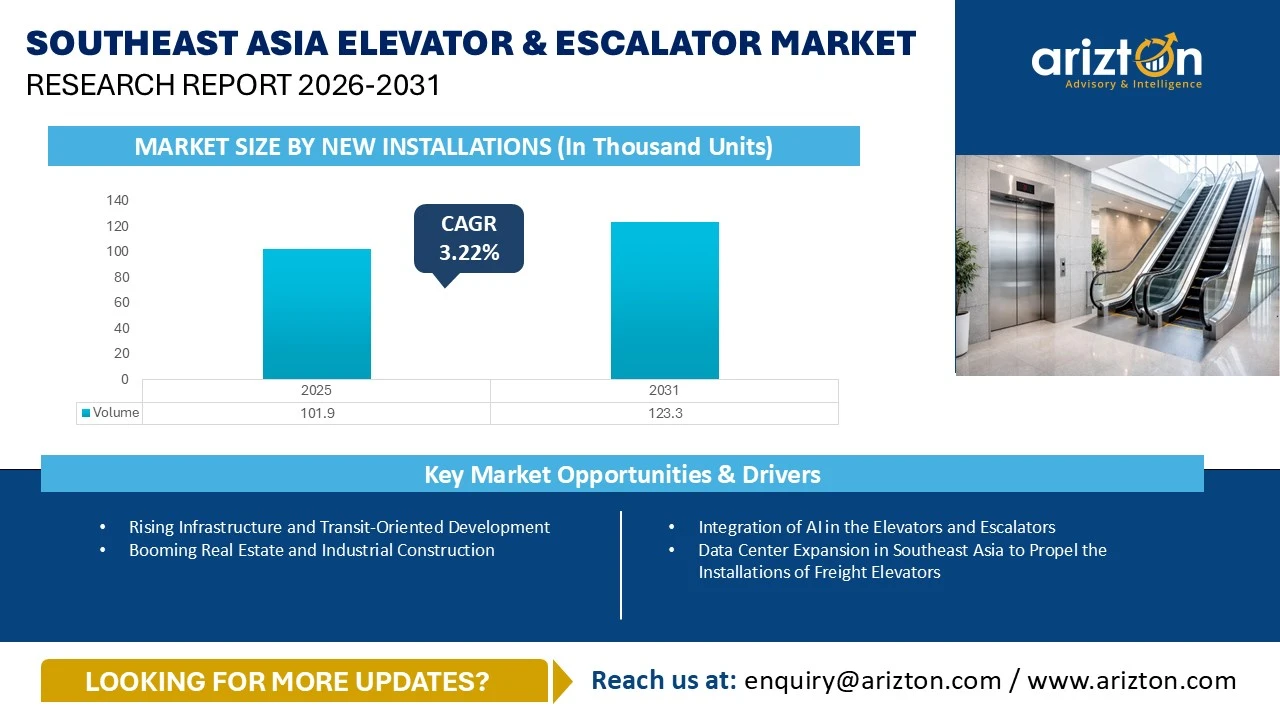
THE SOUTHEAST ASIA ELEVATOR AND ESCALATOR MARKET SIZE BY NEW INSTALLATIONS WAS VALUED AT 101.9 THOUSAND UNITS IN 2025 AND IS EXPECTED TO REACH 123.3 THOUSAND UNITS BY 2031, GROWING AT A CAGR OF 3.22% FROM 2025-2031.
Southeast Asia Elevator and Escalator Market Size (Volume)
- Installation Base
- New Installation Type
- Modernization (In Million)
- Maintenance (In Million)
Southeast Asia Elevator Market Size (Volume)
- Installation Base
- New Installation Type
- Modernization & Maintenance (In Million)
Southeast Asia Escalator Market Size by Volume
- Installation Base
- New Installation Type
- Modernization & Maintenance (In Million)
Southeast Asia Elevator and Escalator Size, Share, & Trends Analysis Report by
Elevator Market Segmentation
- Machine Type: Hydraulic and Pneumatic, Machine Room Traction, Machine Room Less Traction, and Others (Climbing Elevators and Industrial Elevators)
- Carriage Type: Passenger and Freight
- Capacity: 2-15 Persons, 16-24 Persons, 25-33 Persons, and 34 Persons and Above
- End-User: Commercial, Residential, Industrial, and Others (Public Transit, Institutional, and Infrastructural)
Escalator Market Segmentation
- Product Type: Parallel, Multi Parallel, Moving Walkway, and Crisscross
- End-User: Public Transit, Commercial, and Others (Institutional Sector, Infrastructure & Industrial)
Geographical Segmentation
- Region: Indonesia, Thailand, Malaysia, Vietnam, Philippines, and Rest of Southeast Asia
The Industry Analysis Report Provides Industry Trends, Drivers, Opportunities, Competitive Outlook, Industry Size, Sales, and Growth Forecast for 2026-2031
This report includes market data points, ranging from trend
analyses to market estimates & forecasts that you can customize
SOUTHEAST ASIA ELEVATOR AND ESCALATOR MARKET REPORT SCOPE
| REPORT ATTRIBUTE | DETAILS |
|---|---|
| MARKET SIZE BY NEW INSTALLATIONS (2031) | 123.3 Thousand Units |
| MARKET SIZE BY NEW INSTALLATIONS (2025) | 101.9 Thousand Units |
| CAGR - NEW INSTALLATIONS (2025-2031) | 3.22% |
| MARKET SIZE BY INSTALLED BASE (2031) | 2.103 Million Units |
| MARKET SIZE BY MODERNIZATION (2031) | USD 473 Million |
| HISTORIC YEAR | 2022-2024 |
| BASE YEAR | 2025 |
| FORECAST YEAR | 2026-2031 |
| SEGMENTATION BY CARRIAGE TYPE | Passenger and Freight |
| SEGMENTATION BY CAPACITY | 2-15 Persons, 16-24 Persons, 25-33 Persons, and 34 Persons and Above |
| SEGMENTATION BY END-USER | Commercial, Residential, Industrial, and Others |
| SEGMENTATION BY MACHINE TYPE | Hydraulic and Pneumatic, Machine Room Traction, Machine Room Less Traction, and Others |
| GEOGRAPHY | Indonesia, Thailand, Malaysia, Vietnam, Philippines, and Rest of Southeast Asia |
| KEY VENDORS | Otis, KONE, Schindler, Mitsubishi Electric, Hyundai Elevator, Hitachi, and Fujitec |
SOUTHEAST ASIA ELEVATOR AND ESCALATOR MARKET SIZE
The Southeast Asia elevator and escalator market size by new installations was valued at 101.9 thousand units in 2025 and is expected to reach 123.3 thousand units by 2031, growing at a CAGR of 3.22% during the forecast period. Increasing urbanization and construction industry growth significantly contribute to the year-over-year (YoY) growth of the market.
The Southeast Asia elevator and escalator market is witnessing strong and sustained growth, supported by rapid urbanization, large-scale infrastructure investment, rising high-rise construction activity, and increasing adoption of smart and energy-efficient vertical transportation technologies across the region.
Countries including Indonesia, Thailand, Malaysia, Vietnam, and the Philippines are collectively contributing to regional demand expansion through residential, commercial, hospitality, industrial, and transit-oriented developments.
Major projects such as the development of the new capital city, Nusantara (IKN), and the Eastern Economic Corridor (EEC) are expected to generate substantial long-term opportunities for elevator and escalator suppliers.
Despite positive long-term growth, the regional market faces several challenges, including rising construction material costs, exchange-rate volatility, supply chain disruptions, pricing pressure, and shortages of skilled technicians.
Nevertheless, strong urban growth, expanding infrastructure investment, rising modernization demand, and accelerating adoption of connected and energy-efficient technologies are expected to sustain the long-term growth trajectory of the Southeast Asia elevator and escalator market.
SOUTHEAST ASIA ELEVATOR AND ESCALATOR MARKET DRIVERS
Rising Infrastructure and Transit-Oriented Development Driving Elevator and Escalator Demand Across Southeast Asia
- Southeast Asia’s rapid infrastructure expansion is significantly increasing demand for elevators and escalators. Large-scale government investments in railways, airports, smart cities, and transit-oriented developments (TODs) are driving the need for vertical transportation systems across public and commercial infrastructure.
- Vietnam’s massive infrastructure pipeline, including high-speed rail, airports, and ports, is expected to boost installations substantially. Indonesia’s National Strategic Projects and the development of Nusantara are creating long-term demand.
- In Malaysia, new rail networks require elevators and escalators to meet accessibility standards. Meanwhile, Thailand’s mixed-use developments and Singapore’s MRT expansion and modernization projects are further strengthening regional market growth.
Booming Real Estate and Industrial Construction
- The Southeast Asian elevator and escalator market is benefiting from rapid urbanization, growing middle-class populations, rising high-rise residential construction, and expanding mixed-use developments.
- Indonesia’s large housing deficit is accelerating vertical housing projects, while the Philippines’ housing initiatives and commercial real estate investments are creating strong demand for elevators and escalators. Vietnam’s large-scale “super city” developments and major real estate projects are further boosting installation requirements across residential, retail, hospitality, and entertainment sectors. Cambodia’s expanding high-rise construction market is also increasing demand.
- Additionally, Southeast Asia’s emergence as a manufacturing and logistics hub is driving demand for industrial elevators and freight lifts, supported by industrial projects in Indonesia, Laos, and Myanmar. As industrial, commercial, and residential construction activity continues to expand, demand for elevator and escalator systems across the region is expected to grow substantially over the forecast period.
Aging Demographics Stimulating Elevator And Escalator Installations
- Southeast Asia’s elevator and escalator market is increasingly driven by the region’s rapidly aging population, which is creating greater demand for accessible and barrier-free mobility infrastructure.
- Aging demographics across Malaysia, Vietnam, Thailand, Indonesia, the Philippines, and Singapore are prompting governments and developers to integrate elevators and escalators into residential buildings, healthcare facilities, public transport systems, and commercial spaces.
- The growing elderly population is also accelerating modernization and replacement of older systems to meet evolving safety and accessibility standards.
- Singapore remains the most mature market, while Malaysia, Thailand, and Vietnam are experiencing strong demographic-driven demand growth. Overall, population aging is emerging as a long-term structural driver supporting new installations and modernization projects across Southeast Asia.
SOUTHEAST ASIA ELEVATOR AND ESCALATOR MARKET OPPORTUNITIES
Integration of AI in the Elevators and Escalators Industry is Expected to Create Opportunities in the Market
- The growing adoption of AI is becoming a key growth driver for the Southeast Asian elevator and escalator market as urbanization, smart building development, and infrastructure modernization accelerate across the region.
- Leading manufacturers are increasingly deploying AI-, IoT-, and cloud-enabled solutions that support predictive maintenance, remote diagnostics, traffic management, and enhanced safety monitoring. These technologies improve equipment reliability, reduce downtime, optimize energy consumption, and strengthen long-term maintenance service revenues.
- Major projects, such as Singapore’s Cross Island Line and Malaysia’s Armani Hallson KLCC development, are incorporating advanced digital elevator systems with real-time monitoring capabilities. As demand for intelligent, energy-efficient, and sustainable buildings grows, AI-enabled vertical transportation solutions are expected to create significant opportunities for new installations, modernization projects, and recurring service contracts across Southeast Asia.
Data Center Expansion in Southeast Asia to Propel the Installations of Freight Elevators
- Southeast Asia’s rapidly expanding data centre industry is emerging as a significant driver of demand for elevators and specialized vertical transportation systems. Rising investments in digital infrastructure across Malaysia, Thailand, Indonesia, the Philippines, and Vietnam are fuelling the construction of large-scale hyperscale and AI-ready data centre campuses.
- As these facilities become larger, taller, and more technologically advanced, elevators play a critical role in supporting workforce mobility, equipment transportation, and operational efficiency.
- Major investments by global technology companies and data centre developers are accelerating the development of multi-storey facilities that require heavy-duty elevator solutions capable of handling server racks, maintenance equipment, and technical personnel. This trend is creating new growth opportunities for elevator manufacturers, particularly in the specialized industrial and data center segments.
INDUSTRY RESTRAINTS
High Upfront Installation and Service Costs
- High installation, modernization, and maintenance costs remain a major constraint on the growth of the Southeast Asian elevator and escalator market. While demand is increasing due to urbanization, high-rise construction, infrastructure development, and aging populations, the significant upfront investment required for elevator and escalator systems limits adoption, particularly among smaller developers and cost-sensitive residential projects.
- Ongoing expenses related to inspections, repairs, component replacement, and compliance with safety regulations further increase the financial burden on building owners. Many Southeast Asian countries also rely heavily on imported equipment and specialized technical expertise, raising procurement and servicing costs.
- As a result, modernization projects are often delayed, replacement cycles are extended, and the adoption of advanced, energy-efficient, and smart elevator technologies remains slower than market demand would otherwise support.
Dependence on Imported Equipment and High Volatility in Currency Values
- Currency volatility and the depreciation of Southeast Asian currencies against the US dollar are significant challenges for the region’s elevator and escalator market. The industry relies heavily on imported equipment, components, and technologies sourced from countries such as China, Japan, South Korea, and European nations, with most procurement contracts denominated in foreign currencies.
- As a result, exchange-rate fluctuations increase equipment costs, reduce contractor margins, and create budget uncertainty for developers and infrastructure operators. Markets such as Indonesia, Malaysia, and Vietnam have been particularly affected by weakening local currencies, leading to higher procurement expenses and project cost overruns.
- Although long-term demand remains supported by urbanization and infrastructure development, persistent currency instability is increasing financial pressure, slowing modernization activities, and affecting industry profitability across Southeast Asia.
SOUTHEAST ASIA ELEVATOR AND ESCALATOR MARKET SEGMENTATION INSIGHTS
Elevator
- Machine-room-less (MRL) elevators accounted for one of the largest Southeast Asia elevator market shares among the different machine types (hydraulic, pneumatic, machine room traction, and others), representing a major market share in total installations in 2025. The segment is expected to witness steady growth over the forecast period, with new installations expanding at a CAGR of 3.47%.
- MonoSpace DX MRL elevator from KONE is an MRL elevator for mid-rise and low-rise buildings with connectivity, improved people flow, and an inspiring elevator experience. Powered by the compact, energy-efficient KONE EcoDisc hoisting motor, the KONE MonoSpace DX is eco-friendly, and it saves valuable space in a building by completely removing the need for a machine room.
- Demand for MRL elevators continues to rise sharply, driven by the expanding project pipeline of high-end and high-density residential developments under construction across Southeast Asia. For instance, in Hanoi, at the beginning of March 2026, Sunshine Group simultaneously commenced construction on three large-scale projects. The project is designed to consist of 12 towers, each 40 stories high, providing 2,060 apartments on nearly 6 hectares of land.
- In the carriage-type segment, passenger elevators accounted for the largest market share in 2025. This dominance is primarily attributed to the high demand for vertical transportation in residential, commercial, and mixed-use buildings, where passenger mobility remains the primary requirement.
- In Indonesia, approximately 60% of the population is expected to live in urban areas by 2026, accelerating low- to mid-rise residential and mixed-use construction. IKN Nusantara's development and hotel expansions by operators like Hilton are generating sustained elevator demand across Jakarta, Bali, and beyond.
- Furthermore, Thailand's urbanization, concentrated heavily in Bangkok, combined with a $2.73 billion government stimulus and landmark projects like the $1.6 billion Bangkok Mall, is sustaining strong passenger elevator demand across residential, retail, and hospitality segments.
- In the capacity (person) segment, 2–15-person elevators recorded the largest incremental growth in new installations during the 2025–2031 period, recording a CAGR of 3.40%. This growth is primarily driven by their widespread application in residential buildings, mid-rise commercial properties, and mixed-use developments, where moderate passenger capacity is sufficient to meet daily traffic requirements.
- Over the next five years (2026-2030), Phuket is set to undergo a multi-billion-dollar transformation, driven by major developments such as new expressways, a light rail system, and smart-city technologies. These investments will reshape urban mobility, improve connectivity, and stimulate large-scale real estate development across residential, commercial, and mixed-use segments.
- In Indonesia, the development of the new capital (IKN) is reshaping population distribution and accelerating residential construction in surrounding cities such as Balikpapan. Projects like Sepinggan Terrace, developed by PAM Group, highlight rising demand for 2-25-person elevators suited to moderate passenger volumes and limited floor space.
- In Malaysia, major ongoing mixed-use projects in 2026, such as the Penang International Commercial Centre (PICC), demonstrate the importance of mid-capacity elevators in managing varied traffic across residential, retail, and office components.
- In the elevator end-user segment, residential elevators recorded the largest Southeast Asia elevator and escalator market share in terms of volume of new installations in 2025. This dominance is primarily driven by the rapid development of high-rise residential buildings, apartment complexes, and urban housing projects, particularly in densely populated urban areas where vertical transportation is essential.
- Although Thailand’s housing market experienced a slowdown in 2025, rising investments are expected to drive recovery and support future growth. Initiatives such as the “Homes for Thais” (2025) program, targeting around 300,000 units, are accelerating large-scale residential construction. Policy reforms, including the extension of lease terms to 99 years, are also attracting foreign buyers and encouraging the development of low-to-midrise residential projects.
- In 2026, Sansiri announced plans to launch 33 new residential projects worth approximately THB 51 billion ($1.56 billion), further boosting demand for advanced elevator systems in low-to-midrise housing developments.
- Vietnam is also witnessing strong momentum, supported by government-led housing initiatives. In 2026, approximately 158,700 social housing units are scheduled for completion, while as of February 2026, around 220 projects (about 215,000 units) were under construction. Overall, 737 projects totaling over 700,000 units had been implemented, achieving about 70% of the national target of one million homes by 2030.
Escalator
- In the product type segment, parallel escalators recorded the largest volume of new installations. The segment is also expected to experience the highest incremental growth during the 2025–2031 period, expanding at a CAGR of 3.08%.
- This growth is largely driven by their widespread adoption in shopping malls, metro stations, airports, and large commercial complexes, where parallel configurations enable efficient passenger movement and higher traffic handling capacity.
- By the escalator end-user segment, commercial escalators recorded the largest volume of new installations in 2025. They are widely used across shopping malls, department stores, airports and transit hubs, hotels, convention centres, office towers, and integrated mixed-use projects.
VENDOR LANDSCAPE
- Otis, Kone, Schindler, Mitsubishi Electric, and Hitachi Ltd are the top five major players in the Southeast Asia Elevator & Escalator market.
- Other prominent vendors include regional and local companies. In recent years, Chinese manufacturers have also established a stable foothold in the market, with key participants including Canny Elevator Co., Ltd., IFE Elevators Co., Ltd., and SJEC Corporation, among others.
- In April 2026, KONE agreed to acquire TK Elevator in a €29.4 billion ($34.4 billion) transaction, creating the world’s largest elevator and escalator manufacturer by revenue and scale. The acquisition is expected to strengthen KONE’s market position, particularly in the Americas, where TK Elevator has a stronger presence.
- Strengthening its regional footprint, Otis launched its Gen3™ connected elevator platform across Indonesia, Thailand, and Malaysia in August 2024 and, later, in December 2024, secured a contract to supply SkyRise® and Arise™ elevators for the Dawn KLCC mixed-use development in Kuala Lumpur.
- In February 2026, Otis launched the Gen3 Villa home lift in Southeast Asia to meet rising demand for high-quality home vertical mobility solutions driven by urbanization, luxury housing growth, smart homes, and ageing populations.
- In February 2026, Otis launched the Gen3 Villa home lift in Southeast Asia to meet rising demand for high-quality home vertical mobility solutions driven by urbanization, luxury housing growth, smart homes, and ageing populations.
- In February 2026, Otis launched the Gen3 Villa home lift in Southeast Asia to meet rising demand for high-quality home vertical mobility solutions driven by urbanization, luxury housing growth, smart homes, and ageing populations.
- In September 2025, Hitachi Elevator (Thailand) was selected to be part of the Hatai project developed on the former Narai Hotel site; the company announced to install escalators as part of this development.
- In 2024, Hitachi Co., Ltd. won the bid for an order for 63 pieces of equipment, including 32 elevators and 31 escalators for underground stations of the Urban Railway Line No. 1 project in the city. Ho Chi Minh - the first urban railway in Vietnam. This is the largest order ever and the first escalator order from Hitachi in Vietnam.
SNAPSHOT
The Southeast Asia elevator and escalator market size by new installations was valued at 101.9 thousand units in 2025 and is expected to reach 123.3 thousand units by 2031, growing at a CAGR of 3.22% during the forecast period.
The following factors are likely to contribute to the growth of the Southeast Asia elevator and escalator market during the forecast period:
- Rising Infrastructure and Transit-Oriented Development
- Booming Real Estate and Industrial Construction
- Aging Demographics Stimulating Elevator and Escalator Installations
Base Year: 2025
Forecast Year: 2026-2031
The report considers the present Southeast Asia elevator and escalator market scenario and market dynamics from 2026 to 2031. It covers a detailed overview of several market growth enablers, restraints, and trends. The study includes the volume and value sales with a segment analysis of the Southeast Asia elevator and escalator market.
Key Vendors
- Otis
- KONE
- Schindler
- Mitsubishi Electric
- Hyundai Elevator
- Hitachi
- Fujitec
Other Prominent Vendors
- Cibes Lift AB
- Toshiba Elevator and Building Systems Corporation
- Canny Elevator Co., Ltd.
- IFE Elevators Co., Ltd.
- Sigma Elevators
- Sicher Elevator Co. Ltd.
- BLT-Brilliant (Shenyang Brilliant Elevator Co., Ltd.)
- Thai Ji Elevator Co. Ltd.
- Fuji Hengda Elevator
- SJEC Corporation
- Kalea Lifts
- Artico Lifts
- Ecolift Elevator and Escalator Corporation
- KOYO Elevator Co. Ltd.
- EITA Elevator (Malaysia) Sdn. Bhd.
- Nippon Elevator
- Delfar Elevator Co., Ltd.
- Dover Elevators (Malaysia) Sdn. Bhd.
- Sanyo Elevators & Escalators Co., Ltd.
- Stannah Lifts
- Thien Nam Elevator Joint Stock Company (TNE)
- Pacific Elevator Co., Ltd.
- SEC Elevator Co., Ltd.
- Dazen Elevator (Suzhou Dazen Electromechanical Technology Co., Ltd.)
- Xiolift is Hangzhou XIO-Lift Co., Ltd.
- Nibav Lifts
Elevator Market Segmentation by
Machine Type
- Hydraulic and Pneumatic
- Machine Room Traction
- Machine Room Less Traction
- Others
- Climbing
- Elevators
- Industrial Elevators
Carriage Type
- Passenger
- Freight
Capacity
- 2-15 Persons
- 16-24 Persons
- 25-33 Persons
- 34 Persons and Above
End-User
- Commercial
- Residential
- Industrial
- Others
- Public Transit
- Institutional
- Infrastructural
Escalator Market Segmentation by
Product Type
- Parallel
- Multi Parallel
- Walkway
- Crisscross
End-User
- Public Transit
- Commercial
- Others
- Institutional Sector
- Infrastructure
- Industrial
Segmentation by Region
- Indonesia
- Thailand
- Malaysia
- Vietnam
- Philippines
- Rest of Southeast Asia
SOUTHEAST ASIA ELEVATOR AND ESCALATOR MARKET FAQs
How big is the Southeast Asia elevator and escalator market?
What will be the growth rate of the Southeast Asia elevator and escalator market?
What are the key Southeast Asia elevator and escalator market players?
What is the number of installed bases in the Southeast Asia elevator and escalator market in 2024?
What are the key opportunities in the Southeast Asia elevator and escalator market?
What will be the growth rate of the Southeast Asia elevator and escalator market?
How big is the Southeast Asia elevator and escalator market?
What is the number of installed bases in the Southeast Asia elevator and escalator market in 2024?
What are the key Southeast Asia elevator and escalator market players?
What are the key opportunities in the Southeast Asia elevator and escalator market?
For more details, please reach us at [email protected]
For more details, please reach us at [email protected]
Select a license type that suits your business needs
Single User Licence
- Report accessible by one user only
- Free 10% or 3 days of customization
- Free post-sale service assistance
- Continuous support through email
5 User Licence
- Report accessible by 5 users within the organization
- Free 15% or 4.5 days of customization
- Continuous support through email and telephone
- Free analyst hour
- Free Upgrade: If an updated report published within 180 days of purchase, you will get the revised report free of charge
Corporate Licence
- Free Datasheet worth $1500
- Report accessible by the entire organization
- Free 20% or 6 days of customization
- Free post-sale service assistance
- Continuous support through email and telephone
- Direct access to lead analysts
- Free analyst hour
- Free Upgrade: If an updated report published within 180 days of purchase, you will get the revised report free of charge
Datasheet Licence
- Report accessible by 1 user only
- Free 15% or 32 hours of customization
- Free post-sale service assistance
- Direct access to lead analysts
Frequently Asked Questions
How big is the Southeast Asia elevator and escalator market?
What will be the growth rate of the Southeast Asia elevator and escalator market?
What are the key Southeast Asia elevator and escalator market players?
What is the number of installed bases in the Southeast Asia elevator and escalator market in 2024?
What are the key opportunities in the Southeast Asia elevator and escalator market?
What will be the growth rate of the Southeast Asia elevator and escalator market?
How big is the Southeast Asia elevator and escalator market?
What is the number of installed bases in the Southeast Asia elevator and escalator market in 2024?
What are the key Southeast Asia elevator and escalator market players?
What are the key opportunities in the Southeast Asia elevator and escalator market?