

Global Steam Turbine Market Growth Insights – Shipments to Reach 817 Units and Installed Capacity to Exceed 158.12 GW by 2031, Driven by Rising Global Electricity Demand, Continued Investments in Thermal & Combined-Cycle Power Generation, and Expanding Industrial Energy Infrastructure (2026–2031)
To Be Published : September 2026
Last Updated : September 2026
format: PDF
edition : Second Edition

319 pages

44 company

8 segments

5 region

30 countries
Purchase Options
Global Steam Turbine Market Research Report 2026-2031
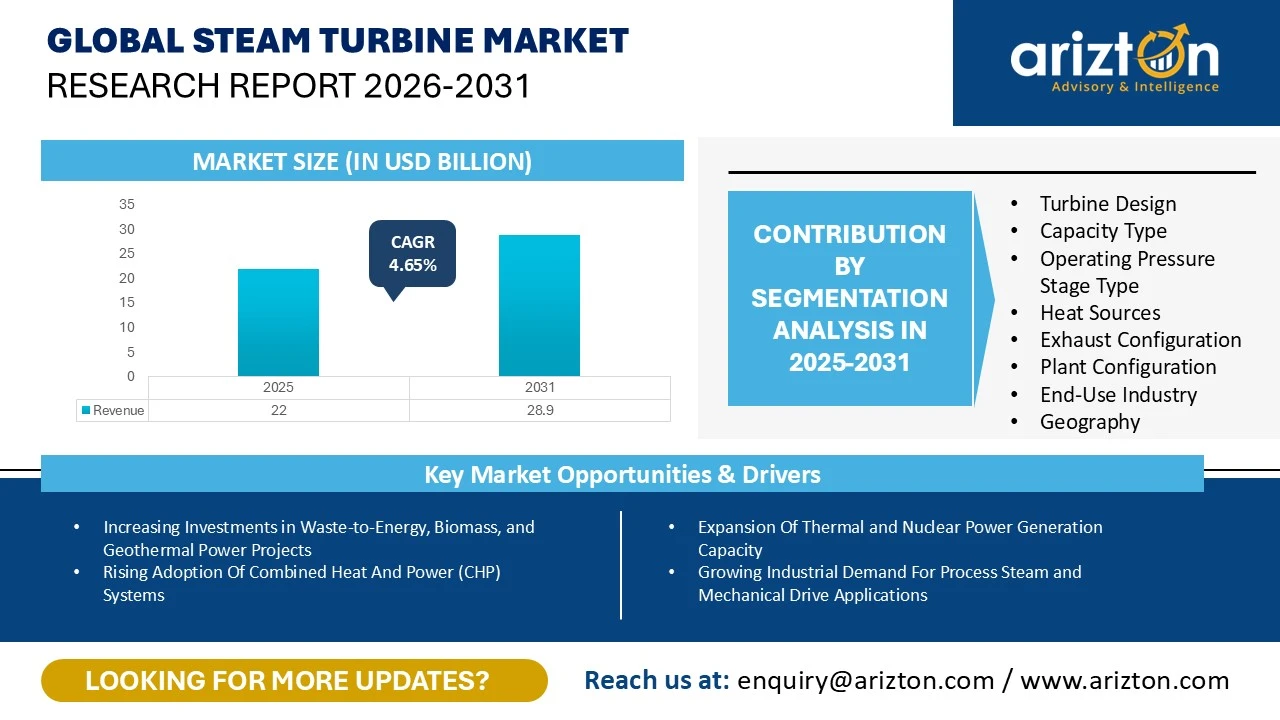
THE GLOBAL STEAM TURBINE MARKET SIZE WAS VALUED AT USD 22 BILLION IN 2025 AND IS EXPECTED TO REACH USD 28.90 BILLION BY 2031, GROWING AT A CAGR OF 4.65% DURING THE FORECAST PERIOD.
The Steam Turbine Market Size, Share & Trends Analysis Report By
- Turbine Design: Mixed-Turbine, Reaction Turbine, and Impulse Turbine
- Capacity Type: >300 MW, 151-300 MW, <150 MW (<30 MW, 30-60 MW, 60-100 MW, and 100-150 MW)
- Operating Pressure Stage Type: High-Pressure, Medium-Pressure, Low-Pressure, and Ultra-High-Pressure
- Heat Sources: Coal, Natural Gas, Nuclear, and Alternative Sources
- Exhaust Configuration: Condensing, Extraction, and Back-Pressure
- Plant Configuration: Steam Cycle and Combined Cycle
- End-Use Industry: Power Generation, Industrial Manufacturing, Oil & Gas, Mining & Metal Processing, District Heating & Cooling, Marine, and Other Industries
- Geography: North America, Europe, APAC, Latin America, and Middle East & Africa
Industry Analysis Report, Regional Outlook, Growth Potential, Price Trends, Competitive Market Share & Forecast 2026–2031.
This report includes market data points, ranging from trend
analyses to market estimates & forecasts that you can customize
STEAM TURBINE MARKET REPORT SCOPE
| REPORT ATTRIBUTE | DETAILS |
|---|---|
| MARKET SIZE (2031) | USD 28.90 Billion |
| MARKET SIZE (2025) | USD 22 Billion |
| CAGR (2025-2031) | 4.65% |
| MARKET SIZE – SHIPMENTS (2031) | 817 Units |
| MARKET SIZE – CAPACITY (2031) | 158.12 GW |
| HISTORIC YEAR | 2022- 2024 |
| BASE YEAR | 2025 |
| FORECAST YEAR | 2026-2031 |
| SEGMENTS BY | Turbine Design, Capacity Type, Operating Pressure Stage Type, Heat Sources, Exhaust Configuration, Plant Configuration, End-Use Industry, and Geography |
| GEOGRAPHIC ANALYSIS | North America, Europe, APAC, Latin America, and Middle East & Africa |
| KEY PLAYERS | GE Vernova Inc, Siemens Energy A.G., Mitsubishi Power, Shanghai Electric, Doosan Enerbility, Toshiba Corporation, Bharat Heavy Electricals Limited, Ansaldo Energia, Harbin Turbine Works, and Triveni Turbine LTD. |
STEAM TURBINE MARKET SIZE ANALYSIS
The global steam turbine market size was valued at USD 22 billion in 2025 and is expected to reach USD 28.90 billion by 2031, growing at a CAGR of 4.65% during the forecast period. The market is witnessing steady growth due to rising electricity demand and continued investment in thermal and combined-cycle power generation. For instance, as per IEA's latest electricity mid-year update forecasts that global electricity demand is likely to grow by 3.6% in 2026 and further by 3.8% in 2027.
The global steam turbine market shipments are expected to reach 817 units by 2031. The market is witnessing a strong shift as governments across the regions encourage energy security initiatives and power capacity expansion programs. For instance, initiatives such as the Nuclear Energy Mission, supported by the SHANTI Act, 2025, aim to reach 100 GW capacity by 2047 to support a developed India and its Net Zero by 2070.
Moreover, the expanding manufacturing industry is further supporting the market demand for steam turbines as it is widely deployed across the industrial manufacturing sector to supply reliable captive power, process steam, and combined heat and power (CHP) for continuous production processes. APAC region remains one of the largest markets for industrial steam turbines owing to rapid manufacturing expansion, increasing industrial output, and continued investment in high-value production facilities. For instance, in 2025, the India Semiconductor Mission, Tata Electronics, and Tata Semiconductor Manufacturing have signed an agreement for India's first commercial semiconductor fabrication plant. The project involves an investment of approximately $10.7 billion with government funding of around 50% of eligible cost.
STEAM TURBINE MARKET NEWS
- In 2026, JSW Thermal Energy agreed with Toshiba JSW to procure two 800-MW steam turbine generators for the 1,600-MW Salboni thermal power project located in West Bengal, India.
- In 2026, Doosan Enerbility secured its first North American steam turbine contract to supply two 370 MW-class steam turbines and two generators for a US combined-cycle power plant supporting rising AI data center electricity needs.
- In 2025, Triveni Turbine Limited secured a $34.7 million order from NTPC for the design, engineering, fabrication, erection, commissioning, and testing of a CO₂ cycle-based Energy Storage System, demonstrating its growing influence in the energy sector.
STEAM TURBINE MARKET TRENDS & ENABLERS
Rising Adoption of Combined Heat and Power (CHP) Systems
The growing adoption of combined heat and power (CHP) systems is supporting demand for steam turbines as utilities and industrial facilities focus on improving energy efficiency, optimizing operating costs, and reducing carbon emissions. The expansion of cogeneration infrastructure is also helping enhance energy security and improve the efficiency of existing power networks. For instance, in 2025, as part of its strategy to modernize district heating infrastructure and improve electricity generation efficiency, the Russian government approved the construction of a new 275 MW steam turbine unit at Mosenergo’s CHP-25 power plant.
Increasing Investments in Waste-to-Energy, Biomass, and Geothermal Power Projects
Growing investments in waste-to-energy (WtE), biomass, and geothermal power projects are creating opportunities for steam turbine deployment. These facilities use steam-cycle technologies to convert thermal energy into electricity and heat, supporting continued demand for efficient steam turbine systems. For instance, in 2025, Hitachi Zosen, now operating under Kanadevia, partnered with Sumitomo Heavy Industries to develop next-generation steam turbines designed to improve power generation and energy recovery performance at Japanese municipal solid waste facilities.
Expansion of Thermal and Nuclear Power Generation Capacity
The expansion of thermal and nuclear power generation capacity is expected to support demand for steam turbines, which play a key role in converting thermal energy into electricity. For instance, in 2025, China’s State Council approved 10 new nuclear reactors across five coastal sites, comprising eight Hualong One and two CAP1000 units. The projects involve an estimated investment of approximately USD 27 billion and are expected to contribute to the expansion of nuclear power generation capacity and associated steam turbine demand.
Also Read: Steam Turbine Aftermarket Industry: Spare Parts & Consumables, Maintenance & Repair Services, Upgrades & Retrofits, Digital Solutions.
STEAM TURBINE MARKET SEGMENTATION INSIGHTS
INSIGHTS BY TURBINE DESIGN
The global steam turbine market by turbine design is segmented into mixed-turbine, reaction turbine, and impulse turbine. The mixed-design steam turbines accounted for the largest market share of around 76%, owing to widespread adoption across end-use industries because these turbines have become the standard configuration for modern supercritical, ultra-supercritical, and nuclear steam turbine installations. Their multi-stage blade arrangement enables efficient energy extraction throughout the steam expansion process while maintaining high reliability during continuous baseload operation.
Mixed-stage turbine architecture has become the preferred design for utility-scale steam turbines operating under supercritical, ultra-supercritical, and nuclear steam conditions. These turbines are engineered to withstand elevated steam temperatures and pressures while maintaining high reliability over extended operating lifecycles, making them suitable for continuous baseload electricity generation.
INSIGHTS BY CAPACITY TYPE
Based on capacity, the >300 MW steam turbines segment accounted for the largest global steam turbine market share in 2025. These turbines are engineered to deliver high power output, superior thermal efficiency, and continuous baseload operation, making them essential for large-scale electricity generation and national grid reliability.
The transition toward supercritical, ultra-supercritical, and advanced ultra-supercritical (A-USC) power generation technologies is strengthening this segment. Utilities are prioritizing higher-efficiency steam turbines to improve plant performance, reduce fuel consumption, and comply with tightening environmental regulations. Simultaneously, expansion of natural gas-fired combined-cycle plants across APAC, North America, and the Middle East continues to create demand for high-capacity steam turbine generators.
INSIGHTS BY OPERATING PRESSURE
Based on operating pressure, the low-pressure (below 40 bar) segment shows significant growth, with the fastest-growing CAGR of 5.81% during the forecast period. The low-pressure segment represents a smaller portion of the market and is primarily designed to operate under relatively modest steam conditions and is generally selected where process steam availability, lower capital investment, and operational simplicity are prioritized over maximum power generation efficiency.
Europe is expected to witness increasing demand for low-pressure steam turbines, supported by stringent industrial decarbonization policies and growing investments in energy recovery technologies. For instance, in 2025, the European Union's Clean Industrial Deal and ongoing industrial modernization initiatives continued encouraging manufacturers to implement waste heat recovery and energy-efficiency solutions, creating favorable conditions for low-pressure steam turbine installations.
INSIGHTS BY HEAT SOURCES
Based on heat sources, the coal segment accounted for the largest global steam turbine market share in 2025. The growth is supported by its extensive installed base across utility-scale thermal power plants, particularly in APAC. Despite the global energy transition, coal-fired power generation continues to play a critical role in ensuring baseload electricity supply in countries such as China, India, and Indonesia, sustaining demand for large-capacity steam turbines.
INSIGHTS BY EXHAUST CONFIGURATION
In 2025, the condensing segment accounted for the largest share of the global steam turbine market. The condensing turbine segment demand is supported by its widespread adoption in large-scale baseload and intermediate-load power generation. The ability to operate efficiently under high-pressure, supercritical, and ultra-supercritical steam conditions, combined with superior power output and long-term operational reliability, has established condensing turbines as the preferred exhaust configuration for modern utility power plants.
Therefore, continued investments in grid modernization, thermal fleet upgrades, and high-efficiency power generation technologies are expected to sustain the segment's market leadership.
INSIGHTS BY PLANT CONFIGURATION
In 2025, the steam cycle segment dominates and holds the largest global steam turbine market share, supported by the extensive installed base of standalone steam power plants across utility and industrial applications. In these systems, steam is generated through dedicated boilers or steam generators and expanded through turbines to produce electricity. The segment remains highly relevant due to the continued operation of existing coal-fired, nuclear, biomass, and industrial steam generation assets, which require turbine replacements, upgrades, and modernization activities.
Despite the gradual shift toward lower-carbon power generation, standalone steam cycle systems continue to remain relevant due to the large installed base of operating plants and the technical challenges associated with replacing high-capacity baseload assets. Market demand is increasingly concentrated around plant upgrades, turbine replacements, efficiency enhancement projects, and life-extension programs, particularly in countries seeking to balance energy security with emission reduction targets.
INSIGHTS BY END-USE INDUSTRY
The global steam turbine market by end-use industry is segregated into power generation, industrial manufacturing, oil & gas, mining & metal processing, district heating & cooling, marine, and other industries. The power generation segment accounted for the largest market share in 2025, supported by the extensive deployment of steam turbines across utility-scale electricity generation facilities. Steam turbines remain the primary power conversion equipment in coal-fired, nuclear, biomass, geothermal, concentrated solar power (CSP), and waste-to-energy plants. Continued investment in modernization, turbine replacement, and efficiency improvement projects across aging generation fleets further sustains demand within this segment.
STEAM TURBINE MARKET GEOGRAPHICAL ANALYSIS
In 2025, APAC is the largest market for global steam turbines, accounting for more than 45% share. APAC domination is driven by rapid industrialization, expanding electricity demand, and sustained investments in thermal and nuclear power generation. China is the largest contributor, and India is the fastest-growing market owing to rising electricity consumption, industrial development, and expansion of steel, cement, refinery, and petrochemical capacity.
Additionally, Europe is the second-largest market and steadily rising because of the presence of stable public investment initiatives. Under the Power Plant Security Act approved in 2025, Germany plans to procure up to 20 GW of hydrogen-ready gas-fired capacity by 2030, creating significant opportunities for high-efficiency steam turbines integrated into combined-cycle power plants and industrial cogeneration projects.
The North America region is the third largest market, and the US dominates the market across the region and accounts for a significant revenue share in 2025, characterized by its extensive thermal and nuclear power fleet, large industrial base, and expanding combined-cycle power generation capacity.
In addition, the Middle East and Africa region is significantly increasing investments in thermal power plants, industrialization, oil & gas, petrochemicals, and desalination infrastructure, which is likely to support the market for steam turbines. Further, investments across the oil and gas sector and energy expansion such as Brazil's Ten-Year Energy Expansion Plan (PDE 2027) outline planned investments of approximately $330 billion across the energy sector, including nearly $251 billion allocated to oil and gas, which are significantly creating new opportunities for steam turbine manufacturers across Latin America.
STEAM TURBINE MARKET VENDOR LANDSCAPE
The global steam turbine market is highly fragmented and encompasses international and regional players such as G Siemens Energy, Mitsubishi Power, GE Vernova, Doosan Enerbility, Harbin Electric, and Dongfang Electric, among others, which hold significant market share because of their broad product portfolios and are implementing various strategies such as technological advancements, M&A, and collaboration with varied retailers to stay competitive in the growing market. For instance, Toshiba is expected to deploy its EtaPRO AI monitoring system across 165 power plants for NTPC Limited in India, with operations starting in spring 2027.
SNAPSHOT
The global steam turbine market size is expected to grow at a CAGR of approximately 4.65% from 2025 to 2031.
The following factors are likely to contribute to the growth of the global steam turbine market during the forecast period:
- Expansion Of Thermal and Nuclear Power Generation Capacity
- Increasing Waste Heat Recovery Installations
- Growing Industrial Demand For Process Steam and Mechanical Drive Applications
- Rapid Industrialization and Infrastructure Development In Emerging Economies
- Retrofitting and Upgrading Existing Infrastructure
- Increasing Investments In Geothermal Energy
Base Year: 2025
Forecast Year: 2026-2031
The report examines the current state of the global steam turbine market and its market dynamics through 2026−2031. It covers a detailed overview of several market growth enablers, restraints, and trends. The study covers both the demand and supply sides of the market. It also profiles and analyses leading companies and several other prominent companies operating in the market.
Key Prominent Players
- GE Vernova Inc
- Business Overview
- Product Offerings
- Key Developments
- Key Strategies
- Key Strengths
- Key Opportunities
- Siemens Energy A.G.
- Mitsubishi Power
- Shanghai Electric
- Doosan Enerbility
- Toshiba Corporation
- Bharat Heavy Electricals Limited
- Ansaldo Energia
- Harbin Turbine Works
- Triveni Turbine LTD
Other Prominent Players
- Dongfang Electric Corporation
- Business Overview
- Product Offerings
- M+M Turbinen-Technik GmbH
- Fincantieri S.p.A.
- Everllence
- Turbimaq
- Chart Industries
- EKOL
- Ural Turbine Works (UTZ)
- Kawasaki Heavy Industries
- WEG
- Hangzhou Turbine Power Group
- Nanjing Turbine & Electric Machinery
- Fuji Electric Co., Ltd.
- Power Machines
- MAPNA Group
- Shandong Qingneng Steam Turbine Co., Ltd.
- Chola Turbo Machinery International
- China Chang Jiang Energy Corporation
- Baker Hughes Company
- Ebara Elliott Energy
- Kanadevia Corporation
- Andritz
- Kessels
- Turtle Turbines
- TurboTech Precision Engineering
- Kirloskar Ebara Pumps Limited
- Shin Nippon Machinery Co., Ltd.
- Industrial Boilers America
- NG Metalúrgica S.A.
- NCON Turbo Tech Pvt. Ltd
- Trillium Flow Technologies
- De Pretto Industrie S.r.l.
- Hyundai Heavy Industries Turbomachinery Co., Ltd. (HHI-TMC)
- TGM Kanis Turbinen GmbH
Segmentation by Turbine Design
- Mixed-Turbine
- Reaction Turbine
- Impulse Turbine
Segmentation by Capacity Type
- >300 MW
- 151-300 MW
- <150 MW
- <30 MW
- 30-60 MW
- 60-100 MW
- 100-150 MW
Segmentation by Operating Pressure Stage Type
- High-Pressure
- Medium-Pressure
- Low-Pressure
- Ultra-High-Pressure
Segmentation by Heat Sources
- Coal
- Natural Gas
- Nuclear
- Alternative Sources
Segmentation by Exhaust Configuration
- Condensing
- Extraction
- Back-Pressure
Segmentation by Plant Configuration
- Steam Cycle
- Combined Cycle
Segmentation by End-Use Industry
- Power Generation
- Industrial Manufacturing
- Oil & Gas
- Mining & Metal Processing
- District Heating & Cooling
- Marine
- Other Industries
Segmentation by Geography
- North America
- US
- Canada
- Europe
- Germany
- France
- Italy
- UK
- Spain
- Russia
- Poland
- Netherlands
- Belgium
- Sweden
- APAC
- China
- India
- Japan
- South Korea
- Indonesia
- Australia
- Taiwan
- Malaysia
- Vietnam
- Latin America
- Brazil
- Mexico
- Argentina
- Chile
- Middle East & Africa
- Saudi Arabia
- Türkiye
- Egypt
- UAE
- South Africa
STEAM TURBINE MARKET FAQs
What is the growth rate of the global steam turbine market?
How big is the global steam turbine market?
Who are the key players in the global steam turbine market?
What are the significant trends in the steam turbine market?
Which region dominates the global steam turbine market share?
For more details, please reach us at [email protected]
CHAPTER 1- SCOPE & COVERAGE
MARKET DEFINITION
- INCLUSION
- EXCLUSIONS
- MARKET ESTIMATION CAVEATS
MARKET DERIVATION
- MARKET SEGMENTATION BY TURBINE DESIGN
- MARKET SEGMENTATION BY CAPACITY TYPE
- MARKET SEGMENTATION BY OPERATING PRESSURE
- MARKET SEGMENTATION BY HEAT SOURCES
- MARKET SEGMENTATION BY EXHAUST CONFIGURATION
- MARKET SEGMENTATION BY PLANT CONFIGURATION
- MARKET SEGMENTATION BY END-USE INDUSTRY
CHAPTER 2- PREMIUM INSIGHTS
CHAPTER 3- MARKET DYNAMICS
INTRODUCTION
- OVERVIEW
- STEAM TURBINE EVOLVING MARKET ASPECTS
- STEAM TURBINE IMPORT & EXPORT ANALYSIS
- STEAM TURBINE MARKET LIFECYCLE ANALYSIS
- STEAM TURBINE MARKET REPLACEMENT CYCLE ANALYSIS
- STEAM TURBINE TECHNOLOGY BENCHMARKING
- REGIONAL PARAMETERS IMPACTING MARKET GROWTH
- CONSUMER REQUIREMENT ANALYSIS
- DEMAND AND SUPPLY ANALYSIS
- COMPARATIVE ANALYSIS OF IMPULSE TURBINE & REACTION TURBINE
- PRICE TREND ANALYSIS
MARKET OPPORTUNITIES & TRENDS
- RISING ADOPTION OF COMBINED HEAT AND POWER (CHP) SYSTEMS
- INCREASING INVESTMENTS IN WASTE-TO-ENERGY AND BIOMASS PROJECTS
- DIGITALIZATION AND EFFICIENCY ADVANCEMENTS IN STEAM TURBINE TECHNOLOGY
- CUSTOMIZED AND MODULAR STEAM TURBINE SOLUTIONS
- DEVELOPMENT OF SUPERCRITICAL AND ULTRA-SUPERCRITICAL STEAM TURBINE TECHNOLOGIES
- GOVERNMENT POLICIES & STRATEGIC ENERGY INITIATIVES
MARKET GROWTH ENABLERS
- EXPANSION OF THERMAL AND NUCLEAR POWER GENERATION CAPACITY
- INCREASING WASTE HEAT RECOVERY INSTALLATIONS
- GROWING INDUSTRIAL DEMAND FOR PROCESS STEAM AND MECHANICAL DRIVE APPLICATIONS
- RAPID INDUSTRIALIZATION AND INFRASTRUCTURE DEVELOPMENT IN EMERGING ECONOMIES
- RETROFITTING AND UPGRADING EXISTING INFRASTRUCTURE
- INCREASING INVESTMENTS IN GEOTHERMAL ENERGY
MARKET RESTRAINTS
- HIGH CAPITAL COSTS AND EXTENDED PROJECT TIMELINES
- RISING COMPETITION AND FUEL VOLATILITY
- ENVIRONMENTAL AND REGULATORY PRESSURES
- COMPETITION FROM GAS TURBINES AND RECIPROCATING ENGINES
MARKET LANDSCAPE
- OVERVIEW
- GLOBAL REVENUE MARKET SIZE & FORECAST
- GLOBAL VOLUME MARKET SIZE & FORECAST
- GLOBAL CAPACITY MARKET SIZE & FORECAST
- FIVE FORCE ANALYSIS
- PEST ANALYSIS
- VALUE CHAIN ANALYSIS
CHAPTER 4- MARKET SEGMENTATION
BY TURBINE DESIGN (MARKET SIZE & FORECAST: 2022-2031)
- MIXED-TURBINE
- REACTION TURBINE
- IMPULSE TURBINE
BY CAPACITY TYPE (MARKET SIZE & FORECAST: 2022-2031)
- >300 MW
- 151-300 MW
- <150 MW
- <30 MW
- 30-60 MW
- 60-100 ME
- 100-150 MW
BY OPERATING PRESSURE STAGE TYPE (MARKET SIZE & FORECAST: 2022-2031)
- HIGH-PRESSURE: 101–300 BAR
- MEDIUM-PRESSURE: 40–100 BAR
- LOW-PRESSURE: LESS THAN 40 BAR
- ULTRA-HIGH-PRESSURE: ABOVE 300 BAR
BY HEAT SOURCES (MARKET SIZE & FORECAST: 2022-2031)
- COAL
- NATURAL GAS
- NUCLEAR
- ALTERNATIVE SOURCES
BY EXHAUST CONFIGURATION (MARKET SIZE & FORECAST: 2022-2031)
- CONDENSING
- EXTRACTION
- BACK-PRESSURE
BY PLANT CONFIGURATION (MARKET SIZE & FORECAST: 2022-2031)
- STEAM CYCLE
- COMBINED CYCLE
BY END-USE INDUSTRY (MARKET SIZE & FORECAST: 2022-2031)
- POWER GENERATION
- INDUSTRIAL MANUFACTURING
- OIL & GAS
- MINING & METAL PROCESSING
- DISTRICT HEATING & COOLING
- MARINE
- OTHER INDUSTRIES
CHAPTER 5- GEOGRAPHY SEGMENTATION
GEOGRAPHY SEGMENTATION (MARKET SIZE & FORECAST: 2022-2031)
GEOGRAPHIC OVERVIEW – MARKET MATURITY INDEX
- APAC
- CHINA
- INDIA
- JAPAN
- SOUTH KOREA
- INDONESI
- AUSTRALIA
- TAIWAN
- MALAYSIA
- VIETNAM
- EUROPE
- GERMANY
- FRANCE
- ITALY
- UK
- SPAIN
- RUSSIA
- POLAND
- NETHERLANDS
- BELGIUM
- SWEDEN
- NORTH AMERICA
- US
- CANADA
- MIDDLE EAST & AFRICA
- SAUDI ARABIA
- TURKIYE
- EGYPT
- UAE
- SOUTH AFRICA
- LATIN AMERICA
- BRAZIL
- MEXICO
- ARGENTINA
- CHILE
CHAPTER 6- COMPETITIVE LANDSCAPE
COMPETITIVE LANDSCAPE
- COMPETITION OVERVIEW
- RECENT INDUSTRIAL DEVELOPMENTS
- MARKET SHARE ANALYSIS
KEY COMPANY PROFILES
OTHER PROMINENT COMPANY PROFILES
REPORT SUMMARY
- KEY TAKEAWAYS
- STRATEGIC RECOMMENDATIONS
Select a license type that suits your business needs
Single User Licence
- Report accessible by one user only
- Free 10% or 3 days of customization
- Free post-sale service assistance
- Continuous support through email
5 User Licence
- Report accessible by 5 users within the organization
- Free 15% or 4.5 days of customization
- Continuous support through email and telephone
- Free analyst hour
- Free Upgrade: If an updated report published within 180 days of purchase, you will get the revised report free of charge
Corporate Licence
- Free Datasheet worth $1500
- Report accessible by the entire organization
- Free 20% or 6 days of customization
- Free post-sale service assistance
- Continuous support through email and telephone
- Direct access to lead analysts
- Free analyst hour
- Free Upgrade: If an updated report published within 180 days of purchase, you will get the revised report free of charge
Datasheet Licence
- Report accessible by 1 user only
- Free 15% or 32 hours of customization
- Free post-sale service assistance
- Direct access to lead analysts
Frequently Asked Questions
What is the growth rate of the global steam turbine market?
How big is the global steam turbine market?
Who are the key players in the global steam turbine market?
What are the significant trends in the steam turbine market?
Which region dominates the global steam turbine market share?