
Global Telemedicine and Digital Health Market Research Report 2026–2031


218 pages

27 company

06 segments

5 region

32 countries
Purchase Options
Global Telemedicine and Digital Health Market Research Report 2026–2031
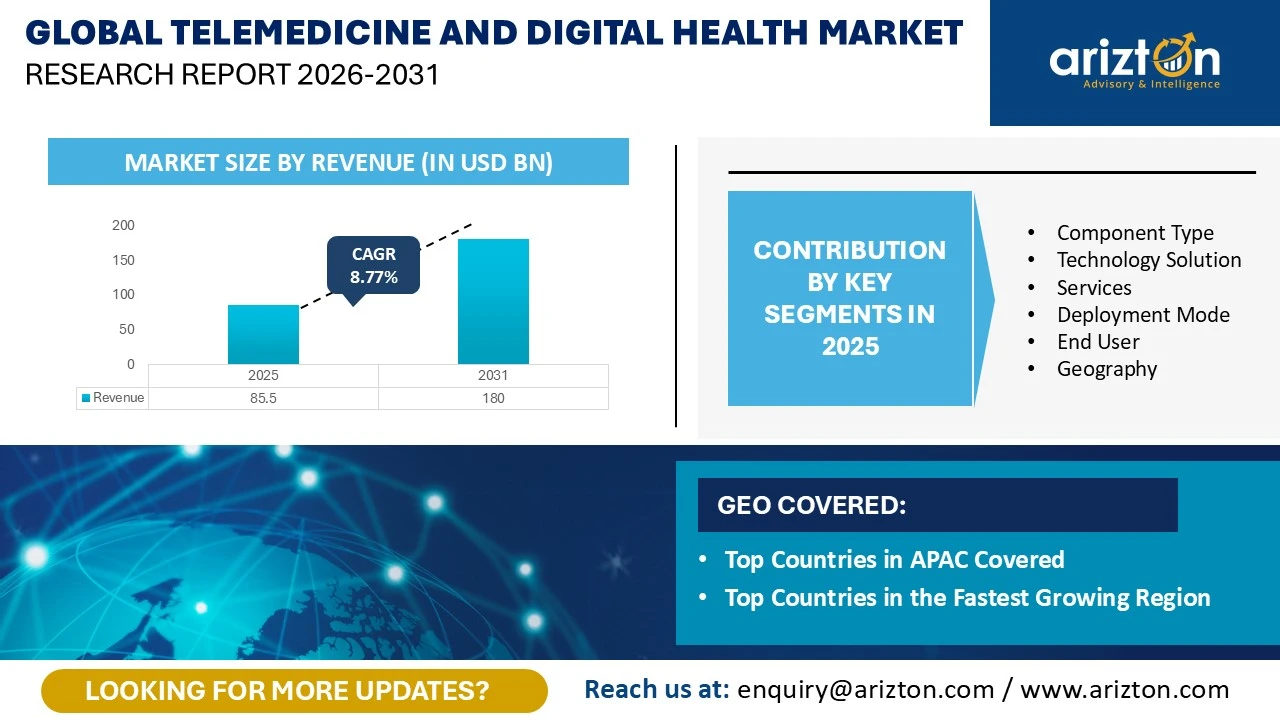
THE GLOBAL TELEMEDICINE & DIGITAL HEALTH MARKET WAS VALUED AT USD 85.50 BILLION IN 2025 AND IS EXPECTED TO REACH USD 180 BILLION BY 2031, GROWING AT A CAGR OF 13.21%.
The Telemedicine and Digital Health Market Size, Share, & Trends Analysis Report By
- Component Type: Technology Solution and Services
- Technology Solution: Telemedicine Platforms, mHealth Solutions, Remote Patient Monitoring Platforms & Devices, and Others
- Services: Virtual Clinical Care Services, Remote Patient Monitoring Services, Care Management & Wellness Services, and Others
- Deployment Mode: Cloud-based Deployment, On-Premise Deployment, and Hybrid Deployment
- End User: Healthcare Providers, Homecare & Patients, Healthcare Payers, Pharmaceutical & Biotechnology Companies, and Others
- Geography: North America, Europe, APAC, Latin America, and Middle East & Africa
Industry Analysis Report, Regional Outlook, Growth Potential, Price Trends, Competitive Market Share & Forecast 2026–2031.
This report includes market data points, ranging from trend
analyses to market estimates & forecasts that you can customize
TELEMEDICINE AND DIGITAL HEALTH MARKET REPORT SCOPE
| REPORT ATTRIBUTE | DETAILS |
|---|---|
| MARKET SIZE (2031) | USD 180 Billion |
| MARKET SIZE (2025) | USD 85.50 Billion |
| CAGR (2025-2031) | 13.21% |
| HISTORIC YEAR | 2022-2024 |
| BASE YEAR | 2025 |
| FORECAST YEAR | 2026-2031 |
| SEGMENTS BY | Component Type, Technology Solution, Services, Deployment Mode, End-Users, and Geography |
| GEOGRAPHIC ANALYSIS | North America, Europe, APAC, Latin America, and Middle East & Africa |
| KEY PLAYERS | Teladoc Health, Inc., Amwell, Philips Healthcare, Siemens Healthineers, GE Healthcare, Medtronic, and Oracle (Cerner) |
TELEMEDICINE AND DIGITAL HEALTH MARKET SIZE
The global Telemedicine and Digital Health market size was valued at USD 85.50 billion in 2025 and is projected to reach USD 180 billion by 2031, expanding at a compound annual growth rate (CAGR) of 13.21% during the forecast period. The market represents a core pillar of the global healthcare IT and smart healthcare solutions ecosystem, encompassing telemedicine platforms, digital healthcare technologies, telehealth solutions, cloud-based healthcare solutions, AI-driven diagnostics, and remote patient monitoring systems.
The Telemedicine Market and Digital Health Market focus on the design, development, and deployment of virtual healthcare platforms, eHealth systems, mHealth applications, wearable health devices, digital therapeutics, and healthcare data management software. These advanced telehealth solutions enable remote healthcare delivery, online medical consultation, virtual doctor consultation, and real-time health monitoring, significantly improving patient outcomes, healthcare accessibility, and system efficiency.
In this highly regulated environment, accuracy, cybersecurity, interoperability, and real-time responsiveness are critical. Even minor errors in digital diagnostics, healthcare data analytics, or patient monitoring systems can significantly impact clinical outcomes, treatment effectiveness, and patient safety. As a result, telemedicine platforms and digital healthcare technologies must comply with HIPAA, GDPR, FDA, and national telehealth regulatory frameworks, while maintaining robust cybersecurity infrastructure and scalable cloud-based healthcare systems.
Applications of Telemedicine & Digital Health Platforms
The Telehealth Solutions Market and Remote Healthcare Market rely on sophisticated AI-powered software, IoT-enabled medical devices, cloud computing platforms, and advanced data analytics to deliver seamless virtual healthcare services. Key applications include:
- Virtual Healthcare & Online Medical Consultation
- Remote Patient Monitoring Market solutions
- mHealth Market mobile applications
- eHealth Market digital platforms
- Digital Therapeutics Market software
- Wearable Health Devices Market technologies
- Cloud-Based Healthcare Solutions
- Healthcare IT Market platforms
Hospitals, clinics, diagnostic centers, and physician networks increasingly integrate telemedicine platforms, healthcare mobile apps, wearable sensors, and EHR systems to monitor vital parameters, manage medication adherence, and enable continuous patient engagement. These digital healthcare technologies facilitate real-time health tracking, predictive diagnostics, chronic disease management, and personalized treatment planning.
Artificial Intelligence (AI), Machine Learning (ML), and predictive analytics are transforming the AI in Digital Health Market by enabling automated clinical decision support, early disease detection, and preventive care strategies. The integration of telemedicine platforms with mobile-first healthcare apps and web-based portals allows patients to seamlessly schedule virtual doctor consultations, access health records, track wellness metrics, and receive digital prescriptions.
Hybrid care models combining telehealth services growth strategies with clinical expertise significantly enhance patient outcomes, operational efficiency, and healthcare delivery scalability.
Integration with Emerging Technologies
The Virtual Healthcare Market is rapidly adopting AI, ML, IoT, blockchain, big data analytics, and cloud-based healthcare solutions to strengthen remote healthcare infrastructure and data security frameworks. These technologies enable:
- Real-time patient monitoring
- Secure healthcare data sharing
- Fraud prevention and cybersecurity compliance
- Medication adherence tracking
- AI-driven clinical decision support
- Predictive population health analytics
This convergence of digital healthcare technologies and smart healthcare solutions is driving the evolution of fully integrated virtual care ecosystems, offering faster, safer, and more personalized healthcare services across global markets.
Focus on Accessibility & Financial Inclusion
The Online Medical Consultation Market and Remote Healthcare Market are increasingly targeting underserved populations, rural communities, and emerging economies by delivering low-cost, mobile-first, and cloud-based healthcare solutions. Affordable telemedicine platforms, healthcare mobile apps, and wearable health monitoring devices significantly reduce travel time, consultation expenses, and hospital dependency.
These solutions democratize access to primary care, chronic disease management, mental health services, preventive screening, and digital therapeutics, enabling widespread participation in the global eHealth and mHealth markets.
TELEMEDICINE AND DIGITAL HEALTH MARKET TRENDS & DRIVERS
AI & ML in Personalized Healthcare
Artificial Intelligence (AI) and Machine Learning (ML) are transforming personalized healthcare delivery within the Telemedicine and Digital Health market by enabling data-driven, scalable, and predictive care models. Leading digital health companies are leveraging AI-powered platforms, intelligent algorithms, and real-time analytics to enhance clinical decision-making, remote patient monitoring, and virtual care delivery.
For instance, Babylon Health utilizes AI-driven symptom checkers and predictive analytics to assess patient conditions, prioritize clinical risks, and guide timely interventions. Teladoc Health (Livongo) applies advanced ML algorithms to analyze real-time physiological data from connected devices, supporting proactive chronic disease management, personalized coaching, and early risk detection. Similarly, Ada Health and Buoy Health deploy AI-based virtual health assistants that conduct dynamic symptom assessments, recommend appropriate care pathways, and improve healthcare accessibility while reducing physician workload and operational strain.
Meanwhile, IBM Watson Health empowers clinicians with AI-enabled clinical decision support systems (CDSS) that deliver evidence-based treatment recommendations, predictive insights, and personalized care plans based on individual patient profiles. These AI-driven innovations are further accelerating advancements in remote patient monitoring, predictive diagnostics, personalized treatment planning, and population health management, enabling healthcare systems to transition toward preventive, patient-centric, and value-based care models.
Expansion of Digital Infrastructure and Smartphone Penetration
The rapid rollout of 4G and 5G connectivity, cloud-based healthcare solutions, and affordable smart devices is accelerating the growth of the Telehealth Solutions Market and Virtual Healthcare Market. Enhanced digital infrastructure supports high-definition video consultations, continuous patient monitoring, real-time clinical data transmission, and scalable telehealth deployment.
Countries such as the United States, China, India, South Korea, and Germany are witnessing significant expansion of telemedicine platforms and healthcare mobile apps, with solutions like Practo, Tata 1mg, MyChart, Babylon Health, and Teladoc Health enabling seamless virtual doctor consultation and online medical consultation services.
The convergence of smartphone penetration, broadband expansion, and cloud computing is driving large-scale adoption of telemedicine platforms, mHealth apps, and wearable health devices, improving healthcare accessibility, affordability, and patient engagement worldwide.
SEGMENTATION INSIGHTS
INSIGHT BY COMPONENT TYPE
The global Telemedicine & Digital Health market by component is segmented into technology solution and services. The technology solution segment accounted for the largest market share of over 61%. This strong growth is driven by the widespread adoption of digital health platforms such as teleconsultation software, remote patient monitoring systems, mobile health (mHealth) applications, electronic health records (EHRs), and AI-enabled clinical decision support tools, which together form the backbone of modern digital healthcare ecosystems. Healthcare providers and payers are increasingly transitioning from traditional, facility-based care models to cloud-based, interoperable, and AI-powered solutions that enable real-time patient monitoring, virtual diagnosis, and personalized treatment planning. Key trends such as AI-driven diagnostics, wearable and IoT-enabled health monitoring, data analytics for population health management, and platform-based care delivery are further strengthening the dominance of technology solutions over service-based offerings.
Additionally, the growing prevalence of chronic diseases, rising demand for remote and home-based care, and increasing patient preference for digital-first healthcare experiences are accelerating platform adoption across both developed and emerging markets. As healthcare systems prioritize scalability, automation, and outcome-driven care, technology solutions continue to outperform service segments by delivering higher efficiency, improved clinical outcomes, and enhanced patient engagement—solidifying their position as the core growth engine of the Telemedicine & Digital Health market.
INSIGHT BY TECHNOLOGY SOLUTION
Based on the technology solution, the telemedicine segment dominates and holds the largest global Telemedicine & Digital Health market share. The segment is growing as they enable the remote delivery of healthcare services by digitally connecting patients and healthcare providers for virtual consultations, diagnosis, treatment, and follow-up care. These platforms integrate real-time video, audio, and chat functionalities with electronic health records (EHRs), e-prescriptions, digital diagnostics, and scheduling tools, significantly improving clinical efficiency and care coordination.
In 2025, telemedicine platforms have become a critical enabler of patient-centric and value-based care models, helping reduce unnecessary hospital visits, improve access to healthcare in rural and underserved regions, and support scalable healthcare delivery amid growing patient demand and clinician shortages.
INSIGHT BY SERVICES
Based on the services, the remote patient monitoring services show significant growth, with the fastest-growing CAGR of 11.81% during the forecast period. The segment enables continuous observation and management of patient health outside traditional clinical settings. These services leverage connected medical devices, wearables, sensors, and cloud-based platforms to track vital signs such as heart rate, blood pressure, oxygen saturation, glucose levels, and body temperature in real time. RPM services allow healthcare providers to monitor patient conditions remotely, detect early deterioration, intervene proactively, and improve outcomes in chronic disease management, post-acute care, and elderly care.
By integrating data analytics, AI-driven predictive insights, and secure cloud infrastructure, RPM services enhance care coordination, patient engagement, and operational efficiency. These solutions are particularly critical for value-based care models, hospital-at-home programs, and population health management initiatives, where timely interventions reduce hospital readmissions and improve patient quality of life.
INSIGHT BY DEPLOYMENT MODE
The cloud-based deployment is the dominant and fastest-growing deployment model in the Telemedicine & Digital Health market due to its scalability, flexibility, and cost efficiency. Cloud-native platforms enable seamless telemedicine consultations, mHealth applications, remote patient monitoring, and health IT functions by supporting real-time data exchange, rapid deployment, and easy integration with existing systems. Its dominance is driven by the growing shift toward virtual care and value-based healthcare models, as cloud solutions reduce infrastructure costs, improve care continuity, and allow providers to scale services quickly across regions.
INSIGHT BY END USER
The global Telemedicine & Digital Health market by end user is categorized into healthcare providers, homecare & patients, healthcare payers, pharmaceutical & biotechnology companies, and others. The segment is dominant as hospitals, clinics, and physician networks are the primary adopters and operators of digital health technologies. Their dominance is driven by the need to improve clinical efficiency, expand patient reach, reduce operational costs, and support value-based care delivery through virtual consultations, remote patient monitoring, and digital health records. Healthcare providers increasingly rely on telemedicine platforms to manage rising patient volumes, address workforce shortages, and extend care to rural and underserved populations.
TELEMEDICINE AND DIGITAL HEALTH MARKET REGIONAL ANALYSIS
North America dominates the global Telemedicine & Digital Health market, accounting for over 36% of total revenue, led primarily by the United States due to its advanced healthcare infrastructure, high digital adoption, and supportive reimbursement frameworks. Favorable telehealth policies, including expanded Medicare and Medicaid coverage and the permanent adoption of virtual care billing codes, have institutionalized telemedicine across healthcare systems. These measures have driven sustained utilization of virtual consultations across primary care, specialty services, chronic disease management, and mental health, ensuring long-term market stability and growth.
Europe is undergoing rapid digital health transformation, fueled by strong government support, public healthcare integration, robust regulatory frameworks, and increasing patient demand for accessible, high-quality care. Healthcare systems across the region are adopting telemedicine, remote patient monitoring, interoperable health data exchange, and AI-powered clinical tools to enhance efficiency, improve patient outcomes, and reduce systemic costs. With aging populations and rising chronic disease prevalence, Europe is leveraging digital health solutions to expand care access, strengthen care coordination, and optimize healthcare spending, positioning the region as a key growth market.
MARKET COMPETITIVE ANALYSIS
The Telemedicine & Digital Health market is characterized by intense competition, rapid technological innovation, and increasing regulatory sophistication, as healthcare systems globally transition from episodic digital interactions toward integrated, end-to-end virtual care ecosystems. Market participants are competing not only on teleconsultation capabilities, but on their ability to orchestrate the full continuum of care—spanning virtual diagnosis, e-prescriptions, remote patient monitoring (RPM), chronic care management, patient engagement, and outcomes analytics—within secure and interoperable digital environments.
Established healthcare, health IT, and medical technology companies continue to hold a strong competitive position due to their scale, trusted clinical relationships, and deep regulatory expertise. Companies such as Teladoc Health, Amwell, Philips Healthcare, Oracle Health (Cerner), and Siemens Healthineers leverage robust data infrastructure, global hospital partnerships, and compliance-ready platforms to support large provider networks and payer organizations. Their offerings increasingly integrate AI-driven clinical decision support, population health analytics, and interoperable electronic health record (EHR) connectivity, enabling providers to meet value-based care and reimbursement requirements.
Recent Developments of the Telemedicine & Digital Health Market
- In 2025, Teladoc Health expanded AI-powered virtual care platforms globally, integrating mental health, chronic disease management, and remote patient monitoring into a single ecosystem.
- In 2025, Practo and Tata 1mg strengthened mobile-first telemedicine platforms across India and Southeast Asia, offering teleconsultations, e-prescriptions, diagnostics, and AI-based health tracking.
- In 2024, Amazon Clinic scaled its virtual primary care services across major U.S. states, offering pay-per-visit consultations and digital prescription fulfilment.
- In 2024, Babylon Health upgraded its AI-based symptom checker and virtual triage systems across Europe, improving patient routing and clinical efficiency.
- In 2025, Philips launched advanced remote patient monitoring solutions for cardiac and chronic care, expanding hospital-at-home programs in North America and Europe.
- In 2024, Google Health integrated generative AI into clinical documentation and telehealth workflows, automating medical notes and care summaries.
SNAPSHOT
The global Telemedicine & Digital Health market size is expected to grow at a CAGR of approximately 13.21% from 2025 to 2031.
The following factors are likely to contribute to the growth of the global Telemedicine & Digital Health market during the forecast period:
- Expansion of Digital Infrastructure and Smartphone Penetration
- Supportive Government Policies and Regulatory Frameworks
- Rising Burden of Chronic Diseases and Aging Population
- Growing Acceptance of Value-Based and Outcome-Driven Healthcare Models
Base Year: 2025
Forecast Year: 2026-2031
The report considers the present scenario of the global Telemedicine & Digital Health market and its market dynamics for 2026−2031. It covers a detailed overview of several market growth enablers, restraints, and trends. The study covers both the demand and supply sides of the market. It also profiles and analyses leading companies and several other prominent companies operating in the market.
Key Vendors
- Teladoc Health, Inc.
- Business Overview
- Product Offerings
- Key Developments
- Key Strategies
- Key Strengths
- Key Opportunities
- Amwell
- Philips Healthcare
- Siemens Healthineers
- GE Healthcare
- Medtronic
- Oracle (Cerner)
Other Prominent Vendors
- Cisco Systems
- Business Overview
- Product Offerings
- ATHENAHEALTH
- EVERNORTH
- TWILIO
- PRACTO
- McKesson Corporation
- VERADIGM
- GlobalMed
- Doxy.me
- Sword Health
- Tunstall Healthcare
- VSee
- Sesame
- PlushCare
- Honeywell Life Sciences
- Capsa Healthcare
- Eagle Telemedicine
- CardioComm Solutions
- Firstbeat Technologies
- NowPatient
Segmentation by Component Type
- Technology Solution
- Services
Segmentation by Technology Solution
- Telemedicine platforms
- mHealth solutions
- Remote Patient Monitoring Platforms & Devices
- Others
Segmentation by Services
- Virtual Clinical Care Services
- Remote Patient Monitoring Services
- Care management & wellness services
- Others
Segmentation by Deployment Mode
- Cloud-based Deployment
- On-premise Deployment
- Hybrid Deployment
Segmentation by End User
- Healthcare Providers
- Homecare & Patients
- Healthcare Payers
- Pharmaceutical & Biotechnology Companies
- Others
Segmentation by Geography
- North America
- U.S.
- Canada
- Europe
- Germany
- United Kingdom
- France
- Italy
- Spain
- Sweden
- Denmark
- Netherlands
- Switzerland
- Russia
- Rest of Europe
- APAC
- China
- India
- Japan
- South Korea
- Australia
- Singapore
- Thailand
- Rest of APAC
- Latin America
- Brazil
- Mexico
- Colombia
- Argentina
- Chile
- Rest of Latin America
- Middle East & Africa
- Saudi Arabia
- UAE
- South Africa
- Israel
- Rest of MEA
TELEMEDICINE AND DIGITAL HEALTH MARKET FAQs
How big is the global Telemedicine & Digital Health market?
Which region dominates the global Telemedicine & Digital Health market?
Who are the major players in the global Telemedicine & Digital Health market?
What is the growth rate of the global Telemedicine & Digital Health market?
What are the key trends in the global Telemedicine & Digital Health market?
For more details, please reach us at [email protected]
1. Scope & Coverage
- Market Definition
- Inclusions
- Exclusions
- Market Estimation Caveats
- Market Size & Forecast Periods
- Historic Period: 2022-2024
- Base Year: 2025
- Forecast Period: 2026-2031
- Market Size (2022-2031)
- Revenue
- Market Segments
- Market Segmentation by Component
- Market Segmentation by Technology Solution
- Market Segmentation by Services
- Market Segmentation by Deployment mode
Market Segmentation by End User
2. Opportunity Pockets
3. Introduction
- Recent developments in the telemedicine & digital health industry
- Role of telemedicine & digital health in global healthcare systems
- Technology integration & smart features in the global telemedicine & digital health market
- Dominant segments in the global telemedicine & digital health market
- Parameters impacting market growth
4. Market Opportunities & Trends
- AI & ML in personalized healthcare
- Growing procurement of renewable energy
- The rapid expansion of (rpm) enabled by iot and wearable technologies
- The rise of digital therapeutics (dtx) and software-as-a-medical-device
5. Market Growth Enablers
- Expansion of Digital Infrastructure and Smartphone Penetration
- Supportive Government Policies and Regulatory Frameworks
- Rising Burden of Chronic Diseases and Aging Population
- Growing Acceptance of Value-Based and Outcome-Driven Healthcare Models
6. Market Restraints
- Data Privacy, Cybersecurity Risks, and Regulatory Complexity
- Limited Digital Literacy and Resistance to Technology Adoption
- Reimbursement Uncertainty and Lack of Standardized Payment Models
- Interoperability Challenges and Fragmented Healthcare Systems
7. Market Landscape
8. Five Forces Analysis
9. Component Type Covered: (Market Size & Forecast: 2022-2031)
- Technology Solution
- Services
10. Technology Solution Covered: (Market Size & Forecast: 2022-2031)
- Telemedicine platforms
- mHealth solutions
- Remote Patient Monitoring Platforms & Devices
- Others
11. Services Covered: (Market Size & Forecast: 2022-2031)
- Virtual Clinical Care Services
- Remote Patient Monitoring Services
- Care management & wellness services
- Others
12. Deployment mode Covered: (Market Size & Forecast: 2022-2031)
- Cloud-based Deployment
- On-premise Deployment
- Hybrid Deployment
14. End User Covered: (Market Size & Forecast: 2022-2031)
- Healthcare Providers
- Homecare & Patients
- Healthcare Payers
- Pharmaceutical & Biotechnology Companies
- Others
15. Geography (Market Size & Forecast: 2022-2031)
Regional Analysis within North America
- US
- CANADA
Regional Analysis within Europe
- Germany
- United Kingdom
- France
- Italy
- Spain
- Sweden
- Denmark
- Netherlands
- Switzerland
- Russia
- RoEurope
Regional Analysis within APAC
- China
- India
- Japan
- South Korea
- Australia
- Singapore
- Thailand
- RoAPAC
Regional Analysis within Latin America
- Brazil
- Mexico
- Colombia
- Argentina
- Chile
- RoLA
Regional Analysis within Middle East Africa
- Saudi Arabia
- UAE
- South Africa
- Israel
- RoMEA
16. Competitive Landscape
17. Competitive Overview
- Key Developments
18. Key Company Profiles
- TELADOC HEALTH
- AMWELL
- PHILIPS HEALTHCARE
- SIEMENS HEALTHINEERS
- GE HEALTHCARE
- MEDTRONIC
- ORACLE
19. Other Prominent Company Profiles
- Cisco Systems
- ATHENAHEALTH
- EVERNORTH
- TWILIO
- PRACTO
- McKesson Corporation
- VERADIGM
- GlobalMed
- Doxy.me
- Sword Health
- Tunstall Healthcare
- VSee
- Sesame
- PlushCare
- Honeywell Life Sciences
- Capsa Healthcare
- Eagle Telemedicine
- CardioComm Solutions
- Firstbeat Technologies
- NowPatient
20. Report Summary
- Key Takeaways
- Strategic Recommendations
Select a license type that suits your business needs
Single User Licence
- Report accessible by one user only
- Free 10% or 3 days of customization
- Free post-sale service assistance
- Continuous support through email
5 User Licence
- Report accessible by 5 users within the organization
- Free 15% or 4.5 days of customization
- Continuous support through email and telephone
- Free analyst hour
- Free Upgrade: If an updated report published within 180 days of purchase, you will get the revised report free of charge
Corporate Licence
- Free Datasheet worth $1500
- Report accessible by the entire organization
- Free 20% or 6 days of customization
- Free post-sale service assistance
- Continuous support through email and telephone
- Direct access to lead analysts
- Free analyst hour
- Free Upgrade: If an updated report published within 180 days of purchase, you will get the revised report free of charge
Datasheet Licence
- Report accessible by 1 user only
- Free 15% or 32 hours of customization
- Free post-sale service assistance
- Direct access to lead analysts
Frequently Asked Questions
How big is the global Telemedicine & Digital Health market?
Which region dominates the global Telemedicine & Digital Health market?
Who are the major players in the global Telemedicine & Digital Health market?
What is the growth rate of the global Telemedicine & Digital Health market?
What are the key trends in the global Telemedicine & Digital Health market?
Other RELATED Reports

Europe E-Pharmacy Market Size, Share & Trend Analysis Report By Medicine Type, By Product Type (Medications, Health & Wellness and Nutrition, Personal Care & Essentials, and Other Products), By Age Group, By Platform Type, By Geography, Forecast to 2029
Published : December 2024

Global Precision Medicine Software Market - Focused Insights 2024-2029
Published : October 2024

Digital Health and Wellness Market - Global Outlook & Forecast 2023-2028
Published : March 2023