

U.S. Snow Blowers Market Growth Insights – Shipments to Reach 1,278.41 Thousand Units by 2031, Driven by Rising Demand for Two-Stage & Three-Stage Snow Blowers, High-Capacity Cordless Models, and Equipment Designed for Heavy Snowfall, Larger Clearing Areas, and Faster Snow Removal (2026–2031)
To Be Published : September 2026
Last Updated : August 2026
format: PDF
edition : Fifth Edition

181 pages

28 company

7 segments

4 region

1 countries
Purchase Options
U.S. Snow Blowers Market Research Report 2026-2031
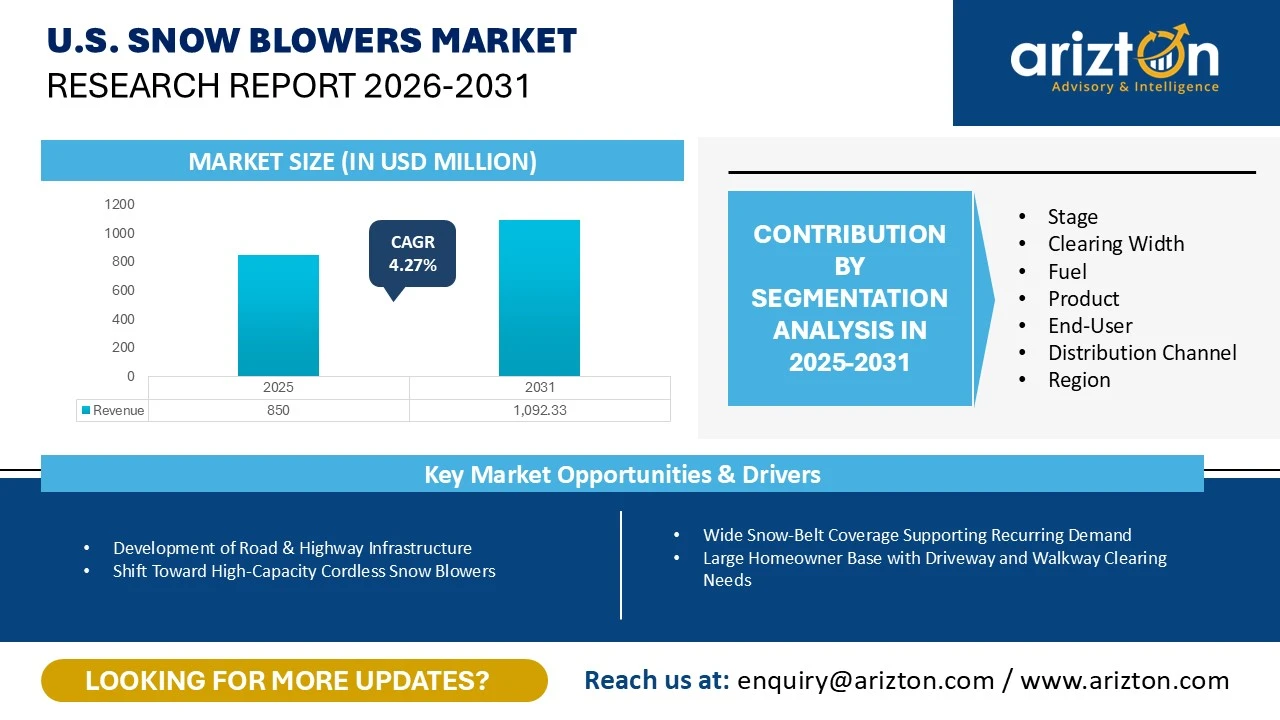
THE U.S. SNOW BLOWERS MARKET WAS VALUED AT USD 850 MILLION IN 2025 AND IS PROJECTED TO REACH USD 1.09 BILLION BY 2031, REGISTERING A CAGR OF 4.27% DURING 2025–2031.
The U.S. snow blower market shipments are expected to reach 1,278.41 thousand units by 2031
The U.S. Snow Blowers Market Size, Share & Trends Analysis Report By
- Stage: Two, Single, and Three
- Clearing Width: >25 Inches and <25 Inches
- Fuel: Gas Powered, Electric Cordless/Battery, and Electric Corded
- Product: Walk Behind, Ride On, and Robotic
- End-User: Residential and Commercial
- Distribution Channel: Offline and Online
- Region: The U.S. (West, South, Midwest, and Northeast)
Industry Analysis Report, Regional Outlook, Growth Potential, Price Trends, Competitive Market Share & Forecast 2026–2031.
This report includes market data points, ranging from trend
analyses to market estimates & forecasts that you can customize
U.S. SNOW BLOWER MARKET REPORT SCOPE
| REPORT ATTRIBUTE | DETAILS |
|---|---|
| MARKET SIZE (2031) | USD 1.09 Billion |
| MARKET SIZE (2025) | USD 850 Million |
| CAGR (2025-2031) | 4.27% |
| MARKET SIZE – SHIPMENTS (2031) | 1,278.41 Thousand Units |
| HISTORIC YEAR | 2022- 2024 |
| BASE YEAR | 2025 |
| FORECAST YEAR | 2026-2031 |
| SEGMENTS BY | Stage, Clearing Width, Fuel, Product, End-User, Distribution Channel, and Region |
| REGIONAL ANALYSIS | Midwest, Northeast, West, and South |
| KEY PLAYERS | Husqvarna, Ariens, Toro, and Stanley Black & Decker |
U.S. SNOW BLOWERS MARKET SIZE
The U.S. snow blowers market size was valued at USD 850 million in 2025 and is projected to reach USD 1.09 billion by 2031, registering a CAGR of 4.27% during the forecast period. This revenue growth will be driven by demand for snow blowers designed for larger clearing areas, heavy snowfall, and frequent use. These requirements favor wider two-stage and three-stage machines and higher-capacity cordless snow blowers offering longer runtime, easier operation, and reduced clearing time.
The U.S. snow blower market shipments are expected to reach 1,278.41 thousand units by 2031. This volume growth is supported by the replacement of old snow blowers, recurring household snow-clearing requirements, and purchases of new snow blowers by commercial users, including contractors and property-maintenance operators.
Snow blower demand is highly seasonal, requiring vendors to stock products ahead of winter and restore availability quickly after major storms. Outdoor power equipment dealers, home-improvement retailers, brand websites, and online platforms support purchasing decisions by allowing customers to compare clearing width, power source, storage requirements, warranty coverage, and service availability. Vendors with strong distribution and inventory coverage in US markets that experience frequent or heavy snowfall are better positioned to serve both planned replacement needs and sudden post-storm purchases.
Recent Developments in the U.S. Snow Blowers Market
- In January 2026, Alterra Mountain Company named Ariens its official snow-removal and lawn-care equipment provider for Deer Valley Resort in Utah and Sugarbush Resort in Vermont. The partnership increased Ariens’ visibility in high-snow resort environments and demonstrated the use of its snow blowers in demanding professional applications.
- In October 2025, Ariens introduced engine enhancements across selected Sno-Thro models, including increased available power and higher fuel capacity. The changes strengthened the company’s position in demanding residential and professional applications where sustained output, operating duration, and reliable performance during heavy snowfall are important purchase considerations.
- In February 2025, The Toro Company joined Call2Recycle’s high-energy battery recycling program, providing participating retailers with systems for collecting and processing batteries above 300 watt-hours. The initiative strengthens end-of-life support for Toro’s expanding high-capacity cordless equipment ecosystem, including batteries used across its Flex-Force snow-removal products.
- In January 2025, Yarbo announced upgrades to its modular outdoor robot for presentation at CES 2025. The company showcased its latest Snow Blower module equipped with the Smart Assist Module, alongside a new HaLow-powered Data Center designed to provide wider and more stable connectivity. The development strengthened Yarbo’s position in autonomous snow removal by expanding system functionality and remote connectivity.
U.S. SNOW BLOWERS MARKET TRENDS & ENABLERS
- The shift toward high-capacity cordless snow blowers is moving battery-powered equipment beyond compact, light-snow applications into wider and more capable models suitable for larger driveways. Improvements in battery capacity, brushless motors, electronic power management, and charging speed are supporting this transition. For instance, Toro’s 26-inch Power Max e26 is a self-propelled, two-stage snow blower designed for heavy, wet snow and uses batteries compatible with more than 75 Flex-Force tools. This demonstrates how cordless products are entering higher-value residential applications while battery compatibility reduces the need for existing platform users to purchase a separate power system.
- Rising demand for user-friendly and safety-enhanced snow blowers is encouraging manufacturers to add self-propelled movement, power steering, electric start, LED lighting, heated controls, improved traction, and simpler chute adjustment. These features make machines easier to start, move, and control, improve visibility during early-morning or evening clearing, and reduce operator effort on sloped properties or during extended commercial use.
- The premiumization of heavy-duty snow blowers in Snowbelt states is being supported by consumers requiring reliable performance in deep, wet, compacted, or repeatedly accumulated snow. Wider clearing paths, stronger intake systems, track-drive configurations, hydrostatic transmissions, and improved engine performance reduce clearing time and improve control on difficult surfaces. For example, Cub Cadet’s three-stage portfolio ranges from 26 to 34 inches and includes track-drive, hydrostatic-drive, IntelliPOWER, and electronic fuel-injection configurations, demonstrating the higher-value product mix available for demanding winter conditions.
- Wide Snowbelt coverage continues to support recurring snow blower demand across the Great Lakes and Upper Midwest, upstate New York and New England, the Mountain West, and Alaska. The Federal Highway Administration reported that more than 70% of US roads are located in regions receiving over five inches of average annual snowfall and that nearly 70% of the population lives in these regions. During the December 2025 winter storm, three to five inches of snow had already accumulated across Indiana, Pennsylvania, Central New York, and parts of New England, while sidewalk and parking-area clearing was underway in Pennsylvania and Massachusetts. Such recurring events create immediate requirements for snow blowers across homes, apartment properties, institutions, and commercial premises.
INDUSTRY RESTRAINTS
- Snow blower demand is difficult to forecast because a large share of purchases occur shortly before winter or immediately after significant snowfall. Mild winters can cause customers to postpone replacing older snow blowers, leaving retailers with excess inventory that may need to be sold at discounted prices. Severe storms, in contrast, can cause sudden increases in demand and temporary product shortages. These fluctuations complicate production planning, inventory allocation, and working-capital management for manufacturers and retailers.
- Premium machines require significant upfront expenditure, dedicated storage, and ongoing ownership effort. Gas-powered equipment involves fuel handling and engine maintenance, while higher-capacity cordless models may require several batteries and rapid chargers. Households with limited snowfall, short driveways, restricted storage, or access to contracted snow-removal services may instead use manual tools, compact snow-clearing equipment, or third-party service providers.
U.S. SNOW BLOWERS MARKET SEGMENTATION INSIGHTS
INSIGHTS BY STAGE
The U.S. snow blowers market by stage is segmented into two-, single, and three-stage. Two-stage snow blowers accounted for the largest revenue share of 57% in 2025. Their leadership reflects use across medium and large residential driveways, commercial properties, and locations experiencing deeper, wetter, or repeatedly accumulated snow. Two-stage models generally offer wider clearing paths, self-propelled drive, stronger intake systems, power steering, and track-drive options, resulting in higher average selling prices than single-stage machines.
Demand for two-stage snow blowers is created by homeowners, rural property owners, small businesses, institutions, and property maintenance users who need dependable clearing across larger spaces. Buyers in this category usually face repeated snow events, heavier accumulation, or wider outdoor areas where a single-stage model would require more time and effort. For many snow-belt households, two-stage equipment is the practical standard for winter readiness.
INSIGHTS BY CLEARING WIDTH
Based on the clearing width, snow blowers with clearing widths below 25 inches are projected to register a volume CAGR of 3.25% during the forecast period. This growth is supported by their lower purchase prices, lighter weight, compact storage requirements, and suitability for sidewalks, decks, narrow walkways, and smaller paved driveways. Expanding availability of compact cordless snow blowers is also increasing adoption among urban and suburban households that prioritize easier handling and limited storage space.
Demand for below 25-inch snow blowers is mainly driven by homeowners and small-property users who want a faster alternative to shovelling. These machines are especially attractive to first-time buyers, renters, elderly users, and households with limited storage space. Their appeal is strongest where users face light to moderate snowfall and do not require the power or size of a wider two-stage model.
INSIGHTS BY FUEL
The gas-powered segment accounted for the largest U.S. snow blower market share in 2025. Their leadership is supported by the established installed base, rapid refueling, longer operating duration, extensive model availability, and suitability for deep or compacted snow.
Gas-powered snow blowers remain the largest revenue contributor because the category includes many premium two-stage and three-stage machines. Higher-capacity models carry stronger average selling prices than basic electric units, supporting revenue even in a mature replacement-led market. Replacement demand is also sustained as users upgrade older machines to models with easier starting, better handling, and improved operator comfort.
Electric cordless/ battery-powered snow blowers accounted for the second-largest revenue share of market volume in 2025. Their growth is supported by easier starting, quieter operation, lower routine maintenance, improving battery output, and compatibility with broader outdoor-equipment ecosystems.
INSIGHTS BY PRODUCT
The walk-behind snow blowers accounted for the largest U.S. snow blowers market share in 2025. Walk-behind snow blowers include manually operated single-stage, two-stage, and three-stage machines designed for driveways, sidewalks, walkways, residential entrances, and small commercial areas. These machines dominate unit demand because they can be operated independently and are well suited for residential driveways, sidewalks, building entrances, and smaller commercial properties. This product category is the most widely recognized in the US market, as it directly addresses the routine snow-clearing needs of homeowners and small property owners. They are available in a wide range of models, from compact machines for light snowfall to high-capacity equipment for deeper snow, enabling households, contractors, and facility operators to choose equipment based on property size, snowfall conditions, and budget.
INSIGHTS BY END-USER
Based on the end-user, the commercial snow blower users are projected to register the highest revenue CAGR during the forecast period. This revenue growth will be supported by shorter replacement cycles resulting from intensive seasonal use, expansion of contracted snow-removal services, and upgrades to machines offering greater durability and clearing productivity. Commercial customers also purchase higher-priced equipment and maintain multiple units to reduce downtime during snowfall events, increasing revenue faster than residential demand.
Demand is strongest in dense snowbelt markets, including the Great Lakes, Upper Midwest, Northeast corridor, and mountain service areas. These locations combine frequent snowfall with commercial property density, institutional campuses, rental housing, and outsourced snow management activity, making reliable snow-clearing equipment a recurring procurement need.
INSIGHTS BY DISTRIBUTION CHANNEL
The U.S. snow blowers market by stage is segmented into offline and online. The offline segment dominates and holds the largest market share in 2025. Offline sales of snow blowers include purchases through outdoor power equipment dealers, home improvement stores, hardware retailers, farm and ranch outlets, mass merchandisers, and authorized brand showrooms.
Demand through offline sales is shaped by the need for dependable snow-clearing equipment in areas with recurring winter accumulation. Homeowners use this channel for driveways and walkways, while landscapers, institutions, and light municipal users choose it for repeated clearing across larger outdoor areas. These buyers usually prioritize equipment suitability, durability, and confidence in performance under heavy-use conditions.
U.S. SNOW BLOWERS MARKET REGIONAL ANALYSIS
In U.S. snow blower demand, the Midwest provides the broadest volume base, the Northeast is mature and replacement-driven, the West contains geographically concentrated premium markets, and the South remains comparatively small and dependent on individual winter-weather events.
The Midwest accounted for the largest regional revenue share of 40% in 2025. The region combines a large homeowner-controlled property base with frequent and repeated snow-clearing requirements. The U.S. Census Bureau reported that the Midwest had the country’s highest regional homeownership rate, at 71.3% in Q4 2025. NOAA also reported above-average snowfall across much of the Midwest and Great Lakes during October–December 2025, with lake-effect locations receiving more than one foot above their normal snowfall for the period. These conditions support recurring replacement and upgrade purchases by households and contractors that must clear driveways, sidewalks, entrances, and compacted snow after repeated storms.
The West is projected to register the highest regional volume CAGR during 2025–2031. Growth will be concentrated in snow-prone Mountain West and Sierra Nevada markets, where an expanding housing base increases the number of properties requiring independent snow clearing. For instance, the U.S. Census Bureau reported that housing units increased by 2.2% in Idaho and 2.0% in Utah between 2023 and 2024, while Idaho and Utah populations grew by 1.4% and 1.0%, respectively, during 2024–2025. Severe snowfall events also reinforce equipment needs; NOAA reported that a February 2026 storm deposited more than nine feet of snow within five days in the Sierra Nevada. Together, property-base expansion and concentrated heavy-snow exposure support faster unit growth from the West’s smaller 2025 volume base.
U.S. SNOW BLOWERS MARKET VENDORS - LANDSCAPE
The US snow blowers market is moderately fragmented, with competition among established outdoor power equipment manufacturers, battery-focused brands, value-oriented suppliers, and online-led participants. Vendors compete through clearing capacity, durability, starting reliability, ease of operation, battery compatibility, retail and dealer coverage, warranty support, and the ability to position inventory across snow-prone states before the winter selling period.
Established participants include AriensCo, The Toro Company, Honda Power Equipment, Husqvarna Group, and Stanley Black & Decker. Ariens and Toro maintain strong positions through dedicated snow blower portfolios and established dealer networks, while Honda and Husqvarna compete primarily in premium and demanding-use applications. Stanley Black & Decker participates through Cub Cadet and Troy-Bilt, giving the company coverage across multiple snow blower types and residential price ranges. Stanley Black & Decker officially identifies these brands within its outdoor equipment portfolio, and all three currently market snow blowers in the U.S.
Competition increasingly centers on how effectively vendors convert seasonal demand into sales while maintaining customer support after purchase. Established manufacturers benefit from dealer relationships, replacement-parts availability, and recognition among existing owners, whereas cordless and online-led competitors rely more heavily on battery-platform participation, digital product comparison, direct delivery, and competitive pricing. Inventory allocation across snow-prone states remains critical because demand can rise rapidly after forecasted storms but weaken when snowfall is below normal.
SNAPSHOT
The U.S. snow blowers market size is expected to grow at a CAGR of approximately 4.27% from 2025 to 2031.
The following factors are likely to contribute to the growth of the U.S. snow blowers market during the forecast period:
- Wide Snow-Belt Coverage Supporting Recurring Demand
- Large Homeowner Base with Driveway and Walkway Clearing Needs
- Commercial and Institutional Snow-Clearing Requirements
Base Year: 2025
Forecast Year: 2026-2031
The report examines the current state of the U.S. snow blowers market and its market dynamics through 2026−2031. It covers a detailed overview of several market growth enablers, restraints, and trends. The study covers both the demand and supply sides of the market. It also profiles and analyses leading companies and several other prominent companies operating in the market.
Key Company Profiles
- Husqvarna
- Business Overview
- Product Offerings
- Key Developments
- Key Strategies
- Key Strengths
- Key Opportunities
- Ariens
- Toro
- Stanley Black & Decker
Other Prominent Vendors
- Briggs & Stratton
- Business Overview
- Product Offerings
- Greenworks
- Snow Joe
- American Lawn Mower Company
- Yarbo
- Ego Power
- Honda
- Litheli
- Green Machine
- PowerSmart
- WEN
- Techtronic Industries TTI
- Kobalt
- Westinghouse Electric Corporation
- Yard Force
- Yardmax
- SENIX
- WORX
- BILT HARD
- Champion Power Equipment
- Massimo Motor
- SuperHandy
- Wild Badger Power
- VOLTASK
Segmentation by Stage
- Two
- Single
- Three
Segmentation by Clearing Width
- >25 Inches
- <25 Inches
Segmentation by Fuel
- Gas Powered
- Electric Cordless/Battery
- Electric Corded
Segmentation by Product
- Walk Behind
- Ride On
- Robotic
Segmentation by End-User
- Residential
- Commercial
Segmentation by Distribution Channel
- Offline
- Online
Segmentation by Region
- The U.S
- West
- South
- Midwest
- Northeast
U.S. SNOW BLOWER MARKET FAQs
How big is the U.S. snow blowers market?
What is the growth rate of the U.S. snow blowers market?
Which region dominates the U.S. snow blowers market?
Who are the key players in the U.S. snow blowers market?
What are the significant trends in the U.S. snow blowers market?
For more details, please reach us at [email protected]
- Chapter 1- Scope & Coverage
- Market Definition
- Inclusion
- Exclusions
- Market Estimation Caveats
- Market Derivation
- Market Segmentation by Stage
- Market Segmentation by Product
- Market Segmentation by Clearing Width
- Market Segmentation by Distribution Channel
- Market Segmentation by Fuel
- Market Segmentation by End-User
- Chapter 2- Premium Insights
- Chapter 3- Market Dynamics
- Introduction
- Consistent Technological Advancements
- Customer Acquisition and Replacement Opportunities
- Consumer Satisfaction Benchmarking
- US Housing and Construction Trends
- Regional Snowfall Conditions
- Market Opportunities & Trends
- Shift Toward High-Capacity Cordless Snow Blowers
- Rising Demand for User-Friendly and Safety-Enhanced Models
- Premiumization of Heavy-Duty Snow Blowers in Snow-Belt States
- Market Growth Enablers
- Wide Snow-Belt Coverage Supporting Recurring Demand
- Large Homeowner Base with Driveway and Walkway Clearing Needs
- Commercial and Institutional Snow-Clearing Requirements
- Market Restraints
- Seasonal Sales Volatility Due to Unpredictable Snowfall
- High Ownership Cost and Maintenance Burden for Seasonal Equipment
- Market Landscape
- Five Forces Analysis
- Chapter 4- Market Segmentation
- Stage (Market Size & Forecast: 2022-2031)
- Two
- Single
- Three
- End-User (Market Size & Forecast: 2022-2031)
- Residential
- Commercial
- Product (Market Size & Forecast: 2022-2031)
- Walk Behind
- Ride On
- Robotic
- Fuel (Market Size & Forecast: 2022-2031)
- Gas Powered
- Electric Cordless/Battery
- Electric Corded
- Clear Width (Market Size & Forecast: 2022-2031)
- >25 Inches
- <25 Inches
- Distribution Channel (Market Size & Forecast: 2022-2031)
- Offline
- Online
- Chapter 5- Geography Segmentation
- Geography Segmentation (Market Size & Forecast: 2022-2031)
- Geographic Overview – Market Maturity Index
- US
- Midwest
- Northeast
- West
- South
- Chapter 6- Competitive Landscape
- Competitive Landscape
- Competition Overview
- Key Developments
- Key Company Profiles
- Other Prominent Company Profiles
- Report Summary
- Key Takeaways
- Strategic Recommendations
Select a license type that suits your business needs
Single User Licence
- Report accessible by one user only
- Free 10% or 3 days of customization
- Free post-sale service assistance
- Continuous support through email
5 User Licence
- Report accessible by 5 users within the organization
- Free 15% or 4.5 days of customization
- Continuous support through email and telephone
- Free analyst hour
- Free Upgrade: If an updated report published within 180 days of purchase, you will get the revised report free of charge
Corporate Licence
- Free Datasheet worth $1500
- Report accessible by the entire organization
- Free 20% or 6 days of customization
- Free post-sale service assistance
- Continuous support through email and telephone
- Direct access to lead analysts
- Free analyst hour
- Free Upgrade: If an updated report published within 180 days of purchase, you will get the revised report free of charge
Datasheet Licence
- Report accessible by 1 user only
- Free 15% or 32 hours of customization
- Free post-sale service assistance
- Direct access to lead analysts
Frequently Asked Questions
How big is the U.S. snow blowers market?
What is the growth rate of the U.S. snow blowers market?
Which region dominates the U.S. snow blowers market?
Who are the key players in the U.S. snow blowers market?
What are the significant trends in the U.S. snow blowers market?
Snow Blowers Market Demand In The US
Other RELATED Reports



U.S. Lawn and Garden Tractor Market - Industry Outlook & Forecast 2022-2027
Published : February 2023