
Vietnam Elevator and Escalator Market - Size & Growth Forecast 2026-2031


129 pages

19 company

6 segments

1 region

1 countries
Purchase Options
Vietnam Elevator and Escalator Market - Size & Growth Forecast 2026-2031
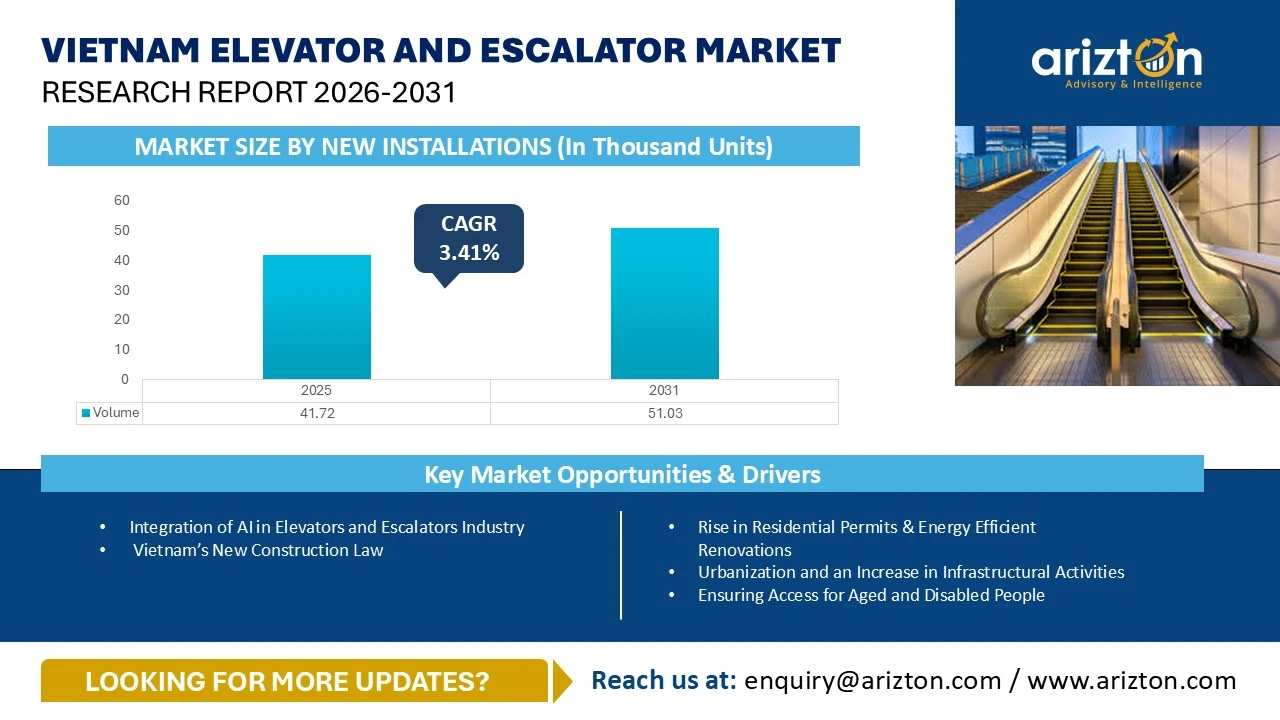
THE VIETNAM ELEVATOR AND ESCALATOR MARKET SIZE BY NEW INSTALLATIONS WAS VALUED AT 41.72 THOUSAND UNITS IN 2025 AND IS EXPECTED TO REACH 51.03 THOUSAND UNITS BY 2031, GROWING AT A CAGR OF 3.41% FROM 2025-2031.
Vietnam Elevator and Escalator Market Size (Volume)
- Installation Base
- New Installation Type
- Modernization (In Million)
- Maintenance (In Million)
Vietnam Elevator Market Size (Volume)
- Installation Base
- New Installation Type
- Modernization & Maintenance (In Million)
Vietnam Escalator Market Size by Volume
- Installation Base
- New Installation Type
- Modernization & Maintenance (In Million)
Vietnam Elevator and Escalator Size, Share, & Trends Analysis Report by
Elevator Market Segmentation
- Machine Type: Hydraulic and Pneumatic, Machine Room Traction, Machine Room Less Traction, and Others (Climbing Elevators and Industrial Elevators)
- Carriage Type: Passenger and Freight
- Capacity: 2-15 Persons, 16-24 Persons, 25-33 Persons, and 34 Persons and Above
- End-User: Commercial, Residential, Industrial, and Others (Public Transit, Institutional, and Infrastructural)
Escalator Market Segmentation
- Product Type: Parallel, Multi Parallel, Moving Walkway, and Crisscross
- End-User: Public Transit, Commercial, and Others (Institutional Sector, Infrastructure & Industrial)
The Industry Analysis Report Provides Industry Trends, Drivers, Opportunities, Competitive Outlook, Industry Size, Sales, and Growth Forecast for 2026-2031
This report includes market data points, ranging from trend
analyses to market estimates & forecasts that you can customize
VIETNAM ELEVATOR AND ESCALATOR MARKET REPORT SCOPE
| REPORT ATTRIBUTE | DETAILS |
|---|---|
| MARKET SIZE BY NEW INSTALLATIONS (2031) | 51.03 Thousand Units |
| MARKET SIZE BY NEW INSTALLATIONS (2025) | 41.72 Thousand Units |
| CAGR - NEW INSTALLATIONS (2025-2031) | 3.41% |
| MARKET SIZE BY INSTALLED BASE (2031) | 751.49 Thousand Units |
| MARKET SIZE BY MODERNIZATION (2031) | USD 32.56 Million |
| HISTORIC YEAR | 2022-2024 |
| BASE YEAR | 2025 |
| FORECAST YEAR | 2026-2031 |
| SEGMENTATION BY CARRIAGE TYPE | Passenger and Freight |
| SEGMENTATION BY CAPACITY | 2-15 Persons, 16-24 Persons, 25-33 Persons, and 34 Persons and Above |
| SEGMENTATION BY END-USER | Commercial, Residential, Industrial, and Others |
| SEGMENTATION BY MACHINE TYPE | Hydraulic and Pneumatic, Machine Room Traction, Machine Room Less Traction, and Others |
| KEY VENDORS | Otis, KONE, TK Elevator, Schindler, Mitsubishi Electric, Hyundai Elevator, Hitachi, and Fujitec |
VIETNAM ELEVATOR AND ESCALATOR MARKET OVERVIEW
The Vietnam elevator and escalator market size by new installations was valued at 41.72 thousand units in 2025 and is expected to reach 51.03 thousand units by 2031, growing at a CAGR of 3.41% during the forecast period. Vietnam’s rapid urbanization and ongoing infrastructure development are sustaining strong demand for elevators and escalators. Additionally, increased public infrastructure spending in 2026, along with the country’s infrastructure strategy for 2026–2030, is expected to further drive demand for vertical transportation systems throughout the forecast period.
Construction of high-rise residential and mixed-use buildings remain the primary drivers of market growth, particularly in Hanoi, Ho Chi Minh City, and emerging Tier-2 cities.
Government policy supporting smart city initiatives and modern infrastructure under the 2021–2030 socio-economic development strategy is further encouraging investment in advanced and connected vertical transportation technologies.
Despite steady growth, the market is expected to face several headwinds in 2026, including geopolitical tensions, global economic uncertainty, exchange-rate volatility, and elevated installation costs. Tightened financial conditions may dampen construction activity, potentially leading to project delays and the deferral or reduction of elevator and escalator procurement.
VIETNAM ELEVATOR AND ESCALATOR MARKET DRIVERS
Large Scale Infrastructure and Public Investment
- Vietnam’s accelerating public investment and large-scale urban development pipeline are set to drive strong demand for elevators and escalators. In 2025, public investment exceeded VND 902 trillion ($34 billion), with further expansion to VND 995 trillion ($37.8 billion) in 2026, supporting infrastructure and construction growth.
- Long-term plans (2026–2030) target VND 8.5 million trillion ($323.5 billion) in investment, funding major transport projects such as high-speed rail, airports, and ports. Expanding expressways, rail networks, and logistics hubs will require advanced vertical transport systems.
- Simultaneously, mega urban developments and “super city” projects led by major developers will boost demand for residential and commercial elevator and escalator installations nationwide.
Ageing Demographics Stimulating Elevator and Escalator Installations
- Vietnam’s evolving demographic profile is set to drive sustained demand for elevators and escalators. The population is projected to reach 104.7 million by 2029 and exceed 110 million by 2039, supporting long-term expansion in urban infrastructure, including residential, commercial, healthcare, and transport facilities.
- Simultaneously, rapid ageing will be a key demand driver, with the 60+ population rising from 14.2 million in 2024 to 27.5 million by 2044 and 38.5 million by 2074. Growth in the 80+ segment will further intensify the need for accessible, barrier-free mobility solutions.
- As Vietnam transitions to an ageing and eventually super-aged society, demand for elevators, escalators, and modernization will accelerate.
Regulatory and Accessibility Standards Driving Elevator and Escalator Demand In Vietnam
- Vietnam’s regulatory framework is significantly strengthening demand for elevators and escalators, particularly in high-rise and mixed-use developments. Under Circular 03/2021/TT-BXD, buildings with five or more floors must install at least one elevator, while those with ten or more floors require a minimum of two, alongside stretcher-compatible lifts.
- Capacity norms—such as one elevator per 200 residents or 70 apartments—are pushing higher installation volumes and larger-capacity systems. Additional mandates for firefighting elevators in tall buildings and strict design standards are further increasing system complexity.
- Accessibility regulations (QCVN 10:2014/BXD) also promote inclusive design, collectively driving demand for compliant, modern, and upgraded vertical transportation systems.
VIETNAM ELEVATOR AND ESCALATOR MARKET OPPORTUNITIES
Integration of AI In Elevators and Escalators Industry is Expected to Create Opportunities in the Market
- The growing adoption of artificial intelligence (AI) is emerging as a key growth driver for Vietnam’s elevator and escalator market, aligned with rapid urbanization and smart city development. As cities like Ho Chi Minh City and Hanoi expand, demand is rising for intelligent vertical transportation systems integrated with building management and urban infrastructure networks.
- Global players such as KONE, Otis, Schindler, and Mitsubishi Electric are introducing AI- and IoT-enabled solutions featuring smart sensors, predictive maintenance, and remote monitoring, improving efficiency, safety, and uptime.
- Product innovations—including smart residential elevators and advanced IoT-connected systems—are reinforcing this shift. Collectively, these advancements are driving demand for digitally enabled equipment and long-term service solutions.
Vietnam’s New Construction Law (2025) Driving Growth Opportunities for the Market
- Vietnam’s Construction Law 2025 is expected to significantly boost the elevator and escalator market by accelerating construction activity and improving the overall investment environment.
- By simplifying licensing and project approvals, the law enables faster development of residential, commercial, and infrastructure projects, directly increasing demand for vertical transportation systems.
- Enhanced transparency and clearer regulations are likely to attract greater domestic and foreign investment, further supporting construction growth. The law also promotes structured urban planning and high-rise development across major and emerging cities, while encouraging renovation and modernization of older buildings. Together, these factors will drive demand for both new installations and upgrade solutions.
INDUSTRY RESTERAINTS
High Installation and Maintenance Costs
- High installation and maintenance costs remain a key constraint on the growth of Vietnam’s elevator and escalator market. While demand is rising alongside urbanization and high-rise construction, the substantial upfront investment—often exceeding $50,000 per unit—can limit adoption, particularly among smaller developers and projects in emerging cities. Costs are elevated due to imported components, specialized construction requirements, regulatory compliance, and skilled labour.
- Additionally, recurring maintenance expenses, estimated at around $2,000 per unit annually, create ongoing financial pressure for building owners. Multiple unit requirements in mid- and high-rise buildings further increase costs, often leading developers to limit installations or delay upgrades, impacting efficiency and accessibility.
Geopolitical Tensions and Global Uncertainty
- Geopolitical tensions are emerging as a significant constraint on Vietnam’s elevator and escalator market by impacting construction activity and investment flows. A 2026 Vietnam Report survey indicates that 74.1% of businesses view geopolitical instability and trade tensions as major growth risks.
- As an export-driven economy, Vietnam is highly exposed to global supply chain disruptions, shifting trade policies, and external conflicts, which can affect industrial output and real estate development—key demand drivers for vertical transportation systems.
- Additionally, rising input and energy costs, cited by 70.4% of firms, are increasing construction expenses and squeezing margins. Combined with cautious investment strategies, these factors may delay projects and moderate demand growth.
Depreciation of Vietnamese Currency to Impact Imports
- Depreciation of the Vietnamese dong and volatility in the USD–VND exchange rate pose a significant challenge to the elevator and escalator market, given its heavy reliance on imported components and technologies.
- Machinery and equipment account for 35–40% of Vietnam’s imports, making the sector highly sensitive to currency fluctuations. A weaker VND increases procurement costs for key components such as motors, control systems, and traction equipment, raising overall project costs for developers.
- With the exchange rate expected to rise by 2.5–3% in 2026 and foreign-exchange reserves under pressure, cost volatility is likely to persist. This may delay investments, compress margins, and slow short-term market growth despite strong underlying demand drivers.
VIETNAM ELEVATOR AND ESCALATOR MARKET SEGMENTATION INSIGHTS
Elevator
- Machine-room-less (MRL) elevators accounted for one of the largest shares of the elevator market among the different machine types (hydraulic, pneumatic, machine room traction and others), representing major market share in total installations in 2025. The segment is expected to witness steady growth over the forecast period, with new installations expanding at a CAGR of 3.55%.
- Demand for MRL elevators rises sharply, driven by the growing pipeline of high-end and high-density residential developments under construction nationwide. For instance, in Hanoi, at the beginning of March 2026, Sunshine Group simultaneously commenced construction on three large-scale projects. The centerpiece is the Noble West Lake Ha Noi project located on plot CT5-6 in the Ciputra urban area, Phu Thuong ward. The project will consist of 12 towers, each 40 stories high, providing 2,060 apartments on nearly 6 hectares of land.
- In the carriage-type segment, passenger elevators accounted for the largest share of the market in 2025. This dominance is primarily attributed to the high demand for vertical transportation in residential, commercial, and mixed-use buildings, where passenger mobility remains the primary requirement.
- The passenger elevator market in Vietnam is witnessing strong expansion, primarily supported by rapid urbanization, a growing middle-income population, and infrastructure investments exceeding $20 billion. The continued development of residential complexes, mixed-use developments, office towers, hotels, and public infrastructure projects is increasing the need for efficient vertical transportation systems.
- In the capacity (person) segment, 2–15 person elevators recorded the largest incremental growth in new installations during the 2025–2031 period, recording a CAGR of 3.55%. This growth is primarily driven by their widespread application in residential buildings, mid-rise commercial properties, and mixed-use developments, where moderate passenger capacity is sufficient to meet daily traffic requirements.
- The development of new high-rise and mixed-use projects in Vietnam is expected to significantly increase demand for 2–15-person capacity elevators. For instance, the proposed Aspira Tower, a 220-meter, 36-storey skyscraper planned at Bãi Trào near Hòn Thơm Island in the Phú Quốc Special Economic Zone, reflects the country’s ongoing push to develop large-scale tourism and commercial infrastructure.
- In the elevator end-user segment, residential elevators recorded the largest Vietnam elevator and escalator market share in terms of volume of new installations in 2025. This dominance is primarily driven by the rapid development of high-rise residential buildings, apartment complexes, and urban housing projects, particularly in densely populated urban areas where vertical transportation is essential.
- Vietnam aims to build about 1 million social housing units by 2030, with over 700,000 units already started across 737 projects, and around 215,000 units currently under construction in 220 projects. The government is also working on policies for affordable commercial housing for middle-income households, as many people do not qualify for social housing but still struggle with high home prices.
Escalator
- In the product type segment, parallel escalators recorded the largest volume of new installations. The segment is also expected to experience the highest incremental growth during the 2025–2031 period, expanding at a CAGR of 3.25%.
- This growth is largely driven by their widespread adoption in shopping malls, metro stations, airports, and large commercial complexes, where parallel configurations enable efficient passenger movement and higher traffic handling capacity.
- By the escalator end-user segment, commercial escalators recorded the largest volume of new installations in 2025. They are widely used across shopping malls, department stores, airports and transit hubs, hotels, convention centers, office towers, and integrated mixed-use projects.
VENDOR LANDSCAPE
- Schindler, Mitsubishi Electric, KONE, Hitachi Ltd. And OTIS Worldwide Corporation are the top five major players in the Vietnam Elevator & Escalator market.
- Schindler is one of the leading elevator companies in Vietnam, holding the largest market share of around 20%. Its strong presence comes mainly from supplying elevators to high-rise office buildings and premium residential projects.
- Mitsubishi Electric and KONE are close competitors, with each representing a signififcant market share. This shows strong competition among top global brands, especially in major cities like Hanoi and Ho Chi Minh City, as well as in key industrial areas.
- Hitachi and OTIS together make up about a quarter of the market. While they are still important players, they are slightly behind the top three and are more active in sectors like infrastructure, hospitals, and public buildings.
- Although international brands dominate the market, imported elevators tend to be more expensive to maintain and repair after the warranty period compared to locally made products.
- At the same time, the “Other Vendors” category also represents significant market share. This includes Chinese companies, local brands, and smaller suppliers. Their growth is driven by lower prices, making them popular for mid-rise residential buildings and smaller commercial projects.
- In 2026, Jardine Schindler Group launched a new contemporary elevator interior design collection aimed at enhancing the aesthetic experience of elevators in buildings across East and Southeast Asia. The new collection offers architects, designers, and developers a wider range of materials, colors, and finishing options to create more modern and refined elevator spaces.
- In 2026, Mitsubishi Electric Building Solutions Corporation (MEBS) announced that it has signed a share transfer agreement with Hitachi, Ltd. to acquire all of Hitachi’s shares in Mitsubishi Hitachi Home Elevator, Ltd., a joint venture specializing in small elevators. Upon completion of the transaction, Mitsubishi Hitachi Home Elevator will become a wholly owned subsidiary of MEBS.
- In 2025, KONE was awarded the Sao Khue Award 2025 for its smart service robot application programming interface (API) solution. This recognition marks the company's second Sao Khue Award, following its first win in 2023 for the KONE 24/7 Connected Services innovation. Organized by the Vietnam Software and IT Services Association (VINASA), this annual award is among the most prestigious honors in Vietnam's information technology sector, and this year set a record with 198 awarded solutions.
- In 2025, Otis announced to supply advanced elevator systems for The Kross, a 39-story mixed-use building in Ho Chi Minh City. The project will include 7 SkyRise elevator units and 9 Gen3 elevator units, with installation expected to be completed by 2026. Otis will additionally provide maintenance services for the building’s vertical transportation systems until 2028, supporting the long-term operation of the development.
- In 2024, Fujitec Co., Ltd. delivered Vietnam’s first high-speed elevators operating at 240 m/min to the Taisei Square Hanoi office building. The project included 10 elevators in total, four of which are high-speed units, serving the 20-storey building with additional basement levels. These elevators feature advanced technologies such as touchless control buttons and an air-purification system using Plasmacluster ion technology.
SNAPSHOT
The Vietnam elevator and escalator market size by new installations was valued at 41.72 thousand units in 2025 and is expected to reach 51.03 thousand units by 2031, growing at a CAGR of 3.41% during the forecast period.
The following factors are likely to contribute to the growth of the Vietnam elevator and escalator market during the forecast period:
- Rise in Residential Permits & Energy Efficient Renovations
- Urbanization and an Increase in Infrastructural Activities
- Ensuring Access for Aged and Disabled People
- Demand For Smart Elevators
- Rise In Airport Expansion and Railway Projects
Base Year: 2025
Forecast Year: 2026-2031
The report considers the present Vietnam elevator and escalator market scenario and market dynamics from 2026 to 2031. It covers a detailed overview of several market growth enablers, restraints, and trends. The study includes the volume and value sales with a segment analysis of the Vietnam elevator and escalator market.
Key Vendors
- Otis
- KONE
- TK Elevator
- Schindler
- Mitsubishi Electric
- Hyundai Elevator
- Hitachi
- Fujitec
Other Prominent Vendors
- Cibes Lift AB
- Toshiba
- Sicher Elevator Co., Ltd.
- Kalea Lifts
- Canny Elevator Co. Ltd.
- KOYO Elevator Co. Ltd
- BLT-Brilliant
- Sanyo Elevators & Escalators Co., Ltd.
- Thien Nam Elevator Joint Stock Company (TNE)
- Pacific Elevator Co., Ltd.
- Xiolift (Hangzhou XIO-Lift Co., Ltd.)
Elevator Market Segmentation by
Machine Type
- Hydraulic and Pneumatic
- Machine Room Traction
- Machine Room Less Traction
- Others
- Climbing
- Elevators
- Industrial Elevators
Carriage Type
- Passenger
- Freight
Capacity
- 2-15 Persons
- 16-24 Persons
- 25-33 Persons
- 34 Persons and Above
End-User
- Commercial
- Residential
- Industrial
- Others
- Public Transit
- Institutional
- Infrastructural
Escalator Market Segmentation by
Product Type
- Parallel
- Multi Parallel
- Walkway
- Crisscross
End-User
- Public Transit
- Commercial
- Others
- Institutional Sector
- Infrastructure
- Industrial
VIETNAM ELEVATOR AND ESCALATOR MARKET FAQs
What will be the growth rate of the Vietnam elevator and escalator market?
How big is the Vietnam elevator and escalator market?
What is the number of installed bases in the Vietnam elevator and escalator market in 2025?
What are the key Vietnam elevator and escalator market players?
What are the key opportunities in the Vietnam elevator and escalator market?
For more details, please reach us at [email protected]
1. Market Scope
2. Executive Summary
3. Introduction
4. Elevators Market in Vietnam
5. Escalators Market in the Vietnam
6. Elevators and Escalators Market – By Service (Maintenance & Modernization)
7. Geographic Analysis
8. Market Dynamics – Market Opportunities, Drivers & Restraints
9. Technological Development
10.Competitive Landscape
11. Report Summary
12. Appendix (Definition, Inclusions & Exclusions)
Select a license type that suits your business needs
Single User Licence
- Report accessible by one user only
- Free 10% or 3 days of customization
- Free post-sale service assistance
- Continuous support through email
5 User Licence
- Report accessible by 5 users within the organization
- Free 15% or 4.5 days of customization
- Continuous support through email and telephone
- Free analyst hour
- Free Upgrade: If an updated report published within 180 days of purchase, you will get the revised report free of charge
Corporate Licence
- Free Datasheet worth $1500
- Report accessible by the entire organization
- Free 20% or 6 days of customization
- Free post-sale service assistance
- Continuous support through email and telephone
- Direct access to lead analysts
- Free analyst hour
- Free Upgrade: If an updated report published within 180 days of purchase, you will get the revised report free of charge
Datasheet Licence
- Report accessible by 1 user only
- Free 15% or 32 hours of customization
- Free post-sale service assistance
- Direct access to lead analysts
Frequently Asked Questions
What will be the growth rate of the Vietnam elevator and escalator market?
How big is the Vietnam elevator and escalator market?
What is the number of installed bases in the Vietnam elevator and escalator market in 2025?
What are the key Vietnam elevator and escalator market players?
What are the key opportunities in the Vietnam elevator and escalator market?
Other RELATED Reports
Malaysia Elevator and Escalator Market - Size & Growth Forecast 2026-2031
Published : October 2026
Philippines Elevator and Escalator Market - Size & Growth Forecast 2026-2031
Published : April 2026
Indonesia Elevator and Escalator Market-Size & Growth Forecast 2026-2031
Published : April 2026
Thailand Elevator and Escalator Market - Size & Growth Forecast 2026-2031
Published : April 2026